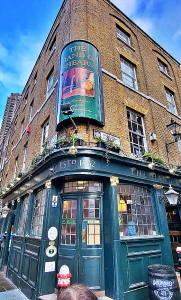
The Hand and Shears pub near London’s Smithfield Market is a delightful, old-fashioned drinking hole. It was granted a licence in 1552, but may have been in existence before that date. The building housing the pub was constructed in about 1852, and its interior has hardly changed since then. Apart from selling booze, the pub used to be a place where meetings were held, as well as coroner’s inquests.
The pub’s name derives from the that the building in which it is located was used by cloth merchants to settle arguments and other matters relating to their business.
Its centrally positioned bar serves customers in each of four rooms surrounding it. The rooms are separated from each other by partitions, but all of them face the bar which they surround. We visited the pub on a weekday at lunchtime. Many local business people were enjoying a sociable pint or two while chatting amongst themselves.
The Hand and Shears is what I believe a pub should be.
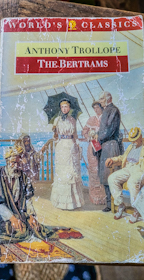
HERE IS A book I have greatly enjoyed reading. It is “The Bertrams” by Anthony Trollope (1815-1882). First published in 1859, this is a story that highlights some weaknesses of human behaviour, the consequences of ill-conceived decision making, and the risks taken when marrying for the wrong reason. The novel is set mainly in England, but significant parts of it take place in the Middle East, notably in Egypt and the Holy Land.
The main characters in the story are George Bertram, George’s miserly but extremely wealthy uncle, George’s cousin Arthur who attended Oxford with him, Henry Harcourt who is a little older than George, Caroline Waddington, and Adela Gauntlet. George falls in love with Caroline, and Arthur with Adela. Each man wins the heart of the lady with whom they have fallen in love. However, in both cases, there are impediments that prevent them from marrying. Eventually to George’s great dismay, Caroline marries his friend Harcourt, by now a successful lawyer and ambitious politician. But this is a marriage without love, for Harcourt has married Caroline in the hope that she will receive a huge inheritance from her grandfather, who is George Bertram’s uncle.
In addition to the principal characters, there are many minor characters, most of whom are important in the story. Trollope’s portrayal of these and the main protagonists is both perceptive and often rich in humour. Throughout the novel, he explores the strength and frailties of human behaviour. He also describes how nineteenth century English people behave while travelling abroad. Although my copy of the book has almost 580 pages, not including notes on the text and a long introductory essay by Geoffrey Harvey, the story never flagged. Even though I began to guess how the tale would end, it was fascinating to follow its often-surprising twists and turns on its way to the conclusion.
“The Bertrams” is not only a ‘page turner’, but an example of storytelling at its best.
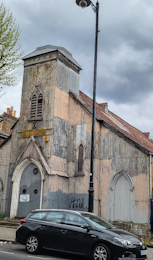
EVER SINCE THE early 1960s, I have travelled along Cambridge Avenue, which runs between Edgware Road and Kilburn Park Underground Station. I have always been in a car or bus. So, whenever I have passed what I am about to describe, I have never stopped to look at it carefully. Yesterday (14 April 2025), we stopped outside it to change buses.
What I am referring to is an edifice made from sheets of corrugated iron, which looks like a Victorian gothic church. It looks slightly shapbby. Notices attached to it inform passers-by that it is a meeting place of the Sea Cadet Corps and it is now the ‘TS Bicester’, ‘TS’ standing for ‘Training Ship’. Known as the Tin Tabernacle, its history has been related on several websites including http://tintabernaclekilburn.org/history/ and https://englishbuildings.blogspot.com/2013/04/cambridge-avenue-london.html .
The church was erected as a temporary structure in 1863, when Kilburn was on the edge of the countryside. According to the Tabernacle’s own website, a local developer called James Bailey:
“… granted a lease to Rev. Woodhouse and the Trustees of Cambridge Road Chapel to build an iron church for Church of England worship at a cost of £1000. The agreement was to build a stone church or a row of 3 terraced houses by Michaelmas 1868. The church paid a yearly rent of £32.”
That deadline has long passed, and the tin church is still standing. The galvanised corrugated iron covers a timber and iron frame, and iron columns support the roof.
1863, the Tin Tabernacle was constructed and was initially called St James Church. It was probably intended to be a stop-gap church to be used while the nearby St Augustine’s Church was being built (it was completed in 1870). In 1948, the tin church, which was then known as ‘Cambridge Hall’, was assigned to the Willesden Sea Cadets for use as a social centre and training centre. In 1956, the HMS Bicester was scrapped. Between 1956 and the 1960s, the church was fitted out to reproduce the scrapped HMS Bicester, and the place was renamed TS Bicester. Sometime between 1960 and 1980, the church lost its spire. In 1998, the building was listed as Grade II, which gives it some protection against being demolished.
The Sea Cadets ceased using the church in 2011. Its naval interior has been preserved, and now the church is used occasionally for community and other events. Although I have seen its exterior, I would love to see inside this unusual edifice.
BASILDON PARK IS an 18th century country house in Berkshire. Managed by the National Trust, it is open to the public. The dinner table in its grand dining room was set as it would have been in Victorian times, so a guide explained to us.
The centre of each place setting is a soup bowl resting on a plate. To the left of it, there are four forks, and to its right there are three knives and a spoon. Above the plates, there is a dessert spoon and fork. Working from left to right, the forks are for seafood (often oysters), fish fork, starter fork, and then closest to the plates, main course fork. To right of the plates, working from right to left, there is a soup spoon, a fish knife, a starter knife, and the closest to the plates, a main course knife. Each place setting had four drinking glasses: sherry, white wine or champagne, red wine, and port. We were told that there was no cutlery for cheese because in the 19th century, cheese was not served at formal dinners. What I have described was typical of a Victorian table setting in a grand country house such as Basildon Park.
In the early 1990s, we were invited for lunch at a friend’s house. Each of the table settings was almost as elaborate as that which I have described above. I looked at the table, and expected that we were about to be served a multi-course feast. The first course was pasta. I was seated so that I was able to see the kitchen. I noticed that there was a light on inside the glass-fronted oven, but it was empty. When our host offered second helpings of the pasta, everyone, doubtless expecting that much more food would be arriving, declined the offer. I was the exception, and said I would love some more. That is because, having seen the empty oven, I was more realistic about the future course of the meal. I was served my second helping, and then a bowl of salad was passed around. After that, the meal was over. However, we had only used a small proportion of the cutlery laid out at each place setting. To this day, I have been puzzling over the elaborate place settings when only one course was served. Seeing the table at Basildon Park reminded me of this occasion.
THE ALBANIAN EMBASSY is on St Georges Drive in London’s Pimlico. On our way there we passed a statue that stands on a triangular plot where St Georges Drive meets Denbigh Street at an acute angle. The statue commemorates Thomas Cubitt (1788-1855), who was born in Norfolk and died in Surrey. It was created in 1995 by William Fawke (1948-2018).
The metal sculpture depicts Cubitt standing on a platform facing a pile of building bricks. In his left hand, he holds a long, notched stick – a brick measure. The platform upon which he stands is supported by balustrade bottles (‘balusters’) that are used to support the railing that rests upon them. The bottles supporting Cubitt are the type found on the houses built by Cubitt.
Cubitt was the son of a carpenter. During his trip to India as a ship’s carpenter, Thomas earned sufficient money to be able to establish a building business in London’s Holborn. In cooperation with his younger brothers, William and Lewis (who designed Kings Cross station), his firm took off. He was an excellent organiser, and created teams of builders that included every branch of the trade. Some of his projects are listed in an interesting web page (https://victorianweb.org/art/architecture/cubitt/bio.html):
“By now he was a close friend of the royal family, having collaborated with Prince Albert on the design for Osborne House, which he then built for him. He also won the contract to extend Buckingham Palace, and it was Cubitt as well who orchestrated the dismantling of Nash’s Marble Arch there, and its reassembly at Hyde Park, ready for the Great Exhibition. The Exhibition itself was a project suggested to Prince Albert by Cubitt, after a conversation with a friend who had recently visited an exhibition in Paris. From 1839 Cubitt was an active member of the Institution of Civil Engineers; he was a leading figure in the campaigns for a main drainage system and a more extensive Thames Embankment, and rooted for limiting smoke emissions and conserving open space: Battersea Park owes its existence largely to him.”
In addition to this and other major projects, he built much of Tavistock Square and great swathes of housing in Pimlico. So, it is fitting that his statue has placed in the midst of the houses which his firm created in Pimlico. It was interesting to ‘discover’ the statue of Cubitt shortly before we entered the embassy which is housed in one of the houses he built in Pimlico.
STEEP CLIFFS OVERLOOK Hastings Old Town and the beach immediately east of it. Although there are roads that lead from these parts of Hastings to the rest of the town on top of the cliffs, a more interesting way of travelling between the bottom and the top of the cliffs is by using either the East Hill Lift or the older West Hill Lift. Both are funiculars. We travelled up and down on the West Hill Lift, which travels between the west end of the Old Town and the ruins of Hastings Castle high above on the top of the cliff.
The West Hill Lift (‘WHL’) is 500 feet long and ascends a height of 170 feet, a gradient of 33% (1 in 3). It comprises two tracks, each 6 feet in gauge. It is powered by electricity. The two carriages, which can each hold up to 16 people are raided and lowered along the tracks by steel cables attached to them. They are equipped with a mechanism that automatically applies brakes to the wheels should the cable break. I did not know this when we made a trip up and down the cliff in the creaky old carriages, which are those that were supplied when the system was originally installed.
The construction of the WHL began in 1899 (the year that the Eiffel Tower was built). But it was only completed in 1891, when the cable winders were operated by a gas-powered engine. The funicular system was built by Messrs A H Holme & C W King of Liverpool, who later built the Snowdon Mountain Railway. In 1894, after the Hastings Lift Company went ‘bust’, the WHL was taken over by the Hastings Passenger Lift Company. This company ran it until 1947, when the Lift was bought by Hastings Borough Council. In 1924, the gas engine was replaced by a diesel engine, which was later replaced by an electric motor (in 1971).
Despite having been refurbished in 1991, the WLF still operates with its original 1890s carriages. Admission to these is via an old-fashioned metal turnstile operated by the ticket seller. Apart from looking archaic, a special feature of the WHL is that most of it travels in a brick-lined tunnel burrowed through the cliff. Its neighbour, the East Hill Lift, runs through an uncovered cleft cut in the cliffs. Apparently, few other funiculars in Britain were built, like the WHL, to run through tunnels, and those that were, are no longer in use.
Although Hastings is not nearly as elegant as other British seaside towns such as Eastbourne and Brighton, it is an intriguing place rich in places of historical and visual interest. The existence of the superb Hastings Contemporary art gallery and the two working funiculars adds to the fascination of the place. It is not a place to be ‘sniffed at’.
CLOSE TO POSTMANS PARK in the City of London, there are two restored items on the pavement of the street called St Martin’s Le Grand. One of these would have been commonly seen all over the City a few decades ago. The other is rarer.
One of the objects is a restored Police Call Post. Free to use, these slender items topped with a red, light signal could be used by members of the public to call a police station. If a police station wanted to call the policeman on the beat, the red light would flash to attract his (or her) attention. Fortunately, I never had cause to use this service. Designed and made in the early 1930’s by British Ericsson, these telephone posts were decommissioned in the 1960s because of the availability of mobile police radio transmitters and receivers. Most of these posts were sold during the 1980s, but eight remain in the City. These have been carefully restored by Rupert Harris Conservation Ltd, and are now protected heritage items. According to the company’s website (https://rupertharris.com/products/police-call-posts-1):
“A few examples of similar posts exist in Westminster and throughout the country, but those differ slightly in design and colour. The Westminster models bear a Royal crest above the front ‘POLICE POST’ panel, and are painted dark blue.”
Ony a couple of days ago, I noticed one of the Westminster models at Piccadilly Circus outside of what was once the magnificent Tower Records shop.
Standing close to the Police Call Post near Postman’s Park, there is a Victorian post box (pillar box). Painted black rather than the usual red, it resembles other Victorian post boxes I have seen in London (e.g., on Ladbroke Grove) and in Fort Kochi (India). A plaque on the black post box (near the defunct Police Call Post) states that this kind of pillar box was designed by John Penfold in 1866, and that this particular example commemorated 500 years since Brian Tuke (1472-1545), the first Master of the Post, was knighted by Henry VIII in 1516. It stands outside the building that was the GPO’s headquarters from 1894-1984. Unlike its neighbour the Police Call Post, this venerable letter box is still in use. Within a short distance from the much-visited St Pauls Cathedral, these less well-known sights and the nearby Postmans Park (see: https://adam-yamey-writes.com/2023/05/21/self-sacrifice-remembered/) are well worth investigating
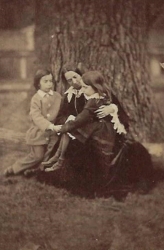
GEORGE FREDERIC WATTS (1817-1904) was a sculptor and a painter. I first became acquainted with him and his work when I was writing my book about west London (“Beyond Marylebone and Mayfair: Exploring West London”). My interest in him increased when I was writing a book about the Victorian photographer Julia Margaret Cameron (1815-1879). Between about 1850 and 1870, he lived with Thoby and Sara Prinsep’s family, about whom I have written in another book, in the now-demolished Little Holland House in Kensington. Not far from where he lived, there are two bronze statues by Watts: a portrait of Lord Holland in Holland Park, and the equestrian sculpture “Physical Energy” in Kensington Gardens. While living with the Prinseps, Watts met Julia Cameron, who was Sara’s sister. Cameron lived at Freshwater on the Isle of Wight in a house that neighboured the property where the poet Alfred Lord Tennyson lived. Watts, who had helped the Prinseps rent Little Holland House, was a frequent visitor to Freshwater, where he met and socialised with both Tennyson and Cameron. Watts, who was briefly married to the actress Ellen Terry, painted Tennyson several times and was himself photographed by Cameron. And Watts painted at least one portrait of Cameron – now in the National Portrait Gallery.
Apart from the numerous paintings and sculptures created by Watts, one of his most unusual works is neither a sculpture nor a painting – it is what one might describe as a precursor of Conceptual Art. Although attractive, the concept that it conveys – self-sacrifice – is more important than its appearance. Located in Postman’s Park, which extends from Aldersgate Street to King Edward Street, it is a memorial to ordinary people who lost their lives during peacetime whilst trying to save those of others. Created in 1898 but conceived by Watts in 1887, the work of art is called “Memorial to Heroic Self-Sacrifice”. It consists of a stretch of wall protected from the elements by a wooden loggia, which was designed by Ernest George who helped design the buildings at the Golders Green Crematorium. On the wall there are memorials to those who sacrificed their lives whilst rescuing others. Each memorial is made of ceramic tiles and records the name of the hero and a brief account of how he or she met their deaths. The first four memorials were designed and made by William de Morgan. Later, others were made by the Royal Doulton pottery. There is room for 120 memorials but by 1931, only 53 had been placed. In 2009, the Diocese of London permitted another memorial to be added.
Watts supervised this project. When he died, his widow, his second wife Mary, took over its supervision, but after a while she lost interest in it as she began concentrating on the management of the Watts Mortuary Chapel and the Watts Gallery – both near Compton in Surrey. The memorial is in Postman’s Park, which was formerly the graveyard of the nearby St Botolphs Aldersgate Church and is, I am guessing, maintained by the Church of England or a local authority.
The memorials are both fascinating and moving. Here are a few examples:
“Mary Rogers. Stewardess of the Stella. Mar 30 1899.Self sacrificed by giving up her life belt and voluntarily going down in the sinking ship.”
“Herbert Peter Cazaly. Stationer’s clerk. Who was drowned at Kew in endeavouring to save a man from drowning. April 21, 1889”
“Herbert Maconoghu. School boy from Wimbledon aged 13. His parents absent in India, lost his life in vainly trying to rescue his two school fellows who were drowned at Glovers Pool, Croyde, North Devon. August 28, 1882”
According to Wikipedia:
“Maconoghu was actually Herbert Moore McConaghey, the son of Matthew and Martha McConaghey, and he was born in Mynpoorie in India where Matthew was working as a settlement officer for the Imperial Civil Service,”
Standing amidst these memorials is a small sculpture depicting Watts. Its inscription reads:
“The Utmost for the Highest. In memoriam George Frederic Watts, who desiring to honour heroic self-sacrifice placed these records here.”
Luckily for us, Watts’s unusual creation has been kept in good condition. Since 1972, it has been a protected structure. Unlike most of the art made by Watts, the memorial in Postman’s Park was an idea created by him, rather than something he made with his own hands. I had seen the memorial several times in the past, but today, the 17th of May 2023, I took my wife to see it for the first time. A few weeks earlier, while visiting the Tate Britain, we had seen an art installation by Susan Hiller. It incorporated photographs of 41 of the memorials on Watts’s wall of memory in Postman’s Park. Having seen this, we wanted to see the original, and were not disappointed.
You can discover more about Julia Margaret Cameron, Tennyson, the Prinsep family, and Watts in my book “Between Two Islands: Julia Margaret Cameron and her Circle”, which is available from Amazon:
Many people will have heard of at least one of the following: Alfred Lord Tennyson, Charles Darwin, Anthony Trollope, Charles Dodgson (Lewis Carroll), Edward Lear, Henry Wadsworth Longfellow, Virginia Woolf, Vanessa Bell, and William Dalrymple.
Fewer might be familiar with George Frederic Watts, Valentine Prinsep, Julia Stephen, and Dejazmatch Alamayou Tewodros.
One thing that all of the people listed above share is that they were in diverse ways connected with a Victorian pioneer of artistic photography – Julia Margaret Cameron (1815-1879).
To discover about this fascinating woman and how her story involves all of the above-mentioned, please read “BETWEEN TWO ISLANDS: JULIA MARGARET CAMERON AND HER CIRCLE” by Adam Yamey. It is available both as a paperback and as an e-book from Amazon:
I VISITED INDIA at least 50 times over the last 29 years. It was not until this trip (2022-2023) that I began noticing letter boxes of historic interest. I spotted three of interest in Bangalore, and now I have found one outside the post office in Fort Kochi in Kerala.
Painted green with some gold coloured details it is hexagonal with a decorative top. Between the words “Post” and “Office”, there is a British royal cipher with the lion and unicorn. Beneath this is a V and a R entwined, a logo I have seen on Victorian letter boxes in the UK.
The old letter box, now sealed up so that nothing can be put in it, stands close to the verandah at the front of the post office. Within the verandah, there is a panel giving some information about postal services in the former Kingdoms of Cochin and Travancore
Postal services began in the Kingdom of Cochin in about 1864. It was known as the Anchal Service. The letter box described above might have been an Anchal post box originally, although it is unlikely.
The post office outside which stands the historic letter box is on Ridsdale Road opposite the east end of the church of St Francis (Church of South India), and was constructed in May 1928. At that time, Fort Kochi was in the Kingdom of Cochin. In 1949, it and its neighbour, The Kingdom of Travancore, were integrated into India and merged to form the State of Thiru-Kochi. In 1956, this state was renamed Kerala and its postal service became incorporated into the Indian Post system.
Interestingly, the post box outside the Fort Kochi post office bears the intertwined V and R. The information panel has a drawing of an anchal letter box. Similar in shape to the Victorian post box, the one in the drawing bears a different logo and the words “Travancore Anchal” and something in Malayalam script. If I am not mistaken, Cochin, unlike Travancore, became a British Protectorate. In which case it might well have become part of the British Indian postal system. This could explain why the historic letter box in Fort Kochi has a British logo instead of that used in the Anchal system. There might also have been Anchal boxes in the Kingdom of Cochin, but I am uncertain about that.
Today, letters are posted in a simple red cylindrical letter box not far from the historic one. The Victorian letter box is one of a huge number of interesting historic survivals that can be seen whilst wandering around Fort Kochi.




 yamey
yamey 