
A concrete environment: a brave new world

ONE SUNDAY MORNING in October 2023, we arrived in central Milton Keynes (‘MK’). The reason for our visit was to see an exhibition at the MK Gallery. I will describe the exhibition in a future posting. Although it was just after 10 am, there were few people around in the city centre. The little that we saw of central MK reminded me of trips to modern parts of cities in Eastern Europe before the collapse of the so-called ‘Iron Curtain’. However, in comparison with those places, central MK seemed much less lively.

Like New Belgrade and the new parts of Bratislava and Budapest, MK was built after WW2. In the 1960s, the UK government decided that to relieve the housing congestion that had developed in Greater London, new towns should be developed. MK was one of these. It was founded in 1967, and named after one of the villages in the area which the new city covers, rather than, as I had believed, in honour of two economists (John Maynard Keynes & Milton Friedman). Laid out in a grid pattern, it is modernist in conception. Having learned the mistakes made when planning earlier new towns in the UK, MK was designed to have commercial buildings that did not exceed six storeys, and residential that did not exceed three. However, a few taller buildings were added in the 21st century to provide the city with a central landmark. The city was designed by Melvyn Webber (1920-2006), who, according to an article in Wikipedia, believed:

“… telecommunications meant that the old idea of a city as a concentric cluster was out of date and that cities which enabled people to travel around them readily would be the thing of the future, achieving ‘community without propinquity’ for residents.”

Thus, MK has an amazing grid of roads that mostly intersect each other at roundabouts. It also has a high proportion of its area covered with open spaces (greenery and water features). MK was granted formal city status in August 2022. The part of MK we saw – and it was only a small part, but centrally located – has roads separated by wide tree-lined walkways. As already mentioned, the place reminded me of post-war urban developments in the formerly Communist countries of Central and Eastern Europe. I wondered whether the city has been a success. I have read that it makes an important contribution to the economy of the UK, but what I would like to know is how its inhabitants feel about living in what resembles a totalitarian utopia.
Searching for Samsung

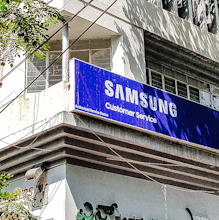
ONE OF OUR SAMSUNG mobile phones needed repairing while we were in Bangalore. Using the Google search engine, we discovered that the Samsung Service Centre nearest us is at Jayanagar. We gave the address provided by Google to an autorickshaw driver and after some navigational difficulties we reached the spot. There was no Service Centre but close to where we expected it to be, we found a Samsung showroom. Clearly, there was a mistake on Google.

Jayanagar gets scant mention in a new guidebook to Bangalore, so I turned to the (not always completely reliable) Google search engine to get a bit of background to this district of Bangalore close to the Lalbagh, a historic botanical garden. According to Wikipedia, a good starting place for research, Jayanagar means ‘victory city’. The area was established in 1948, and was one of the first planned suburbs of Bangalore. What little we saw of Jayanagar during our quest for the Samsung Service Centre reveals that the area is well planned in comparison with other areas of Bangalore. It gives the impression of being a prosperous suburb, which it is.

The people working in the Samsung showroom, where we stopped, confirmed that the address given by Google was indeed incorrect. They gave us directio s for finding the Service Centre, which was ten minutes’ walk away. This walk gave us a chance to gain some impressions of Jayanagar.

After walking past several palatial, fancy looking jewellery stores, we entered a long, mainly residential, street. Most of the houses were well spaced from each other, quite unlike the hugger mugger found in, for example, the prosperous but poorly planned suburb of Koramangala. The architecture of the houses along the street (7th Main Road) in Jayanagar is not uniform but interestingly varied. Several of the houses carry rakshasas, grotesque, scary masks to ward off the ‘evil eye’.

An elegant mandir, the Ganesha Vinayaka Temple, stands next to the intersection of 7th Main Road and New Diagonal Road. Established in the late 1970s, this temple attracts many politicians. Those seeking power come to worship at this place.

Beyond the temple, we reached 27th Cross Road. After crossing its central divider, we entered our destination, the Samsung Service Centre.

As with many faults of an electronic nature, when the engineer checked out the problem we were having with the phone, it had disappeared. Our search for the Samsung Service Centre had been unnecessary… so we thought.

PS After we had returned from Jayanagar, we discovered that our phone was repeating the fault which had caused us to make the apparently pointless journey to the pleasant suburb of Jayanagar.