A landing stage in the Sea of Marmara near Istanbul

ONE OF ISTANBUL’S many attractions is that it is intimately associated with water: the Golden Horn, the Bosphorus, the Black Sea, and the Sea of Marmara. Incorporated within the city’s excellent public transport system, there are many boat services on all these bodies of water. During our recent visit to the city in April 2024, we took a boat from Kabataş on the European shore of the Bosphorus to Büyükada – one of the Princes Islands out in the Sea of Marmara. This pleasant journey took about 1 hour and 40 minutes. As we sailed across the smooth sea, flocks of seagulls followed us, and were fed by other passengers, who threw them bread and other titbits.
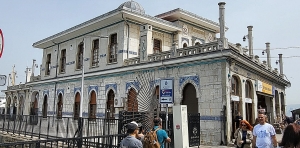
One of the piers at Büyükada has a beautiful old quay building in which passengers can wait for their boat and do a little shopping. Equipped with ticket windows, which are no longer in use because modern ticket machines have replaced them, the building is decorated with lovely tiling and stained-glass windows. As with many old buildings we saw in Istanbul, this one was supplied with a panel describing (in both Turkish and English) its history.

The pier was built in 1899. It was rebuilt with the addition of the present two-storey terminal building, which was completed in 1915 to the designs of its architect, Mihran Azaryan (1876-1952) from Izmit. He was an Ottoman Armenian. It is worthy of note that by the time that his building was built, the Ottoman rulers had been involved in the death of many Armenians.

The upper floor had a café between 1918 and 1923. And between 1950 and 1951, it had been the island’s first ever cinema. Between 2000 and 2001, the edifice was beautifully restored, and although the ticket windows no longer serve any purpose, its octagonal waiting room-cum-ticket hall is a rare survival.

Having seen this superb example of a ferry terminal, I kept my eyes open during the many other boat trips we made along, and across, the Bosphorus. Many of the landing stages have ornate terminal buildings – often with tiling and stained-glass windows, and sometimes with their names still in the old Turkish script. However, the terminal at Büyükada is the most impressive of all those we saw.
ONCE A VILLAGE ON THE MARMARA SEA, NOW A SUBURB OF ISTANBUL

THE FIRST TIME I visited Turkey was in about 1960. My father was participating in a conference organised by the Eczacibaşi Foundation. It was held in the then luxurious Çinar Hotel on the European shore of the Marmara Sea at a place called Yesilköy, which is about 9 miles west of old Istanbul. This April (2024), we visited Yesilköy both for old times sake and because we had read that the place has several interesting sights to be seen. Incidentally, it was in Yesilköy that I had my first piece of chewing gum.

After disembarking from the Marmaray train, which connects settlements on the coast of the Sea of Marmara, we enjoyed the best cheese börek we have eaten since arriving in Turkey. Then, despite constant rain, we walked along Istasyon Caddesi, admiring the many houses with decorative timber cladding that line the avenue.

We made a small detour to look at a Syriac Christian Church, which looked recently built. We could not enter because a service was in progress. Thence, we walked to the rainswept seafront, where we looked around a museum dedicated to the life of Ataturk. It was housed in a mansion once owned by Greeks. The ground floor is dedicated to the first decade of the Turkish Republic, which was founded in October 1923. The first floor has a display of ethnographic exhibits from Turkey. The second floor is a collection of photographs, items, and books relating to the life of Ataturk.

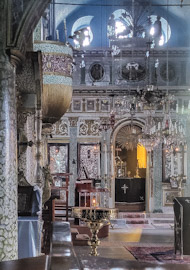
Greek Orthodox church in Yesilköy

Next, we came across a Greek Orthodox church. We could enter its covered porch in which candles were flickering. Through the windows of the porch we could see enough of the church’s interior to realise it is quite beautiful. Unfortunately, the church was locked.

Nearby, we found the huge Latin Catholic Church, which was open. Its interior was nothing special, apart from one religious painting which contained words in the Ottoman Turkish script. The size of the church suggests that there might once have been a large Roman Catholic community in Yesilköy.

Yet another church is a few yards away from the Latin church. It is an Armenian church, enclosed in a compound surrounded by high walls. The entrance was open, and after looking at the church, we joined the congregation (at least 40 people), who invited us to have tea and cakes. A couple of gentlemen began speaking with us in English. They told us that the Çinar Hotel was no longer in business, but it was still standing. They also told us that they are in the textile business. They are waiting for Indian visas because they are planning to visit Bangalore and Tiripur soon because they are looking to buy textile machinery there.

Several people told us that the Çinar Hotel is about a mile from the centre of Yesilköy. As it was cold and raining we decided against looking for it. Despite not revisiting the place I first stayed in Turkey more than 60 years ago, we saw Yesilköy and some of its fascinating sights. It is close to the railway tracks and not on most tourists’ beaten tracks.

A MAJOR ATTRACTION FOR VISITORS TO ISTANBUL

I AM ALWAYS WARY about visiting the ‘must-see’ places partly because I hate queuing and do not particularly enjoy crowds. Also, one of the few flaws in my personality is that I love visiting places that are off the beaten track taken by most visitors to a town or city. That said, I visited one of Istanbul’s most popular tourist attractions today – The Grand Bazaar – on my way to places less often seen by tourists.

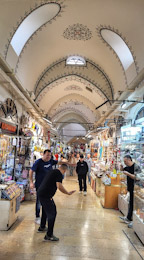
The Grand Bazaar (Kapali Çarşi = ‘covered bazaar’) covers a huge area, and is like a city within a city. It has 62 covered streets and about 4000 shops. It’s construction commenced in about 1455/56 – a very few years after the Ottoman conquest of Constantinople/Istanbul. Much of its construction occurred during the second half of the 15th century, and it was largely completed by the beginning of the 17th century.

Many things impressed me about the Bazaar. It is very clean. The numerous shops are mainly tidy. Until we entered the place, I had not realised that it is built on a hillside. Many of its gently curving streets (or wide corridors) are far from level – they slope gently. The beautiful curved ceilings, supported by numerous arches, are wonderfully decorated with painted Ottoman motifs and patterns – tasteful not garish. Despite the presence of many people – tourists and locals – the bazaar did not feel crowded. Because of the great width of the streets, the bazaar did not have the bustling feeling that many large bazaars in India have.

All in all, despite my initial reservations about entering such a ‘mustn’t miss’ attraction, I greatly enjoyed visiting the Grand Bazaar, and am very pleased I did.

A resourceful lady and a book about a famous Turkish architect in Istanbul

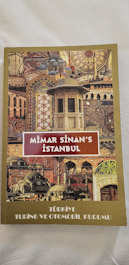
THE ARCHITECT MIMAR SINAN (c1489-1588) was the greatest of Turkish architects. There are many wonderful buildings of all sizes and for a wide variety of purposes designed by him all over Istanbul.

When visiting a tourist information office on the Asian side of Istanbul, I noticed several copies of a book called “Mimar Sinan’s Istanbul”. Beautifully illustrated with a detailed text, I quickly decided that I would love to own a copy. I asked if I could buy a copy. The official said that he could not sell me one because they were for reference only. I asked where they were sold, and was told that I could buy one at the publisher’s bookshop. The book is published by Turing. The discovery of the book occurred on a Friday.

On the following Sunday, we found the Turing shop. It was shut. We went again on Monday, and found a notice stating that it was always closed on Mondays. Tuesday was a public holiday. So, we did not bother going to the shop. On each of our abortive visits, I could see the book on a shelf in the shop, but could not quite see its title.

On Wednesday, the shop was open. We entered it, and discovered that they only stocked the Turkish edition. As it is beautifully illustrated and remarkably cheap given its fine quality, we purchased a copy.

Later that day, my wife Lopa had an ingenious idea. We were not sure whether it would work, but it was worth a try, especially as the tourist office was close to where we wanted to go the next day.

On the following day, we took the ferry to the Asian side, carrying with us the brand new copy of the Turkish edition of the book about Sinan, and returned to the tourist office. Lopa asked the official, who remembered us, whether we could exchange our Turkish book for one of the office’s books in English. Without hesitating, the official said:
“Why not. We don’t have a copy in Turkish.”

He handed us a copy of the book in English, and we gave him our Turkish copy. I was very pleased and full of admiration for Lopa’s resourcefulness – especially as it was her birthday.

TWO MOSQUES AND A BAZAAR IN ISTANBUL

WHILE WANDERING THROUGH the older part of Istanbul on our way to the Yeni Camii (‘New Mosque’), we came across the Mahmut Paşa Camii. This mosque stands in a remarkably peaceful, large compound, considering how close it is to a route used by crowds of tourists. Despite being in the heart of the most visited part of the city, this mosque seems to be ignored by most tourists.

The Mahmut Paşa was built in about 1463, making it one of Istanbul’s oldest mosques. It was built only 10 years after Istanbul was captured by the Ottomans. The spacious mosque was built in a style typical of some mosques found in Bursa. It has a large central hall flanked on each side by smaller rooms – rather like side chapels. It was the work of Grand Vizier, Mahmut Paşa, who was put to death by Mehmet the Conqueror in 1474. During his life, he was involved with the Siege of Belgrade, chasing Albania’s Skanderbeg, and the conquest of Bosnia. In addition to his military exploits, he was a noted writer, both in Turkish and Persian. It is worth noting that Mahmut Paşa was converted to Islam after he was captured in Serbia by the Ottomans when he was a young boy.

After seeing the mosque, we walked past the crowded Grand Bazaar, and after passing numerous shops selling lingerie and hosiery, we arrived at the Misir Çarşisi (Egyptian Market aka Spice Market). We walked through this covered, fragrantly scented spice market, which was constructed gradually from 1597 to 1664. Where two passageways lined with shops intersect, there is an open space overlooked by a wooden pavilion reached by a spiral staircase. This was used to say prayers to the merchants who gathered to listen to them at the start of each day.

The Yeni Camii is next to the Misr Çarşisi. It is an enormous structure with numerous domes. It was completed in 1603, and overlooks the Golden Horn and the Galata Bridge, which crosses it. Both the interior and the facade facing the courtyard are rich in tiles covered with blue and white motifs and calligraphy. This eye-catching tiling greatly adds to the mosque’s attractiveness. The huge, spacious interior is an oasis of tranquillity compared with the busy roadway and waterfront only a few yards away.

In between the three edifices I have described, the steeply sloping streets connecting them are lined with buildings of all ages – some of them attractive, others less so. Many of these buildings house shops.

Yet again, a stroll in Istanbul has proved to be fascinating. It is not only the historic monuments that I enjoy seeing, but also glimpses of everyday life in the city.

A MOSQUE IN ISTANBUL REMEMBERED, BUT ITS NAME FORGOTTEN

ON OUR LAST visit to Istanbul at least 15 years ago, we visited a small but attractive mosque in Üsküdar (the Asian part of Istanbul). During our present holiday in the city (in April 2024), we hoped to see this mosque again, but we had forgotten its name.

After having waited for the midday Friday prayers to be over at the Atik Valide Mosque, we looked around this edifice that was designed by the famous architect Mimar Sinan in 1583-1584. Incidentally, to reach this building, we climbed a steep staircase with 114 steps – a so-called short cut. Apart from its fine architectural form, the mosque is adorned with several lovely tiled plaques covered with Arabic calligraphy intertwined with the occasional flower.

As we were leaving the mosque’s enclosed compound, a man stopped us, and told us in broken English that we should visit another mosque in the neighbourhood. He said it had beautiful tiling, and it’s name is Çinili. When we heard the name, we remembered that was the mosque, whose name we had forgotten.

Çinili mosque

After climbing another hill, we reached the Çinili mosque. Completed in 1640, it is not as fine architecturally as buildings by Sinan. However, it’s interior is lined with intricately decorated tiling. Unfortunately, the mosque was locked up, but by peering through the windows we got a good impression of the magnificent tiling. The wall of the covered porch in which the main entrance can be found is also covered with beautiful tiling. What we saw was what we remembered from our first visit there at least 15 years ago. We were very grateful that a complete stranger reminded us of the name of the place that we remembered, but whose name we could not recall.

PS both mosques mentioned above were connected with a Valide Sultan – that is with the mother of a reigning Sultan.

MORE ABOUT CATS IN ISTANBUL AND SOMETHING ABOUT CATS IN MY LIFE

I HAVE ALWAYS LIKED cats. Once, when I was about 7 years old, I was in bed suffering from one of my then frequent attacks of tonsillitis. I was recovering in bed when a small black cat wandered into my bedroom.

Knowing my love of cats, my mother had bought one to cheer me up. I christened it “Crumpet”.

There was a big problem. My mother was not keen on cats. As she thought I was too young to be trusted with a tin opener and she was worried that I might cut myself on the opened tins of cat food, she became Crumpet’s feeder.

Because Crumpet knew that Mom was the source of her food, she took a liking to her, often rubbing herself against my mother’s legs. This did not please my mother, and I believe that Crumpet sensed this. After a few months, Crumpet abandoned our house, and moved into another house along our road, where she found a more appreciative host.

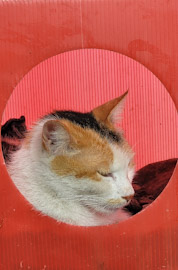
Cat shelters in Üsküdar

We are now visiting Istanbul, which is swarming with cats. As I have already written previously, street cats seem to be well treated in this city. People put out food for them, and various organisations, including local municipalities, provide them with cosy shelters.

Today, whilst sitting in a garden outside a mosque in Üsküdar in the Asian part of Istanbul, we saw many cats – as usual. It was a cold, rainy day, and one cat, lacking in shyness, spent time keeping warm by sitting on my wife’s lap, and then mine.

What we have seen of the cats of Istanbul reinforces my affection for these furry creatures.

Istanbul is a city for cats

WE HAVE ALREADY seen many fantastic historical places in Istanbul, and I plan to tell you about some of these. But before proceeding with descriptions of landmarks in the history of Istanbul/Constantinople, let me relate something current.

Istanbul is full of cats. Wherever you look you are bound to see a cat – often looking extremely healthy. They feed both by scavenging and they are also fed by local people. They seem unafraid of humans.

During our first three days in Istanbul, we have noticed something we had not seen before. In several places, we have seen small kennel shaped ‘sheds’ which are large enough to house one big cat or a couple of smaller ones. The floors of some of these shelters are lined with soft material including bits of old bedsheets. Most of the sheds have round holes through which the cats can enter and leave the shelters.

Another feature that makes life more pleasant for felines is that compared with many other cities I have visited, there are few dogs around in the streets.

The cats of Istanbul have much to purr about!

A toilet in the airport of Istanbul

I FIRST VISITED Turkey in the early 1960s. It was then that our family first came across squatting toilets. For want of a better name, we called these hole in the floor lavatories ‘Turkish loos’.

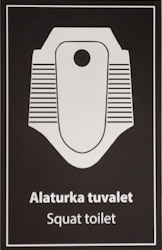
Today, in April 2024, we landed at Istanbul’s vast new airport. As nature was calling, I visited one of the many toilets in the airport building. You can imagine my surprise and satisfaction when I saw on the door to a cubicle containing a squatting toilet a sign that read in Turkish “Alaturka tuvalet”, and beneath it, the English words “Squat toilet”. So, it seems that we were right to christen these types of toilets ‘Turkish loos’.

Keeping on the safe side

IT IS ALWAYS WISE to ward off the Evil Eye. The Turks use characteristic amulets known as ‘nazar’. They are usually flat and almost circular with a design that resembles a stylised eye. This is now to seen on the homes of many people with no connection with Turkey. The Arabs and some Jewish people use an amulet, the ‘hamsa’, depicting a hand with five outstretched digits, to protect against the malevolent effects of the Evil Eye.

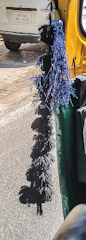
During road trips in India, I have often seen lorries (trucks) and other vehicles with thick, black, plaited tassels attached on the left and right sides of the driver’s cab. These things fly out sideways as the vehicles speed along.

One of our driver’s, the highly educated and informative Raheem, explained that these tassels are nazars. The drivers attach them to their vehicles to ward off the Evil Eye – an especially wise precaution on many roads in India.

During a recent (December 2022) visit to Panjim in Goa, my wife bought a couple of scarves from a female street vendor. The seller was so happy that my wife had bought from her that she immediately attached a bracelet on my ‘other half’s’ right wrist. The bracelet has a Turkish style Eye nazar and is made of black beads, which might well be designed also to protect against the Evil Eye.

Even more recently, I noticed that an autorickshaw, which we had hired in Bangalore, was adorned with two hefty black tassels just like those seen on lorries. I was struck by these because on the whole autorickshaws in the city do not have them.

I have one minor concern about vehicles whose drivers have attached things to ward off the Evil Eye. That is, I wonder whether the knowledge that their vehicles are equipped with such protection might drive more recklessly than those who do not put any faith in objects that might possibly have a protective value.