HERE WE ARE in England’s West Country once again. Apart from coming to enjoy the scenic delights of Somerset, Devon, and Cornwall, we have another reason for visiting the area. That reason is socialising. During the last few years, many of our good friends who used to live in London, or not far from it, have moved westwards.
Some old friends, who lived near Windsor for several decades have sold up and now live in Dorset, which is on the way from London to the West Country. Long before the 1980s, my good friend (and fourth cousin) Peter Bunyard shifted to a very remote spot in the heart of Cornwall. More recently, another cousin shifted to the Clifton district of Bristol. Also, living not far from Bristol are two friends, who used to live in Ealing. Another couple, who had homes near Reading and in Kensington have moved to Topsham on the River Exe. Not far from them, living in Sidmouth, are some other close friends who lived in Hertfordshire. A dentist with whom I used to work in a practice in Rainham, Kent, and her husband have just moved from their home near Maidstone (Kent) to the city of Bath. And only a couple of days ago, I received a text message from another of my former colleagues, who is moving from Acton (in west London) to the North Devon coast.
In addition to those who have drifted west, we have other friends who have lived in the West Country seemingly forever. One couple lives in Cornwall close to the River Tamar. The other couple live in a house overlooking the River Dart in Dartmouth. An yet another couple live in Torquay.
All these people are good friends with whom we have a great deal in common, and enjoy seeing. However, now they have drifted west, and not all of them visit London much, if at all. So, we like to make an annual – and always enjoyable – trip to the west to see some, if not all, of them. They seem to enjoy seeing us, so I do not think they moved away from London to avoid meeting us! If more of our friends shift westwards, we might even begin to think of following them.
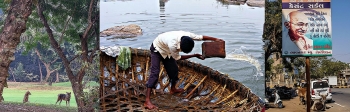
AMONGST THE 101 diverse topics in my book about travelling in India, you will find the following four: observing a padlock made by a company called Hitler; encountering jackals on a golf course; travelling in coracles on crocodile-infested waters; and having spectacles made by Gandhi’s optician. Since getting married in India in early 1994, I have made over fifty visits to the country during which I have spoken to many people and explored a multitude of places – both well-known and hardly known except to locals. My book, “The Hitler Lock & Other Tales of India”, contains a selection of my experiences in the country. The book aims to fulfil the idea of great Jean Molière (1622-1693), namely, “If you want to edify, you have to entertain.” I hope that you will find that I have achieved that.
You can purchase my book from Amazon (either as a paperback or a Kindle e-book) by clicking on the picture below:
MY PARENTS WERE born in South Africa. They settled in England in about 1947/48. In 1955, when I was three years old, my parents took me on a visit to their native land, possibly to show me off to relatives who lived there.
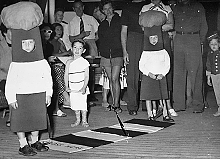
We travelled to Cape Town by sea. I remember nothing of the voyage, which must have taken about two weeks. Recently, I came across a photograph, which had remained in storage for several decades in my late father’s garage. The picture shows a little boy in a white outfit resembling a Roman toga. He is standing between two children dressed up to resemble, if your imagination is good enough, Belisha beacons such as are found at pedestrian crossings of the zebra variety.
The photograph reminded me of what my mother had told me many years ago. During our voyage to South Africa, we crossed the Equator. My mother told me that to celebrate this event, there was a fancy-dress party for the children on-board. My mother, unlike some of the other parents, had not been aware that this was going to take place. So, she had not packed a costume for me to wear. Ever resourceful and extremely creative (she was a painter and sculptor), Mom used one of the sheets from a bed in our cabin to wrap me up as if I was wearing a toga. Looking at the photograph, it appears that also she fashioned a pair of what look like Roman sandals, using some string. Thus, during my first crossing of the Equator, I was attired in a Roman toga.
Looking at this image, which includes a rug designed to look like a pedestrian crossing, made me think. There I was standing halfway across a zebra crossing whilst our liner crossed from one side of the Equator to the other.
ONE EASTER DURING the late 1990s, we drove to Provence in the south of France. There, we hired a lovely rural cottage (a ‘gîte rural’) located on the edge of a village next to an orchard of trees overladen with ripe cherries. That year, there was a heatwave in the south of France, daytime temperatures reaching and staying at 37 degrees Celsius. We were pleased that our Saab saloon car had built-in air-conditioning and that our gite had a large garden and a shady terrace.
Roman amphitheatre, Orange, France
Despite the high daytime temperatures, we managed to do plenty of sight-seeing. One day, we decided to explore the delights of the city of Orange, which was not far from our gite. The city is rich in Roman remains including a magnificent open-air theatre with steps, on which the audience perched, arranged in a circle.
In the 12th century, Orange and its surroundings became a principality within the Holy Roman Empire. In 1554, William the Silent, Count of Nassau, who had possessions in the Netherlands and became a Protestant, inherited the title ‘Prince of Orange’. The Principality of Orange was incorporated into what became the House of Orange-Nassau, whose royal family continues to rule the Netherlands today. One member of the family became King William III of England in 1689. Orange remained a Dutch possession more or less continuously until the Treaty of Utrecht in 1713, under whose terms it was ceded to France.
So much history and clambering around the Roman ruins made us ready for lunch. We had no idea which restaurant to choose in the centre of Orange. My wife had the bright idea of entering one of the local shops, a shoe store, to ask where its workers went to eat their midday meal. They told us about a small restaurant around the corner. This busy eatery had a name which brought to mind associations with the American Wild West, ‘Le Buffalo West’, or something similar. It was a good recommendation and the food it served was excellent quality, reasonably priced French fare.
After a decent meal, we drove to a parking plot near a Roman triumphal arch. To enter the parking area, one had to drive below an arch designed to keep out large vehicles, and then down a steep ramp. Unfortunately, I turned the steering well before the car was fully off the ramp. We became grounded on a large concrete rock. The engine cut-out. I could not restart it. The car was well and truly stuck on the rock. Some people nearby saw our plight and told us that there was a repair garage a few yards away. We walked there.
The garage people sent out a team with a tow truck. Sadly, the truck was too high to pass beneath the height-restricting arch. Seeing the problem, three garage employees set to work with spades to dig around the rock on which our Saab was marooned. After at least an hour and a half’s hard toil in the baking afternoon heat, they removed the boulder and thus freed the car. Then, they pushed it beneath the arch so that it could be attached to the towing truck.
Raised on a ramp, it was easy to see where the rock had ruptured the Saab’s fuel line. It did not take the engineers long to replace the fractured section. Luckily, little other damage was visible beneath our car. Finally, we were ready to leave. It was with some anticipation that I asked to settle the bill. Imagining how expensive this labour-intensive episode would have been in the UK, I was expecting a bill of at least £300. So, I was not surprised when I was asked for about 300 French Francs. Then, a moment later, I could not believe my luck. A quick calculation had revealed that I was being asked not for £300, but for the Franc equivalent of about one tenth of this amount.
We returned to our gite, highly relieved that the car was back in service so quickly. That evening, as the sun set, we sat outdoors and enjoyed glasses of the local rosé wine whilst the charcoal on our barbecue began to reach the glowing stage that is best for grilling the meat that we had bought in one of the local markets.
The Saab remained in use for several more years but, to the surprise of our local dealer who serviced it annually, it began developing ominous cracks in its chassis. It was providential that these did not develop immediately after my driving misjudgement in that car park in Orange.



 yamey
yamey 