A toilet suspended above the waters of the Arabian Sea in Bombay

THE IMPRESSIVE GATEWAY  of India stands on a short promontory surrounded on three sides by the water of the Arabian Sea.  The sea surrounding the Gateway is crowded with small, colourful vessels. Seeing  one of these craft reminded me of a story told to me by a friend many years ago.


In Bombay

My friend had just returned from Kenya. During his stay there he spent several days at sea on a local trading ship. It was a very basic vessel.  He told me that he could not find a toilet on board. Eventually,  he could no longer resist the urge, and asked the crew where he could relieve himself. He was directed to the rear of the vessel and shown a toilet seat that was suspended from it over the waters below. With some difficulty he managed to sit on the swinging toilet seat, and to his great embarrassment, the entire crew came to the back of the ship to watch him in action.


That really happened a long time ago.  Today, 17 November 2025, while visiting the Gateway of India,  I spotted a small boat. Projecting from its rear and hanging over the water, there was a small, square based cubicle with a door. On the door,  there was the word “TOILET”. Seeing this reminded me of my friend’s story. Users of this cabin are shielded from sight, unlike that swinging loo seat on the Kenyan boat.

A toilet in the airport of Istanbul

I FIRST VISITED Turkey in the early 1960s. It was then that our family first came across squatting toilets. For want of a better name, we called these hole in the floor lavatories ‘Turkish loos’.

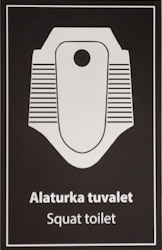
Today, in April 2024, we landed at Istanbul’s vast new airport. As nature was calling, I visited one of the many toilets in the airport building. You can imagine my surprise and satisfaction when I saw on the door to a cubicle containing a squatting toilet a sign that read in Turkish “Alaturka tuvalet”, and beneath it, the English words “Squat toilet”. So, it seems that we were right to christen these types of toilets ‘Turkish loos’.

Sir Anthony Blunt sat here often

HOME HOUSE IN London’s Portman Square was completed in 1777 for the wealthy Elizabeth Home, Countess of Home (c1703-1784). Born in Jamaica into a slave-owning family, her wealth was produced by the unpaid labour of slaves imported from Africa. The house is remarkable, especially for its intricately detailed interior décor designed by the architect Robert Adam (1728-1792).

In 1933, Home House became home to the Courtauld Institute of Art, now part of the University of London. A close friend of mine, now sadly deceased, studied at the Courtauld for both his bachelor’s degree and his doctorate. Whilst writing his doctoral thesis, my friend was supervised by Sir Anthony Blunt (1907-1983). Blunt was the director of the Courtauld from 1947 to 1974. He was also in charge of the Royal Collections of art from 1945 onwards. In addition, he carried out much important scholarly work in the field of history of art. Blunt, as director of the Courtauld, was given a flat in Home House.

Until 1979, few people knew, or even suspected, that Blunt had been involved with spying for the Soviet Union.  When this came out into the public domain, Blunt’s downfall commenced. He was stripped of his knighthood and his Honorary Fellowship at Cambridge’s Trinity College was rescinded. Also, Blunt resigned as a Fellow of the British Academy. Soon after his exposure as an espionage agent, who worked against his own country for the Soviet Union, Blunt ceased residing at Home House. In 1989, the Courtauld Institute shifted from Home House to larger premises in Somerset House in the Strand. Home House remained vacant until 1998, by which time it had been beautifully restored and adapted to become a private social club. During a recent visit to Home House when we were entertained by a friend, our host, a member, took us to see an interesting exhibit, which is housed in the wash basin area of one of the Club’s unisex toilets. We were shown a glass-fronted display case containing a wooden furniture item. It bears a label with the words: “From the bathroom of Sir Anthony Blunt”. The labelled object is the toilet seat on which Blunt must have sat numerous times, and its wooden lid. Another case in the room contains Blunt’s telephone. Although the loo seat and the ‘phone are unremarkable except for their provenance, the rest of Home House is a visual delight.

The importance of being British

HBY 60s 36 HW BLOG

I HAVE ONLY VISITED CRETE once, and that was in the late 1960s with my parents and sister. We were based in Heraklion and made excursions from there around central Crete, visiting sites including Knossos, Matala, the windmills of Lasithi, Malia, Aghios Nikolaos, and Phaistos. This piece concerns three memories of my late mother on that visit.

The first recollection is of the rather non-descript but very comfortable hotel where we stayed in Heraklion. It had its own swimming pool. My mother, who could not swim, and was always a bad sailor, could not bear to look at the pool; it made her feel seasick seeing its water.

The next memory is of a hot day somewhere in the Cretan countryside. We were all thirsty and ready for a drink. We passed a house with a garden. Some people were sitting at a table sipping the tiny cups of coffee that Greeks favour. They were drinking what many people call ‘Turkish Coffee’, which many Greeks prefer to call ‘Greek Coffee’ or even ‘Byzantine Coffee’.

My mother walked up to the gate leading into the garden and using one of the few words of Greek that she knew, called out:

Kafenion?

Kafenion (καφενεῖον) is the Greek word for ‘café’. Another Greek word she knew well was ‘siga’ (σιγά), which means ‘slowly’. She used it almost in every car that we were being driven in Greece. She was terrified that others driving her would have an accident because as a child in South Africa she had been involved in a dreadful car crash.

Getting back to my story, the coffee drinkers invited us into the garden and asked us to join them. My mother was mildly embarrassed to discover that this was a private house, not a ‘kafenion’. Soon, we were all supplied with Turkish Coffee. One of our hosts spoke rudimentary English. He had been a sailor when younger and excitedly told us that he had been to ‘Kong Kong’, in his own words.

Then, my mother noticed a single brightly coloured flower in the hedge surrounding the garden. She pointed at it, exclaiming “oreia” (ωραία), the Greek word for ‘lovely’. Our hosts burst out laughing. They found my mother’s reaction to the flower hilarious. One of them took Mummy to the flower and showed her it was artificial, attached to the hedge with a fine wire.

The third thing I recall about our Cretan odyssey relates to a commodity that was in great demand recently here in the UK: toilet paper. When we used to visit Greece in the 1960s and 1970s, there were usually people sitting at the entrances to public toilets. These folk, often elderly women, were there to sell sheets of toilet paper to people about to make use of the facilities.

We were in one small Cretan village when my mother needed to answer Nature’s call. We found a public convenience. An elderly toilet paper vendor was sitting by its entrance. My mother rummaged in her handbag for small change. While she was doing this, the lady asked my mother:

“Deutsch? German?”

My mother answered:

“British.”

The lady handed her some toilet paper and would not accept the customary two Drachma payment.

We were in Crete at least twenty years after the German occupation of the island had ended in spring 1945. The Germans had perpetrated many horrific deeds on the Cretan population. The woman outside the toilet was certainly old enough to have had strong memories of that ghastly time. Had my mother been German, she would have had to pay for the toilet paper. Being British, she was like the great writer Patrick Leigh Fermor (1915-2011) who fought the Germans in occupied Crete, a representative of  a nation which helped rid the island of its unwelcome occupiers. This toilet attendant’s small act of kindness towards my mother helped drive home how awful it was to have been occupied by the Germans during WW2.