Building boats by hand at a port in Kutch, (Gujarat, India)

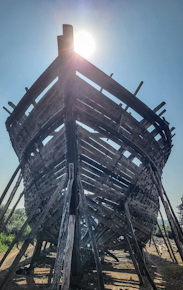
THE SEAPORT MANDVI in the Kutch district of the Indian state of Gujarat was founded by Maharao Khengarji I, the ruler of the kingdom of Kutch, in 1580. It became an important, thriving centre of trade for several centuries. And for over 400 years it has been a place where dhows have been built. Today, these huge wooden ships can be seen in various stages of construction along the banks if the Rukmavati River on whose shore lies the town of Mandvi.


The dhows are constructed largely by hand as they have been done for over 400 years. They are built with timber, sal wood, imported from Malaysia. Today, the timber is landed at the port of Kandla in Kutch  a d brought by road to Mandvi.


According to an article in the The Hindu  newspaper dated April 2017:

“As maritime trade grew, traders—belonging to the seafaring Kharva community of both Hindus and Muslims—developed a new expertise: boat-making and repairing to add to their traditional navigational skills.”


Furthermore ,  the arti le related, the dhows:

“… built by hand by craftsmen who are barely literate and have no training in engineering, the ships come up expertly without so much as a sketch being referred to.”

I found this to be quite amazing.


The dhows take several year to be built. When they are completed,  they are usually  towed to the Persian Gulf where they are fitted with engines. Occasionally,  engines are fitted in Mandvi.


Having been fitted with engines in the Gulf, they return to Mandvi with a small crew. Back in Mandvi,  the dhows are loaded with cargo and a larger crew before sailing back to the Middle East.  About a year after they have been completed,  the dhows are sold in the Gulf or East Africa.


Whereas in the past, the dhows had a capacity of about 40 Tonnes, some of those being built today can carry up to 2000 Tonne.


Whenever we visit my wife’s cousins, who lives close to Mandvi, we take a walk along the road next to stretch of shore where the dhows are being made. The huge timber structures, upon which men are assembling the ship using hand held tools. The workmen appear to cling to the beams of timber as they worked on the ship. They do not wear safety harnesses.


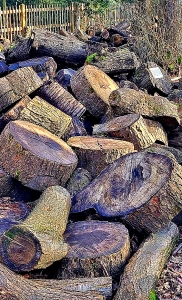
The ‘embryonic’ dhows are surrounded by piles of uncut timber as well as the planks that have been cut prior to being attached to the ships being constructed.  Apart from the building  materials, the area contains numerous stray dogs and the occasional foraging cow.


Mandvi is about 250 miles northwest of Alang (in Saurashtra,  Gujarat),  which we have visited. It is in Alang that ships that have reached the end of their lives are broken up. I was interested to read in The Hindu article that in Mandvi:

“The boat-makers use old generators discarded from dismantled ships lying in Gujarat’s Alang ship-breaking yard. These are then modified by installing gear boxes in them and converted into boat engines.”


I have no idea for how much longer  the handmade dhows will continue to be built in Mandvi. So, if you are able, a visit to Mandvi to see this traditional boat building  is well worthwhile. It is handicraft on a huge scale.

Twisted on top of a church in Shropshire

CLEOBURY MORTIMER IS a small town in Shropshire, near to Clee Hill. I could not help noticing that a peculiar church steeple dominates its skyline.

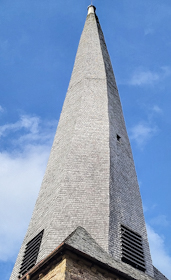
The spire is that of the church of St Mary the Virgin. What makes it distinctive is that it is twisted.

The shingle covered steeple has a timber skeleton that was constructed in the 13th century. Over the centuries, the timbers became damaged by damp, and the spire began to tilt towards the southwest. Furthermore, warping of the woodwork caused it to become twisted. So, the spire not only leans away from being perpendicular but also twists. Fortunately, restorations carried out in 1993 will probably prevent this ancient spire from further deformation.

Caught in time in west Buckinghamshire

DUE TO BE DEMOLISHED in 1900, the newly established National Trust (founded in 1895) saved it from this terrible fate that year. The building is a long, narrow half-timbered, brick and wattle structure in the attractive village of Long Crendon in the west of Buckinghamshire. Built sometime between the 14th and 15th century, it served as the manorial courthouse.

Meetings of the manorial court of Long Crendon are believed to have begun before the 13th century. Until 1233, they were held in the lord of the manor’s house, which was demolished that year. In 1275, the manor was divided equally among three female heirs, and courts were held in the farmhouses of their families. By 1558, the courts of the three lords of the manors combined, and it must have been around this time that the courthouse began being used for judicial procedures. The building was not only used by the court but also as a facility for the poor. By the 19th century, it was used by one family to store wool. Some historians question this. In Victorian times the courtroom was used as a Sunday school and a place where occasional public lectures were given.

In 1900, the National Trust purchased the venerable edifice and began repairing it to keep it standing.  The Arts and Crafts architect and designer Charles Robert Ashbee (1863-1942) and his wife lived in the courthouse. They used to invite groups of apprentices from London for arts-based holidays lasting a fortnight. In 1902, the Ashbees, whose bohemian activities disturbed the locals, left for Chipping Camden where they established the Guild of Handicrafts. In 1918, Ashbee was sent to Jerusalem as civic adviser to the British Administration for Palestine.  In 1937, the courthouse became used as a clinic by the area’s District Nurse. This continued after the NHS was established in 1948. The courtroom then served as a Welfare Clinic.

Between 1985 and 1987, the building was intensively restored. Now, the long room, which occupies most of the upper floor, and was once the court room, is now a village museum. It is reached by a steep flight of wooden stairs. The upper rooms are the only part of the building open to the public. The long courtroom has a timber floor made with irregularly shaped planks. The arched ceiling is supported by massive timber crossbeams. Each one differs in shape from the others. Various exhibits and boards with historic photographs line the walls of this otherwise empty room, in which long ago trials were held.

We visited Long Crendon to see the courthouse. However, many other buildings in this village are incredibly picturesque and well-worth exploring.

Creating art with wood and a chainsaw

BORN IN WHAT BECAME EAST GERMANY in the town of Deutschbsaselitz, the artist christened as Hans-Georg Kern (b. 1938), is better known by the name of Georg Baselitz. His first education in art was at Hochschule für Bildende und Angewandte Kunst in East Berlin, commencing in 1955. After two semesters, he was expelled from this academy because of his lack of compliance with the socialist diktats of the German Democratic Republic. By 1957. he was a student at the Hochschule der Künste in West Berlin. In 1961, he changed his name to Georg Baselitz in honour of the town where he was born. In 1979, he began creating sculptural works, some of which are on display at London’s Serpentine South Gallery until the 7th of January 2024.

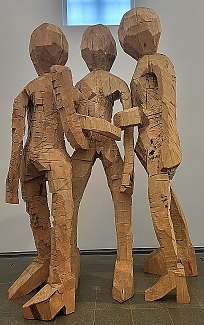
The works being shown at the Serpentine are all made of wood. They were created between 2011 and 2015 as models (maquettes) for finished works, and as such were not originally intended for public display. The wood has a rough finish and is pitted with many saw marks. After making preliminary drawings, some of which are displayed at the exhibition, Baselitz used axes, chisels, and chainsaws to fashion huge bits of timber into intriguing sculptural forms. These works are beautifully displayed in the various spaces of the gallery.

Although Baselitz’s timber sculptures are more figurative and much more complicated than those produced by my mother, seeing them reminded me of her. After leaving the sculpture workshops of St Martins School of Art, my mother hired a garage near Golders Hill Park, and used it as her studio. There, she worked on huge pieces of wood, creating abstract sculptures. Unlike Baselitz, she had no power saws, but only chisels and a power drill. I recall that when she wanted to create a ring-shaped piece of timber, she would first trace circles on the wood and then using a power drill she would drill holes around the circumference until the circle was complete. After that, she had to smooth the edges to produce a perfect circle. It was laborious, and lifting the heavy timber (without lifting gear) damaged her back.

The works on display in the Serpentine  (and one outside it) appear to be crudely finished when looked at closely, but as semi-abstract sculptures they seem to mock the grandeur of classical Greek or Roman sculptures. Born a rebel, the artist has produced attractive works that comfortably go against the grain of traditional sculpture.

A gift of William the Conqueror

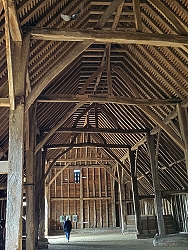
IF WE HAD NOT MISSED a turning at a road junction in Essex, we might never have visited Prior Hall Barn (near Widdington). Maintained by English Heritage, this well-preserved, huge timber-framed, wood-cladded 15th century barn. Constructed entirely of timber – without any metal, it has been estimated that its 900 pieces of timber were derived from 400 trees. Some metal structural elements have been added since the barn’s original construction, which judging by the date of the timbers commenced no later than about 1472. It remained in use as a barn until 1976.

A mediaeval barn such as this one is fascinating enough. However, the land on which it stands has a most interesting history. Just before William the Conqueror set sail for England, he assembled his fleet in the river port of Saint-Valery-sur-Somme. It is believed that he was made welcome in the town’s priory. As a gift of thanksgiving for his successful conquest of England in 1066, he gave the farm on which the barn stands to the priory in St Valery.

In the 14th century, lands owned in England by foreign owners became a drain on the economy, and properties such as the village of Widdington were confiscated by King Edward III. In 1377, the land where the barn and village stand were given to William of Wykeham, the Bishop of Winchester. In 1379, Wykeham founded New College Oxford and endowed it the farm, The college owned the farm from 1379 until 1920, when a local farmer purchased the freehold. It was resold in 1950, and in 1976 its owner, Mr Jeremy Dillon-Robinson placed the barn into the care of the Department of the Environment. Now, it is cared for by English Heritage.

Although I have no idea whether William the Conqueror ever set foot in Widdington, the place’s connection with St-Valery-sur-Somme adds to the excitement of seeing this historic barn. Had we stuck to the ‘beaten track’, we might well never have even heard of the barn, let alone the land’s interesting ownership history.

A homely pavilion in the park

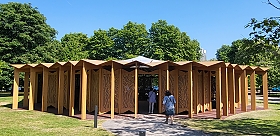
EVERY YEAR SINCE 2000, the Serpentine Gallery in London’s Kensington Gardens has commissioned the construction of a temporary pavilion in its garden. These pavilions have two things in common. One is that they contain a café and the other is that it must be designed by a noteworthy architect who has never had one of his or her creations constructed in England. Almost all the pavilions constructed to date have been examples of adventurous and exciting architecture. This year’s architect is Lina Ghotmeh, who was born in Lebanon and now works in her studio in Paris.

Given the French name “À table”, the circular timber pavilion was conceived as a place for people to sit together and chat, just as they would around a dinner table. Given this aim of the architect, it succeeds. To enhance her aim, the specially designed tables and chairs are arranged in a circle. As my wife said, it is the homeliest of all the pavilions built to date. Unlike some of the earlier pavilions, one does not feel that one is entering an unfamiliar, or even alien, environment. Despite its welcoming nature and very human scale, the pavilion’s design is far from mundane. Although it is far from being amongst the most visually spectacular of the temporary buildings, it is pleasing to the eye. I will certainly visit it again before it is dismantled on the 29th of October 2023.

An elevating experience

RAINHAM HALL IN the London Borough of Havering is a fine example of a house built in the early 18th century for a prosperous merchant. Owned and managed by the National Trust (‘NT’), the house stands at one side of its large garden. Across the yard next to the house, there stands the recently restored 18th century combined stable block/coach house and brewhouse. The ground floor of this building contains the NT reception area, a small second-hand bookshop, toilets, and a café. The upper storey contains a large exhibition/community space beneath a timber roof. The restoration of this edifice was completed in October 2015.

There are two ways to reach the upper floor from the lower one. And it is the design of these that really impressed me. There is a spiral staircase, whose treads are cantilevered from a central timber cylinder. Bands of metal surround the cylinder in the same way that similar bands can be found binding the timber elements of wooden barrels. This design was chosen to commemorate the former existence of Rainham Hall’s brewhouse (brewery).

The lift at the upper floor level

The cylinder not only supports the staircase, but it also contains a lift shaft. The circular lift is entered on the ground floor through a barely discernible door in the cylinder. The lift consists of a circular platform without a ceiling. A mechanism below it raises the platform to the first-floor level, where it is surrounded by the top edge of the central cylinder. A door opens to allow access to the upper floor from the lift.  

The restoration and renovation of the stable block was carried out by Julian Harrap (Architects). The firm’s website (https://julianharraparchitects.co.uk/projects/rainham-hall) noted:

“The restoration of the stable block to provide essential facilities, included a visitor café and community room, required sensitively designed interventions and additions. Amongst these were a new bespoke lift and staircase in the brew house to provide access to the hayloft. The ambition was for the modern insertions to reinforce the understanding of the buildings’ original use.”

I believe that the architectural firm’s ambition has been fulfilled. Although the 18th century Rainham Hall is well worth seeing for its antiquity, the ingenious new combined lift and staircase should not be missed.

Breakfast with Samuel Pepys in Salisbury

THE BOSTON TEA Party in Salisbury’s High Street serves great coffee and tasty breakfast dishes. It is housed in the premises of what used to be The Old George Inn. This hostelry is in a building, whose construction is said to have begun in the 14th century. Most of the older part of the former tavern straddles a pedestrian footway leading from the High Street to a modern shopping mall and its associated multi-storied car park.

The entrance to The Boston Tea Party is via a shop beneath a building that looks newer than the older looking half-timbered edifice straddling the passageway mentioned above. A staircase leads to a dining area above the shop, which is where we enjoyed breakfast one morning in March 2022. This room has a decoratively patterned plaster ceiling and the remains of an old inscription in gothic script. As we were leaving, I saw a notice that advised customers that if the section, where we ate, was closed, customers should proceed up to the ‘Great Hall’. I was intrigued.

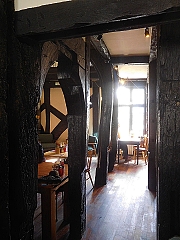
The Great Hall is one of the historical marvels of the city of Salisbury.  Its ceiling is supported by beams cut from old ships’ timbers. The Inn has been rebuilt several times. However, the beams that exist today include wood from trees that were felled in the mid-15th   century (www.buildingconservation.com/articles/george/inn_conservation.htm). Some of the walls are covered with wood panelling decorated with carvings and there are at least two elaborately carved wooden fireplace surrounds. Other decorative features include plasterwork covered with intricate bas-relief designs, and a lovely bow window overlooking the High Street. The hall is overlooked by a gallery with a balustrade. There is also a window with stained glass that includes a depiction of a royal coat-of-arms and the name of a king, probably Edward VI, who reigned from 1547 until 1553. According to the historicengland.org.uk website:

“On lst floor the south room has early C17 plaster work friezes on beams and carved wood overmantel. Projecting to east on north side open hall through 2 storeys. C15 hammerbeam roof, arched braces to collars. Heavy scissor bracing visible on 2nd floor lath decorated wall plates and spandrels. 2 rooms with tie beams and kingposts with 4-way struts.”

Over the centuries, The Old George Inn has had many visitors including William Shakespeare, Oliver Cromwell, Samuel Pepys, and Charles Dickens. It is believed that Shakespeare and his players, whilst on their way to Wilton, rehearsed “As You Like It” in the garden of the inn. Samuel Pepys spent one night at the inn but moved to another after having argued with the innkeeper over his bill.

Once upon a time, the Great Hall of the Old George Inn would have been filled with guests enjoying tankards of beer and ale and hearty meals. Today, in its reincarnation as The Boston Tea Party, the place is bustling with customers drinking cappuccinos and chai lattes as the consume trendy delicacies such as poached eggs on smashed avocado and ‘The Vegan Boss’. Whether or not you are thirsty or hungry, a visit to the Great Hall is a ‘must’ before or after you have viewed the cathedral.

At Liberty in London

BEFORE WE MARRIED in 1993, many of our kind friends wanted to give us wedding presents. A large proportion of them wanted to choose gifts from a ‘wedding list’. For those who are unfamiliar with this kind of list, let me explain. A ‘wedding list’ is a list of items, usually available from a shop chosen by the bride and groom, from which those wishing to give wedding presents can choose. As the items are bought, the shop removes them from the list so that the likelihood of duplicate purchases is reduced.

We were a little reluctant at first, but people insisted that it would be helpful if we compiled a wedding list. We chose to have our list at a shop that we both enjoy visiting: Liberty on Great Marlborough Street, very close to Regent Street.

Above an entrance to Liberty shop

From the outside, Liberty looks like an extremely well-preserved example of Tudor architecture, too good to be true. It is not because it was completed in 1924.

Liberty was founded by Arthur Lasenby Liberty (1843-1917), son of a draper. In 1875, he opened his own shop on Regent Street. According to the Liberty website (www.libertylondon.com), he wanted:

“… a London emporium laden with luxuries and fabrics from distant lands, his dream was to metaphorically dock a ship in the city streets. To this day, a voyage of discovery awaits on the good ship Liberty, with history hidden amongst six floors of cutting-edge design, unexpected edits and beautiful wares from the world’s greatest craftspeople. In 1875, Arthur borrowed £2,000 from his future father-in-law and took a building on Regent Street, London with just three dedicated staff and plenty of ambition.”

By the time that Liberty opened his shop, the British public was fascinated by Japan and other parts of Asia. In 1885, he brought 42 villagers from India and set up a temporary ‘living village’ of artisans in the shop.

The website added:

“Liberty’s collection of ornaments, fabric and objets d’art from around the world proved irresistible to a society intoxicated at the time by Japan and the East and Liberty effected social change in interior design and dress, so much so that the Art Nouveau period in Italy is called ‘Liberty Style’.”

Liberty died before his new shop was completed. Designed by Edwin T Hall and his son Edwin S Hall, it was built in the Tudor Revival style that achieved great popularity in the 1920s.  Not only is the shop’s exterior in the Tudor Revival style, but also its interior. A great dela of wood was used in the construction as the shop’s website revealed:

“… the builders Messrs Higgs & Hill were given a lump sum of £198,000 to construct it, which they did from the timbers of two ancient ‘three-decker’ battle ships. Records show more than 24,000 cubic feet of ships timbers were used including their decks now being the shop flooring: The HMS Impregnable – built from 3040 100-year-old oaks from the New Forest – and the HMS Hindustan, which measured the length and height of our Liberty building.”

Even if you do not wish to purchase anything from our long out-of-date wedding list, a visit to Liberty is rewarding not only to see the wonderful range of beautiful products on sale but also to narvel at the building and its many finely crafted decorative features.