Going Dutch in the fort at Bikaner

UNLIKE JAIPUR, JODHPUR, and Jaisalmer, the city of Bikaner in Rajasthan is not (yet) overrun with tourists. We have been in Bikaner for three days and apart from at the Junagarh Fort (Bikaner’s most significant historical attraction), we have seen only one European visitor. Bikaner differs from the three Rajasthani cities mentioned in the first sentence in that its streets are not lined with shops designed to attract tourists. Apart from the fort the rest of the city is a fascinating, busy working environment, which someone, like me, who enjoys observing everyday scenes of life in India, has plenty to see.

Many of the older buildings that can be seen in the streets of Bikaner have jharokas – decorative, stone-framed windows that project over the street. They are commonly seen features of the Rajput style of architecture and are still being constructed.

The Junagarh Fort is rich in jharokas. Many of them overlook courtyards within it. One of them is of great interest. From a distance it looked to me like it was decorated with blue and white tiling, like Portuguese azulejo work. Close up, it can be seen to be something else.

A huge consignment of Dutch blue and white Delft ceramic plates had been ordered for the royal family of Bikaner. When that was, I do not know. While they were being transported to India by sea, they were damaged, and arrived broken. Instead of throwing them away, the thrifty maharajah had them cut up to produce tiles, all of which bore details from the pictures that had decorated the plates. The tiles were then used to decorate both the inside and the outside of the jharoka overlooking a courtyard that contains an elaborate water feature: a pool with fountains.

Although there is much more to be seen in the fort, this example of repurposing broken plates intrigued me. The Junagarh Fort is definitely a must-see attraction in Bikaner, but it it is now merely a museum-like remnant of the past. Visitors to the city should see this, but also set aside at least a few hours to absorb the busy atmosphere of enterprise, both traditional and contemporary, in the older districts of Bikaner.

The azulejo tiling of Portugal is moving onwards

ONE OF THE CHARMING aspects of Portuguese culture is the use of the mainly blue and white decorative tiling known as ‘azulejo’. It can be found in Portugal and wherever else the Portuguese had colonies. One of the former colonies was Brazil. It was there that the artist Adriana Varejão was born in 1964 (in Rio de Janeiro). Today (the 11th of October 2024), at the Frieze Masters art show in London’s Regents Park, we saw a fine exhibition of her works in the booth set up by the Victoria Miro Gallery.

It was fascinating to see how Adriana subverts the azulejo, which was introduced to what is now Brazil by its Portuguese conquerors. Clearly inspired by the traditional tiling, her works both refer to it and distort the technique to create attractive, imaginative artworks that allude to the distortive effects of colonialism on indigenous culture.

I love seeing traditional azulejo. Seeing Adriana’s work was particularly enjoyable given that, to use a well-worn expression, ‘I know where she is coming from’. And I like the way that she has been moving the age-old art of azulejo into pastures new.

A MOSQUE IN ISTANBUL REMEMBERED, BUT ITS NAME FORGOTTEN

ON OUR LAST visit to Istanbul at least 15 years ago, we visited a small but attractive mosque in Üsküdar (the Asian part of Istanbul). During our present holiday in the city (in April 2024), we hoped to see this mosque again, but we had forgotten its name.

After having waited for the midday Friday prayers to be over at the Atik Valide Mosque, we looked around this edifice that was designed by the famous architect Mimar Sinan in 1583-1584. Incidentally, to reach this building, we climbed a steep staircase with 114 steps – a so-called short cut. Apart from its fine architectural form, the mosque is adorned with several lovely tiled plaques covered with Arabic calligraphy intertwined with the occasional flower.

As we were leaving the mosque’s enclosed compound, a man stopped us, and told us in broken English that we should visit another mosque in the neighbourhood. He said it had beautiful tiling, and it’s name is Çinili. When we heard the name, we remembered that was the mosque, whose name we had forgotten.

Çinili mosque

After climbing another hill, we reached the Çinili mosque. Completed in 1640, it is not as fine architecturally as buildings by Sinan. However, it’s interior is lined with intricately decorated tiling. Unfortunately, the mosque was locked up, but by peering through the windows we got a good impression of the magnificent tiling. The wall of the covered porch in which the main entrance can be found is also covered with beautiful tiling. What we saw was what we remembered from our first visit there at least 15 years ago. We were very grateful that a complete stranger reminded us of the name of the place that we remembered, but whose name we could not recall.

PS both mosques mentioned above were connected with a Valide Sultan – that is with the mother of a reigning Sultan.

Some Islamic figurative art in the Victoria and Albert Museum

THE VICTORIA AND Albert Museum (‘V&A’) in London’s South Kensington is one of my favourite museums. It contains a huge variety of exquisite artefacts. Some of them were obtained by fair means, and others, such as Tipu’s Tiger (an 18th century mechanical toy), by means that some might consider foul. I do not propose to write about the current discussions on the ethics of museum collections, but instead I will concentrate on some interesting tiles that arrived in the museum from Persia, where they were made during the Safavid Dynasty that was established in 1501 AD, and lasted until 1722.

The 36 tiles, arranged in 4 rows of 9, together depict a garden in which a lady is reclining with her 5 attractively dressed attendants around her, all wearing headgear: their uncovered faces are portrayed fully. This tiled panelling might have been originally made as part of an extensive architectural project in early 17th century Isfahan, the capital of the Safavid Dynasty. Other similar tiled panelling can be found in the Metropolitan Museum of Art in New York City, so wrote Farshid Emami in his paper “All the City’s Courtesans: A Now-Lost Safavid Pavilion and Its Figural Tile Panels” (published in the Metropolitan Museum Journal in 2019). The panel is shaped so that it could be fitted beneath a window.

The Safavid Dynasty was Islamic. Unlike many other groups in the Islamic world, which discourage or forbid figurative representation, the Safavid rulers, who were great patrons of the arts, developed a dynastic artistic style in which the depiction of human figures played an important role. The tiles that are on display are a fine example of this. According to the V&A’s website (https://collections.vam.ac.uk/item/O93167/tile-panel/) these tiles were:

“Bought from L.S. Myers, 6 Savile Row, for £275…”

Myers & Co, which flourished at the above-mentioned address in the 19th century, usually dealt with prints. “A Biographical Dictionary of Nineteenth Century Antique and Curiosity Dealers” by MW Westgarth (publ. 2009) revealed:

“Abraham Myers (born c1815/16) traded as a curiosity dealer in Old Bond Street and at New Bond Street, London, from the 1850s. Myers is listed as ‘antiquary dealer’ at 179 New Bond Street in Kelly’s Directory, 1878 and 1886 and at 6 Savile Row in 1886–91.”

So, assuming that LS Myers was associated with this firm, the tiling might well have been bought between 1886 and 1891.

Every visit to the V&A, which might take much of a lifetime to explore fully, is exciting because each time I visit the place, I discover something fascinating, which I had not noticed before. These tiles are no exception to this.

Roof ornaments in Funchal, Madeira

MANY ROOFS IN FUNCHAL are covered with terracotta tiles. Quite a few of these roofs have small sculptures on their corners. Many of them depict heads, birds, and scrolls ( leaves?) I have no idea why these things are added to the roofs.

Someone suggested that these ornaments are supposed to deter mice, squirrels, and birds. Maybe, they are for that purpose. In India ornaments depicting ogre’s faces (‘rakshasa’) are atteched to roofs to ward off the Evil Eye. Possibly, this is a finction of the ornaments I have seen in Funchal. Another possible function of these roof ornaments (finials) might be to distinguish one house from another. However, I am not sure about this here in Funchal because there is little variety in the firms used.

I would love to know more about them: their purpose and history.

The way to the summer ballroom

HOLLAND HOUSE IN Holland Park was badly damaged by aerial bombing during WW2. What is left of the building shows that it must have been a splendid Jacobean palace. It stands on the estate of Sir Walter Cope (c1533-1614), for whom it was originally constructed. In his time, the estate extended south from what is now Holland Park Avenue almost to what is now Fulham Road.

Although much of Holland House was destroyed in the War, many of its out-houses still stand today. Amongst these are the icehouse with its conical roof; a disused dairy; a stable block which now houses a Parks police station; and an orangery, which is attached to what was once the summer ballroom.

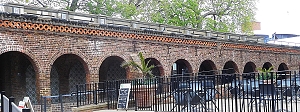
A covered arcade, open to the outside on one side, runs from where the southwest corner of the house used to stand, passing near the icehouse, to the southeast corner of the orangery. In poor weather, this long covered passageway was used by house guests moving between Holland House and its summer ballroom. From the western end of the passageway, they would have had to walk through the orangery to reach the ballroom. In fine weather, those attending balls would have walked along the walkway above the covered passage. In places, this runs past walls covered with colourful tiled panels, made in Florence (Italy), which were placed there in the 1850s. The wall of one stretch of the covered walkway, the section nearest to the orangery, are painted with scenes depicting an imaginary garden party held sometime in the 1870s. They were created between 1994 and 1995 by the artist Mao Wen Biao (born 1950).

Currently, the former summer ballroom is being restored. For many years, it was home to The Belvedere restaurant, a pricey establishment. When the restoration of the ballroom is complete and its former glory restored as much as possible, it will be used to house a new Italian restaurant, which is planned to be more affordable than its predecessor.

Over several decades, we have made innumerable visits to lovely Holland Park, but had not realised that the arcade described above was anything but decorative. Today, we met Jenny Kettlewell, who is the Chairman of the Friends of Holland Park. It was she who revealed its purpose. Currently (2nd to 10th of April 2022), there is an annual art exhibition in the orangery. The works on display are by local artists.