THERE IS A NIGERIAN woven fabric called ‘sanyan’. Made mostly by the Yoruba people, its principal ingredient is a type of wild silk. The fabric is thick and resembles denim or canvas in texture. Strips of sanyan are sewn together to make garments and other items. During a recent visit to the Hastings Contemporary Art Gallery, which stands close to the seashore, we saw an exhibition of paintings made on sanyan cloths.
The creator of these images is Nigerian born Nengi Omuku who was born in Lagos (Nigeria) in 1987. It is there that this artist, who trained at the Slade School of Fine Art in London, now works. Before becoming an artist, Nengi worked in her mother’s florist shop, eventually coming into contact with art when she began making preparatory drawings for customers’ garden planning.
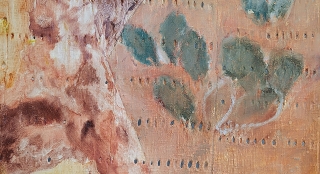
Nengi’s exhibition at Hastings is called “The Dance of People and the Natural World”and is on until the 3rd of March 2024. The artist took large sheets of sanyan fabric, consisting of strips of sanyan sewn tightly together, and then coated them with a gesso ground. When this was ready, she then used oil paints to create images. Whether it was her painting technique or some property of the material upon which she applied the colours, the resulting images have a uniquely haunting, other-worldly quality that I have not seen in other artists’ works.
The paintings are well displayed. They have been hung away from the walls so that one can look at their backs. By looking behind the paintings, you can see the stitching that holds the pieces of sanyan together as well as beads of the gesso ground that had oozed between the adjoining strips. By looking closely at the paintings, the joins between the constituent strips of sanyan can easily be detected (see photograph above). These create an interesting surface texture quite unlike the canvas usually used by painters.
I enjoyed the exhibition not only because the artwork was attractive but also because I became aware of an interesting fabric, which is in common use in Nigeria.


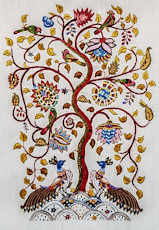 PONDICHERRY IS RICH in wonderful attractions, many of them souvenirs of its French colonial past. One of the most delightful of these is the Cluny Embroidery Centre on Rue Romain Rolland, a street named after a French writer and Nobel Prize winner who met Gandhi and was sympathetic to India and its philosophies.The Embroidery Centre is housed in an 18th century French Colonial building (a former residence, which was built by 1774) that forms part of a religious centre under the aegis of the Order of Cluny. It is believed that one of the former owners of the house donated it to help poor women in need. This must have been before 1829, when the Embroidery Centre was established. Every day except Monday and Sunday, at least twenty women of various ages arrive at the centre and take their places at tables in a large room with tall windows that open out into a verandah supported by neoclassical pillars and decorated with elaborate stucco bas-reliefs. The verandah looks out onto a courtyard surrounded on three sides by other buildings, parts of the convent, and the outer wall with a decorative entrance gate.This ensemble of buildings forms only part of a much larger complex of buildings, some of which surround another courtyard filled with a garden.After singing what sounds like a hymn, the women begin working on their elaborate embroideries. They stitch according to patterns designed by artists who work at the centre. While they work away silently with needle and thread, a simple sound system provides background music at a low volume.Dressed in white habit, Sister Agatha, who runs the convent, watches over the ladies at work and organises the sales of their labours to visitors who step into this peaceful sanctuary a few feet away from the noisy outside world.The resulting products are exquisitely beautiful. They embroider everything from coasters to handkerchiefs to napkins to pillowcases to table cloths and bedcovers. Visitors to the centre can purchase these treasures of fine needlework. Or, customers can place orders for specific items they need. The women who embroider at the centre get paid on a piecework basis. Some of them have had a history of mistreatment before joining the centre. Visiting the Cluny Embroidery Centre is a moving experience. It provides a very good example of how a religious order can work for the benefit of the ‘common’ folk.
 yamey
yamey 