An alarming purchase at a supermarket in London

A TRUE STORY

I entered one supermarket and purchased a bottle of gin. I paid for it, and as I left the store, the alarm rang. I ignored it. Nobody stopped me.

I took a bus to another area, where I  entered a different supermarket.  Once again, as I  left the store, nobody, not even the store’s security guard, stopped me.

When I got home, I  discovered that the anti-theft device had been left on my bottle. It should have been removed when I paid for the gin.

I tried removing the tag, which was tied to the neck of the bottle with tough metal cable. I realised that without breaking the glass bottle,  I would not be able to reach the gin.

In the end, I  retraced my steps and returned to the shop, which was a 10 minute bus ride away. I explained what had happened, showed the shop assistant the receipt, and demanded a fresh bottle, but with the security tag removed.

This episode made me wonder why so much effort is put into protecting goods when the security officials at the supermarkets take so little heed of their alarms when they are set off.

They must be expecting riot and insurrection at Amazon Fresh during the carnival

DURING THE NOTTING Hill Carnival, always held during the last weekend of August, some homes, shops, and other businesses in the area where it is held or along the routes leading to it, take precautions to prevent their properties being damaged by over exuberant (i.e., drunk, drugged, or violent) revellers. Usually, the preventative measure taken is the erection of wooden boarding, which is usually soon covered with colourful graffiti.

The recently opened Amazon Fresh supermarket in Notting Hill Gate has taken things much further. Not only have they put up wooden boarding (upmarket quality compared with what other businesses use), but behind it they have placed huge concrete blocks such as are usually used to make temporary barriers to protect workers from being hit by fast moving traffic while they are doing repairs on busy motorways. Furthermore, these heavy blocks have been encased in sturdy metal cages. And to prevent things from being lobbed over the top of this recreation of the Berlin Wall, netting has been placed. The weak points in this anti-insurrection barrier are gaps in it for the entrance and exit. No doubt, tough security guards will be stationed at these vulnerable positions, but would they be prepared to risk injury and the wrath of a mob simply to save the paltry selection (compared with other nearby shops) of wares sold in the shop? Finally, I wonder whether the cost of the precautions taken will be outweighed by the profits that this now unwelcoming-looking, fortress of a shop might hope to make.

A lovely garden just east of a huge supermarket in North Kensington

IF YOU WALK EASTWARDS from the canal side of Ladbroke Grove’s huge Sainsburys supermarket, the towpath alongside the Grand Union Canal (Paddington Arm) next runs alongside Meanwhile Gardens. There are several apertures through which one can enter the gardens from the towpath, and you can also gain access to the place from the streets that surround it.

In my book “Beyond Marylebone and Mayfair: Exploring West London” I wrote:

“In 1976, the Meanwhile Gardens were conceived as a green space for the local, then generally low-income, mixed-race community, by Jamie McCollough, an artist and engineer. They were laid out on a strip of derelict land, which once had terraced housing and other buildings before WW1. The garden received financial assistance from the Gulbenkian Foundation and other organisations. The garden was, according to circular plaques embedded in its pathways, improved in 2000.

The Garden and the Sainsbury supermarket are in a part of London that used to be known as ‘Kensal Town’. Residential buildings began appearing in the 1850s and many local people were employed in laundry work and at the gasworks of the Western Gas Company that was opened in 1845. In the 1860s and 1870s, there was much housebuilding in and around the area now occupied by Meanwhile Gardens.Golborne Road was extended to reach this area in the 1880s. Many of its inhabitants were railway workers and migrants, whose homes in central London had been demolished. The area was severely overcrowded and extremely poor. Few houses had gardens and the population density was high.

After WW2, many of these dwellings were demolished and replaced by blocks of flats, including the impressive, Brutalist style Trellick Tower (designed by Ernő Goldfinger [1902-1987], opened in 1972) and smaller but salubrious shared dwellings.

A winding path links the various parts of the lovely garden including a sloping open space; a concrete skate park; a children’s play area; several sculptures; small, wooded areas; some interlinked ponds with a wooden viewing platform; plenty of bushes and shrubs; bridges; and a walled garden that acts as a suntrap. Near the latter, there is a tall brick chimney, the remains of a factory. The chimney was built in 1927 near to the former Severn Valley Pure Milk Company and the Meadowland Dairy. It was the last chimney of its kind to be built along the Paddington Arm canal and is completely dwarfed by the nearby Trellick Tower.

The Moroccan Garden, an exquisite part of the Meanwhile Gardens, was opened in 2007 by Councillor Victoria Borwick on behalf of the local Moroccan community. It celebrates the achievements of that community and is open for all to enjoy. A straight path of patterned black and white tiling leads from the main path across a small lawn to a wall. A colourful mosaic with geometric patterning and a small fountain is attached to the wall, creating the illusion that a tiny part of Morocco has been transported into the Meanwhile Gardens. Nearby, there are a few seats for visitors to enjoy this tiny enclave within the gardens.

Words are insufficient to fully convey the charm of the Meanwhile Garden, one of west London’s many little gems. If you can, you should come to experience this leafy oasis so near the busy Harrow Road.”

If this short extract from my book that explores parts of west London – both familiar and unfamiliar – head for Amazon, where you can buy the book as a paperback and as a Kindle:

https://www.amazon.co.uk/BEYOND-MARYLEBONE-MAYFAIR-EXPLORING-LONDON/dp/B0B7CR679W/

Poetry and a Chinese supermarket

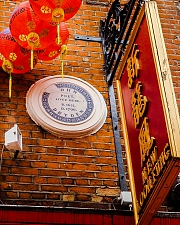
GERRARD STREET IS THE HEART of London’s Chinatown. We often visit it to eat delicious dim-sum and other dishes at our favourite restaurant, The Golden Dragon, which has both indoor and covered outdoor dining spaces. One of our favourite dishes, which was introduced to us many years ago by my sister, is steamed tripe with chilli and ginger. It might sound off-putting, but, believe me, it tastes wonderful. Our visits to Gerrard Street always include a visit to Loon Fung, a Chinese supermarket. This well-stocked establishment bears a commemorative plaque that I only noticed for the first time today (12th August 2021). Partially hidden by a string of Chinese lanterns, it informs the passerby that the poet John Dryden (1631-1700) lived on the spot where we purchase pak-choi, chilli sauce, black bean paste, and a host of other ingredients for preparing Chinese-style dishes at home. I suspect that Dryden was unlikely to have ever come across any of these exotic ingredients back in the 17th century.

According to the English Heritage website (https://www.english-heritage.org.uk/…/blue…/john-dryden/):

“Dryden lived at 44 Gerrard Street with his wife Elizabeth (c. 1638–1714) from about 1687 until his death in 1700. His years there were difficult: his conversion to Catholicism in about 1685 meant that he was unable to take the oath of allegiance after the Glorious Revolution of 1688. As a result he lost his position as Poet Laureate, one he had held for 20 years. He found himself in financial difficulties but remained highly active in London’s literary world.Dryden usually worked in the front ground-floor room of the house, and it was here that he completed his last play, Love Triumphant (1694), the poem Alexander’s Feast, or, The Power of Musique (1697) and translations such as The Works of Virgil (1697). In the preface to the latter, Dryden likened himself to Virgil in his ‘Declining Years, struggling with Wants, oppress’d with Sickness’…

… Number 44 was built in about 1681 and re-fronted in 1793, before being redeveloped in about 1901. At the same time number 43 was demolished, a deed described in the press as ‘a hideous and wonton act of vandalism’ …

… The plaque, though damaged, was immediately re-erected on the new structure. It is unique among surviving Society of Arts plaques in its colour – white, with blue lettering.”

Well, I can add nothing to that informative quote. So, ext time you wander along Gerrard Street do look for this and other reminders of the area’s history. It was a place where several other well-known writers and artists resided several centuries ago.

Dining in a church

A FRIEND INVITED us to dine one evening at the exclusive Mosimann’s Club in West Halkin Street in London’s elegant Belgravia district. As it was dark when we arrived and I was too busy chatting with our host, I failed to notice the exterior of the establishment. Years later, I noticed that the narrow façade of this fancy eatery, named ‘The Belfry’, is that of a Victorian gothic church with a slender spire.

The church was being used by the Presbyterians in 1866, so wrote Edward Walford in the 1880s. The website of The London Metropolitan Archives catalogue reveals more:

“…a chapel was built on Lower George Street, called the Ranelagh Chapel. In 1845, on the death of the Methodist minister, the church joined the English Presbyterian Church and was renamed Ranelagh Presbyterian Church. The lease on the Lower George Street chapel expired in 1866 and the church merged with a Presbyterian Mission in West Halkin Street, Belgrave Square. The name Belgrave Presbyterian Church was adopted. The church was rebuilt in 1881. In 1923 the church moved to premises in Emperor’s Gate, Kensington.”

The former church is an unusual structure in that the end facing the entrance is considerably wider than the façade. As to when it was originally built, I am uncertain. Nikolaus Pevsner, the architectural historian, does not give it a mention in his extremely detailed guide to the buildings of the City of Westminster in which it is located. However, he does mention the chapel’s neighbour, to the left of it as you face the façade. Far more attractive than the chapel is the façade of its neighbour which is decorated in a neoclassical style. It has two porticos supported by pillars with Doric capitals. This building was built in about 1830.

Today, the Doric pillars flank entrances to a branch of Waitrose food stores. This shop also has an entrance on the street parallel to West Halkin Street, Motcombe Street. Thus, two temples of food stand side by side. If you cannot afford to dine in the former church, then you can console yourself and appease your appetite by acquiring something edible in Waitrose by stepping between the Doric pillars. In case you are wondering what we ate at Mosimann’s, I am afraid I cannot recall as it was so long ago, but I do remember enjoying it.

Long lasting

A bunch of flowers

Brings endless happiness

And plenty of  good cheer


Back in the early 1990s when I was practising as a dentist in Kent and owned a house in Gillingham, my future wife and I visited the local superstore, the Savacentre. Its name has nothing to do with the River Sava that meets the River Danube near Belgrade in Serbia. The shopping mall in Kent is pronounced “saver-centre”.

We wanted to buy some flowers and approached a florist within one of the wide corridors of the mall. He had some blooms of a kind we had never noticed before. We asked him what they were, and his answer sounded like “owlstromeriya”.

We bought a bunch of these attractive flowers and asked him how long we should expect them to survive in a vase. He answered:
“No worries there. They’re good lasters.”

And, he was right.

Alstroemeria, or Lily of the Incas, are native to South America but I guess many of those on sale in the UK are grown elsewhere.