
Some things never seem to change

DURING THE 1970s and 1980s, we used to make visits to a restaurant in north London’s Willesden Lane. Founded in 1964 and specialising in South Indian cuisine, it was called Vijay. It still exists at the same address. Out of curiosity and ‘for old times’ sake’, we paid it a visit last night (the 29th of February 2024).

Entering Vijay was like stepping back in time. It was uncanny; nothing seemed to have changed. The walls are still lined with raffia work panelling, the wooden Kerala-style ceiling, and the pictures on the wall (mostly colourful depictions of Hindu deities) looked exactly as we remembered. Naturally, none of the staff were recognizable.
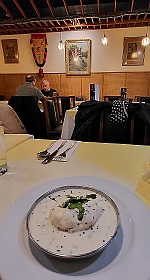
Back in the ‘70s and ‘80s, we used to eat at Vijay to enjoy South Indian dishes that were not easy to find elsewhere in London. If I remember correctly, in those days Vijay only had this kind of food on its menu. Today, the menu still has South Indian dishes, but also many offerings of food that is definitely not typical of South India. It offers a wide selection of North Indian dishes – such as most British people would hope to find in an ‘Indian restaurant’. One of the hors d’oeuvres, which you would never find on India, but is common in British Indian restaurants is fried pappads (poppadums) served with a  tray of chutneys and pickles to accompany them, Vijay now offers this. Probably, Vijay has added North Indian dishes to their menu because, for many potential customers, South Indian dishes are far less familiar.

Yesterday, we ordered a few dishes. They were enjoyable enough but not outstanding, However, it was great fun sitting in a place that had hardly changed since we last visited it at least 30 years ago.
Beverages beneath the banyans

ONCE A CITY FILLED with lovely gardens and other verdant open spaces, Bangalore (Bengaluru) is growing alarmingly rapidly. So, public spaces that have been as yet saved from being built on are valuable amenities. One of these areas of greenery is the so-called Tivoli Garden, which is in the grounds of Airlines Hotel in the heart of the city.

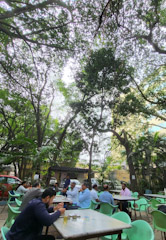
Known popularly as ‘Airlines’, the Tivoli Garden, a name by which it is hardly known, has tables and chairs set out in an open space, a clearing, surrounded by trees, several of them being elderly banyans.

Opened in 1969, the open air café and eatery is still supervised by a man who helped set it up two weeks before it opened all those years ago. Despite its rather untrendy appearance, Airlines is popular with Bangaloreans of all ages. Quite a few of them are students, but many are office workers. Very good South Indian filter coffee is served at Airlines. A wide range of South Indian vegetarian dishes is also served.

The coffee, other drinks, and food are prepared in the kitchen of the hotel. Waiters in white uniforms carry drinks and food across the car park from the kitchen, which is located at the far end of a dingy dining hall, to the garden seating area. Some customers prefer to have their orders served to them whilst sitting in their parked cars.

For my wife and me, Airlines has several attractions. One is the coffee. Another is the pleasant ambience under the trees. And yet another is nostalgia. My wife used to visit Airlines with her family in her late teens. And together with our daughter, my wife and I have been regular visitors to Airlines since when we married in 1994.

For several years, Airlines has been under threat of closure by the people who own the land. Over a decade ago, these people reclaimed half of the area occupied by the café. They built an ugly grey wall (rather like a Berlin Wall) to separate what is left of Airlines from what has now been built on. The supervisor, whom we have known for ages, assured us that as far as he knows the remaining part of the establishment will remain safe from redevelopment.

It would be tragic if Airlines were to disappear, not only because we love it but also it would be yet another example of how what was once a lovely garden city is becoming more and more of an urban jungle

Filter coffee

South Indian filter coffee is wonderful. Here is how it is prepared. First coffee powder is placed in the upper chamber of a cylindrical metal vessel with a finely perforated base. Hot water is poured on it. Then, the water slowly filters through the powder to produce an intensely strong, undrinkable filtrate, known as ‘decoction’. This filtration takes many hours.

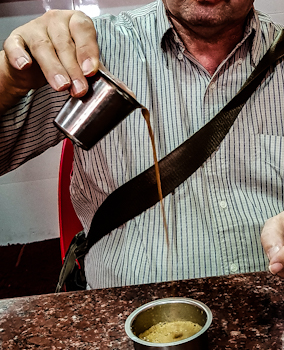
The coffee-maker ladles some decoction into a vessel, often a stainless steel beaker. Then, he or she fills the rest of the beaker with freshly boiled milk (With or without sugar).

If you want your coffee without sugar, ask for “sugarless”.

The coffee cup comes with a deep saucer. To cool the coffee, you pour the coffee from the beaker to the saucer and vice versa.

Then, ENJOY!