A Boer officer in Bangalore 1901

GEORGE GLAESER MUNNIK was a  Boer  during the first Anglo-Boer War (1899-1902). He was captured by the British and imprisoned in the south of India. During his time in India, he was taken to Bangalore briefly and was put up in the West End Hotel.

In his autobiography,  Munnik recalled:

We arrived in Bangalore early in the morning and went to the West End
Hotel. This hostelry stands in extensive grounds and consists of about
half-a-dozen bungalows, each a hundred yards apart and holding six
visitors; each has its own cook, butler, etc…

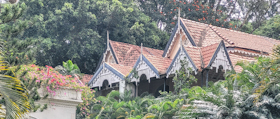
The hotel still exists and is one of the finest in Bangalore. Although enlarged since Munnik stayed there, it stands in beautifully maintained grounds.

To discover why the British took this POW from his prison camp to a deluxe hotel in  Bangalore, you will need to read my book “Imprisoned in India”.  It is available as a kindle from Amazon: https://www.amazon.in/IMPRISONED-INDIA-South-African-Bangalore-ebook/dp/B07Z2S4V3P/     

OR  as  a paperback from: https://www.lulu.com/shop/adam-yamey/imprisoned-in-india/paperback/product-1y5j98em.html?q=Yamey&page=1&pageSize=4

Two barristers from South Africa stand together in central London

A FEW MONTHS AFTER Mahatma Gandhi was born in India in October 1869, Jan Smuts was born in South Africa’s Transvaal Republic (in May 1870).

In 1893, the young barrister Mohandas K Gandhi, the future ‘Mahatma’, arrived in Durban, South Africa, from Bombay. This was the year before Smuts graduated in law at Christ’s College in Cambridge, England. After passing the Bar examinations in late 1894, he returned to South Africa, where he became involved in politics.

Gandhi remained in South Africa from 1893 until 1915. During his time there, he practised law as a qualified barrister, fought for the rights of Indians in the country, and gradually developed his non-violent approach to protest, which he later practised during the struggle to free India from British domination. During the Second Anglo-Boer war (1899-1902), Gandhi assisted the British with caring for casualties. Meanwhile, Smuts fought with his fellow Boers.

After that war, Smuts was involved with negotiations that led eventually to the union of the four territories, which then became unified as the South Africa we know today. In 1914, the First world War broke out. Smuts fought for the British, most notably in what was then German Southwest Africa, now Namibia. Meanwhile, in 1915 Gandhi returned to India, and the rest is history.

Both Gandhi and Smuts are commemorated by statues in London’s Parliament Square. They stand near each other, but not next to each other. Jan Smuts stands on the north side of the square, and is depicted as striding towards Westminster Abbey. Mahatma Gandhi stands on the east side of the square quite close to the statue of another South African, Nelson Mandela. Gandhi appears to be gazing at the Houses of Parliament.

Seeing those statues standing in the same square today made me wonder how, if at all, Gandhi and Smuts felt about each other. I found an article in a website called “The Observation Post”, which helps understand their relationship. Here are some quotes from it:

“It’s a common misconception that Jan Smuts and Mahatma Gandhi’s relationship was one of animosity. It is a little known fact that both men actually respected each other, remaining life long admirers of one another … Gandhi tried, at all times, to look for the positive in Smuts and said of him that he had a ‘high place among the politicians of the British Empire and even of the world’.”

When Gandhi was about to leave South Africa in 1915, he sent Smuts a pair of sandals that he had made at Tolstoy Farm, a cooperative colony he set up near Johannesburg, from which he ran his campaign of satyagraha (non-violence). Smuts wore these every day when at his farm, and is recorded as having said on Gandhi’s seventieth birthday:

“I have worn these sandals for many a summer, even though I may feel that I am not worthy to stand in the shoes of so great a man.”

A BOOK FROM A LIBRARY IN SOUTH AFRICA AND AN ANCESTOR

IN AUGUST 2003, we spent a day in Aliwal North (now called ‘Maletswai’). This small town on the northern border of South Africa’s Eastern Cape Province is not on many tourists’ itineraries. We went there for a special reason. It was originally named after the Battle of Aliwal (1846), a British victory during the First Anglo-Sikh War.

The town was laid out in 1849. When this happened, the Jewish mercantile firm, Mosenthals, opened a branch in the newly established town. After a few months, they sent a young man, Heinrich (later ‘Henry’) Bergmann (1831-1866), to manage the new store and to help sell land in the embryonic township. Very rapidly, Bergmann became one of the most prosperous people in Aliwal North. He owned much land and managed a bank in the town. Soon, he was so successful that he took over the town’s other two banks. For reasons that are not altogether clear, but they might have had something to do with a financial problem, Bergmann shot himself. Having committed suicide, neither the small Jewish cemetery nor the Christian one was prepared to bury him. In the end, his friends the De Wet family, who farmed in the district, buried him in their private family cemetery, and that is where we saw his gravestone when we visited Aliwal North in 2003.

Henry Bergmann was my mother’s grand uncle.

Arriving in what was then the Cape Colony in 1849, he was the first member of my family to migrate from Germany to southern Africa. He was also amongst the small number of Jewish people who came to that part of the world in the first half of the nineteenth century. The majority of Jewish migrants to what is now South Africa began arriving after the late 1860s, as I have described in my book “Exodus to Africa”.

We visited Aliwal North in 2003 as part of my research into the life of Henry Bergmann. Apart from meeting members of the De Wet family, descendants of those who buried Bergmann, who showed me family histories containing details of my ancestor’s life and fields that were once owned by him, we spent some time with Mrs Joubert, the librarian of Aliwal North’s public library. She was extremely helpful and took a great interest in my research.

Aliwal’s library was selling a few books that were no longer needed. My wife bought a few novels, one of which was “Mr Mirakel” by E Phillips Oppenheim (1866-1946). The book we bought contains the words: “First printed  … 1943”. It is a first edition. Inside the book, there are labels inserted by the library. They are printed both in English and Afrikaans. There are also four imprints of an inked rubber stamp. Each one reads: “Aliwal North. Public Library. Cape of Good Hope.”

Just before 1910, when the Unification of South Africa occurred, what had been known as the Cape Colony became known as ‘The Cape of Good Hope Province; (‘often shortened to ‘the Cape Province’). In 1994, this vast territory was divided into the Northern Cape, Western Cape, and Eastern Cape provinces. Given that the book can only have been acquired in or after 1943, the words ‘Cape of Good Hope’ on the stamp intrigued me. Although they do refer to a geographic entity, they have never, as far as I can see, referred to an administrative area, and did not do so on or after 1943 when the book was published.

Had we not been sorting out our books recently, we would not have come across the book from Aliwal North. Seeing it and its library labels and stamps brought back memories of our visit to Aliwal North 22 years ago.

Norfolk is a great distance from South Africa

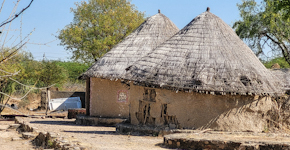
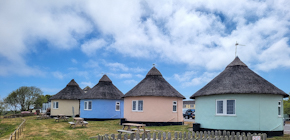
WHEN I WAS LESS than 8 years old,  my uncle and aunt took their young daughter and me to the Norfolk coast. We travelled there by car in their Citroën. All that I can remember of this holiday was that we stayed in a circular cottage wirth a conical thatched roof. It was like what in South Africa is called a ‘rondavel’.


The rondavel  we stayed in was not in South Africa but at Winterton-on-Sea on the coast of Norfolk. The resort, which still exists and was fully booked when we paid a brief visit in May 2025, is called Hermanus is the name of a popular seaside resort on the south coast of the Cape Province of South Africa.


Although the Hermanus resort at Winterton-on-Sea changed hands about 50 years ago, its original owners were South Africans. And because my aunt was born in South Africa,  it was likely that this resort in Norfolk was chosen for a short break because of its South African owners and the rondavels.

Do not throw it away because it might become valuable one day

AFTER MY DAD’S father died, his mother remarried Isaac, a merchant, who lived and worked in Port Elizabeth (South Africa).

In his holidays, both school and then later university, Dad, whose father had owned a general store (in Tulbagh, South Africa), helped his stepfather in his shop in Port Elizabeth. Once again, he was in an environment where he was acquiring first-hand experience of the workings of commerce, one of the foundations on which the study of economics is based. By all accounts, including the fact that Isaac could afford regular holidays in Europe, the business prospered. Dad told me that during his vacations, he used to help Isaac compile annual inventories of his stock.

The shop owned by my father’s father in Tulbagh

One day, Dad came across many large glass bottles filled with boiled sweets that had become unsaleable because the candies had fused together to form huge masses. My father asked Isaac whether these bottles should be thrown out. He was told that they were to be retained. A few years later, WW2 broke out and there was a shortage of glass. Isaac sold the bottles filled with inedible sweets because the glass, now valuable, could be sold (for recycling) during the glass ‘famine’.

Was it experiences in his father’s and stepfather’s shops that might have led him to eventually become a professor of economics, and helped him to understand the concept of futures markets? I wonder.

An artist from South Africa and a civil war

DURING THE ANGOLAN civil war (1975-2002), many Angolan families were forced to flee to South Africa.  The parents of Helena Uambembe, who was born in South Africa in 1994, were amongst those who were forced to leave Angola. Her father was coerced to join the South African Defence Force (‘SADF’), which was engaged in fighting in southern Angola during the period when the Apartheid regime was still in power.  He was enrolled in the 32 Battalion of the SADF.

Until 20 March 2025, there is an exhibition of art works by Ms Uambembe at the Goodman Gallery in Mayfair’s Cork Street. Her intriguing and somewhat terrifying works are on paper, canvas, and cloth. The drawings on display show her interest in the kind of posters used to attract young people into joining the military. I felt that these pictures illustrated the fearsome nature of serving in the military, rather than its attractions.  A large cloth work with images printed on it depicts the loss of self-identity or individuality that members of the military must undergo.

The small exhibition is visually exciting, of interest historically, full of angst about the war in Angola and now elsewhere, and well worth visiting.

Bringing a forgotten artist out of the shadows

THE BEN URI Gallery and Museum began its life in 1915 as a place where Jewish immigrant craftsmen and artists could exhibit their works. At that time, mainstream British artistic institutions were reluctant to include artists from recently arrived minority immigrant communities. Things have moved on a long way since then, and the organisation no longer confines itself to Jewish artists. Ben Uri’s remit:

“… has expanded to include relevant works by immigrant artists to the UK from all national, ethnic and religious origins, who have helped to enrich our cultural landscape.” (https://benuricollection.org.uk/)

My mother, the painter and sculptor Helen Yamey, was born in South Africa, and came to England in 1948. She was an immigrant artist.

When I was researching her life to write her biography, I discovered something about her which I had not known before. It was that during the first half of the 1960s, her sculptural work was chosen to be exhibited in several prestigious exhibitions. She exhibited alongside now famous artists such as Elisabeth Frink, Anthony Caro, David Annesley, Eduardo Paolozzi, Menashe Kadishman, William Tucker, Phillip King, David Hockney, Henry Moore, Barbara Hepworth, Paula Rego, Bridget Riley, Duncan Grant, and Jean Arp. As a youngster in the early 1960s, I was unaware that my mother’s work was rated as highly as those with whom she exhibited. It was only when writing her biography to accompany some photographs of her work, which had recently come into my possession, that I realised that although she was now forgotten by the art world, she had achieved something quite significant in the artistic world of the early 1960s. Having learned this about her artistic prowess, I discussed the matter with my daughter, who is a curator and a historian of art. In turn, she mentioned it to the current director of the Grosvenor Gallery in Mayfair. He suggested that I should contact the Ben Uri to find out whether they had any information about my mother.

The Ben Uri had no material about my mother, and were interested when I sent them information about her association with the Sculpture Department of St Martins School of Art and the exhibitions in which her work was shown. They decided to add her to their already extensive database listing immigrant artists from of 100 countries. After donating a copy of my book to the Ben Uri’s research library and having been interviewed by one of the organisation’s researchers, they added my mother, a long-forgotten sculptor, to their database. In addition, the researcher, Ms Milcic, has added an 800-word profile of my mother and her art to one of their websites. It can be read online here: https://www.buru.org.uk/contributor/helen-yamey- . This webpage also gives links to a site where some pictures of my mother’s sculptures can be viewed.

It gives me great satisfaction that my mother’s works, which had become largely forgotten, have at last been given some of the prominence they deserve. The reasons why she became forgotten and many other details about her life can be found in my recently published book “Remembering Helen: My Mother the Artist” (available from Amazon: www.amazon.co.uk/REMEMBERING-HELEN-MY-MOTHER-ARTIST/dp/B0DKCZ7J7X/)

Some old baggage discovered in an attic and a Roman toga

WHEN MY FATHER sold our family home in Hampstead Garden Suburb in the early 1990s, he gave some of his unwanted possessions to some neighbours, who still live opposite. They stored much of it in their attic. Recently, a plumbing problem required them to empty the attic. Soon after this, we paid them a visit as we had not seen them since before the start of the covid19 pandemic and its associated lockdowns. Amongst the stuff they removed from their attic, they found a sturdy, brown leather suitcase in a well-worn canvas protective covering. The covering was stencilled with the letters ‘BSY’, these being my father’s initials.

The canvas case bears an oval label, which was provided by the “Holland-Afrikalijn”. It states that the suitcase was “For the cabin” and the name of the ship’s destination was “Southampton”. The ship carrying this case was the “Jagersfontein”, and the label bears the date “3/9/55”, There is another torn label, which was issued by South African Railways and what is left of it is “T Elizabeth”, which probably was “Port Elizabeth” before it was torn. This suggests that the case must have travelled to and/or from Port Elizabeth by rail. A third label, which is circular and was stuck on by the shipping company bears a large capital “Y”.

By September 1955, I was three years (and a few months) old. That year, my parents, who were born in South Africa, took me from London, where we lived, to be shown to family and friends in that country. I remember almost nothing of that visit apart from two things. One of them was getting my small foot caught in the groove of the tram-like track of a mobile dockside crane. The other thing was being afraid of the cacti in a greenhouse in a park in Port Elizabeth, the city where my father’s sister and his mother resided.

I know that we also visited King Williams Town, where many of my mother’s family lived. This visit was recorded in a 1955 issue of the town’s “Cape Mercury” newspaper. I discovered it while I was researching information about my mother’s grandmother, who lived in the town. The newspaper article, which is full of small inaccuracies, described me as being “… an adorable little son, aged three …”.

The Jagersfontein has an interesting history (http://ssmaritime.com/fontein-ships-1.htm). Built in Danzig (Germany) in 1939 and given another name, it was badly damaged during WW2, and it sunk. In 1947, she was recovered from the sea, towed to Holland, and refurbished by the Dutch. In September 1947, she began sailing again, as a passenger-cargo liner.

During the voyage from Southampton to South Africa, I crossed the Equator for the first time in my life. My mother told me that when the ship carrying us crossed the Line, a fancy-dress party was held for the children onboard. Some of the parents knew that this would happen and had come prepared with fancy-dress costumes for their children. However, my mother was unaware that this would happen. Being a creative person, she took some of the white bed linen from our cabin, and fashioned a Roman toga for me to wear at the party.

My mother died 44 years ago. Only a few days before we saw the suitcase at our old neighbours’ home, I was rummaging through some photographs that I had not seen since her death. It shows me in my rapidly fashioned bedsheet toga, standing between two larger children dressed up to depict Belisha beacons (that mark so-called ‘zebra’ pedestrian crossings). A small cloth with black and white stripes, representing a zebra crossing, separated the two beacons. Behind the three of us are some adults, whom I cannot recognise.

Empty, the leather case, which looks almost new, weighs 6.3 kilogrammes (13.9 lb). In 1955, passengers travelling by ships such as the Jagersfontein did not need to worry about the weight of their luggage. There were plenty of porters to carry it. We have been given the suitcase, which our daughter is keen to have because it is a family heirloom with sentimental value. Along with the photograph and the newspaper cutting, the case is a wonderful reminder of my first ever travel adventure.

The force of ambition standing in Kensington Gardens

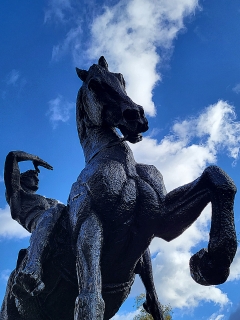
CAST IN BRONZE, he sits aside a rearing horse. He looks west towards Kensington Palace and uses his right hand to shield his eyes from the setting sun. I am describing a cast of a sculpture by George Frederic Watts (1817-1904), which bears the name “Physical Energy”. The sculptor was born on the birthday of the conductor George Frederic Handel – hence his two first names.

Watts began work on an equestrian sculpture in 1870, when it was commissioned by Hugh Lupus Grosvenor, who became 1st Duke of Westminster. It was to depict Hugh Lupus, 1st Earl of Chester. This was at Eaton Hall near Chester. In the early 1880s, Watts began working on “Physical Energy”, which was inspired by this sculpture. The first bronze casting of “Physical Energy” was made in 1902, and transported to southern Africa.   

Watts had been principally a painter until the 1870s, when his interests moved towards sculpture. “Physical Energy” was the high point of his efforts. A plaque next to the bronze horse and rider explained that this sculpture depicted:

“… a universal embodiment of the dynamic force of ambition …”

One man for whom these words might well be applied was the mining magnate and a Prime Minister of the South African Cape Colony, Cecil Rhodes (1853-1902), who ruthlessly let nothing get in the way of his ambitions. Therefore, it was particularly appropriate that one of the casts of Watts’s “Physical Energy” (that made in 1902) was placed at Groote Schuur (in Cape Town) as part of a memorial to Rhodes after Rhodes’s death. Unlike a bust of Rhodes placed nearby, which was vandalised recently, the equestrian statue has survived … so far.

An article published by Artnet News (https://news.artnet.com/art-world/watts-sculpture-royal-academy-ideological-baggage-1155971) made the following remarks:

“Watts, like Rhodes, believed in British imperial might to back its right to rule … the artist “plied” a leading politician with suggestions that military service should be introduced. (The colonial statesman Lord Grey was the man who suggested Watts turn the equestrian sculpture into a memorial to Rhodes after he died…)

… Watts’s imperialism was “liberal” and that the sculpture’s ideological meaning is open-ended. Socialists used the image, too. In fact, Watts had multicultural references in mind when he first conceived the statue: It was due to be dedicated to great empire builders including Mohammed, Attila the Hun, and Genghis Kahn. (Trowmans adds that May Watts, the artist’s second wife and a fellow artist, was much more sceptical of Rhodes.)”

The quotation mentions that Watts married twice. His first wife was the young actress Ellen Terry (1847-1928). They married when she was 16 years old. They separated after 10 months. During that brief period, she met, and was photographed by the Victorian pioneer of artistic photography, Julia Margaret Cameron (1815-1879). I have written about both Watts and his young bride in my book about Mrs Cameron (“BETWEEN TWO ISLANDS: JULIA MARGARET CAMERON AND HER CIRCLE”).

In addition to the cast in Cape Town, at least two others were made. One of them was produced in 1959. It now stands outside the National Archives in Harare (Zimbabwe). The cast which stands in Kensington Gardens was cast by AB Burton (a founder) in Thames Ditton in 1905, and was put in its present location in 1907. It stands on a line that runs between a Henry Moore sculpture on the bank of the Serpentine and Kensington Palace. Another cast was made in 2017 to commemorate the 200th anniversary of Watts’s birth. Briefly, it stood in the courtyard at the Royal Academy. Now, it stands at the Watts Gallery near Guildford.

We pass “Physical Energy” on our frequent strolls through Kensington Gardens. From it, there is a fine view of Henry Moore’s tall concrete sculpture across the Serpentine Lake. Watts was a contemporary of the French sculptor Auguste Rodin (1840-1917). However, sadly, neither Watts nor Moore produced works as fine as those of Rodin.

[My book about Julia Margaret Cameron is available from Amazon, e.g.,

https://www.amazon.co.uk/dp/B0BZFCVLX9/ ]

A leather purse

OF MY FOUR GRANDPARENTS, I met only one of them – my father’s mother. The other three died before I was born. My mother’s mother was called Ilse – her parents were born in Prussia and Baden Württemberg before the Unification of Germany in 1870. From what I can recall, my mother told me that her mother was gifted artistically. She painted and made various kinds of objects by hand. One of these came into our possession some years ago. It is a large purse made from leather. With two industrial press-studs, it is held together with stitched leather. The front flap has a leafy design tooled in it. The image has the characteristics of the art-nouveau style that was popular in the late 19th century, and the early part of the following century. In the centre of the design, there is a pair of intertwined initials tooled in the leather. These appear to be “J” and “B”.

When Germans wrote in the late 19th century, they often used what looks to our eyes like the upper-case letter ‘J’ where we would now use the upper-case letter ‘I’. To write the letter ‘J’ (as in jelly), the old German alphabets used a ‘J’ that differed slightly from the ‘J’ used to denote ‘I’. Therefore, the initials on the purse are most likely ‘IB’. Now, IB could either refer to Ilse or to her husband, my grandfather, Iwan B.

Inside the purse, there is some handwriting, which I recognise as my mother’s. It gives her name, Helen B, and the address of the farm her mother bought after having been widowed twice:

“Bantouzelle, Stellenbosch. Phone No. Stellenbosch 2646.”

Beside this, she had written “Poste restante”. I imagine that she had done this because most of the time she was living not in Stellenbosch, but in Cape Town. This would have been before 1948 when she travelled to England to marry my father.

Apart from a few old photographs, this well-made purse is one of the very few material souvenirs of a grandmother whom I never met.