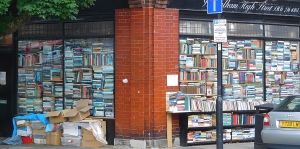
From floor to ceiling
Crammed full of pre-loved books
A reader’s paradise
WHEN I WORKED AT MAIDENHEAD, I used to travel there by train from London Paddington. Many of the trains terminated at a station called Bedwyn, which serves Great Bedwyn. I visited this small town on the Kennet and Avon Canal for the first time only recently. While driving through the place, I noticed a building covered with gravestones and other ornamental carving. My curiosity was aroused.
The name ‘Bedwyn’ might have been derived from ‘Biedanheafde’, an Old English word meaning ‘head of the Bieda’, which referred to a stream in the area. In 675 AD, “The Anglo Saxon Chronicle” recorded the battle of ‘Bedanheafeford’ between Aescwine of Wessex and King Wulfhere of Mercia, which is supposed to have been fought near the present Great Bedwyn. The will of King Alfred the Great (c848-899) makes reference to Bedwyn. In short, Bedwyn has been a recognizable settlement for a long time.
Bedwyn’s combined post office and village shop can be found in a long, rectangular brick building on Church Street. The wall at the east end of the edifice carries a depiction of the Last Supper and above it, God on a throne, surrounded by saints and angels. These sculptural panels are in white and blue and somewhat resemble the kind of things produced by the Florentine sculptor Luca della Robia (1400-1482). Three gravestones are attached to the west facing end of the post office. A wooden gate next to this end of the building is labelled ‘Mason’s yard’. The front of the building, facing the street, is adorned with carved funerary monuments including gravestones, some of which bear humorous inscriptions.
The shop is attached to a house with a front door framed by a gothic revival porch. A carved panel in the porch reads: “Lloyd. Mason.” I asked some of the customers queuing up to enter the shop/post office if they knew anything about the curious decoration of the building. I was told that the place had once been the workshop of a stone mason who specialised in funerary items. My informant said that most of the carvings attached to the building were test pieces made by the stonemason’s apprentices; rejected or uncollected items; and offcuts.
Benjamin Lloyd (1765-1839), who died in Bedwyn, started his stonemasonry business in 1790 (www.mikehigginbottominterestingtimes.co.uk/?p=2825). He was responsible for some of the work done during the construction of the Kennet and Avon Canal, which began before he was born and was eventually completed in 1810. The company still exists. Now, it is run by John Lloyd, the seventh generation of the family to maintain the business (www.johnlloydofbedwyn.com/about-us). However, his premises have moved away from Bedwyn’s post office.
Benjamin Lloyd is buried alongside his wife Mary (1764-1827) in St Mary’s Church Burial Ground in Great Bedwyn. I do not know, but I would like to imagine, that their gravestone was made in the company Benjamin created.

Golborne Road intersects London’s famous Portobello Road. I practised dentistry in a clinic on Golborne Road between 1995 and 2001. In those days, Golborne was far less chic than it is today. Every day I used to pass E Price and Sons, a vegetable shop on Golborne.
The shop had a disorderly display of vegetables outside it and was run by a very old couple. I never entered their shop because it seemed to be impenetrable.
On the rare occasions that I purchased anything there, either the old lady or the old man would hurl the produce onto the scales and hardly waited to see the true weight. Then, they would mention a price, always adding the word ‘alright’, pronouncing it as if they were asking the question “is that alright?” They said the word ‘alright’ in such a way that suggested that something was not alright.
My lasting memory of this vegetable shop is of watching either of the man or woman sitting outside the shop removing withered outer leaves from the cabbages. Every day, I noticed that the cabbages on display got smaller and smaller; they seemed to be shrinking.
The shop closed a few years ago, and was later reopened by younger members of the Price family. Sadly, their lovely shop went out of business and the premises are awaiting their new reincarnation.