A garden of funkiness in London’s Kensington

THE SERPENTINE GALLERY rarely puts on exhibitions that can be described as ‘mundane’. It is the most exciting and adventurous public art gallery in London. True to form, its current show (in the South gallery) is both weird and unexpected – actually, quite funky. Called “Emajendat” (i.e., ‘imagine that’), it is on until the 2nd of March 2025. The exhibition or art installations were created by Lauren Halsey, who was born in 1987 in Los Angeles (USA), where she lives and works.

Ms Halsey has created a series of fantasy landscapes that reflect the backyard culture of the part of Los Angeles – South Central – where was brought up and still lives. The exhibition’s leaflet explained that she:

“… has developed a distinct visual language deeply rooted in South Central Los Angeles where her family has lived for generations. Through objects and installations, Halsey archives and remixes the changing signs and symbols of her environment, gathering physical and graphic material from her neighbourhood. In her work Halsey merges past, present and future via her interest in iconography connected to the African diaspora, Black and queer icons and architecture. Halsey cites the collective sonic and visual layering associated with funk music as the blueprint for her approach to making, traversing time and drawing on a wide range of sources.”

 The extraordinary environments she has created in the various spaces within the Serpentine have a humorous dreamlike quality, and at the same time contain her comments on the social culture of Los Angeles. These comments and her message as described in the gallery’s leaflet were lost on me, but I enjoyed the visual impact and creativity of what I saw. From a purely aesthetic point of view, this extraordinary exhibition is like the proverbial ‘breath of fresh air’.

An architect from Korea making something out of nothing in a London park

ALMOST ALWAYS I ENJOY the annual temporary pavilions erected beside the Serpentine South Gallery in Kensington Gardens. This year’s offering was designed by the South Korean architect Minsuk Cho (born 1966 in Seoul). The Serpentine website (www.serpentinegalleries.org/) explained:

“Tracing the history of past Serpentine Pavilions, Minsuk Cho observed that they often emerge as a singular structure situated at the centre of the Serpentine South lawn. To explore new possibilities and previously untold spatial narratives, Cho approaches the centre as an open space. The 23rd Serpentine Pavilion envisions a unique void surrounded by a constellation of smaller, adaptable structures strategically positioned at the periphery of the lawn.”

The five structures surrounding the void (or open space) in the middle of the pavilion compound vary in shape and purpose. One serves as a library, another as a café serving area with minimum seating, another as a children’s play area, another is a kind of hallway, and the fifth is supposed to represent a tea house.  

Apart from two of the small buildings (the play area and the library), I did not find the others visually satisfying. Also, I did not feel that the five structures surrounding the central space were in harmony with each other. All in all, I was unimpressed by this year’s so-called pavilion.

I realise from reading the information on the Serpentine’s website that Minsuk Cho was trying to express a set of concepts by designing the small complex of buildings that together form the pavilion. However, without knowing that, the result looks unsubstantial compared with almost all the pavilions that have preceded it over the years. The architect’s ideas have not translated well into concrete forms. Apart from this, the current pavilion, unlike its predecessors, has few places for people to sit and enjoy the space. In all the pavilions that have been constructed before this year, there has been ample place to sit and rest. And providing such a place within uniquely designed architectural spaces has, until this year, been one of the things that makes the pavilions accessible for people of all ages to enjoy – whether or not they have an interest in the architecture or its designer.

Subversion at the Serpentine art gallery: ways with words

THE ORIGINAL SERPENTINE Gallery in London’s Kensington Gardens is housed in a former tea pavilion that was built in 1934. It began to be used as a contemporary art exhibition space in 1970. Since then, it has been showing modern and contemporary artworks in a series of temporary exhibitions. I have been visiting this gallery and its newer branch, Serpentine North, regularly since the 1990s (the North branch opened in 2013). Almost without exception, the art displayed in the Serpentine galleries has been both exciting and adventurous – sometimes quite challenging. The latest exhibition, which is on until the 17th of March 2024 in the original gallery, is of artworks by the American (USA) artist Barbara Kruger, who was born in Newark (NJ) in 1945.

Kruger’s art is not purely visual. It is designed to convey ideas that challenge the viewer to question commonly held contemporary beliefs in an eye-catching, often witty way. The exhibition, “Thinking of You. I mean Me. I mean You” consists of 12 art installations that reference or parody everyday things such as advertising, magazine illustration, video art, social media, the Internet, and other media that bombard us on a daily basis. Each of them present messages that subvert political ideas, the moral code, and the meanings of words. Kruger makes much use of video techniques. Several of the exhibits have words projected sequentially to make up sentences. Often, the words change on the screen to alter the perceived meaning of the text being projected. However, her art is not simply all about words and their meanings in different textual environments. The words are harmoniously accompanied by intriguing visual images, often continuously changing.

Although the exhibition is about words and their usage and varying meanings, words alone cannot describe this exhibition adequately. Therefore, if you can, it is worth taking a look at this interesting – nay, challenging – show. Having viewed the show, I was heartened to discover this artist from America who is perceptive enough to see where her country is heading and brave enough to criticise the political direction in which it appears to be moving. After seeing her exhibition, I would hazard a guess that she will not be voting for Mr Trump.

The Black Chapel in the park

EVERY SUMMER SINCE 2000 except for the year 2020, the Serpentine Gallery in London’s Kensington Gardens has hosted a special event. On each of these years between June and October, a temporary pavilion has been erected near to the original Serpentine Gallery (now known as Serpentine South). No two pavilions have looked the same. However, what they have in common is that each one of them is the first ever completed structure erected in England by the pavilion’s designer/architect.  

This year (2022), the pavilion, called “Black Chapel”, was designed by the American artist Theaster Gates (born in Chicago in 1973). In the past, we have seen exhibitions of his works hosted in the White Cube Galleries at both Masons Yard and in Bermondsey. Many of his exciting artworks have impressed us greatly. So, it was with high expectations that we went to see his pavilion.

At first sight, we were disappointed by the Black Chapel. It is a huge black cylinder with three apertures. Two of them are entrances and the third is a circular orifice in the centre of the tall structure’s circular, domed ceiling. A segment of the cylinder is walled off and serves as a café servery. Benches line the lower parts of the wall of the rest of the building. Seven large, flat rectangular, metallic paintings (or plates) are attached to a part of the internal wall, and there is a large bell just outside one of the pavilion’s two entrances.

Today, many people like to have art explained to them. For me, it is my visceral reaction to an artwork that is more important than its intended meaning or the artist’s intentions. The ‘meaning’ of a work of art is, for me, secondary to the way I am affected by it. For those, who seek meaning in art, this is what the Serpentine’s website has to say about the pavilion:

“The structure, realised with the support of Adjaye Associates, references the bottle kilns of Stoke-on-Trent, the beehive kilns of the Western United States, San Pietro and the Roman tempiettos, and traditional African structures, such as the Musgum mud huts of Cameroon, and the Kasubi Tombs of Kampala, Uganda. The Pavilion’s circularity and volume echo the sacred forms of Hungarian round churches and the ring shouts, voodoo circles and roda de capoeira witnessed in the sacred practices of the African diaspora.”

Interesting as this might be, it neither increases nor diminishes my appreciation of the Black Chapel. Theaster Gates’s Black Chapel is less exciting visually than some of the past pavilions. Although our initial impressions of this seemingly simple structure were not particularly favourable, after spending a little time in it, the place grew on us and now we hope to visit it again.

Shifted to Somerset from London

EVERY YEAR SINCE 2000, excepting 2020, The Serpentine Gallery in London’s Kensington Gardens has erected a temporary summer pavilion. Each pavilion is designed by a different architect or group of architects. What they have in common is that their pavilion is the first of their designs to be constructed in London, or maybe the UK. They stand in front of the Serpentine Gallery during the summer months and into early autumn. They are always fascinating visually and always contain a café with seating. Over the years some of them have been used as event spaces.

At the end of the season, the pavilions are dismantled and are never seen again in Kensington Gardens. Some of them might be sold and others re-erected elsewhere, but until recently I have never seen one again.

A few years ago, a contemporary art gallery, Hauser and Wirth, which has a branch in London’s West End, bought a farm on the edge of Bruton in Somerset. They have used some of the farm buildings and constructed some new ones to accommodate another branch of their gallery. In addition to the exhibition spaces, there is a superb restaurant, an up-market farm shop, and a wonderful garden created by the Dutch garden designer Piet Oudolf (born 1944).

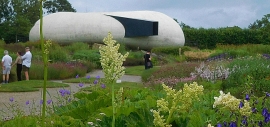
The garden slopes upwards from the gallery. At the top of the slope, there is something that at first sight looks like a giant hamburger patty or the profile of an oversized bagel. I recognised it immediately as being one of the former summer pavilions that once stood next to The Serpentine Gallery in Kensington Gardens. It is the 2014 Serpentine pavilion designed by Smiljan Radic (born 1965 in Santiago, Chile).

When I saw it in London in 2014, I was not overly impressed by it. However, seeing it at Hauser and Wirth in Somerset, it looks great. My description of it as an oversized bagel is not too far from the truth. It is, basically, an annular structure like a ring or a bagel, but it is far more interesting than that. Supported on rocks, the ring is not in one plane, but it undulates gradually. Irregularly shaped holes in its translucent skin provide intriguing views of Oudolf’s garden, which looks good in all seasons, and the surrounding hilly Somerset countryside.

A visit to Hauser and Wirth in Somerset makes a fine day out even if you have only a scant interest in contemporary art. The food served in the restaurant is of a high quality and not unreasonably priced. The buildings on the estate are lovely and the garden is hard to beat for its beauty.