Memorials commemorating the lives of royalty near Jaipur

THE AMBER FORT, which we visited yesterday (17 December 2024), was swarming with noisy, jostling tourists. It was not pleasurable visiting that place. In contrast, today we explored a beautifully peaceful site between Jaipur and Amber Fort: Gatore ki Chhatriya, which I will abbreviate to ‘Gatore’.

Situated between two steep hills, one of which is home to a popular Ganesh temple, the Gatore is a set of three walled enclosures. Each of them contains several ornate domed chhatris (pavilion; ‘chhatri’ means umbrella). Each chhatri was erected over the spot where a member of Jaipur’s royal family (the Kachwaha dynasty) was cremated. After each cremation, the ashes of the deceased were carried to the sacred city of Haridwar, where they were consigned to the waters of the River Ganges.
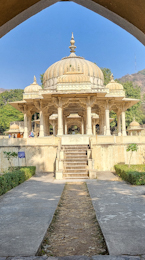
The earliest of the chhatris at Gaitor was put up in 1743, after the cremation of Sawai Jai Singh II. Despite the fact that Indian royalty is no longer officially recognised, the most recent chhatri was constructed in 2011, when the titular ruler, Sawai Padmanabh Singh, died. In addition to the larger chhatris dedicated to the maharajas, there are smaller ones to royal children, who died before adulthood.

Unfortunately, none of the chhatris have any labels that help the visitor know for whom each of these structures was erected. An official at the entrance to the Gaitor compound told us that there had been wooden signs by each chhatri, but locals had apparently stolen them … for use as fire wood, maybe.

Apart from the peacefulness of the Gaitor compound, it is filled with the beautiful chhatris, which are set within well maintained gardens. And the whole place is flanked by the wooded slopes of the hills surrounding it.

If you do not have a long time to explore Jaipur, you should not miss visiting both the Gaitor and the Jantar Mantar. If you have a longer time, the Gaitor is a lovely place to linger.
Swinging the royals in Jodhpur

IT IS NOT UNUSUAL to find a swing (‘hichko’ in Hindi) in an Indian home. Often, they consist of a seat suspended from a frame by ropes or chains. The museum in the fort at Jodhpur in Rajasthan has a fine collection of hichkos that were once used by the former royal family.


Hichko presented by the PWD

One of the swings in the collection caught my eye both because it was quite different in design from the others in the collection and because it bore an interesting label, which had been attached by its maker(s). The wording on the label reads:

“With profound loyalty of Jodhpur PWD Employees Union”

(PWD: Public Works Department)


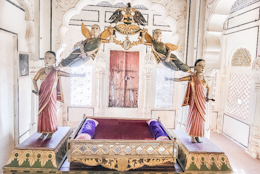
This hichko which is decorated with the royal crest of Jodhpur and almost lifesize models depicting two women in saris is not dated. The union still exists, but since 1947, the royal family has lost the power which it once possessed.

Royal memorials in gardens near Jodhpur

MANDOR IS A FEW MILES out of Jodhpur. It was the capital of Marwar kingdom until the founding of the city of Jodhpur in the mid-15th century AD. After that, Mandor remained the place where members of the royal house of Jodhpur were cremated. It was also where the cenotaphs commemorating the rulers of Marwar were erected. These beautiful, intricately designed, red sandstone structures are now part of a well-manicured park known as Mandore Garden.

Part of a cenotaph

High above the group of cenotaphs, there are the ruins of Mandore’s fort. And near to these memorials, there is an important Hindu temple and a lovely octagonal tower: the Ek Thamba Mahal. This structure with latticed window apertures might have been where ladies could watch ceremonies without contravening the conventions of purdah.

A morning in Mandore Park, the abode of many monkeys, is well worthwhile. At 7 pm, the monuments are lit up, and this is a highly recommended sight, so we were told.

PS a cenotaph is a monument to someone whose remains are buried or disposed of elsewhere

Chairs, coronations, and royalty

BASILDON PARK IS an 18th century neo-classical mansion not far from Reading. From 1949, the house was owned and restored by the 2nd Baron and Lady Iliffe. They lived in it for 25 years. In one room on the ground floor, which contains the fascinating sketches made by the artist Graham Sutherland for his tapestry in Coventry Cathedral, there are four chairs. Two of them have the insignia of King George VI embroidered on their covers, and the other two are embroidered with the insignia of Queen Elizabeth II.

A National Trust volunteer guide working in the house explained that the 2nd Baron and his wife had attended the coronations of both King George VI and Queen Elizabeth II. The chairs were those they had sat on during these ceremonies. After the coronations, so the guide told us, the Iliffes bought the chairs they were sitting on to keep as souvenirs. The proceeds of sales such as this helped to pay for the coronation events.

Seeing these chairs reminded me of another chair, which I saw in a cousin’s house in Cape Town, South Africa. It was in this chair that Queen Mary (wife of King George V) had sat for a few minutes when she paid a brief visit to the Mayor’s house in King Williams Town (now called ‘Qonce’) in South Africa in 1946. The Mayor was my mother’s uncle. His grandson, my cousin, has kept this souvenir of the royal visit. I saw it when I visited him in Cape Town. Unlike the chairs at Basildon Park, there is no royal insignia on it.

A beneficient ruler of a kingdom now part of Gujarat

THE AINA MAHAL (‘Palace of Mirrors) in Bhuj (Kutch, Gujarat) was constructed in about 1750, and badly damaged during the terrible earthquake of 2001. Luckily, some of the palace survived, and several rooms containing an intriguing variety of objects can be visited by the public. Above these, there is another floor, which is not accessible to the public. A prominent member of the royal family of Kutch, with whom we have become friendly, kindly showed us around these rooms, which include the old Durbar Hall where the ruler, the Maharao, used to hold audiences. After 1868, when a new palace, the gothic revival style Pragmahal, was built, the rulers of Kutch used its larger durbar.

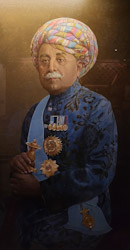
The old durbar Hall in the Aina Mahal contains fine painted portraits of some of the previous Maharaos. One of these depicts Maharao Desarji II, who ruled from 1819 to 1860. Amongst his many achievements he encouraged the study of mathematics, geography, and astronomy. He developed schools and hospitals. And he also put an end to slave trading in Kutch. In addition, he put an end to the practice of sati (‘self’-immolation of widows during their husbands’ cremations).

His son Pragmalji II, who ruled from 1860 to 1875, not only had the Pragmahal place built but also encouraged education. It was during his reign that the Alfred School was built. It was named in honour of Queen Victoria’s son Prince Alfred, who visited India in 1869/70.

My wife’ great great grandfather, Laxmidas Ravji Sapat, was the 11th headmaster of the Alfred High School between 1888 and 1892. This was during the reign of Maharao Khengarji III, who ruled Kutch from 1876 to 1942. He loved wildlife and took an interest in education. Amongst the many things he did was establishing the Museum of Kutch and the Jubilee Hospital – both in Bhuj. He also helped Laxmidas Ravji Sapat.

After being headmaster of the Alfred School, Laxmidas and his son-in-law went to London to study law, Mr Thacker, at Middle Temple. Going to London to study was expensive. As both Laxmidas and his son-in-law, Mr Thacker (my wife’s great grandfather) were bright, their community, the Kutchi Bhatias, clubbed together to help finance the education of these two promising men. Additional money was donated by the Maharao (Khengarji III), who, as already mentioned, was keen on promoting education.

I am grateful that we were privileged to have been shown around a part of the Aina Mahal not open to the public. Apart from seeing something new and having a member of the royal family to explain things, we managed to see portraits of his ancestors, each of which was accompanied by labels that summarised their achievements.

A palace by the sea

IN OCTOBER 2022, we visited the Isle of Wight and went around Osborne House, which Queen Victoria and her consort Prince Albert had constructed as a holiday home near the seaside on the north coast of the island. A largely unattractive Victorian pile, its saving grace is the Durbar Hall, which is a near perfect example of the Indo-Saracenic style of architecture that can be found in many places in India. Recently (in February 2023), we visited another royal summer palace located close to the sea. It is the Vijaya Vilas Palace close to Mandvi in the former Kingdom of Kutch, now a part of the Indian State of Gujarat.

The Vijaya Vilas was completed in 1927. It was built by Kutch’s ruler Maharao Kengarji III as a summer resort for his son and heir, the Yuvraj Shri Jayarajii.

Architecturally, it resembles older Rajput palaces, and is a fine example of the Indo-Saracenic style. It and its various oriental decorative and structural features were made by craftsmen from Bengal, Jaipur and other places in Rajasthan, Saurashtra, and Kutch. The predominant material used is sandstone , of which there is no shortage in Kutch. It seems that the palace suffered little damage during the 2001 earthquake, which badly affected the Maharao’s palaces in nearby Bhuj (the capital of Kutch).

Inside the palace there are rooms with furniture that would not look out of place in many English stately homes. There are many framed photographs of the royal family, their guests, and the many wild animals that were shot. One of these was a leopard that was shot by someone inside the palace. One of the window panes has a bullet hole that is said to have been made by the bullet that killed the creature. There are also photographs that record the many times that scenes in Bollywood movies were shot in the Palace.

One photograph shows the US General Dwight Eisenhower seated in a jeep. This picture was taken in Europe during WW2. I have yet to discover what, if any, connection existed between Eisenhower and the royal family of Kutch.

Visitors can visit the rooms on the ground floor, and can ascend to the roof from which there are superb views of the sea and the flat countryside around the palace. The first floor, which is private, is the residence of members of the former royal family.

Although not as old as it looks, Vijaya Vilas, is a superb example of the kind of palace typical of those older ones that can be seen in Rajasthan. To my taste, Vijaya Vilas is a much more lovely and harmonious edifice than Victoria and Albert’s seaside home on the Isle of Wight.

A cook from Kutch in Norway

THE SHARAD BAUG HOMESTAY is in the extensive, luxuriant, verdant grounds of the Sharad Baug Palace. Badly damaged in the 2001 earthquake, the palace is a short walk from the excellent homestay. This accommodation is owned and run by members of the royal family of the former Kingdom of Kutch.

Close to the homestay in the middle of a field, there is another ruined edifice. This was formerly used as a guesthouse by important guests of the ruler, the Maharao. For some time, the poet Dara Shiko (1615-1659) hid from his brother (the future emperor Aurangzeb) in this building.

Near the ruined palace, there is a building, which was the last Maharao of Kutch’s sitting room and dining hall. Now, the building houses a small museum filled with exhibits relating to the royal Jadeja family. Amongst these, there are several items connected with the last ruler of independent Kutch when he spent some time in Norway.

After Kutch had joined India soon after 1947, its last Maharao, Madansinhji (1909-1991), was appointed India’s ambassador to Norway. There are photographs relating to his stay in Norway in the museum. There is also a Christmas card in Norwegian and a certificate issued by the Oslo Tennis Club. He served in Norway between 1957 and 1960.

While in Norway, Madansinhji was served by his chef from Bhuj, a member of the Yadav family. For many generations, the Yadavs have been chefs, specialising in non-veg food.

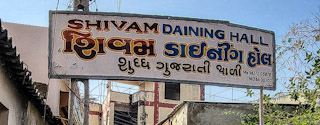
When we first visited Bhuj, in 2018, we were recommended to eat in a simple, small restaurant in the bazaar of Bhuj. Named Shivam Daining (sic), it serves very tasty pure vegetarian food. We returned to eat there several times during our recent (January 2023) stay in Bhuj. While chatting with its chef and his relatives, we learned that the man who produces the excellent food is a grandson of the Mr Yadav, who cooked for Madansinhji in Norway. Although the family have a tradition of cooking meat and fish, they do not offer it at Shivams because they rightly feel that there is little demand for non-veg food in the mainly vegetarian city of Bhuj.

Without knowing it when I booked the Sharad Baug homestay, it turned out that it and one of our favourite restaurants in Bhuj had at least one common connection, and that is Norway.

A pretty perambulation

LONDON’S KENSINGTON GARDENS is bounded to the north by Bayswater Road and to the south by Kensington Gore (overlooked by the Royal Albert Hall and the Albert Memorial), which becomes Kensington Road.  Within the park and running almost parallel with its southern boundary is the South Flower Walk (also known as The Flower Walk). The Northern Flower Walk, which runs near and parallel to Bayswater Road was once used by royalty. According to a document published on the Royal Parks website, this was:

“… a delicious and appealing place to stroll for the monarch on the way to … the site of the Bayswater ‘Breakfasting House’…”

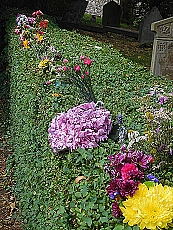
The breakfasting house no longer exists. I am not sure whether the South Flower Walk can boast of such an illustrious past. However, when it is in full bloom, it outdoes its northern counterpart in colourfulness and variety of its flora.

Although the whole of Kensington Gardens makes for a pleasant place to stroll, a walk along the South Flower Walk provides and exceedingly pretty perambulation.

On the wall

IT IS ODD how seeing a mundane object can stimulate less than mundane thoughts. Embedded into a wall in Salcombe (Devon), I saw an official post box for depositing mail. At first, I took little notice of it. Then, when I saw it a second time, I noticed that its red-painted front bears the letters “GR”. This refers to a King George. Because the first letter boxes were installed in the reign of Queen Victoria, the GR on the letter box in Salcombe must refer either to George V (reigned 1910-1936) or George VI (reigned 1936-1952) because the other King Georges all preceded Victoria.

Possibly the GR on the box in Salcombe refers to George V because he was the first George to follow Victoria, in whose reign the boxes bore the letters “VR” (Victoria Regina). Even though Edward VII was the first monarch to follow Victoria, boxes installed in his reign include the Roman numeral VII. Likewise, in the case of other monarchs who followed Victoria, their initials on post boxes include numerals identifying which king or queen they denoted (i.e., E VII R, G VI R and E II R). Not having ever looked out for it before, I am not sure whether any post boxes installed during the reign of George V bear the logo G V R or, as I saw in Salcombe, simply GR. A rapid search of the Internet revealed that most George V post boxes illustrated on websites dealing with post boxes bear the letters GR, as was the case with the example I noticed in Salcombe.

I suppose that when Charles or his son William come to the throne, letter boxes, if they still exist in the age of electronic mail, will bear the logos “C III R” and “W V R” respectively, rather than “CR” and “WR”. Why the V (meaning ‘5’) was not included on the post boxes issued during the reign of George V but the VII (meaning ‘7’) appears on those installed during his predecessor’s reign is not clear to me.