I HAVE BEEN PAST the Old Bull and Bush pub near Hampstead inummerable times during the past 70 years, but until today (1 June 2025), I had never entered it. Here is a little about the pub from my book “Beneath a Wide Sky: Hampstead and its Environs”:
“Made famous in an old music hall song Down at the Old Bull and Bush (by Andrew B Sterling and Henry von Tilzer), the Old Bull and Bush began life as a farmhouse that was built around 1645. The pub began in the early 18th century. The artist William Hogarth (1697-1754) visited it regularly. The artists Gainsborough and Reynolds frequented the pub with the actor/director Garrick. The present pub was built in the 1920s and is uninteresting architecturally. When I was a child, there was another pub next door to the Old Bull and Bush. This was the ‘Hare and Hounds’. I used to pass it and the two pubs on my way to school in Highgate (between 1965 and 1970). It was already present in the early 19th century. In 1940, during WW2 it was twice destroyed by aerial bombardment. And, according to Christopher Wade, it: “… existed for a time in five linked caravans…” before being rebuilt in 1968. The pub ceased operating in 2000 and has since been demolished. A modern brick apartment block now stands where people used to enjoy a casual pint.”
Well, today, we ate lunch at the pub. The dining room was comfortable, the service was good, but the food was unexceptional. Would I visit that establishment again? Maybe, but I still prefer other pubs in Hampstead.
EVERY NOW AND THEN, we feel the need to leave London, and sample the country life. Recently, we decided to visit Buntingford, a small town in Hertfordshire and to eat lunch at a pub nearby. Using the Internet, we chose one at random. It was the Sword Inn Hand in the hamlet of Westmill, which is a few miles south of Buntingford.
It was an excellent choice for two reasons. First, Westmill is a neat, picturesque little settlement. Secondly, the pub served excellent food in a pleasant ambience and, more importantly, the staff were friendly and extremely obliging. The pub has been in existence since the 14th century but looks as if it has been modified considerably since then. It is next door to the grounds of the medieval parish church, which was locked when we were in Westmill.
After visiting some family members in nearby Baldock, we returned to London, having had a satisfactory few hours’ experience of country life.
ESTABLISHED IN 1829, the Minerva is a pub next to the Humber River and close to the recently developed Hull Marina. It has a genial atmosphere, friendly staff, good unpretentious food, and a fine range of alcoholic beverages.
The place consists of several interconnecting rooms where one can eat and drink. One of these rooms is tiny. It can accommodate 4 adults at a squeeze and is, apparently, the smallest pub room in England.
We ate at the Minerva 4 evenings in a row, and were never disappointed. The fish and chips served at this pub were second to none. If you happen to be in Hull, it would be wise to visit the sign of the owl at the Minerva pub to have a good time.
IN THE 1980s, there was a shop that sold a variety of products imported from Communist Albania, which was then ruled by the Stalinist dictator Enver Hoxha and, after 1985, by his successor Ramiz Alia. I visited it once or twice. Although it had a few items of interest, it was quite expensive. The shop, which had closed by 1990, was in Betterton Street, which leads from Drury Lane to Endell Street, which is not far from the Seven Dials.
Yesterday (20th of June 2024), we walked along a part of Endell Street and then into Betterton Street, on our way to the Garden Cinema (in Parker Street). We watched a completely weird, arthouse film called “Daisies”, which was made in Communist Czechoslovakia in 1966. Despite being awarded a Czech film prize in 1966, it was banned by the censors in 1967.
Returning to Endell Street, we spotted three buildings of interest. The first of these is on the southeast corner of Endell Street and Shorts Gardens. It bears a commemorative plaque that reads:
“Zepherina Veitch (1836 -1894) Dame Rosalind Paget (1855 – 1948) Pioneering midwives trained at the British Lying-in Hospital, founded 1739 and sited here, 1849 – 1913.”
The tall Victorian building, to which this plaque is attached, is red brick with white stone facings. Between 1849 and 1913, this place housed a hospital for married women in the last month of pregnancy. A website concerned with former hospitals (https://ezitis.myzen.co.uk/britishlyingin.html) related:
“The staff consisted of two physicians and two surgeons who practiced midwifery, a Matron skilled in the same, a chaplain, an apothecary, nurses and ‘other inferior servants’. Women were admitted in the last month of their pregnancy – they were only permitted to stay for three weeks – and needed a letter of recommendation from a subscriber (patients were not charged by the Hospital) and an affidavit of their marriage and their husband’s settlement.”
Adjoining the former lying-in hospital, there is an edifice made with layers of bricks that vary in colour and white stone trimmings. It has Victorian gothic features, and its Endell Street facade bears an inscription, which reads:
“Lavers and Barraud Stained Glass Works”
This firm was founded in 1858 by Nathaniel Wood Lavers (1828–1911) and Francis Philip Barraud (1824–1900). When Barraud (of Huguenot descent) became dissatisfied with the firm’s designs, he was recommended to hire Nathaniel Westlake (1833-1921) as a designer. Westlake’s knowledge of mediaeval art and skills in the pre-Raphaelite style of art brought fame and fortune to the firm in the 1860s. In 1858. He became one of the firm’s partners, and in 1880, he became the firm’s sole owner.
A building on the corner of Betterton Street and Endell Street, across the road from the former stained glass works bears a plaque that informs the viewer that in this house, number 20 Endell Street, Westlake resided in the 1880s. His firm continued in business until his death.
So, today, neither the lying-in hospital nor the stained-glass works are still operating, and the Albanian shop has long gone. However, one place that would have been in business when those two places were functioning, is still in business: The Cross Keys Pub. Established in 1848, this pub has a baroque Victorian façade. The interior of this long narrow hostelry is most people’s idea of a real old-fashioned pub. A long bar with brass fittings runs along one side of the saloon, The walls are covered with numerous paintings and prints and several glass cases containing stuffed (taxidermy) fish. All manner of things, including a brass instrument and an archaic diver’s helmet, are suspended from the ceiling. Yet, despite this great amount of assorted ‘clutter’, the pub has a cosy atmosphere. When we dropped in for some mid-afternoon refreshment, there were a few other customers – mostly elderly local people. Although in the heart of the city, the pub has a rustic feeling about it. I suspect that workers and other staff from the stained-glass factory used to pop into the Cross Keys for liquid refreshment. But I wonder if many of those associated with the lying-in hospital -staff or patients – were patrons.
After dallying in Endell Street, we walked the short distance to the Garden Cinema in Parker Street to see the Czech film. If you have not been to this cinema, you are missing a treat – it is a truly independent, art-house cinema (see www.thegardencinema.co.uk).
AFTER WATCHING A superb play, “Moffie” (a one man show about homosexuality in apartheid South Africa), at the Riverside Studios in London’s Hammersmith, we visited the nearby William Morris Museum, and then retired to its close neighbour, The Dove pub. This quaint little hostelry has a riverside terrace and the shortest bar counter in England. There has been a pub on its site since the 17th century. At one time, it was also a coffee house. The present building, whose interior is rich in timber beams, dates from the 18th century.
Being a sunny Sunday afternoon, the riverside terrace was full when we arrived at the pub. So, we found seats in the room with the short bar at the front of the pub. It was while we were enjoying our refreshments that I noticed a lovely white carving on the chimney breast above the fireplace – its style reminded me a little of the work of Eric Gill. Near to the carving there was a framed notice that provided the following information:
“As a result of old age and Hitler, this fireplace had to be re-built in 1948. It was re-built by Mr Ward of Barnes, in Elizabethan bricks, from a design by Mr Reece A.R.I.B.A.
The plaque was sculpted in white Portland stone by Ian Coleman, from a design prepared by John Worsley, after a woodcut in the possession of the landlord”
I have no idea about the woodcut that the landlord possessed, but I can tell you that John Worsley lived from 1919-2000. He painted at least one view of Hammersmith Bridge from a viewpoint close to The Dove – in 1948 (www.orleanshousegallery.org/collection/boat-race-hammersmith-bridge/). As for Ian Coleman, I cannot find any references to an artist with this name, who would have been alive in the late 1940s.
The fireplace alone is of interest, but there are also many other artworks – paintings and old photographs – that can be viewed in this delightful pub.
WE USUALLY PASS this place early on Sunday mornings. As it opens at 12 noon, we had never been able to enter it until a few days ago. Situated on the riverside in Hammersmith with its entrance in a narrow passage that is the east end of Upper Mall, it is The Dove pub. As it looks so quaint and ‘olde worlde’, we have long planned to visit it during its opening hours.
The Dove pub has been in existence since the early 18th century, or maybe the century before. Its north facing façade was created in the early 19th century. It is said that King Charles II (reigned 1660-1685) might have entertained his mistress Nell Gwynne here. Although there is no certainty about that, there is evidence that the Scottish poet James Thomson (1700-1748) spent time in The Dove. In 1740, he composed the poem “Rule, Britannia!”, which was later set to music by the composer Thomas Arne (1710-1778). He is said to have written the poem in The Dove, where there is a memorial commemorating the birth of this famous British patriotic song. Later regular visitors to the pub included Ernest Hemingway, Dylan Thomas, and William Morris (who lived a few yards away).
We decided to visit the pub after a late afternoon performance of an enjoyable film, “Taste of Things”, at the nearby Riverside Studios. On entering The Dove, there is a bar to the right and a small seating area to the left. The bar is one of the shortest in the UK – it is only 7 feet long. To comply with legal requirements, a second bar had to be built. This is reached by climbing a few steps into a larger middle room, which was heated by a real coal fire and lined with pictures. We took a table in this cosy dining area, and enjoyed acceptably good food. Another flight of steps leads down into a third seating area with windows overlooking the Thames. Beyond this, there is an open terrace with views of the river.
The Dove is wonderfully old-fashioned. Even though it is in the heart of west London, it feels just like a traditional country pub in the middle of nowhere. Most of the clientele in the pub on the Monday evening we visited it were local people. I suspect that during weekends and public holidays, the locals become outnumbered by visitors who are not local.
Having ‘broken the ice’ and entered the pub, I am sure that we will become regular visitors there, but it is unlikely that we will compose a song that can rival “Rule, Britannia!”- however much we drink.
BRICK LANE IN east London has been home to immigrants from various parts of the world. Currently, many of the people who live and work in the area are of Bangladeshi heritage. In the last few years, the area has attracted the ‘trendy’ set, whose interests are mainly in the attractions north of the former Truman Brewery. Some years ago, my friend David, visiting from Atlanta (Georgia), and I paid a visit to Brick Lane and were surprised to find a bit of ‘Ye Olde England’ almost hidden amongst the predominantly Asian businesses. It was the The Pride of Spitalfields London – a real old-fashioned ‘boozer’. Stepping into it, it was difficult to imagine you were not in a country pub, but in the heart of east London. It is on Heneage Street next door to what had once been part of a brewery.
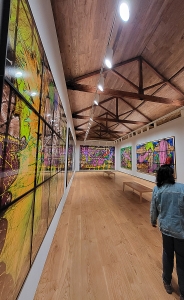
In 2015, the Trustees of the Gilbert & George Centre, a charity, acquired the building next door to the pub. On the 1st of April this year (2023), the converted buildings were opened to the public. They have been beautifully transformed by the SIRS Architects practice and they house artworks by the duo Gilbert and George (‘G&G’), who both trained at London’s St Martins School of Art. According to the G&G website (gilbertandgeorgecentre.org):
“The property was purchased with the idea to create a permanent home for works of the artist and to enrich London’s cultural offering thus further.”
G&G produce often very colourful works, all of which include the pair of creators within their images. As artists, they are also the subjects of their creations – they are almost always depicted in all their works. Their works deal imaginatively with a wide variety of things that we all face in our daily lives – some of them often considered too distasteful to be discussed or displayed. But G&G boldly bring them to our notice in a dramatic way. As Michael Bracewell, a Trustee, wrote on the website:
“Gilbert & George maintain an ideological opposition to formalistic art theory and the reference of art to the history or theory of art. Asserting instead the power of emotion and actuality, their art addresses subjects that are culturally excluded, neglected or disowned. Their art questions social taboos and morality. By looking at difficult subjects the art and vision of Gilbert & George is intended to ‘de-shock’ rather than seeking to shock. Its aim is not the simple task of ‘shocking’ a viewer, but the difficult task of interrogating a subject and themselves … Unchanging, they have the appearance and countenance of modern sober-minded, anonymous citizens, who have embarked on the astral journey of their own Divine Comedy: purgatory, Heaven and Hell as they find it and perceive it in our world, in nature and in themselves.”
Whether or not you like the creations of G&G, the new Centre is well worth visiting, even if only to see the fine design of the buildings containing it. If the art is all too much for you, you can pop into the pub next door and seek liquid relief. And if you loved the place, which we did, you can visit the boozer to celebrate the arrival of this superb new addition to the London art scene.
FOR SEVERAL MONTHS following March 2020, movement was restricted to within a short distance of home because of rules that were supposed to limit the spread of covid19 infections. Almost everything except food stores was closed. Socialising was frowned upon. And travel for leisure was not possible. Around about June 2020, things eased up just a little bit, and travelling became possible once more, albeit subject to various rules and precautionary measures. It was then we decided to buy a car to travel around without risking infection by using public transport.
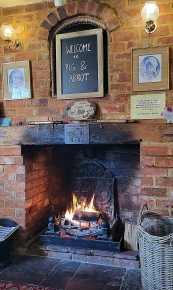
After collecting our (pre-loved) car from a garage on the Edgware Road, we decided to drive up to see my wife’s cousin in Baldock (Hertfordshire). We asked him to recommend a nice country pub where we might be able to get something for lunch. He suggested that we tried Ashwell, which is about 4 miles northwest of Baldock. This pretty village has three pubs. Two of these were closed, and the remaining one did not serve food. We asked the rather melancholic barman to suggest somewhere else in the area. He pointed at the pub’s only customer, a gentleman seated at a table, and said: “You could try his place at Abington Piggotts – it’s only just up the road.” The man, Mick, told us that his pub was open and serving food. So, we drove a few miles to tiny Abington Piggotts, which is 3 ½ miles northeast of Royston. With about 80 households, the village has one pub, a free house called The Pig and Abbot. Housed in a century’s old building, this hostelry is a lovely example of an unspoilt country pub. We were given a warm welcome. We enjoyed a small snack and a drink and decided to return at a later date for a proper meal.
We returned and enjoyed excellently cooked food prepared by Mick’s wife Pat. It was so good that we began returning at regular intervals to enjoy Pat’s cooking. The Pig and Abbot, like all other pubs and restaurants, was subject to compulsory closures during the various ‘lockdowns’ that were imposed by the government, yet it has remained in business despite these interruptions. I am not sure how many times we have visited the Pig and Abbot, but each time has been as least as enjoyable as the others. It was not long before we began regarding Mick and Pat as good friends. Whenever we visit the pub, Pat gives us all a great hug when she sees us. Especially during the periods when lockdown restrictions were only partly eased, a visit to the Pig and Abbot provided a welcome respite from the gloomy atmosphere during the height of the pandemic. Whenever we drive along the country lanes leading to Abington Piggott, I have a warm feeling of gratitude because it was this countryside that lightened our lives during two years of covid-related misery.
Recently, we booked for Sunday lunch at the pub. Several days before we were due to eat at the pub, Pat rang. At first, we thought she was going to cancel us for some reason, but it was worse than that. She rang to tell us that Mick had died suddenly and completely unexpectedly. We felt devastated by this news. When we asked her whether she wanted us to cancel, she said ‘definitely not’. She had decided she must continue, and she wanted to see us. When we arrived for our lunch, the pub was full, Pat greeted us warmly, and her food was as excellent as usual. We will greatly miss Mick, and we wish Pat all the very best for the future.






 yamey
yamey 