THE PRINTER AND bookseller William Caxton (c1422 – c1491) is believed to be the person who brought the first printing press to England. I do not often think about him, but when we were driving from London to Cambridge, he sprung to mind when I saw a road sign pointing to a place (in Cambridgeshire) called Caxton. I wondered whether this place was in any way connected with the printer Caxton.
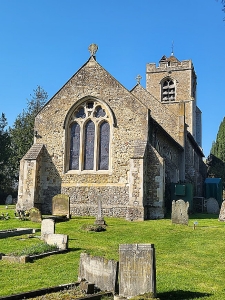
St Andrew, Caxton, Cambridgeshire
Caxton is a small village with some lovely old houses, a pub called The Chubby Frog, and a mediaeval church: St Andrews. The church is a little way out of the village. When we arrived at the place of worship, we saw that there was a sign inviting all to enter to enjoy a coffee morning. We entered, and were made to feel welcome before being served cups of coffee. We spoke with a couple of friendly church wardens, and asked them about any link between their village, Caxton, and the famous fifteenth century printer. The told us that there was no connection between them. Later, I found out that the village’s name was noted as ‘Caustone’ in the 1086 Domesday book.
As for the printer, nobody is certain where he was born, but it has been suggested that it was somewhere in Kent, possibly near (or in) Tenterden or near Hadlow. According to Wikipedia:
“One of the manors of Hadlow was Caustons, owned by the Caxton (De Causton) family.”
Now, De Causton is like the old name of Caxton village, Caustone’. I wonder whether it is remotely possible that the family in Kent might once have lived in what is now Caxton. Just wondering …
A TALL MINARET OVERLOOKS Ebrahim Saheb Street in Bangalore’s busy Commercial Street bazaar district. Not far from the lofty structure stands the premises of a printing firm called Sundaram. It is here at this efficient enterprise that I have often had visiting (business) cards printed.
Recently, I went to Sundaram’s to collect my latest batch of cards. While I was waiting to have them packed, I noticed a man in the shop, folding what looked like A3 sized sheets of plain white paper. He folded them in half lengthwise. I asked him what he was doing, and he replied: “Seed papers” I must have looked puzzled because the owner of the business added: “You put them in the ground and plants will come. You leave them in the ground after plants have come. The papers have seeds in them.” He told me that these seed papers were made in Coimbatore, a town south of Bangalore. Then, he went to the rear of his shop and brought me a few offcuts of the seed paper.
The paper is quite thick and rather stiff. It has a slightly rough surface. When you examine it you can see well spaced, small darkish thickenings. These spots are the seeds, which have been incorporated into the biodegradable paper.
Not being a gardener, I had not come across seed paper before. It has been around for many centuries. Until 1941, it used to be handmade in small batches, but after that year it began to be made on an industrial scale.
The paper can incorporate a variety of seeds from flowers to edible plants. I suppose that the advantages of seed papers include appropriate spacing of seeds and protection from consumption by birds etc.
When I entered Sundaram’s to pick up my cards, little did I expect to learn about seed paper, or to discover horticultural material being processed in a printing shop. It is surprises such as these that make visiting India so much fun.
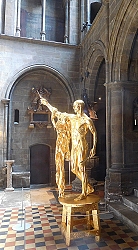
ONE OF LONDON’S FEW remaining pre-1666 (Fire of London) buildings is the church of St Bartholomew the Great close to Smithfield Market. Founded in the 12th century, the building has many Norman (Romanesque) features. It also contains some contemporary artefacts including “Colloquy” (a work made from glass) by Sophie Arkette, and “St Bartholomew. Exquisite Pain” (a work in gilded bronze) by Damien Hirst.
By Damien Hirst
Beyond the chancel at the east end of the church there is the spacious Lady Chapel. During the Reformation (after about 1529), this part of the church was closed off from the rest of it, and used as commercial premises. In the 18th century, it was used as a printer’s workshop owned by Mr Palmer. Benjamin Franklin (1706-1790), one of the founding fathers of the USA, worked as an apprentice in this printing works in 1725. Then, he was lodging nearby in Little Britain. While he was working in the converted Lady Chapel, he wrote his philosophical pamphlet, “A Dissertation on Liberty and Necessity, Pleasure and Pain.” Franklin wrote:
“At Palmer’s I was employed in composing for the second edition of Wollaston’s “Religion of Nature.” Some of his reasonings not appearing to me well founded, I wrote a little metaphysical piece in which I made remarks on them. It was entitled “A Dissertation on Liberty and Necessity, Pleasure and Pain.” I inscribed it to my friend Ralph; I printed a small number. It occasion’d my being more consider’d by Mr. Palmer as a young man of some ingenuity, tho’ he seriously expostulated with me upon the principles of my pamphlet, which to him appear’d abominable.”
The workshop was purchased by the church and restored as a Lady Chapel in 1897. An information panel next to it provides its history and connection with the young Franklin. It was by pure chance that I came across this London link with the American Revolution on the 4th of July.
IT IS ALWAYS FUN TO MAKE new discoveries. Yesterday, we braved incessant rain and the mist on the motorway to drive to Compton Verney House in Warwickshire, the county where William Shakespeare was born. Our main reason for visiting this lovely 18th century house was to see a special exhibition devoted to the works of the German artist Lucas Cranach the Elder (c 1472-1553). He was born in Kronach in the then predominantly Roman Catholic Holy Roman Empire. He was an extraordinarily successful painter. Also, he was a prosperous businessman: he had his own printing business and was also an apothecary. Cranach painted religious as well as mythological subjects in addition to court (and other) portraits.
Cranach became the court painter for the electors of Saxony in the town of Wittenberg. The electors in Wittenberg were supporters of Martin Luther (1483-1546), a professor of theology (at the University of Wittenberg) who rejected Roman Catholicism and became a ‘father’ of Protestantism. When Luther arrived in Wittenberg in October 1512, Lucas Cranach was already running a prosperous workshop (studio) in the town. Cranach made a portrait (engraving?) of Luther in 1520, which shows the reformer in priest’s garb with his head shaved to create a tonsure. This picture of Luther, when he was still an Augustinian monk, was not on display at Compton Verney. However, one room of the exhibition is dedicated to prints (designed by Lucas) and pamphlets (written by Martin) produced on Cranach’s presses. These works were all produced to promote Luther’s then revolutionary ideas.
Cranach’s courtly patrons in Wittenberg were supporters of Luther and Protestantism. The British historian, an expert on the Reformation, Andrew Pettegree wrote (in “Apollo”, 15th October 2016):
“From the beginning Cranach was a firm and important supporter of the Reformation. This was a relationship of mutual respect, mutual affection and mutual benefit. Cranach provided the Reformation with some of its most memorable images…”
Cranach became one of Luther’s important allies:
“… not merely because of his artistic talents. By this point he was one of Wittenberg’s leading citizens, firmly established among the city’s ruling elite. He would play a crucial role in this regard when Luther was absent from Wittenberg in 1521, and over-enthusiastic supporters, led by Andreas Karlstadt, pressed for radical changes to the order of worship that Luther would not have approved. Cranach, civic leader and artistic entrepreneur, was one of the rocks on which the Wittenberg Reformation was built. He also had the managerial skills and resources to conceive a solution to the problem that might otherwise have stopped the Reformation in its tracks: how to build a mass movement from a small place with extremely limited infrastructure.”
Part of that solution was Cranach’s high-quality printing works that were able to produce large editions of publications either written by Luther or by authors promoting his cause. The exhibition at Compton Verney has several examples of Cranach’s printed pro-Luther propaganda tracts and prints on display. In one of them, facing pages depict the contrast between Protestantism and Catholicism. For example, an image of the pure Christ rising towards Heaven faces an image of the corrupt Pope burning in Hell. For those not able to read, this was a graphic illustration of Luther’s objections to Catholicism.
In 1521, Luther was excommunicated by Pope Leo X. Four years later, Luther, the erstwhile priest who had taken the vows of celibacy, decided to marry. His bride was Katherine von Bora (1499-1552), a nun who had fled to Wittenberg from a convent near the town of Grimma along with eight other nuns. Luther had undertaken to find them husbands or to find families for them to join so that they could enjoy ‘normal’ lives. At first, Katherine joined the household of Luther’s friend Lucas Cranach (the Elder). Luther tried hard to find her a husband. His friends tried hard to get Luther to marry. In the end, he married Katherine. Lucas Cranach was one of a few close friends who were present when Martin and Katherine took their wedding vows. Luther’s Roman Catholic enemies were quick to claim (according to Richard Marius in his “Martin Luther”) that:
“… all Luther ever wanted was sex, and since he had married a former nun, it seemed he had now lived out yet another of the bawdy stories told of nuns and monks lusting for one another…”
Popular legend of the time predicted that the Antichrist would be born to a monk and a nun, but Erasmus (1466-1536) wrote in connection with this:
“How many thousands of Antichrists had the world already known!”
Katherine and Martin produced six children. Cranach married Barbara Brengbier. They had several children including Lucas Cranach the Younger (1515-1586), the painter, one of whose works is displayed in the exhibition at Compton Verney. In 1517, Luther stood as a godfather to the last of Cranach’s children. Later, when Luther married, Cranach became godfather to some of his children.
Before visiting Compton Verney, I was already familiar with the fine paintings of Lucas Cranach the Elder, but I had no inkling of Cranach’s close connection with Martin Luther and the promotion of Protestantism. Also, I did not know that Cranach had had other business interests apart from producing works of art. I came away from the splendid exhibition at Compton Verney pleased to have had my eyes opened to an important episode of history about which I was only dimly aware.
Travelling to Compton Verney on a rainy day fulfilled what Mark Twain wrote in his 1869 book “Innocents Abroad”:
“Travel is fatal to prejudice, bigotry and narrow-mindedness, and many of our people need it sorely on these accounts. Broad, wholesome, charitable views of men and things can not be acquired by vegetating in one little corner of the earth all one’s lifetime.”
In other words, travel broadens the mind. Our journey to Compton Verney did, despite inclement weather conditions, did precisely that.



 yamey
yamey 