In most churches, one can light candles when saying prayers.
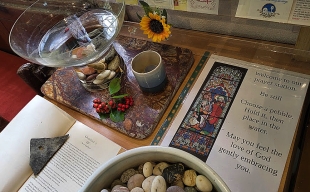
At St Winnow in Cornwall, we noticed something quite different. A bowl filled with water was standing on a table next to a bowl filled with pebbles. Those wishing to make a prayer, are invited to take one of the stones and place it into the water, instead of lighting a candle. We were told by someone working in the church that the stone dropping is a Celtic Christian tradition. I have since read that it might also have been a pagan tradition.
THE WORD AARTI is from the Sanskrit language. It means ‘something that removes darkness’. In many pujas (Hindu ceremonies), an aarti is performed: it involves presenting a flame to appease the deity or deities.
One evening, we were walking along the bank of the Hooghly (a part of the holy Ganges river that flows through Kolkata) just after sunset. We came across rows of plastic chairs facing the river at Babughat (one of the stepped landings used by people bathing in the river). Between them and the water there was a row of altars. We asked someone the reason for the chairs. We were informed that they were set up so that people could watch the daily Ganga Aarti, which was due to happen at 530 pm. Our daughter, who had witnessed a Ganga Aarti at Varanasi, persuaded us to wait and watch the forthcoming aarti.
We sat down and joined the other spectators. While we waited, several hawkers walked along the rows of chairs, selling snacks of various kinds, both packaged and prepared to order (for example, jhal muri – puffed rice with flavourings). One hawker carried a tray on which a small lamp (a diya) was flickering. For a small cash offering, he blessed the ‘customer’ and placed some prasad (blessed food) into his or her right hand. Meanwhile, rotating spotlights and piped music added to the festive atmosphere. Gradually, all the seats were occupied, and many people were standing nearby on the sides of the ghat.
At 5.30 pm, priests dressed in shiny gold robes with wide sashes over their left shoulders began assembling, one in front of each of the altars. The latter were illuminated with hoops carrying brightly lit electric light bulbs. Then, the ceremony began.
A pandit, dressed in white, speaking into a handheld microphone chanted prayers in Sanskrit. As he was doing this, the gold clad priests performed several visually exciting activities. These included moving containers emitting clouds of smoke. They swung them and moved them in circles, each man in synchrony with the others. After this, they did much the same thing with candelabras each carrying many small flaming oil lamps (diyas). These were then replaced by larger flaming lamps, each of which had handles shaped like cobras ready to attack. After the balletic flame movements, the flaming lamps were carried down to the water’s edge. I could not see whether they were immersed in the river.
In addition to the movements with the flaming lamps, large conch shells were washed through with water, some of which was sprinkled on the crowd. The conches were also blown to produce a sound indistinguishable from the horns on the locomotives of the trains running every few minutes on the suburban railway track that was a few feet behind where the ceremony was being performed.
I am very pleased we waited to watch the Ganga Aarti. Apart from being more spectacular than many theatrical performances I have seen, it was very moving. It is yet another example of how much more vibrant and fervent religious ceremonies are in India than they are in most parts of Europe.
THE PUARESHWAR MAHADEV Shiv temple is about 24 miles west of Bhuj. Built about 1200 years ago, it is possibly the oldest surviving Hindu temple in the Kutch region of Gujarat. Partially restored, this attractive small mandir is still in use but has lost most of its roof.
At Puareshwar
As we approached the temple, I noticed that near it, there were numerous small piles of stones. Each of the precarious looking piles consisted of several rock’s or fragments of masonry piled carefully, one on top of another. I asked our driver, who had suggested we visit this temple on our way to Narayan Sarovar, about these small piles. He said that they were constructed by people, praying to obtain or build a home of their own.
After visiting, Narayan Sarovar, its lake and mandir, we stopped to see the mandir at Koteshwar, which is on a spit of land near India’s border with Pakistan. Outside this temple, there were many piles of stones just like we had seen at Puareshwar.
Although I have visited many Hindu temples in India during 30 years of travelling to the country, it was only yesterday, the 27th of November 2023, that I first became aware of these small stone offerings. According to one online article I found (https://medium.com/six-word-photo-story-challenge/prayer-stone-stacks-a-belief-b7fc0edc5d9a), stones are piled outside temples all over India by people hoping to build their own homes. I will now look out for them whenever I visit a mandir.
CALL ME UNINFORMED but until the afternoon of the 22nd of April 2022 when I attended a service in Westminster Abbey, I had thought that Sidney Sussex College in Cambridge was named after someone called Sidney Sussex. Now, I know better.
On the 22nd, we attended choral Evensong in Westminster Abbey. The choir was that of Sidney Sussex College, and they sung well despite the not too brilliant acoustics in the huge church. After the service, a select group of us, consisting mainly of people associated with the College, moved over to a small side chapel behind and north of the High Altar: The Chapel of St Paul. When we were all crowded into the small chapel, already filled with funerary monuments, the choir of Sidney Sussex squeezed in. They sung a short mass, and then the Master of the College laid a floral wreath at the foot of the monument to Frances Sidney, Countess of Sussex (c1531-1589). This ceremony, commemorating the founding of Sidney Sussex College, has been performed annually since her death.
Frances Sidney, aunt of the poet Phillip Sidney (1554-1587), was a philanthropist. She had inherited a great deal of money when her husband Thomas Radcliffe, Lord Fitzwalter, Lord Deputy of Ireland and from1557 the 3rd Earl of Sussex, died in 1583. One of her many good deeds is recorded on her colourful stone monument in Westminster Abbey. As per tradition, the Master of Sidney Sussex read out aloud the resumé of Frances’s life as recorded on the monument. The part that is pertinent to the college is as follows:
“…By her last will and testament she instituted a divinitie lectur to be redd in this Collegiate Church and by the same her testament gave also fyve thowsande powndes towards the buildinge of a newe colledge in the Universitie of Cambridge, with sufficient yerelie revenew for the continuall maintenaunce of one Maister, X Fellowes, and XX Schollers, eyther in ye same Colledge or ells in another house in ye said Universitie already builded, comenlie [commonly] called Clare Hall…”
To put it in plainer English, on her death in 1589, she bequeathed £5,000 (worth far more than £ 1 million today) to pay for the building of a new college in the University of Cambridge and to provide an annual revenue sufficient to finance 1 Master, 10 Fellows (i.e., academic teachers) and 20 scholars. The first sentence of the quote states that a “divine lectur” (i.e., prayers) should be said annually in the Abbey. And this is what was being done as we stood assembled in the small chapel. It was a curiously moving occasion especially when the wreath was laid at her monument. Later, one of the clerics who had been present at the ceremony explained to me that not only had Frances Sidney paid for the college, which is named in her memory but also she would have had to pay for the elaborate marble and alabaster monument erected to remember her.
As for the name of the college, Sidney Sussex, this is a shortened version of its full name: The College of the Lady Frances Sidney Sussex.



 yamey
yamey 