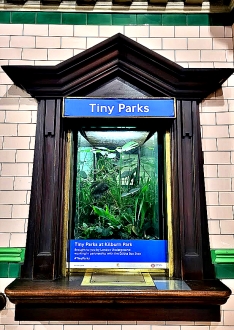
A house of glass
Home to flourishing tropical plants
At Kew Gardens
ONE OF THE characteristics of a living organism is the ability to reproduce itself. Pollination of plants is an important stage in maintaining the survival of a species.
Yesterday (the 15th of May 2024), we saw a curious tree at Kew Gardens. It looked as if it had both green and white leaves. It is a Handkerchief tree (Davidia involucrata). The white appendages are not leaves but bracts. They form for about a fortnight each year, and serve to increase the chances of the tree’s flowers being pollinated.
I ALWAYS ENJOY visiting Bushy Park, which is near to London’s famous Hampton Court Palace. Parts of the park are unenclosed, where plenty of deer roam at liberty. Other parts – the Pheasantry and Waterhouse plantations – are enclosed by fencing to keep the deer excluded.
The plantations contain a rich variety of plants and trees, all of which are a joy to see. There are two types of plants that never fail to fascinate me. One of these is the swamp cypress trees (Taxodium distichum). What makes them interesting is their aerial roots (known as ‘Cypress Knees’), which look like small woody stalagmites or tapering tree trunks. You can see rows of these stumpy aerial roots lining the stream near to the Pheasantry Café. According to a web article (www.graftingardeners.co.uk/trees-of-bushy-park/), these trees were:
“Once native to Britain, there have been ancient remains of this tree species found in Bournemouth. However, the swamp cypress was reintroduced to Britain by John Tradescant the Younger in 1640 … When the ground is particularly waterlogged, the swamp cypress tree grows pneumatophores. These are like knobbly woody stumps that grow out of the ground and serve as a sort of snorkel.”
Skunk Cabbage flowers
The other plant that stands out in my mind is known as Skunk Cabbage. With yellow flowers that slightly resemble Arum lilies, the Skunk Cabbage (Lysichiton americanus) is believed to emit an odour similar to that of skunks when it blooms. The smell is attractive to pollinators. The plant, although interesting to look at is a potential pest, as I found out on a website that deals with invasive species (www.invasivespecies.scot/american-skunk-cabbage):
“The large leaves and dense stands of the plant lead to it out-competing smaller plants due to its shading effect and can cause extensive damage locally to native flora including vascular plants and mosses. It can grow in shade or full-light and in a range of different soil conditions and thrives in disturbed environments. Given the popularity of this plant in gardens and its continued introduction into the wild, the problems are likely to increase. Although initial invasions will expand slowly, once this plant takes hold it can spread rapidly and become a serious problem.”
We saw the Skunk Cabbage in various stages from bud to full bloom when we visited Bushy today (the 24th of March 2024), but could not get close enough to the flowers to smell the odour from which they have got their name. I had noticed these plants before, but until today I did not know what they are.
Seeing curious plants such as the Swamp Cypresses and the Skunk Cabbage, which, incidentally, is edible if its root is roasted and dried, adds to the pleasure that is gained from seeing Bushy’s less strange plants such as daffodils, camellias, rhododendrons, and so on. Visiting the park and its gardens is well worthwhile, but get there early in the morning to ensure finding a place in the car parks.
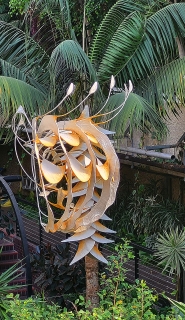
I ENJOY SEEING SCULPTURES displayed in gardens or other plant-filled locations. Until March 2024, the wonderful conservatory in London’s Barbican Centre is hosting a selection of sculptures by Ranjani Shettar. She was born in Bangalore (Bengaluru, India)) in 1977, and now lives and works in rural Karnataka. Her current exhibition in the Barbican is called “Cloud Songs on the Horizon”. The works on display were made especially for this site.
Her works are made of various materials (wood, stainless steel, muslin, and lacquer) and she employs techniques that have been adapted from traditional Indian crafts. Ms Shettar’s organic sculptures look like magnified plants or parts of plants. As she said once:
“Nature’s beauty is ever present, art helps to uncover, perceive and appreciate it.”
Seeing her exhibits in the Conservatory, certainly confirms this. However fine the artworks, putting them amongst plants helps emphasise the greater beauty of nature’s creations. The beauty of the sculptures competes with that of the plants, but the latter almost always win. So, placing one’s artworks within an area rich in plant life is a brave thing to do. I felt that Ms Shettar had done it successfully. Her creations have a harmonious relationship with the plant life surrounding them.
Whether or not you visit the exhibition, which I enjoyed, seeing the Barbican’s Conservatory – the second largest in Greater London – is always a worthwhile experience.
A TALL MINARET OVERLOOKS Ebrahim Saheb Street in Bangalore’s busy Commercial Street bazaar district. Not far from the lofty structure stands the premises of a printing firm called Sundaram. It is here at this efficient enterprise that I have often had visiting (business) cards printed.

Recently, I went to Sundaram’s to collect my latest batch of cards. While I was waiting to have them packed, I noticed a man in the shop, folding what looked like A3 sized sheets of plain white paper. He folded them in half lengthwise. I asked him what he was doing, and he replied:
“Seed papers”
I must have looked puzzled because the owner of the business added:
“You put them in the ground and plants will come. You leave them in the ground after plants have come. The papers have seeds in them.”
He told me that these seed papers were made in Coimbatore, a town south of Bangalore. Then, he went to the rear of his shop and brought me a few offcuts of the seed paper.
The paper is quite thick and rather stiff. It has a slightly rough surface. When you examine it you can see well spaced, small darkish thickenings. These spots are the seeds, which have been incorporated into the biodegradable paper.
Not being a gardener, I had not come across seed paper before. It has been around for many centuries. Until 1941, it used to be handmade in small batches, but after that year it began to be made on an industrial scale.
The paper can incorporate a variety of seeds from flowers to edible plants. I suppose that the advantages of seed papers include appropriate spacing of seeds and protection from consumption by birds etc.
When I entered Sundaram’s to pick up my cards, little did I expect to learn about seed paper, or to discover horticultural material being processed in a printing shop. It is surprises such as these that make visiting India so much fun.
FUNCHAL IN MADEIRA is famed for its glorious gardens, which can be visited by members of the public. Actually, the whole city is filled with so many flowering plants and trees that it is almost like a huge garden. Nevertheless, we decided to see one of the gardens for which the city is known. We chose the Palheiro Gardens, which are located about 500 metres above sea level.

To reach the gardens, we took local bus number 37 from the Pingo, a square near the Mercatos Lavradores. While waiting for the bus to depart, we began chatting with another passenger, a lady who spoke English with a Germanic accent, who last visited the Palheiro 18 years ago. It turned out that she is from Lichtenstein. As far as I can recall, she is the first person from that tiny country next to Switzerland with whom I have ever spoken.
The bus trip up to the Palheiro is spectacular. The road winds ever upwards along the edges of deep ravines. As the road ascends, there are many dramatic views of Funchal and its bay.
The gardens are well-tended and are laid out in a seemingly informal way, in the English garden style. The gardens flourish on slopes overlooking the city far below and a golf course nearby. I do not know enough about trees and flowers, but suffice it to say that the place provides a colourful feast for the eyes.
The Palheiro gardens are laid out in the former estate of the wealthy Count of Carvalhal. The place was purchased in 1885 by the Blandys, a family of British entrepreneurs, bankers, makers of Madeira wine, and merchants who have been important in the development of Madeira’s economy. Part of the gardens retain features laid out by the Count in the 18th century, but much of the rest of the grounds have been developed since then.
Being at about 500 metres, the garden is noticeably cooler than in the centre of Funchal. In fact, during our visit, we were close to the clouds and occasionally felt the moisture contained within them. I am pleased that we visited the Palheiro, but feel that given the profusion of lovely plants all around Funchal, I wonder whether visiting gardens like this one is a ‘must do’ activity unless you have a special interest in gardens and gardening.
The journey between Funchal and Palheiro and my first meeting with a person from Lichtenstein enhanced my trip to the gardens.
REMNANTS OF LONDON’S ROMAN wall can be seen from various points in the Barbican Estate, whose construction began in 1965. The not entirely unattractive residential brutalist concrete jungle, known as The Barbican is sited next to the northern edge of what was formerly Roman Londinium. According to a history of the area (www.cityoflondon.gov.uk/services/barbican-estate/barbican-estate-history):
“The name of the Barbican comes from the Low Latin word ‘Barbecana’ which referred to a fortified outpost or gateway: an outer defence of a city or castle or any tower situated over a gate or bridge which was used for defence purposes. The “Barbecana” was probably situated somewhere between the northern side of the Church of St. Giles Cripplegate and the YMCA hostel on Fann Street.”
By the 1850s, the district of Cripplegate, where the Barbican is located, was very crowded with dwellings and business premises. Much of the area now occupied by the Barbican had been destroyed by bombing during WW2. The Estate was built to replace what the Luftwaffe had destroyed.
Apart from several water features, there is one oasis of greenery on the otherwise extremely urban site. This is the Barbican Conservatory. Opened in 1982, it is located above the Barbican’s main theatre and can be entered through an entrance close to that of the Barbican’s Art Gallery. Despite it having been in existence for so many years and having known about it for several decades, it was only yesterday (6th of April 2022) that I first ventured inside it. We had just viewed the current exhibition in the Gallery, “Postwar Modern: New Art in Britain 1945-1965”, an impressive display of rather unexciting artworks. Entering the Conservatory was literally “a breath of fresh air” after viewing the exhibits that had been arranged to illustrate the depressing emotional aftermath of WW2 as depicted by artists in Britain.
I was surprised to learn that the Barbican Conservatory is:
“… the second largest in London (after Kew Gardens) and home to over 1,500 species of plants, but is one of the city’s lesser-known green spaces.” (www.atlasobscura.com)
Apart from the plants, many of them exotic, which are arranged on various levels and can be viewed from both a lower floor and an elevated walkway, there are three ponds. One contains koi carp and the other, raised above ground level, is home to two terrapins, which were found in ponds on Hampstead Heath. The Conservatory is divided into two main sections. The larger is the tropical section, where visitors are permitted to wander about. The other, which was locked up yesterday, is the arid section, containing cacti and succulents.
Despite being in the midst of a manmade, visually intriguing, but harsh urban environment, the Conservatory with its tall trees, bushes, flowers, and other vegetation, feels like another world – a primaeval paradise from which the modern world can be glimpsed in the background.
SOME OF LIFE’S PLEASURES are seasonal. Such is the case for the explosion of colour that can be seen in the Isabella Plantation in London’s Richmond Park. During late April and most of May, the azaleas and rhododendrons in the Isabella burst into flower. These alongside many other flowering plants, including seas of bluebells, provide a sumptuous banquet of colour for the visitors’ eyes. It is not so much the immense number of flowers that provides so much joy but the way the shrubs and other plants have been planted that creates a visual experience that easily rivals the best of fireworks displays. Even if I were able to express myself better in writing, words cannot possibly recreate the experience of seeing the Isabella Plantation in full bloom. Although I am keen on photography, I feel that even good photographs of the place can only hint at the impact of seeing the flora in real life. In brief, if you can, you must try to visit the plantation when the blooms are at their most magnificent.
The Plantation is in the southwest part of Richmond Park, not far from both the Robin Hood and Kingston Gates. The latter is open to motor traffic currently (May 2021). Richmond Park was a royal deer park, a hunting ground, established by the 14th century when it was part of the Manor of Sheen (https://historicengland.org.uk/listing/the-list/list-entry/1000828). King Henry VII was particularly fond of the park, which he named ‘Richmond’ after his earldom in Yorkshire (Richmond is a town in that county). He also had a palace built there, of which precious little remains because by the Restoration of the Monarchy in 1660, it was already dilapidated and was never rebuilt. In its heyday, it was one of the few places fitted with a flushing lavatory. This was installed by Queen Elizabeth I’s godson, Sir John Harington (baptised 1560- died 1612; https://en.wikipedia.org/wiki/John_Harington_(writer)).
The history of public access to the park is of interest (www.trpg.org.uk/perch/resources/newsletter-005.pdf). Between 1637 when King Charles I enclosed the park and the 1730s when Robert Walpole forbade it, there was pedestrian access to the park. In 1758, a certain John Lewis (1713-1792) won a court case that re-established the right of some public access to the paths and roadways within the park. By the mid-19th century, the public could drive their carriages through it. Today, its roadways are popular both with cyclists and motorists.
The history of the Isabella Plantation is detailed on the website of The Royal Parks (www.royalparks.org.uk/), from which I obtained the following information. By the 17th century, the waterlogged area in the south west corner of Richmond Park was known as ‘The Sleyt’, a sleyt being a word for boggy ground or an open space between woods and banks. The area where the Plantation is today was marked as ‘Isabella Slade’ on maps published by 1771. The name Isabella either referred to a lady with that name, or, more likely, it was a corruption of the word ‘isabel’, which as far back as the 15th century meant ‘dingy’ or ‘greyish yellow’, which is the colour of the soil in the area of the park where the Plantation is located.
A Deputy Park Ranger, Henry Addington, Lord Sidmouth (1757-1844), fenced off an area of 42 acres of the Isabella Slade in 1831, planted various kinds of trees for timber, and gave the land its present name, ‘Isabella Plantation’. Sidmouth, a Tory politician, was briefly Prime Minister at the beginning of the 19th century, lived in the White Lodge of Richmond Park from 1801 until his death (https://whitelodgetimeline.royalballetschool.org.uk/1800/item/161/). He had been given it as a residence by King George III, who appointed himself the park’s Ranger and Sidmouth his Deputy. Currently, the White Lodge houses The Royal Ballet school.
Getting back to the Plantation as we see it today, it was created chiefly by the work of the Park Superintendent, George Thomson, done between 1951 and 1971. The Royal Parks website explains that:
“The present garden of clearings, ponds and streams was established from the 1950s onwards. It is largely the work of George Thomson, the park superintendent from 1951-1971. Along with his head gardener, Wally Miller, he removed Rhododendron ponticum from large areas and replaced it with other rhododendron species. They established evergreen Kurume Azaleas around the Still Pond and planted other exotic shrub and tree species.”
The Plantation has three ponds, of which the Still Pond is the most spectacular. Surrounded by azaleas and Rhododendrons, its waters are still, that is they are mirror-like. The flowers of the shrubs surrounding the water are reflected in the water, producing a delightful and dramatic visual effect. The other ponds, Peg’s Pond, and one named after Thomson, have their own charms but lack the drama of the Still Pond. Streams and rivulets lined with ferns and other plants flows across the Plantation. The longest stream was dug in 1960 and includes Peg’s Pond.
So far, we have visited the Isabella Plantation three times. Twice, we saw it in its full floral glory and once a few months before the flowering began. Timing is important if you want to enjoy the full floral impact. So, get there in late April or during the first few weeks of May in order to best experience the forms, colours, and fragrances of this beautiful collection of flowering shrubs.