A visitor from Persia in a house in Sussex

PETWORTH HOUSE IN West Sussex is a huge palace maintained by the National Trust. It contains an unbelievably remarkable collection of old master paintings, including many by Joshua Reynolds, JMW Turner, and Anthony Van Dyck (1599-1641). The paintings and many sculptures were collected by the 3rd Earl of Egremont, George O’Brien Wyndham (1751–1837), who was a patron of JMW Turner and John Constable, both of whom were regular visitors at Petworth House. When we visited the house in August (2024), we saw the paintings by Turner, but did not notice any by Constable. A full list of the paintings in Petworth is listed at: www.wikidata.org/wiki/Wikidata:WikiProject_sum_of_all_paintings/Collection/Petworth_House .

While viewing the overwhelmingly splendid artworks at Petworth, a pair of paintings by Van Dyck intrigued me. Painted in 1622, one depicts Sir Robert Shirley (1581-1628), and the other his wife Lady Theresia Shirley (1589-1668). They are fine portraits, but what interested me was the lives of these two people.

The Safavid dynasty ruled Persia from 1501 until 1736. In 1598, Robert Shirley travelled to Safavid Persia with his brother Anthony to train the Shah’s army in the military techniques used by the English army. It is not clear who put the idea of visiting Persia into the minds of the Shirleys. One suggestion is that it was mooted by the Venetians. The modernisation of the military supervised by the Shirley brothers improved the fighting ability of the Persian army to such an extent that they were able to score a great victory in a war between the Safavids and their Ottoman neighbours in 1612.  After Anthony left Persia (in about 1600), Robert stayed behind with 14 other Englishmen. In 1607, he married Sampsonia, whose portrait by Van Dyck hangs in Petworth. She was a Christian lady born into the Circassian nobility of Safavid Persia. After being baptised, she added the name Teresia to her own name, and became known as Lady Teresia Sampsonia Shirley.

The Safavid Shah Abbas (ruled 1587-1629) sent Robert to England in 1608 to encourage King James I to join a confederacy against the Ottoman Empire. While in Europe, Robert visited other rulers for the same reason. Between 1609 and 1613, he lived in Spain. His wife travelled from Persia to join him there.  Between 1613 and 1615, Robert was back in Persia. Then, he returned to Europe, and resided in Spain.

It was in Rome in 1622 that Van Dyck painted the portraits of Sir Robert and Lady Teresia now hanging in Petworth. They were dressed in lavish Persian clothes. It has been suggested that these ‘exotic’ outfits attracted Van Dyck, but by 1622 this couple were already sufficiently celebrated to be worthy of the artist’s attention regardless of how they were attired.  

Shirley’s final visit to Persia was in 1627, when he accompanied Sir Dodmore Cotton – England’s first ambassador to Persia. However, soon after arriving there, he died in Qazvin (now in northwest Iran). His wife took his remains to Rome in 1658. She retired to a convent in that city, and lived there until her death.

I have discussed only two of the multitude of paintings at Petworth. Most of the others we saw there were not only by great masters, but also worthy of study. Although the design of the rooms in Petworth is not as spectacular as in many other stately homes, the collection within it deserves a leisurely visit. And as there is so much to see in the way of artworks, the visitor should plan to spend several hours there. We were there for three hours and that was hardly long enough.

A horse trader from Persia and his life in Bangalore

MR HUSSAIN WAS a charming old gentleman full of ‘joie de vivre’, even when infirmity confined him to his bed. A retired businessman, we knew him as ‘Mahomet Uncle’. He was a Kutchi Memon (a Muslim whose ancestors had migrated from Kutch – now a part of Gujarat – to Karnataka). He was immensely popular. His many friends and relatives used to visit him to enjoy his company and to share their news. Once, near the end of his life, we went to his house to wish him ‘Eid Mubarak’ at the end of Ramazan. While we were in his bedroom, where he used to ‘hold court’, a seemingly endless stream of people passed through his front door to celebrate the occasion with him. His death was a great loss not only to his family but also to a vast number of people in Bangalore, who knew and loved him.

We were introduced to Mahomet Uncle by one of his sons who was studying in London at the same time as my then future wife, Lopa, and I were undertaking post-graduate courses. Mahomet Uncle lived in a house on Aly Asker Road Cross, a quiet lane close to the busy Cunningham Road. The Cross road is an offshoot of the larger Aly Asker Road. We have often travelled along this thoroughfare, not only to visit Mahomet Uncle but also other friends who live close by. In addition, when returning from the excellent Shezan Restaurant (on Cunningham Road) to the Bangalore Club, where we often stay, the best route is along Aly Asker Road.

For many years, I have wondered about Aly Asker and why a road should have been given his name. The answer was provided only recently, at the end of January 2024 just before we flew from Bangalore back to London. My friend Subhash Agarwal, with whom I often enjoy an afternoon cup of tea on the lawn in front of the main building of the Bangalore Club, knowing of my interest in the history of Bangalore, kindly presented me with a book, which has the title “Agha Aly Asker”.  Published in 2019, it was written by Syeda Mirza, the wife of Aly Asker’s great grandson. The book is well-researched and a pleasant, compelling read. Apart from detailing his life, the author gives many insights into the traditional Persian ways of life.

Aly Asker, a Persian, was born in Shiraz (Persia) in 1808. In 1824, along with his two brothers, he set off for India to sell horses to the British military. They travelled with 200 horses by sea to Mangalore, and then travelled overland to Bangalore. The brothers left him and the horses in Bangalore, where he began selling them to the army of the East India Company. The business was successful, and he imported more batches of horses to sell. Ali Asker became a successful businessman and was befriended by Sir Mark Cubbon (1775-1861), who was the Chief Commissioner of Mysore between 1834 and 1861. Amongst Cubbon’s many achievements were the introduction of Kannada and Marathi as the official state languages, instead of the formerly used Urdu, Hindi, and Persian.

Cubbon was very fond of horses, and is said to have had up to 60 in his stables. His equestrian interests helped develop his friendship with Aly Asker. As a result, Cubbon asked Aly Asker, who had already built himself a fine bungalow, to build 100 bungalows to accommodate the growing military establishment that was developing in Bangalore. Cubbon offered the land free of charge, but Aly Asker told him that he was happy to pay for it, which he did. The residences were constructed on land near today’s Palace Road, Sankey Road, Cunningham Road, and Richmond Road. Many of these houses no longer exist – Bangalorean property developers seem to value heritage far less than profit. One notable example that still stands is the Balabrooie State Guest House. Aly Asker also owned the land on which the luxurious Windsor Manor Hotel now stands.

Aly Asker’s interest in horses extended beyond trading, He was keen on horse-racing, and is said to have been important in putting Bangalore on the horse-racing map of India. His biographer, Syeda Mirza, includes an appendix in which the many victories of Aly Asker’s horses are listed. He was a frequent visitor to the racetrack in Bombay, and then later in Bangalore.

It was their interest in horses that drew together Aly Asker and another noteworthy person in Mysore State – Mummadi Krishnaraja Wodeyar III (1794-1868), the 22nd Maharajah of Mysore. It was through Aly Asker’s help that the British were encouraged to allow the Maharajah’s adopted son Chamarajendra Wadiyar X (1863 – 1894) to become his successor on the throne. Initially, the British, who effectively ruled the state, were reluctant to recognise him as the successor, and it was partly due to the gifts that Aly Asker chose for Queen Victoria that changed their mind in his favour.

Aly Asker died in Bangalore in 1891. He is buried in a cemetery near to the city’s Hosur Road. This is a Persian Cemetery that stands on land granted to Aly Asker and his heirs in 1865. His simple grave is beside that of his wife, and is shown in in a photograph in Mrs Mirza’s book. She noted that he established Bangalore’s first Shia Muslim community. It was when he married Sheher Bano that the first Muharram rituals were first observed in the city. In his will, Aly Asker left money to build the Masjid-e-Askari. It was built in 1909, and still remains as the city’s oldest Shia mosque.

So, having read Syeda Mirza’s book, I now know why there are roads in Bangalore named after Aly Asker. In addition to detailing his life in, and contributions to, the development of Bangalore, Mrs Mirza also described the exciting journey that Aly Asker made between his native land and India. Oddly, Aly Asker does not appear in the index of the authoritative history of Bangalore. “Bangalore Through The Centuries” by M Fazlul Hasan (publ. 1970). In a later (2014) comprehensive history of the city, Maya Jayapal makes one mention of Aly Asker Road, but gives no description of Aly Asker’s contribution to the story of Bangalore. It is therefore valuable that Syeda Mirza took the trouble to write about Aly Askar. As her book bears no ISBN number, and I could not find it either on Amazon or the much wider ranging bookfinder.com, it might well have been privately published, and is now probably quite a rare volume. I am very grateful to Subhash Agarwal for gifting me this informative book – a window on a hitherto poorly described aspect of Bangalore’s history.

Some Islamic figurative art in the Victoria and Albert Museum

THE VICTORIA AND Albert Museum (‘V&A’) in London’s South Kensington is one of my favourite museums. It contains a huge variety of exquisite artefacts. Some of them were obtained by fair means, and others, such as Tipu’s Tiger (an 18th century mechanical toy), by means that some might consider foul. I do not propose to write about the current discussions on the ethics of museum collections, but instead I will concentrate on some interesting tiles that arrived in the museum from Persia, where they were made during the Safavid Dynasty that was established in 1501 AD, and lasted until 1722.

The 36 tiles, arranged in 4 rows of 9, together depict a garden in which a lady is reclining with her 5 attractively dressed attendants around her, all wearing headgear: their uncovered faces are portrayed fully. This tiled panelling might have been originally made as part of an extensive architectural project in early 17th century Isfahan, the capital of the Safavid Dynasty. Other similar tiled panelling can be found in the Metropolitan Museum of Art in New York City, so wrote Farshid Emami in his paper “All the City’s Courtesans: A Now-Lost Safavid Pavilion and Its Figural Tile Panels” (published in the Metropolitan Museum Journal in 2019). The panel is shaped so that it could be fitted beneath a window.

The Safavid Dynasty was Islamic. Unlike many other groups in the Islamic world, which discourage or forbid figurative representation, the Safavid rulers, who were great patrons of the arts, developed a dynastic artistic style in which the depiction of human figures played an important role. The tiles that are on display are a fine example of this. According to the V&A’s website (https://collections.vam.ac.uk/item/O93167/tile-panel/) these tiles were:

“Bought from L.S. Myers, 6 Savile Row, for £275…”

Myers & Co, which flourished at the above-mentioned address in the 19th century, usually dealt with prints. “A Biographical Dictionary of Nineteenth Century Antique and Curiosity Dealers” by MW Westgarth (publ. 2009) revealed:

“Abraham Myers (born c1815/16) traded as a curiosity dealer in Old Bond Street and at New Bond Street, London, from the 1850s. Myers is listed as ‘antiquary dealer’ at 179 New Bond Street in Kelly’s Directory, 1878 and 1886 and at 6 Savile Row in 1886–91.”

So, assuming that LS Myers was associated with this firm, the tiling might well have been bought between 1886 and 1891.

Every visit to the V&A, which might take much of a lifetime to explore fully, is exciting because each time I visit the place, I discover something fascinating, which I had not noticed before. These tiles are no exception to this.

A Persian carpet and a Socialist

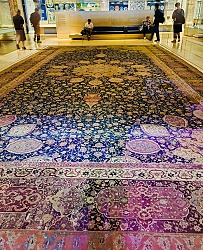
The Victoria and Albert Museum houses a huge, antique carpet from Ardibil (in Persia).It was made in about AD 1539, and is one of the oldest accurately dated carpets.

You will need to read my book “Beyond Marylebone and Mayfair: Exploring West London” to discover the link between this carpet and a Socialist activist, who lived in Hammersmith.

Buy your copy of my book at Lutyens & Rubinstein (Kensington Park Road) OR from Amazon (https://www.amazon.co.uk/BEYOND-MARYLEBONE…/dp/B0B7CR679W/)

A well hidden treasure and a film from Iran

FROM THE STREET, the Gate Cinema in Notting Hill Gate does not look like much from the aesthetic viewpoint. However, although the box-like building containing the cinema is typical of unexciting 1960s architecture, the auditorium is a real treasure. Its beautifully decorated interior was converted in 1911 from a former Italian restaurant, which had been designed in 1861 by William Hancock. The ceiling is adorned with plaster mouldings depicting fruits and foliage. The dull exterior housing this lovely auditorium contains in addition to the cinema, the foyer, and offices. It was built in 1962 by the architects Douton and Hurst. Unlike the walls and ceiling, the seating in the cinema is modern and comfortable. One small problem is that there is not much of a rake so that if you are unlucky enough to have someone tall in front of your seat, your view of the screen might be obstructed if you do not lean to the left or right.

To celebrate the 1st of August (2022), we watched a prize-winning film made in Iran in 2021. Its title (in English) is “Hit the Road”, and it is a ‘road movie’. Its four main actors, who are the characters making a long journey across Iran, are superbly credible. Although it portrays the stunning landscapes of Iran beautifully, there is much more to it. Subtly and intelligently, it reveals how delicately the filmmakers view the sophisticated nature of Iranian life and culture. It is easy to make the mistake of viewing Iran solely as a menace and threat to western civilisation. This film and others that I have seen, which were made in Iran after the downfall of the Shah’s regime, might occasionally have aspects critical of the current status quo, but they also demonstrate that the great cultural heritage for which Persia has been known for many centuries persists today. “Hit the Road” does allude delicately at several problems that plague Iran today, but so gently are these allusions made that they were either missed or ignored by the censors in the country where the film was made.

“Hit the Road” should not be missed. If you are in London, why not see it at the Gate, and before the lights dim enjoy the well-conserved early 20th century décor of the auditorium.

A place of refuge

THE ROAD FROM SURAT TO BOMBAY runs through flat terrain with many industrial establishments until it is within a few miles of the border between Gujarat and Maharashtra, a frontier that did not exist before 1960, when the former Bombay State split along linguistic lines into Gujarat and Maharashtra. Beyond the border, the countryside changes suddenly and dramatically, becoming hilly, greener, and much more rustic.

We stopped at Sanjan, a small town near the Arabian Sea and just within Gujarat. In 689 AD, some boatloads of Zoroastrian refugees, fleeing from the Moslems in Iran landed at the, port of Sanjan. The local Indian ruler gave them sanctuary. Thus, began the Parsi community in India.

Sanjan today is a small rather untidy country town surrounded by Arcadian landscape. The modernistic Parsi agiary (fire temple) stands in a walled enclosure at the edge of town close to the Surat to Bombay railway line. It is only open to Parsis.

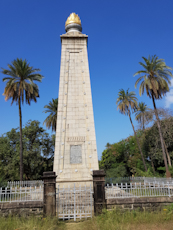
Close to the agiary and open to the public there is a large enclosure dominated by a tall obelisk surmounted by a gold coloured jar from which gold coloured metal flames are modelled. On three of the four sides of the obelisk there are inscribed plaques: one in an ancient Parsi script (maybe Avestan), another in Gujarati, and the third in English. These notices explain that the obelisk was inaugurated in 1920 by Sir Jamsetji Jeejeebhoy. The column was erected to celebrate the arrival of the first Iranian Zoroastrians at Sanjan and their welcome by the Hindu ruler Jadi Rana.

Next to the obelisk, there is a structure containing a Parsi time capsule placed there in 2000. It contains objects that characterise the past and present of the Indian parsi community. It does not mention when the capsule may be opened.

About 50 yards from the monument stands a cluster of buildings. One of them that stands alone is a meeting hall. The other buildings are parts of a hostel (dharamshala) where Parsi pilgrims can stay for 15 rupees per night in simple accommodation. The main room of the hostel contains aging photographs of no doubt eminent Parsis. There is also a bust of Dadabhai Naoroji, one of the founding members of the Indian National Congress.

We left this peaceful flower filled Parsi compound and returned to the National Highway. We stopped for lunch at a roadside restaurant called Atithi (means ‘guest’) and ate a very good mutton dhansak, a Parsi dish containing meat cooked in a gravy rich in dals and spices. We were surprised how excellent it was. A few hours later, we met a Parsi friend in Bombay, who told us that the restaurant is owned by a Parsi.

After crossing the river or large creek near Vasai, which was once a Portuguese possession and port, we entered the region of Greater Bombay. Immediately, the countryside ended and the landscape became urban. We were 70 kilometres from the heart of Bombay. We drove that distance through an uninterrupted built up area containing modern high rise buildings that look over large areas of slums filled with makeshift corrugated iron shacks, most of which have TV satellite dish antennae.

Eventually, we crossed the attractive Rajiv Gandhi Sealink Bridge that connects the suburb of Bandra with the upmarket Worli Seaface. It was not long before we were cruising along Marine Drive, one side of which is the sea and the other a series of buildings that includes many fine examples of Art Deco architecture.

Soon, we became immersed in the social life of Bombay, a tropical version of Manhattan: endlessly fascinating but quite exhausting.