Inspired in the twenty-first century by fifteenth century art

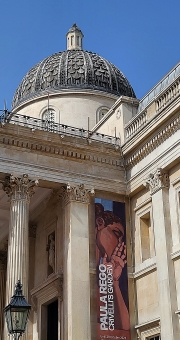
THE WORD ‘INSPIRATION’ has at least two meanings. One of them is ‘to breathe in (i.e., inhale air). When air is inhaled, many of the oxygen molecules it contains are converted to become other substances, some of which is carbon dioxide that is exhaled. Another meaning of the word is to be mentally stimulated, often by something one has perceived in the world around us. What results from this form of inspiration might not much resemble whatever it was that caused it. Today (the 6th of August 2023), we visited a small exhibition in one room of London’s National Gallery. Showing until the 29th of October 2023, the exhibition is called “Paula Rego: Crivelli’s Garden”.

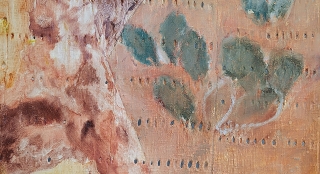
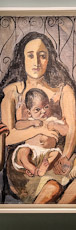
The exhibition contains two major works: “La Madonna della Rondine (The Madonna of the Swallow)” painted in about 1490 by Carlo Crivelli (c1435-1495); and “Crivelli’s Garden” painted in the early 1990s by Paola Rego (1935-2022) when she was the National Gallery’s first Associate Artist between 1990 and 1992. There are also some sketches that Rego made for her enormous painting, originally designed to be a mural.

Both the Crivelli and the Rego paintings are excellent, but quite different in style. However, Rego was inspired to create her mural after seeing Crivelli’s altarpiece. Although both paintings are of religious subjects, there is no obvious similarity between the two of them. As Paola Rego said in 1992:

“If the story is ‘given’ I take liberties with it to make it conform to my own experiences and to be outrageous.”

And that is what she has done after having been inspired by Crivelli’s masterpiece.

The paintings at the base of Crivelli’s altarpiece (the ‘predella’) include scenes set in gardens. According to the National Gallery’s website, what Rego did was to reimagine:

“…Crivelli’s house and garden to explore the narratives of women in biblical history and folklore based on paintings across the collection and stories from the medieval Golden Legend. Her figures inspired by the Virgin Mary, Saint Catherine, Mary Magdalene and Delilah, share the stage with other women from biblical and mythological histories.”

She has populated her picture with portraits of people she knew including (to quote the website again):

“…friends, members of her family and staff at the National Gallery whom she asked to sit for her, including Erika Langmuir, Lizzie Perrotte and Ailsa Bhattacharya who were members of the Education Department at the time.”

The resulting work is both beautiful and fascinating, but quite different from the 15th century work which had inspired her.

Whether your artistic preferences are for art created during the Italian Renaissance or in the late 20th century, this small exhibition will not disappoint you. If you enjoy both, as I do, then this inspiring show of artistic inspiration is a ‘must see’ event.

A painting of Hampstead at Sotheby’s auction house

THE ARTIST JOHN Constable (1776-1837) lived at various addresses in London’s Hampstead. There, he created many sketches and paintings. He was extremely interested in depicting clouds – difficult subjects for an artist to portray convincingly, but Constable was able to do it well. Hampstead, high above most of the rest of London, provided a good spot for an artist interested in creating pictures of meteorological phenomena. High above the built-up parts of the city with no obstructions in his field of vision, Constable was able to set up his easel under a vast sky.

Recently (5th of June 2023), we visited the pre-auction viewing rooms at Sotheby’s in New Bond Street. In one of the galleries, paintings by ‘Old Masters’ were on display. One of them, which caught my eye, was by Constable, and labelled “Study for Hampstead Heath with a rainbow”. Valued at between £300,000 and £400,000, this picture includes a pond in the foreground; two people on the edge of the pond; some trees; a windmill with some small buildings near it; and a flock of birds flying above a small hill. This rustic scene is lovely, but what really catches the viewer’s attention is the sky. Constable has painted billowing clouds, which almost completely hide the clear sky behind them. Some of the clouds are white and others are ominously grey. Almost as accurate as a photograph, this cloudscape does more than slavishly reproduce what the artist saw – it manages to evoke what he must have felt seeing these clouds. And given the fleeting, ever-changing appearances of clouds, the artist must have worked swiftly to capture the celestial scene he saw.

Although I know that Hampstead once had a windmill near Whitestone Pond (now remembered by a lane called Windmill Hill), judging by its surroundings, the pond in the picture was not Whitestone. It might have been one that local enthusiasts he reconstructed recently – located beside Branch Hill. There is a painting in the Tate Gallery’s collections called “Branch Hill Pond, Hampstead Heath, with a Boy Sitting on a Bank”, which has a similar appearance to that which I saw in Sotheby’s, except that there is no windmill. Constable made many paintings and sketches that included the Branch Hill Pond, but apart from the picture I saw in Sotheby’s, which is a study rather than a finished work, they do not include a windmill.

A few months ago, I published a book about Hampstead and some of its interesting neighbours (including Highgate, West Hampstead, and Primrose Hill). Some people have wondered about the title I chose. It was because of Constable’s fascination with sky and clouds and his years of residence in Hampstead that I chose to give my book about the area the title “Beneath a Wide Sky: Hampstead and its Environs”.

My book is available from Amazon as a paperback or an e-book:https://www.amazon.co.uk/BENEATH-WIDE-SKY-HAMPSTEAD-ENVIRONS/dp/B09R2WRK92/

An artist named Balthus

ON THE LAST DAY of May 2023, I visited the Luxembourg Gallery on London’s Savile Row. My wife and I went to see a small exhibition of paintings and drawings by an artist whose name was not familiar to me – Balthasar Klossowski (1908–2001). Better known as ‘Balthus’, he was according to Wikipedia:

“…known for his erotically charged images of pubescent girls, but also for the refined, dreamlike quality of his imagery.”

Although there were three drawings that fall into the “erotically charged” category, most of the other works on display were delicately executed, attractive paintings. Most of these demonstrate what the gallery’s website described as follows:

“Exercising meticulous control over the form and placement of models, their bodily gestures, as well as the domestic or rural settings in which they reside, Balthus sought to create, at least in appearance, dreamlike scenarios, absent of time and devoid of emotional expression. Yet the restraint in his works results in suggestive and even violent relationships between elements or figures in the picture, as well as in their relation to viewers or the artist himself.”

The results are extremely pleasing to the eye.

The Wikipedia article mentioned something that particularly interested me:

“Throughout his career, Balthus rejected the usual conventions of the art world. He insisted that his paintings should be seen and not read about, and he resisted any attempts made to build a biographical profile. Towards the end of his life, he took part in a series of dialogues with the neurobiologist Semir Zeki, conducted at his chalet at Rossinière, Switzerland and at the Palazzo Farnese (French Embassy) in Rome.”

When I was studying for my BSc in physiology at University College London in the early 1970s, one of my teachers was Semir Zeki, mentioned in the quote above. I recall that he was an excellent teacher, who was able to explain complex topics extremely clearly.

Although I did not know about Balthus nor of Professor Zeki’s connection with him, I am very pleased I visited the Luxembourg Gallery and became aware of such a fine 20th century artist.

A surprise in Suffolk

I FEEL SURE THAT I visited Ickworth House in Suffolk at least 25 years ago. Apart from remembering the external appearance of its wonderful central rotunda, I could not recall anything else about it when we revisited it yesterday (13th of May 2023).

Ickworth House was built between 1795 and 1829 by the Hervey family, who became the marquesses of Bristol in 1467. Now maintained by the National Trust, it contains a remarkable collection of paintings. Unlike the often-indifferent paintings that can be found hanging in many English stately homes, Ickworth possesses many works by top-rated Western European artists of yesteryear. These were collected by the 4th Earl of Bristol and Bishop of Derry, Frederick Hervey (1730-1803), who inherited the fortune that allowed him to finance the construction of Ickworth. A frequent visitor to mainland Europe, he amassed a fine collection of art – both paintings and sculptures.

By Elisabeth Vigée Le Brun

Visitors to Ickworth can view a painted sketch by Velasquez, a portrait by Titian, five paintings by Johann Zoffany, a picture by Angelica Kauffmann, a sculpture by John Flaxman, and many other works by artists including Reynolds, Romney, and Gainsborough. And this is not all. There are also plenty of paintings by artists whose names are less familiar to me.

In one room there are two paintings by Élisabeth Louise Vigée Le Brun (1755–1842), who was court artist to Marie-Antoinette. One of them is an interesting self-portrait, in which the artist depicted herself painting a portrait of her daughter. She and her daughter fled from France after the arrest of the French royal family in 1789. She met Frederick Hervey, the Earl-Bishop, in Italy twice in 1790. Both in Rome and in Naples, she painted his portrait. The one painted in Naples hangs at Ickworth, facing her self-portrait.

We visited Ickworth yesterday as apart of a drive around Suffolk. As we had done no advance planning or research on the place, what we found inside – the amazing collection of artworks – was a delightful surprise.

Revealing the soul. Alice Neel.

DESCRIBED AS THE FIRST living artist to have had a retrospective exhibition in the Soviet Union, the American painter Alice Neel (1900-1984), there is a superb exhibition of her art at the Barbican Centre in the City of London until the 21st of May 2023. Alice, who was born in a small town in Pennsylvania, led a colourful life – and by this, I am not referring only to her paintings. Politically, she was leftward leaning. In 1935, she joined the US Communist Party and remained a member throughout the McCarthy era and after it. She participated actively in anti-fascist activity before WW2. Some of the portraits she painted were of Marxists and members of the US Communist Party. Maybe, it was this political activity that got her, her family, and her paintings invited to Moscow in 1981. She was a Communist but objected to the bureaucracy associated with the Party. In late life, when she was asked about her political views, she replied that she was “an anarchic humanist.”

During the Great Depression that hit the USA in 1929, President Franklin Delaney Roosevelt initiated the New Deal programme to deal with the unemployment crisis. In 1933, as part of this the Public Works Art Project was set up, and Alice joined it immediately. She was paid US $26.88 per week to produce a painting every six weeks. Her works done for this organisation and its successor, the Federal Art Project of the Works Progress Association, depicted urban scenes of adversity and social injustices. These paintings were her own brand of Socialist realism. I liked what was on display.

Alice remained a figurative artist throughout her life and throughout the period when most of her fellow American artists were moving away from the figurative and increasingly towards the abstract. The highlights of the exhibition are her portraits, some of them of subjects who have removed their clothing. In all of her portraits, she gets beneath her subjects’ clothing or external appearance and portrays not what a conventional portraitist depicts, but the personalities of her subjects as she understood them. The results were not always liked by her subjects, but the viewer can get much more of an idea of what the people would have been like had we been lucky enough to meet them. Like the Victorian photographer Julia Margaret Cameron (1815-1879), Alice’s portraits are not a slavish reproductions of nature but a wonderful attempt to portray what lies beneath the surface – the subject’s soul and character. She once said:


“As for people who want flattering pictures of themselves, even if I wanted to do them, I wouldn’t know what flattery is. To me, as Keats said, beauty is truth, truth beauty … I paint to reveal the struggle, tragedy, and joy of life.”

Included at the Barbican’s exhibition, there is a documentary film about Alice made by Nancy Baer. Alice was filmed in various situations, and comes across as a delightful person. Some of the scenes in the documentary show her at work on a portrait. What impressed me when watching these scenes in her studio was her ability to create straight from life unwaveringly. She looked at her subject and without faltering painted elements of the portrait that did not need adjusting. Her eye-brain-hand coordination looked to be superb.

Returning to the Moscow exhibition, the “Morning Star” newspaper (https://morningstaronline.co.uk/article/c/rebel-cause), which praised the exhibition, pointed out:


“…a wall text incorrectly refers to Neel’s 1981 Moscow exhibition as being by the “first living artist to have a retrospective in the Soviet Union,” whereas many artists including Yuri Petrov-Vodkin, Alexander Deyneka, Pablo Picasso and Fernand Leger had exhibited there from the 1930s onwards.”


They may well be right, but whether the artists mentioned were showing a few of their works rather than a retrospective covering their whole output until the date of the exhibition, is a question I cannot answer. In any case, it was no mean achievement to have been both invited to exhibit in Moscow during the Cold War and to have been elected to the American Academy and Institute of Arts and Letters (in 1976).

Once again, I must admit my ignorance: Alice Neel was an artist who was new to me. However, I am pleased that she is now on my radar. I can strongly recommend visiting the exhibition at the Barbican for an exciting visual feast.

ART AND ARCHITECTURE IN A MAYFAIR GALLERY

ONE OF THE MANY JOYS of visiting London’s commercial art galleries is, apart from seeing the works of art on display, viewing the architecture of the galleries. Today, the 1st of Aoril 2023, we made a brief visit to the Bernard Jacobson Gallery in Mayfair’s Duke Street St James. Most of the exhibition space is in the basement. However, who ever designed the place has done something both spectacular and intelligent. Part of the ceiling of the basement has been removed to reveal above it a two or three storey high lightwell,which admits ample daylight to augment the artificial illumination in the rest of the basement.

The exhibition we viewed, which continues until the 28th of April 2023, is of paintings by the German artist Bernd Koberling (born 1938). His large works, executed in a variety of materials, are colorful abstracts. Even though they are abstracts, they bring to mind plants and other natural phenomena including reflections in watery surfaces.

I liked the pictures, but could not help being distracted by the gallery’s eye-catching design.

Morandi or bore-andi

CALL ME A PHILISTINE if you wish but I was underwhelmed by the much-hyped temporary exhibition of the works of the Italian artist Giorgio Morandi (1890-1964), which is being shown until the 28th of May 2023 at the Estorick Collection of Modern Italian Art in London’s Canonbury district. Morandi, who was born in Bologna (Italy), where he lived most of his life and died, was primarily a still-life and landscape artist. Without doubt, his works are both carefully and extremely well executed. However, his numerous still life works depicting bottles, jars, and other containers, did little to excite my interest in them. His landscape images appealed to me more, but not much more. For me, almost the best work in the show is a self-portrait, showing Morandi seated.

Compared with the other works in the Estorick’s permanent collection (e.g., Balla, De Chirico, Modigliani, Boccioni, Music, Greco, Manzu, and Russolo), all of which are highly creative and visually exciting, poor old Morandi’s work pales into insignificance. Having expressed my opinion about the temporary exhibition, I must admit that many of the other viewers I saw today seemed to find Morandi’s works of great interest. Many of them stood staring intensely at individual works for minutes rather than a few seconds. Few of the works in the exhibition grabbed my attention for more than a few instants.

Well, maybe I missed something that other people see in Morandi’s art, but if someone were to give me a genuine Morandi, I would sell it as quickly as possible, and might spend the money on a work by a more interesting Italian artist.

The Geometry of Fear

MY MOTHER SETTLED in London in about 1951, a year before I was born. The UK was still recovering from WW2, and life was not too easy. There were shortages of food. I remember my mother telling me that during the early 1950s, relatives in South Africa used to send parcels of food, including, as I can still recall, tinned guavas. The postman used to lug these heavy packages to our home in Hampstead Garden Suburb. My mother used to feel guilty that she was lucky enough to be receiving food that few others could not obtain, and used to open the parcels and give the postman a couple of tins from them. Soon after I was born, my mother, already a painter, began making sculptures. Somehow or other, she managed to get permission to work in the sculpture studios at the St Martin School of Art, which was then located on Tottenham Court Road. She was not enrolled as a student, but worked alongside, and received help from, several sculptors who have now become famous. Amongst these were Antony Caro, Phillip King, William Turnbull, and Elisabeth Frink, who became a family friend.

Most of my mother’s sculpting was done during the 1950s and 1960s. This was a period when many people, including British sculptors, were simultaneously recovering from the horrors of war; fearful of the Cold War and the possibility that it might develop into a war with atomic weapons; and looking towards the future. Sculptors reacted to this situation in various ways as can be seen at an exhibition being held in the Marlborough Gallery in London’s Mayfair until the 22nd of April 2023. Called “Towards a New World: Sculpture in Post-War Britain”, this show to quote the gallery’s press release:


“… emphasises the international impact of a group of young sculptors and artists who merged past trauma, present anxieties, and future hopes into a new visual language.”

Lyn Chadwick


The artists whose works are on display include, amongst others, Elisabeth Frink, William Turnbull, Reg Butler, Bernard Meadows, Kenneth Armitage, Lyn Chadwick, Graham Sutherland, and Francis Bacon.


Apart from some of the works by Reg Butler and Bernard Meadows, the artworks on display exhibit what the art historian Herbert Read described as:
“…the iconography of despair, or of defiance; and the more innocent the artist, the more effectively he transmits the collective guilt. Here are images of flight, or ragged claws ‘scuttling across the floors of silent seas’, of excoriated flesh, frustrated sex, the geometry of fear.”


The Geometry of Fear was the name of a group of British artists who exhibited at the 1952 Venice Biennale.

Bernard Meadows (1915-2005) was a name that was new to me. He was Henry Moore’s first assistant. Later, he taught Elisabeth Frink at the Royal College of Art. He was a member of the The Geometry of Fear group but as the press release explained he differed from most of its members:
“While the distorted human figure became a prominent motif for many of the artists associated with the ‘geometry of fear’ group, for others, like Bernard Meadows, it was animal imagery that resonated most with the collective societal trauma of the war. Visceral depictions of birds and crabs acted as vehicles to express human emotion.”


I enjoyed seeing this exhibition. The works are well-displayed in the spacious, well-lit rooms of the Marlborough. After viewing the exhibition, I wondered about my mother’s sculptures, most of which now only exist in photographs. Her first sculpture, a terracotta mother and child, was figurative but veering towards the abstract. As time passed, her work became increasingly abstract, and tended to be closer to being brutalist rather than naturalist. Although I never heard her mention The Geometry of Fear, I wonder whether her artistic sympathies lay with them rather than with any other ‘school’ of artistic activity.

An artist from Accra

ONE OF THE MANY JOYS of living in London is the ability to view exhibitions in the city’s commercial galleries, many of which can be found in Mayfair and the West End. These galleries display artworks, which are mainly for sale, or occasionally borrowed from places away from London. The exhibitions are of a temporary nature. Visiting them allows members of the public to view works, which might never be on public view again in London because they will be sold to private collectors, big corporations, or to galleries and museums abroad. When we are in London, my wife and I try to visit several of the commercial galleries at least once a week. At the recommendation of our daughter, whose employment is in the world of art, we paid a visit to Pace Gallery in Hanover Square to see an exhibition that will continue until the 15th of April 2023.

The artist, whose works are being displayed in the spacious modern rooms at Pace, is Gideon Appah. He was born in 1987 in Accra, Ghana. His training as an artist was at the Kwame Nkrumah University of Science and Technology in Ghana. His first major exhibition was in 2022 at the Institute of Contemporary Art at Virginia Commonwealth University in Richmond, Virginia (USA). His paintings have also been exhibited in many other places.

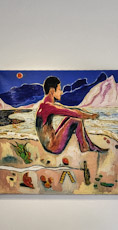
All of Appah’s works on show at Pace are oil and acrylic on canvas. They are all highly colourful and include, with one exception, figures in a variety of landscapes. The figures are positioned in landscapes that have an intensity that makes them look slightly unreal, yet completely compelling. One of the pictures we particularly liked is “Night Vision” which depicts a brightly lit town on a hill at night reflected on a sea of still water. The leaflet issued by the gallery describes Appah’s work as “dreamlike”, and this was also my opinion. On the whole, the dreamy nature of the works is quite distinct from that seen in the works of the great Surrealists of yesteryear. Appah portrays his scenes with the clarity and strangeness that I associate with the dreams I experience. His works are intriguingly eery, but not scary. If you can get to Pace, do so to enjoy the well-executed and fascinating works by this artist from Accra.

Art behind bars

FORT KOCHI IN Kerala was occupied by three European powers: first by Portugal, then ny the Netherlands, and then by the British until 1947. It was whilst the British were in charge that a small jail was built on what is now Tower Road. Next to a police station and close to a string of roadside seafood restaurants, there is a gate that leads into the Jail of the Freedom Struggle. This prison was built by the British at a forgotten date during the 19th century. One clue to its age is that some of its roof tiles can be dated to 1865. The prison has a row of eight cells, each equipped with a 6 foot long concrete bed.

The prison, which might have been used as a transit establishment for prisoners waiting to be taken elsewhere, is said to have held leading freedom fighters such as Mohammed Rehman, Accamma Cherian, and K J Herschel,  A K Gopalan, E M S Namboothiripad, and Abdurahiman Sahib. However, this is not known for certain. The prison, which had become disused and dilapidated, was restored in 2009, and opened as a museum.

In February 2023, we visited Fort Kochi to explore the 2022 Kochi Muziris Art Biennale. Unconnected with this major event, we visited an exhibition of artworks being displayed in the former prison. This included both paintings and sculptures. What made it an usual exhibition is that the exhibits are all contained within the cells behind strong iron doors with vertical bars. The doors that once prevented the prisoners from leaving the cells now prevent visitors from entering them.