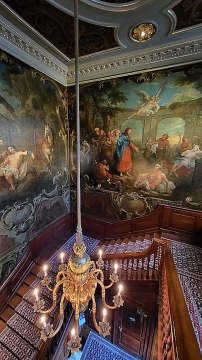
RECENTLY I WENT to a hospital, St Bartholomew’s (‘Barts’), which is near to London’s Smithfield meat market and the Barbican. I went there not because I was ill, but to view a magnificent artwork. It is in the hospital’s North Wing.
The walls of the main staircase in the North Wing are covered with huge paintings depicting scenes from stories in the Holy Bible. What makes them both attractive and interesting is that they were painted by the English artist William Hogarth (1697-1764). According to a website relating to this artwork (https://bartsnorthwing.org.uk/):
“Hogarth decorated the stair free of charge, allowing him to indulge his ambition, and giving the hospital a grand entrance to the Great Hall at no cost.”
Hogarth was a Governor of the hospital. The paintings that illustrate ‘The Pool of Bethesda’ and ‘The Good Samaritan’, were created in 1736–1737.
In 2025, the restoration of the paintings was completed, and the staircase was opened for public viewing at last – they had been hidden from public view for about 300 years. The stairs lead up to the spectacular, vast Great Hall (designed in 1732 by architect James Gibbs), which can also be visited.
And when you have admired the artwork and the Great Hall, head around the corner into Long Lane, and enjoy refreshments at Details, a charming café (near Barbican station) with interesting interior design.
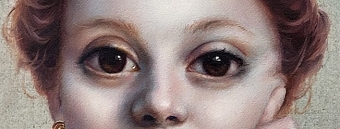
GINNY ON FREDERICK is a tiny art gallery at 99 Charterhouse Street, next to Smithfield meat market. We had never heard of it before, and after seeing it mentioned in the Financial Times newspaper, we went there today (11 March 2026) to view a collection of portrait paintings by British-born Hanna Murray (b. 1994). She received her MFA from New York Academy of Art in 2021, and now lives and works in Brooklyn, New York (USA). Like the gallery, the artist was new to us.
The six paintings on display were all portraits, beautifully executed. What makes each of them special is the artist’s depictions of her subjects’ eyes. They are literally eye-catching, and especially alluring. Along with her choice of colouring, the eves give the portraits an almost dreamlike quality, slightly weird but in a positive way. The gallery’s excellently written handout mentions the eyes, suggesting (quite correctly) that the subjects depicted:
“ … appear to observe themselves being observed.”
Difficult to find because it is so small and without a noticeable sign outside it, Ginny on Frederick was well worth the visit, and seeing the works by Hannah Murray was a delightful experience.
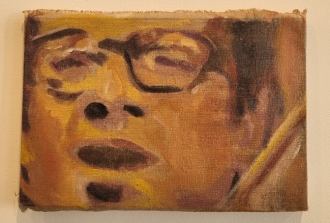
IT IS WORTH climbing the steep staircase that leads to the Larkin Durey gallery in Mason’s Yard, near London’s Piccadilly, to view the paintings of Naira Mushtaq, which are on display until 20 March 2026. Ms Mushtaq was born in Lahore, Pakistan. She studied art at Kinnaird College For Women, Pakistan, and then at National College of Arts, also in Pakistan. Then, between 2017 and 2019, she studied at University of the Arts London: Central Saint Martins. Currently, she lives and works in London.
“ … is focused on history, memory and social commentary stemming from a desire to understand grief and memory and how memories are formed as affect … My practice examines these questions by looking at the socio political and cultural context, while in most instances the backdrop of this comparison is my home country of Pakistan – the concerns under question are broader. Which memory is being remembered, who is it being remembered by, and the context of remembrance. How one memory merges with another, multiplicity and singularity of memory, what narratives we tell, what we choose to remember and what is the value of the narratives that we choose to remember if at all, drawing from these areas of interest and I examine memory as a form of impalpable archive while the tangible photograph or sourced materials aid to its inaccuracy, a palimpsest of truths and half-truths.”
Each of the 20 paintings on display depict faces or parts of faces. In each painting, the artist has used subdued colouring, which maybe suggests a sadness about her subjects, and concern about her often troubled native land. Some pictures depict faces and people in such a way that they look as if they are adapted from stills taken from a film (movie), being watched through darkly tinted spectacles. One portrait shows a distorted face, which reminded me of the way that Francis Bacon used to paint. And another evoked memories of Edvard Munch’s “The Scream”. Otherwise, her style is her own. Despite their melancholic, sometimes menacing subject matter, and dark colours, the paintings are both highly original and pleasing visually.
I am very glad I climbed the steep staircase to view this talented artist’s paintings.
ONE OF INDIA’S greatest modern painters was Maqbool Fida Husain (1915-2011), who was born in what is now Maharahtra. He studied art at the Sir JJ School of Art in Bombay.
While visiting Bombay’s branch of the National Gallery of Modern Art (NGMA) on 2 January 2026, we saw two of Husain’s drawings and two of his paintings. They had been hinges next to a portrait of the artist by Anil Naik (born 1959), a graduate of Sir JJ School School of Art.
Husain’s painting at LIC
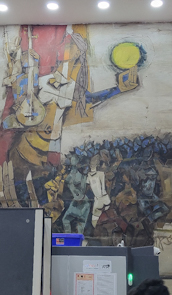
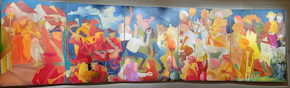
From the NGMA, we made our way to the huge Bombay headquarters of the LIC insurance company. My wife had read that this place is home to a painting by MF Husain. Nobody in the building knew about it despite the fact that the painting occupies most of one wall of the foyer of one wing of the building.
Husain’s painting at LIC is in need of some conservation work. The lower part of it is hidden from view because an x-ray machine used to check bags etc has been placed against it. It was painted in 1963 and depicts Indian life and culture.
It is to be hoped that thus fine mural will neither be allowe to fade away nor destroyed.
ROSNEFT IS A Russian company that supplies oil to India. The company has sponsored an exhibition, “Dream Vision”, that we visited in Bombay’s branch of India’s National Gallery of Modern Art (NGMA). The show will continue until 15 January 2026.
The works on display are by a People’s Artist of the Russian Federation, Nikas Safronov (born in the USSR in 1956). So far, he has painted portraits of at least 300 notable people, including one of President Donald Trump.
By Nikas Safronov
The portraits are not on display at the NGMA. Instead, there are about 40 of his well-executed paintings. Each of them is painted in a classical style that cannot be described as adventurous. However, most of the paintings contain whimsical or Surrealist elements. Some of the works contain Indian subject matter. The paintings are displayed in a large room onto whose walls and ceilings video images are projected.
Although this is by no means one of the best exhibitions I have seen, it is interesting to see what is being produced, and approved of, in Russia, which has become culturally isolated from much of the world beyond its borders. In fact, this exhibition is part of what the Hindustan Times (30 December 2025) described as part: “… of a broader Indo-Russian cultural initiative, Dream Vision positions art as a form of cultural diplomacy…”
Today, 2 January 2026, we were discussing this exhibition with a friend, who knew of the initiative, and had recently attended an event that had been part if it: a ballet performed by dancers who had come to India from St Petersburg.
Although I have reservations about the profundity of the artworks we saw at the NGMA, I was pleased to have seen the show and to have viewed what kind of work is being produced by an artist who is currently highly regarded in Russia.
THE BHARATIYA SANSKRUTI DARSHAN Museum in Bhuj houses a fascinating collection of artefacts which were collected from all over Kutch by Ramsinhji Kanji Rathod (1907-1997). Amongst these is an amazing collection of various kinds of textiles collected from all over the former Kingdom of Kutch (now part of Gujarat). Rathod also collected clay articles from the Harrapan site of Dholavira long before archaeologists began to take an interest in the area. I could continue by listing many other fascinating exhibits in the museum, but I will concentrate on three of them.
The three exhibits are all paintings by two Kutchi artists from Bhuj: Vadha and Lalmahad Juma. They were painted by 1884 at the latest. One of their creations hangs in Kedlestone Hall in Derbyshire, home of the Curzon family.
Sidi dancers
One of these three paintings in the museum depicts a folk dance being performed by Kutchi Sidis (people of Black African heritage living in India). The other two paintings depict Kutchi weddings.
What fascinated me was that these three paintings were exhibited outside Kutch: in Pune in 1888, and in London’s Wembley in 1925. They travelled over 5000 miles to Wembley to be exhibited in the British Empire Exhibition, which was held in the Empire Stadium between 9 May and 31 October 1925. The stadium later became England’s national football stadium. It was demolished by 2003, and replaced by a new one.
Interesting as this is, there are plenty of other exhibits to stimulate the admiration visitors to this wonderful museum ably curated by our friend Neeta Joshi. Undeservedly, this museum, which rivals many others I have seen in India, is not as well-known as other sights in Bhuj.
KRISHEN KHANNA CELEBRATED his one hundredth birthday in July 2025. The NGMA (National Gallery of Modern Art) in Bombay is currently holding a superb exhibition showcasing his paintings. The show is beautifully displayed and the artworks are skilfully illuminated.
Khanna was born in Lyallpur, now in Pakistan. After the Partition of India in 1947, he worked as an official in Grindlays Bank in Bombay. However, before Partition, he had already begun painting. The bank job was just to help keep him and his family going after they had left/fled what became the Pakistani part of Punjab.
Soon after arriving in India, Khanna began associating with members of Bombay’s Progressive Art Group that included notable creators such as FN Souza and MF Hussain. Thereafter, his painting career took off, and his reputation soared.
The exhibition at the NGMA surveys Khanna’s extraordinary range of paintings. Their subject matter ranges from political to historical to religious … and much more. The show, which demonstrates the artist’s amazing versatility and great artistic skill, continues until 12 December 2025, and should not be missed if you are in Bombay.
WE ATTENDED AN exhibition of paintings on cloth textiles by Anju Dodiya, who was born in Bombay in 1964. She studied at the Sir JJ School of Art. We were fortunate to have met her at Chemould Galleryin Bombay’s Prescott Street, where her paintings are being exhibited.
The exhibition is called “The Geometry of Ash”. The fabrics on which she has painted beautiful, slightly mysterious images come from all over the world. Some from West Africa, and one from London (it is a slightly stained British Museum tea towel).
According to the gallery’s handout: “Anju speaks of stillness not as passivity, but as resistance. In an age of urgency, of constant outrage and digital noise, her paintings compel us to pause. They demand attention, not compulsion …”
Whetether or not you feel this when you view the exhibition is irrelevant because the paintings are beautifully executed and visually compelling. I am pleased that we were braved Bombay’s high air temperature one afternoon to walk to the show.
THE ARTIST PETER DOIG was born in Edinburgh in 1959. He grew up in Trinidad and Canada. He moved to England, where he studied art at Saint Martins School of Art and Chelsea School of Art, both in London. Until 8 February 2026, there is a superb exhibition of his paintings being held at the Serpentine South Gallery in Kensington Gardens. Many of the works on show reflect the years (2002-2021) that Doig lived in Trinidad.
The exhibition is called “House of Music” because that is exactly what has been created in the gallery. Not only can Doig’s pictures be viewed, but also there is music to be heard. The curators have created a “multi-sensory environment”. Along with the paintings, there are some beautifully restored loudspeakers originally designed for use in cinemas and large auditoriums during the first half of the twentieth century and the 1950s. The gallery’s website noted:
“Spanning the last 25 years, the exhibition brings together the artist’s paintings with sound for the first time. At the core of the exhibition are two sets of rare, restored analogue speakers, originally designed for cinemas and large auditoriums in the early and mid-twentieth century. Music selected by the artist – from his vast archive of vinyl records and cassette tapes accumulated over decades – plays daily through a pair of original ‘high fidelity’ 1950s wooden Klangfilm Euronor speakers. A rare Western Electric and Bell Labs sound system, produced in the late 1920s and early 1930s to meet the demands of the first ‘talking movies’, is installed in the central gallery.”
Doig’s beautifully executed, often colourful and quite delicate, paintings are the ‘stars’ of the show. Many of the 25 paintings depict life in Trinidad. Six of them include musicians and/or musical instruments. And Lions appear in many of the images. One of the paintings is Doig’s image of the large kind of loudspeaker that reminds one of the actual speakers on display in the exhibition.
Chairs are distributed randomly in two of the rooms of the gallery, and viewers are invited to sit down, contemplate the paintings, and enjoy the background music. On their own, the paintings would satisfy most people, but the careful use of background sound results in a show that should not be missed.
THE ARTIST ANSELM Kiefer is said to have remarked:
“I think there is no innocent landscape, that doesn’t exist.”
By Nomoru Minata
For what we see when we regard a landscape is the result of millions of years of geological and meteorological evolution as well many millennia of interventions by biological phenomena including human activities: both constructive and destructive. As the writer and academic Robert Macfarlane wrote:
“We live on a restless crust of earth. Behind the façade of stability, everything is shifting, imperceptibly, but continuously.”
Artists have been creating images of landscape for many centuries. The earliest known depictions of landscape include Minoan frescoes created in about 1500 BC. The genre of European art called ‘landscape painting’ began in Holland in the seventeenth century. The website of the White Cube Gallery in Bermondsey noted in connection with this:
“17th-century Dutch artists of the Golden Age, during which the genre ‘landschap’ was first named, turned away from religious subjects as an expression of Protestant values …”
Until 7 September 2025, the White Cube at Bermondsey is hosting an exhibition called “Alien Shores”. Curated by Susanna Greeves, this show:
“… explores landscape as a place of memory, imagination, yearning and belonging. Through painting, video, photography and sculpture, the artists included offer speculative, symbolic or surreal depictions of emotional terrain and voyages of the imagination, visions of the distant past or possible futures.”
The exhibition includes works by 37 artists, all of whom worked in the twentieth and/or twenty-first centuries. It is a display of modern and contemporary works of art that either depict landscapes or try to evoke thoughts of landscapes. The works are distributed amongst three rooms. In the first two rooms there are videos and kinetic sculptures as well as paintings. A video by Noémie Goudal is particularly fascinating and dramatic. The third and largest room contains a mixed bag of paintings and a sculpture by Noguchi. My enjoyment of the paintings in this room was not 100%. Some of the paintings looked like wall space fillers rather than great works of art. However, it his is not a room to be missed because it contains three outstanding landscapes by Anselm Kiefer. Seeing these in the company of many of the others served to emphasize (to me) what a great contemporary artist he is. Other ‘stars’ in this room were paintings by Minoru Nomata, Georgia O’Keeffe and Marina Rheingantz. A three-dimensional screen depicting a leafless forest by Eva Jospin in the long corridor of the White Cube also impressed me.
Although I wondered why a few of the artworks were included in the show, the Alien Shores exhibition has much to recommend it. It was fascinating to see how in a time frame of well under 100 years, artists have been tackling their various portrayals of landscape, and the interesting varieties of ways they have done it.




 yamey
yamey 