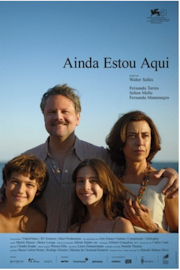
A wonderful film from Brazil

WE HAVE JUST WATCHED a superb film from Brazil, “I am still here”. It was released in 2024 and has deservedly just won an Oscar for being ‘the best foreign film’.

Sensitively and beautifully, it charts the catastrophic life of a family after one of its members is kidnapped during Brazil’s military dictatorship (mid-1960s until the 1980s). This film based on the life of one of those who was ‘disappeared’ by the military authorities, Rubens Paiva (1929-1971), is both terrifying and moving. Each character in the film acts perfectly. This is docu-drama at its best.

This great ‘movie’ is well worth watching.

A very slowly moving film from Taiwan

MOST FILMS WE have watched at the Garden Cinema near London’s Holborn have been excellent or extremely excellent. Today, we watched a Taiwanese film called “Days”, directed in 2020 by Tsai Ming-liang. It is one of the slowest moving films I have ever seen. It was not devoid of interest, but it was almost sleep inducing. Lasting about 2 hours, it felt like months, not days.

A good film about the Holocaust in Poland

Set in about 1991, this recently made (2024) film, “Treasure”, is about a Ho;ocaust survivor, played by Stephen Fry, returning to visit Poland to re-visit where he was born and. then later interned (in Auschwitz). He travels with his 36 year old daughter, played by Lena Dunham. In brief, this film covers many aspects of the annihilation of Jews in Poland in a profound way, but with a delicate touch. The portrayal of a visit to the remains of the concentration camp at Auschwitz was handled beautifully – deeply moving but intelligently handled.

Stephen Fry is excellent in the film. His Polish/English accent reminded me of that of a Holocaust survivor, K, whom I knew well. Although I never knew what K was thinking deep down inside him, some of his behavioural aspects were portrayed well by Fry. The character played by Fry adapts well to his return to the town where he was born and the camp where he last saw his parents. The survivor played by Fry brought back many memories of my friend K.

The other actors in the film were very good, but Fry’s performance was outstanding.

A few months ago, I watched another Holocaust themed film, “Zone of Interest”, which in many ways failed to impress me. “Treasure”, on the other hand, is very good both in what it covers and how it achieves that.

Diwali and a film from Germany about the futility of warfare

GEORG WILHELM PABST (1885-1967) was a film director born in Austria. His film “Westfront 1918” was produced in 1930. This harrowing film vividly portrays the horrors of trench warfare and its effects on both the active German soldiers and their families back home in Germany. It is really an anti-war film. It was banned by the Nazis because it did not portray German soldiers as victorious heroes. Today, the 11th of November 2023 (Armistice Day), we watched a screening of this horrifying film about the last months of WW1 at Bangalore’s Max Mueller Bhavan (a branch of the Goethe Institute).

After the screening and interesting discussion about the film were over, we walked down the staircase instead of using the lift in which we had ascended. On each of the steps, there were small terracotta oil lamps (diyas), such as are typically lit during the Hindu festival of light – Diwali. Seeing this charming set of lamps placed to celebrate the imminent festival raised my spirits after having watched such a depressing film about the futility of warfare.

A yak in the classroom

THE RIO CINEMA in London’s Kingsland Road district (in Dalston) is a fine example of a film theatre constructed in the Art Deco style. It was designed by Frank E Bromige, who specialised in designing cinemas in that style, and constructed in 1937 on the site of an earlier Edwardian-style film theatre, which first opened in 1909. The Rio has been showing films ever since then. Since 1976, the Rio has been run successfully, and independently of any cinema chain, as a not-for-profit charity. The cinema’s Art Deco exterior has been faithfully maintained and the interior’s original design has been reconstructed. There are two screens. The largest one, the main auditorium, looks much as it might have done when it was built in the late 1930s. There is a smaller auditorium in the basement. This has a large screen and comfortable raked seating.

Today, the 18th of March 2023, we watched a film in the smaller auditorium. Called “Lunana: A Yak in the Classroom”, this film was shot mainly in the tiny Himalayan Kingdom of Bhutan. It is a beautiful film, beautifully made. Without giving the story away, it is about the experience of a young Bhutanese teacher sent from the capital to teach in a remote village called Lunana. The tiny elementary school in that high altitude settlement surrounded by breathtakingly attractive mountain scenery is the remotest school in the world. The film shows how Lunana impacted on the young teacher and vice-versa.

Apart from having a good story, some humour, and much emotion, the film provides a fascinating view of Bhutan. “Lunana” allows the viewer to realise the spectacular nature of the country’s landscape and rural traditions. What particularly interested me was the depiction of a lifestyle so remote and different from what we are used to here in the west and in many parts of India, even also in the urban areas of Bhutan’s neighbour Sikkim. The subject of global warming is introduced, but in a quite subtle way. The villagers in Lunana are portrayed as being simultaneously innocent, playful, spiritual, and philosophical. Although “Lunana” is a highly enjoyable film and Bhutan is portrayed in an affectionate and appealing way, I felt that the country, which is undoubtedly spectacularly attractive, is not one that I am in a hurry to visit. It is an unusual and unique film, and it was appropriate to have watched it in one of London’s unique individual cinemas.

Man in the waves

GORM


At first sight, I thought I saw a man standing alone and naked out in the waves at Margate on a sunny but very windy afternoon. Crazy, I thought to brave those rollers on suchb a cold day and without a wet suit. Then, I noticed that he was coloureed green and motionless despite the battering he was getting from the sea. He was not a man, but a sculpture.

This sculpture braving the sea is Another Time  created in 2013 by the British sculptor Antony Gormley (born 1950).

The clever thing about this sculpture is placing it in the water. Though static, the waves dashing against it can create the illusion that the sculpted man is moving. Also, by putting it in the sea, the whole sea becomes an important part of the artwork.

Although I am not too keen on Gormley’s art works, this piece at Margate, just outside the Turner Contemporary art gallery satisfies me greatly. 

You can now see the sculpture and the waves in this short video:  http://www.ipernity.com/doc/adam/48815810

Gandhi to Hitler

GTO H 2

On the 24th of December 1940 Mohandas Gandhi (the ‘Mahatma’) wrote to the Chancellor of Germany, Adolf Hitler. Amongst other things that he wrote in his letter, the following extracts suffice to give the gist of it:

I hope you will have the time and desire to know how a good portion of humanity who have view living under the influence of that doctrine of universal friendship view your action. We have no doubt about your bravery or devotion to your fatherland, nor do we believe that you are the monster described by your opponents. But your own writings and pronouncements and those of your friends and admirers leave no room for doubt that many of your acts are monstrous and unbecoming of human dignity, especially in the estimation of men like me who believe in universal friendliness. Such are your humiliation of Czechoslovakia, the rape of Poland and the swallowing of Denmark. I am aware that your view of life regards such spoliations as virtuous acts. But we have been taught from childhood to regard them as acts degrading humanity. Hence we cannot possibly wish success to your arms.

But ours is a unique position. We resist British Imperialism no less than Nazism. If there is a difference, it is in degree. One-fifth of the human race has been brought under the British heel by means that will not bear scrutiny. Our resistance to it does not mean harm to the British people. We seek to convert them, not to defeat them on the battle-field. Ours is an unarmed revolt against the British rule. But whether we convert them or not, we are determined to make their rule impossible by non-violent non-co-operation…

…During this season when the hearts of the peoples of Europe yearn for peace, we have suspended even our own peaceful struggle. Is it too much to ask you to make an effort for peace during a time which may mean nothing to you personally but which must mean much to the millions of Europeans whose dumb cry for peace I hear, for my ears are attended to hearing the dumb millions? I had intended to address a joint appeal to you and Signor Mussolini, whom I had the privilege of meeting when I was in Rome during my visit to England as a delegate to the Round Table Conference. I hope that he will take this as addressed to him also with the necessary changes.” (see: https://www.mkgandhi.org/letters/hitler_ltr1.htm).

I do not think that this unbelievable letter ever reached the Führer. However, it formed the basis for a film, which was on general release in India briefly.

G TO H

[Source: MensXP.com]

In 2011, an Indian film, “Gandhi to Hitler”, was put out on general release in India. One newspaper accorded it a rating of half a star out of five. We were staying in Bangalore when it was showing, and I was dying to see a film whose name juxtaposed the peace-loving Gandhi with the war-mongering Adolf Hitler.

Only one cinema was showing the film in Bangalore. It was a long way from where we were staying. We arrived for the 10 am performance and joined a long queue of school-aged children waiting at the box office of the cinema multiplex. When we reached the ticket office, I said to the ticket seller:

“Two for the Gandhi/Hitler film.”

“Not possible, sir,” came the reply.

“Why not?”

“I must sell three tickets before we can screen a film, and you are only two.”

“But,” I protested, “we have come all the way from London to see this film.”

I thought for a moment, and then said:

“Sell me three tickets, and then you can screen the film.”

The seller was happy with this. We walked over to the lift that would take us up to the cinema. While we were waiting, the ticket man came rushing up to us, waving one of the notes with which we had paid for our tickets. He had managed to find a third taker for the film and refunded our third ticket.

Apart from an usher, there were only three of us in the large auditorium. The film was so dreadful that it was quite amusing. The plot had three main strands that ran in parallel. The first was Gandhi and his followers walking endlessly around a lovely garden. One of the followers was the wife of a man, who appears in the second strand. This aspect of the plot revolved around a group of Indian soldiers who had joined the German Army but were trying to desert from it. For those who are unaware of it, some Indian soldiers did actually join the Wehrmacht during WW2, hoping that a German defeat of the British might hasten the independence of India. Throughout the film, this forlorn band of soldiers trudged through a snowy mountainous landscape that was supposed to be the Alps but looked more like the Himalayas. Somehow, quite inexplicably, the woman in India was able to correspond by letters with the soldier tramping through the ‘Alps’.

The third strand of the film, which had no obvious connection with the other two strands, was set in Hitler’s bunker in Berlin during the last days of the Third Reich. Anyone who has watched the excellent film “Downfall” (2004) would be able to see that the bunker in the Indian film is a very crude copy of that in the German film. Unlike Adolf Hitler, the man portraying him in the Indian film is a true Aryan, an Indian. Goebbels is played by a character who looks like an elegant Italian. The Indian Hitler kept forgetting which of his arms was supposed to be lame.

There was an interval half way through the film. We left the auditorium to stretch our legs. When we returned for the second half of the film, my wife and I were the only people left in the auditorium.