ON THE EIGHTH of September 1846, Queen Victoria and Prince Albert disembarked at Fowey in Cornwall. To commerote this momentous occasion, a stone obelisk was erected on Albert Quay (formerly named ‘Broad Slip’), where the royal couple landed. For many years, it lay on the seabed of Fowey’s harbour.
However, it was recovered from beneath the water in 1977, and re-erected to commemorate the visit to Fowey of queen Elizabeth II and Prince Philip in 1962. It was not put in its original location, but at the Caffa Mill car park, which stands on the site of former shipyards. The name, Caffa Mill, comes from the river Caff or Cough which flowed here and the 2 water mills recorded as early as 1272.
Although not one of Fowey’s main attractions, this stone monument is of interest because of its curious history of submersion and recovery.
PARBOLD IS A village about 16 miles northeast of the centre of Liverpool. In 1742, the Douglas Navigation, a canal that links Wigan and Liverpool, became operational. It carried stone, coal, and other goods to Liverpool from where they could be shipped to Dublin. The canal passes through the centre of Parbold, and led to the mining of coal in the area. In turn, this led to an increase in the village’s population. With the arrival of the railway in 1855, Parbold became more easily accessible to Manchester and Wigan. This resulted in wealthy inhabitants of these towns coming to live in Parbold. And in the 1960s and 1970s, new housing estates were built in the area. Despite this, Parbold remains a charming place to visit.
Parbold mill
Parbold Hall, which was built in the 1750s, housed a Benedictine School. This institution was the forerunner of the leading Roman Catholic Ampleforth School, which opened in North Yorkshire in 1802. Soon after that, the boys studying at Parbold Hall were moved to Ampleforth, and the Parbold school was closed. Currently, the hall is privately owned, and let out for weddings and holiday accommodation.
One of Parbold’s main attractions is the tall, conical tower that was once a windmill. It stands next to the canal, and replaced a water mill that no longer exists. A website published by West Lancashire Borough Council related that the tall mill:
“… replaced the water cornmill which once stood near the Douglas bridge in Alder Lane. The windmill in its turn was superseded in the middle on the 18th century by the present mill which was originally worked by a steam engine and produced compound cattle foods until its closure in 1985.”
Part of the former mill is now an art gallery. Next to it, there is a pub appropriately named The Windmill. It opened in 1794 to serve both the growing traffic along the newly opened sections of the Leeds to Liverpool Canal and the farmers delivering grain to the neighbouring windmill. It soon became a meeting place for locals. Today, it incorporates a restaurant in addition to the usual bars.
The most interesting sight in Parbold is on a hill overlooking the village and the fields around it. Looking like the top third of a wine bottle, it is a stone monument known as both the Reform Pillar and the Parbold Bottle. It was erected by local worthies to replace another structure, which commemorated the passing of The Reform Act in 1832. The Act made great changes in the electoral system by changing constituency boundaries; creating new constituencies in areas that had been hitherto unrepresented in Parliament; and extending the franchise, giving the vote to all men owning houses over £10 in rateable value. It was the beginning of the path that led eventually to universal suffrage in Great Britain. As a result of the Act, Lancashire gained 11 new Members of Parliament. The bottle-shaped monument was badly damaged by a gale in 1942, but was restored in 1958. A short path leads from a busy main road to the Bottle from which lovely views can be obtained. The monument itself, although interesting, is not a thing of beauty.
Today, Parbold is mainly residential and a popular place for those wishing to walk along the canal or to go fishing. And apart from The Windmill pub, there are several other places where refreshment can be obtained.
DURING THE EARLY 1960s, my parents used to take us to Cambridge, where one of my father’s friends, the late Cyril Sofer, lived with his family. Often, we spent the night before our meeting with the Sofers at Bury St Edmunds. We always slept at the town’s Angel Hotel that faces the park containing the ruins of the monastery attached to the still existing Abbey.
Angel at Bury St Edmunds
This June (2025), my wife and I spent a little time in Bury St Edmunds. The Angel, whose facade is covered with foliage, is still in business. When I used to stay there many decades ago, the bedrooms were equipped with harnesses attached to ropes. These were to enable the occupants to escape from the room during a fire. I mentioned this to the receptionist during our visit in 2025. She had never heard of these fire escape aids, but then, I stayed at the hotel long before she was born.
While looking at the hotel’s facade, I noticed that the writer Charles Dickens had stayed there at least once. The town figures in “The Pickwick Papers”.
While walking in the park opposite the hotel, we came across a sculpture shaped like a teardrop. Placed in 2015, it is a memorial to all victims of genocide. It also records that 57 Jewish residents of Bury St Edmunds were massacred near the spot on Palm Sunday in 1190.
Brief as was our latest visit, Bury St Edmunds offers many interesting things for visitors to discover
A HUGE STATUE OF a naked man holding up a shield in his left hand stands opposite the London Hilton Hotel, across Park Lane. It looks as if he is defending himself from missiles being hurled from the upper floors of the hotel. Depicting the ancient hero Achilles, it is the Wellington Monument, commemorating the victories of Arthur Wellesley, 1st Duke of Wellington, and his men who helped achieve them.
The statue was designed by the sculptor Richard Westmacott (1775-1856), it was inaugurated in 1822 by King George IV. On its granite base, there are the names of four of Wellington’s military victories: Salamanca, Vittoria, Toulouse, and Waterloo. The statue was financed by donations given by British women.
Although I think that the statue is unattractive, there are two things about it that I find interesting. It was the first public nude sculpture in London since ancient times. Despite the presence of a fig-leaf, this caused quite a bit of controversy when it was unveiled. The other thing that attracted my attention is that the sculpture was cast from the enemy’s cannons captured at the four places mentioned above, and then melted down.
There is a phrase ‘from swords to ploughshares’. The Wellington Monument must be one of the few examples of ‘from cannons to nudes’.
SLEAFORD IS A SMALL town in Lincolnshire. I do not think it is on many tourists’ itineraries, and I am not sure that I would recommend it highly. However, on a positive note, everyone we met there was extremely friendly. Southgate Street is a vibrant shopping district with plenty of charity shops and places to eat and drink. At the south end of this thoroughfare, there is a gothic revival monument that towers over its surroundings. Shaped a bit like an Eleanor Cross or a shabby version of London’s Albert Memorial, it commemorates Henry Handley (1797-1846).
Henry was the son of a local banker and attorney, Benjamin Handley. He was educated at Charterhouse, Eton, Oxford, and Lincolns Inn. He married Caroline Edwardes, daughter of William Edwardes, 2nd Baron Kensington in 1825. He neither graduated at Oxford nor practised as a barrister. Three years later, he inherited his father’s estate. He served as a Whig Member of Parliament for Heylesbury in Wiltshire from 1820 to 1826. In 1826, he left Parliament and became a gentleman farmer near Sleaford. So far so good, but why does Sleaford have such an imposing monument to remember him?
Between 1832 and 1841, he was the elected MP for Lincolnshire South. According to an online article in “Lincolnshire World”, during this period:
“Henry, a father of 10, was a budding entrepreneur and his interest in agricultural affairs was always to the fore. During his time as MP for S. Lincolnshire … Henry opposed corn imports, championed steam power, and supported steam railways rather than canals. In 1842, Henry became President of the Royal Agricultural Society.”
So, it appears that Henry worked well for improving the prosperity of Lincolnshire. He proposed and carried out projects that would have helped both the locals and his own agricultural endeavours. In these things, the local people rated him as being so successful that after his death, they raised more than £900 to pay for the construction of his 65-foot-tall memorial in Sleaford. It was designed by the Birmingham architect William Boyle, and it remains a remarkably immodest landmark in a pleasantly modest town.
UNTIL AIR TRAVEL really ‘took off’, travelling between South Africa and London involved a long sea voyage, either via the Suez Canal or via the Atlantic Ocean. Boats carrying passengers up and down the Atlantic often called in at Funchal in Madeira. Aged three, I travelled with my parents to South Africa by sea. I have seen a photograph of me dressed in a toga made from a sheet from our cabin. I was taking part in a fancy dress party to celebrate crossing the Equator.
Many years before that – in 1906 – a barrister, Mohandas Karamchand Gandhi, travelled by ship from London to South Africa. He was on his way back to South Africa, having petitioned young Winston Churchill, then Under Secretary of State for the Colonies, against the Black Act – a law promoting racial segregation. Apparently, when his ship docked in Funchal, the future Mahatma received news that his efforts had been successful, but this news turned out to be false.
On the 5th of September 2019, a bust of Gandhi was unveiled on the seafront in Funchal, close to the harbour where liners dock today. The bust, which unusually shows Gandhi without his characteristic round lens spectacles, was sculpted by Ram Vanaji Sutar (born 1925 in Gondur, Maharashtra). Sutar is also the sculptor of the massive Statue of Unity, depicting Sardar Vallabhai Patel in Gujarat. Beneath the bust there is a quotation incorrectly attributed to Gandhi; it was actually said or written by the Dutch American pacifist AJ Muste (1885-1967). The artwork was unveiled by HE Miguel Albuquerque, President of the Regional Government of Madeira and HE Nandini Singla, Ambassador of India to Portugal. It celebrates the 150th anniversary of Gandhi’s birth.
I am grateful to our friend Claus for telling us about the bust, which is not easily visible despite its position so near the waterfront: it is partially hidden by plants.
Over the years, I have visited Porbandar where the Mahatma was born; Rajkot where he went to school; Bhavnagar where he went to college; West Kensington where he lodged when studying for the Bar; Mumbai where he attempted to work as a lawyer; and the Gujarat Club in Ahmedabad where he first met Vallabhai Patel, and also set up his ashrams. So seeing him on Funchal has added to my attempts to follow in his footsteps.
SAINT THOMAS MOUNT in Chennai is best known for being the place where St Thomas was martyred (by whom I have no idea). A friend in Bangalore, John Fernando, told me that apart from the much-revered saint, another notable person is commemorated on the summit of the Mount. His bust can be found near the east end of the church almost hidden away between a couple of banyan trees. The bust is a depiction of the British Colonel, William Lambton (1753-1834).
It is appropriate that the soldier Lambton is commemorated on the summit of the Mount. For, it was from this lofty place that in 1800 he commenced his trigonometric fieldwork for his project, a great trigonometric survey of India.
To quote Wikipedia, Lambton’s: “… initial survey was to measure the length of a degree of an arc of the meridian so as to establish the shape of the Earth and support a larger scale trigonometrical survey across the width of the peninsula of India between Madras and Mangalore. After triangulating across the peninsula, he continued surveys northwards for more than twenty years. He died during the course of the surveys in central India and is buried at Hinganghat in Wardha district of Maharashtra.” Lambton’s assistant was George Everest (1790-1866), who succeeded him as Surveyor General of India. Everest is associated with a famous Peak in the Himalayas. However, it was not him but two others, Andrew Scott Waugh and Radhanath Sikdar, who ascertained the mountain’s height.
I am grateful to John for mentioning Lambton’s memorial to me. Even without seeing this bust, a visit to Saint Thomas Mount is worthwhile as there is much of interest to see there including an old church built by the Portuguese, gravestones and paintings with Armenian script on them, and the vibrant nature of Indian Christianity.
SAWBRIDGEWORTH IS AN ATTRACTIVE small town with many picturesque old buildings and a parish church, St Mary’s, whose construction began in the 13th century. It is an unusual edifice, being about as wide as its length, rather than longer than its width as is the case for most English churches. It contains a fine selection of elaborate funerary sculptures.
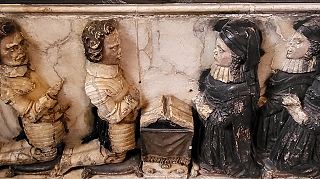
The most impressive funerary monument is the memorial to John Leventhorpe and his wife Joan, who died in 1625 and 1627 respectively. Within a multi-coloured marble frame, both of the deceased are depicted reclining on their left sides with their heads propped up by their left hands. John holds a sword in his right hand and Joan a small book in hers, Beneath the two statues, the couple’s six sons (one of whom, Arthur, died as a baby) and eight daughters are depicted in bas-relief, all kneeling in prayer. Baby Arthur is also present on the memorial but has been sculpted much smaller than his brothers. The whole sculptural ensemble is magnificent, and if you had time to see only one thing in Sawbridgeworth, this should not be missed.
High on the wall facing the Leventhorpe memorial, there is a smaller one, commemorating Jeremiah Milles (died 1797) and his wife Rose, who died in 1835. It is typical of early 19th century memorial art. It shows a female mourner in Hellenic dress kneeling in front of a sarcophagus. It was sculpted by John Termouth (1795-1849) of Pimlico (London).
The sculptor of the Leventhorpe memorial has been forgotten, but Termouth, who sculpted the Milles memorial, has not been consigned to obscurity. A notice in St Mary’s revealed that Termouth was:
“… an uninteresting artist whose symbolism was always obvious, hackneyed, and uninspired.”
THE PRIORY CHURCH in Christchurch (Dorset) is all that remains intact of the Priory of the Holy Trinity, one of many monastic institutions dissolved by King Henry VIII. The king allowed the cathedral-like priory church to be preserved and used as Christchurch’s parish church. The rest of the priory was demolished. The church’s construction began in the Norman era, the nave being completed by about 1150. The church contains many fine Norman architectural and decorative features. On the north wall at the west end of the building, at the bottom of the square bell tower, there is a 19th century monument that commemorates one of England’s great poets and his equally famous wife, a novelist.
In 1816, the poet Percy Bysshe Shelley (1792-1822) married the novelist, author of “Frankenstein”, Mary Wollstonecraft Shelley (1797-1851). Six years later, Percy was in Italy, where he met Leigh Hunt and Lord Byron to discuss establishing a new journal to be called ‘The Liberal’. During this trip, Shelley died at sea (on the 1st of July 1822). His body was washed up near Viareggio ten day later. It was cremated on the beach. However, his heart resisted burning (possibly because it was highly calcified due to a tubercular infection). His ashes were buried in the Protestant Cemetery in Rome, and his heart was eventually buried either at St Peters Church in Bournemouth or at the Priory Church in Christchurch, Mary, Percy’s wife, died in her home in London’s Chester Square, but was buried at St Peter’s Church in Bournemouth, which was near her seaside home at Boscombe (now part of Bournemouth).
The monument to Percy and Mary in the Priory Church was sculpted in white marble by Henry Weekes (1807-1877) in 1853-54. It was erected by Percy and Mary’s son, who lived at Boscombe. The memorial:
After attending Sung Eucharist one Sunday morning in October (2022), we asked the cleric why the monument was in the Priory Church. He was not entirely sure of the reason, but suggested that at the time when the memorial was put up, Bournemouth was far smaller than its older neighbour Christchurch. He explained that before the arrival of the railway in 1870, Bournemouth was a smallish place, a village, and that Christchurch was a far larger and more important place, a town, in the area. Whatever the explanation, it was interesting to discover this monument to Shelley during our visit to the beautiful, venerable Priory Church.
APPLE TREE YARD is a cul-de-sac near London’s Piccadilly. It runs east from Duke of York Street and parallel to Jermyn Street. On its south corner where the Yard meets Duke of York Street, there is an interesting monument consisting of three slightly separated carved basalt slabs with letters inscribed in them. The letters make up the following words, all in capital letters:
“SIR EDWIN LUTYENS ARCHITECT
DESIGNER OF NEW DELHI
LAID OUT HIS PLANS HERE IN APPLE TREE YARD”
Although I have never been to Delhi, I am familiar with the work of Edwin Lutyens (1869-1944). I was brought up in north London’s Hampstead Garden Suburb not far from its Central Square, which is surrounded by buildings that Lutyens designed before embarking on his projects in New Delhi. Although the above-mentioned basalt blocks were completed in 2015, I had not been past Apple Tree Yard until yesterday (13th September 2022). Next to the inscribed blocks there is an attractive figurative bas-relief carving, also in basalt, mounted on a wall.
The carvings were made by Stephen Cox and he describes them in detail on a web page (www.lutyenstrust.org.uk/portfolio-item/apple-tree-yard-sculpture-honours-spirit-lutyens/). Here is a brief summary of what he wrote. The bas-relief sculpture is called “Relief; Figure emerging”. It was inspired by sculptures in Hindu cave temples, especially those around a town near Chennai (Madras): Mahabalipuram. The basalt that can be seen in Apple Tree Yard was quarried near the south Indian temple town of Kanchipuram. Cox, who has a studio in Mahabalipuram, was assisted by local carvers, when he created the bas-relief. In summary, the monumental slabs and the nearby sculpture have their roots in India, which is highly appropriate as they commemorate an architect, who worked in India.
I must admit that amongst all the foreign architects, who have made significant buildings in India, Lutyens is not my favourite. Those, whose works I have seen in India and liked, include William Emerson (1843-1924), Frederick W Stevens (1847-1900), Le Corbusier (1887-1965), and Louis Kahn (1901-1974).
Lutyens, who was a former Viceroy of India’s son-in-law, drew up the plans for New Delhi in an office at number 7 Apple Tree Yard. Hence, the location of the monumental stones. Number 7 was for a long time the home of the Royal Fine Art Commission, but it exists no longer. It is now covered by a new building. However, his work in both India and the Hampstead Garden Suburb can still be admired by those who like Lutyens’s work. I feel that Cox’s memorial to him is much more elegant than much that I have seen of his buildings.





 yamey
yamey 