THE AUCTION HOUSE Christies was founded in London in 1766 by James Christie (1730-1803). Their main premises are on King Street, near St James Palace in the City of Westminster. Usually, the auction house is open to the public, who may enter and view the items waiting to be auctioned, and to watch or participate in an auction. Until 12 March 2026, works from the collection of the Belgian couple Roger and Josette Vanthournout, both now deceased, are up for sale. The sale is being held as a series of auctions over a period that extended from 25 February 2026 until 12 March 2026.
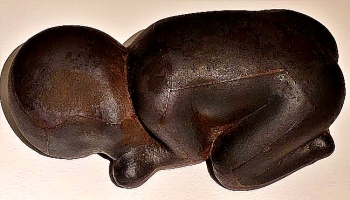
“Iron Baby” by Antony Gormley
The Vanthournout couple have been collecting art for over 60 years. At first, they collected Chinese vases, but soon after that, they began buying modern and contemporary art. Roger trained as an interior designer and ran a furniture store in Izegem, Aurora, which had been founded by his father in 1921. Josette (née T’Kint) was an artist and an art lover. From the 1950s onwards, the couple travelled a great deal, visiting art fairs where they engaged directly with artists, dealers and galleries. They tended to buy much of their art from artists, who had not yet achieved great fame, and by doing so acquired artworks at reasonable prices. And viewing the pieces on display at Christies today (5 March 2026), one can easily see that Roger and Josette both had a ‘good eye’, and bought wisely. After the widowed Josette died in 2025 aged 95, the family decided to sell the collection.
And what a collection it must have been, judging by what we saw on display at Christies. There were fine examples of artworks by, to name BUT A FEW: Josef Albers, Pablo Picasso, Man Ray, Rene Magritte, Henry Moore, Yayoi Kusama, Jean Arp, Lucio Fontana, Jean Dubuffet, Lynn Chadwick, Paul Delvaux, Jacques Lipchitz, Tracey Emin, and James Ensor. I was interested to see a couple of works by Victor Vasarely (1906-1997) because when I lived at home, we had one of his abstract prints hanging on the wall of our living room (I have not seen the print since 1991). There were several sculptures by Antony Gormley. These are quite unlike any of the many works I have seen by this artist. Josette and Roger were lucky to have these examples of his work.
The collection we saw at Christies was well-displayed and filled with an amazing array of art created in the twentieth and twenty-first centuries. Once they have been auctioned, many of the bought by private collectors and galleries far away from London, it will be a very long time, if ever, before they can be seen again by the London public.
Because it is possible to see works of art that are not usually on public display, visiting Christies (and other auction houses) allows ‘the man (or woman) in the street’ to catch a glimpse of artists’ creations that are frequently not usually accessible except by their owners. And even if you have no intention of making a bid, the staff at Christies are most welcoming and willing to answer any questions you might have regarding the items awaiting auction.
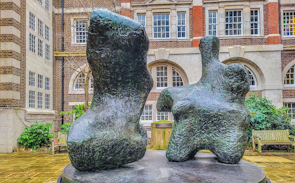
RECENTLY I NOTICED a sculpture close to Tate Britain but not within it.
When the Chelsea School of Art – now the Chelsea College of Art and Design – moved from Chelsea to Millbank next to Tate Britain, so did this sculpture by Henry Moore (1898-1986). Called “Two Piece Reclining Figure No 1” and created in 1959, this was originally placed in the Chelsea campus of the art school, where for a time in the 1930s Moore was Head of Sculpture. When the college relocated to Millbank, the Sculpture moved with it.
THE ARTIST BARBARA Nicholls (born 1963) invited us to the opening of her solo show at the Patrick Heide Contemporary Art gallery in Church Street, near Edgware Road. All her creations on display are watercolours on paper. Each of them resembles what looks like a natural phenomenon, but an imagined one. Although her pictures do not depict actual natural occurrences, each one of them is a result of the artist exploiting the unpredictability of the behaviour of the materials she is using at the same time as exerting some control over how they behave. To give some idea of what I am trying to say, here is something written in the notes issued by the gallery:
“Nicholls’ operations begin at times with large-scale sheets of heavyweight paper laid flat on the studio floor. The physicality of her practice is vital; she moves across and over the surface, first guiding water into pools or creating delicate lines with transparent washes. Once water touches the paper, it no longer remains flat, requiring Nicholls to carefully manage the buckling surface as she introduces pigment, experimenting with how much liquid the paper can handle. The drying process can be natural or carefully controlled through appliances like electric fans and heaters, which create microclimates that accelerate evaporation, allowing layers of colour to settle and crystallise over time.”
In other words, the artist chooses the places on the paper where the pigment and the water can be allowed to act as nature determines, and then lets them get on with it, producing whatever result the conditions permit. Thus, she covers the paper with a composition that is partly her choosing and partly the result of chemical and physical processes within the areas she has chosen for them to occur. The results are colourful abstract images, which are both beautiful and intriguing.
HE WAS BORN in Chicago (Illinois) in 1935 and as a child was often taken by his mother to public galleries in the city. Maybe at least partly because of this Richard Hunt, who died in December 2023, became an artist. In 1953, he was awarded a scholarship to study at School of the Art Institute of Chicago. It was there that his interest in working with metal began and that he became acquainted with the work of the leading modernist artists of the 20th century. He taugh himself welding, and many of his fascinating sculptures that are on display at the White Cube Gallery in Bermondsey (until 29 June 2025) can be seen, beautifully displayed.
Many of the sculptures consist of bits of waste metal that Hunt salvaged, modified, polished, and welded together. Other sculptures are made of cast metal. Many of Hunt’s works are abstract, but suggest to the viewer that they might also depict transformations of organic forms. Each of the sculptures is intriguing and original. The influences of other artists might be subtly evident in some of them, but they are not at all obvious. The gallery’s website noted:
“Hunt developed a sculptural language that was both deeply personal and richly associative, drawing on a broad array of influences: the forms and rhythms of the natural world; the mythic narratives of Greek and Roman antiquity; his cultural heritage and global travels; the formal vocabulary of European modernism and the legacy of African American civil rights leaders who shaped his time.”
As one looks at the works on display, many of the things in the quote above become apparent.
Although some of the works at White Cube are quite small, Hunt has produced many huge works – too large to be within the White Cube – that are displayed in public places. I thought that Hunt’s sculptures were wonderful, and was surprided that until visiting this show I had not been aware of his work. The show at the White Cube was quite a wonderful eye-opener for me and I can strongly recommend seeing it.
BIDRI WORK IS a method for creating decorative metal items. Its name derives from Bidar in Karnataka, where this technique was developed and is still used. Objects are made by casting a black coloured alloy containing copper and zinc in the proportion 1: 16. Then, craftsmen use fine chisels to engrave often very intricate patterns on the surface of the cast alloy. These grooves are then filled by hammering fine silver wire into them. So, the resulting item is a dark metal object inlaid with silver.
Today, 8 February 2025, we visited the Kaash gallery, which is housed in a well-preserved traditional Bangalore bungalow. One of the three small exhibitions currently being displayed is a collection of Bidri art works. The artefacts were designed by Stephen Cox, a British artist, and were made by Abdul Bari, a Bidri craftsman. The resulting artworks are both unusual and beautiful.
The two other exhibitions at Kaash were: colourful contemporary seating made by weavers from Tamil Nadu and designed by David Joe Thomas, and some sculptures and lighting by Italian artist Andrea Anastasio.
Our visit to Kaash was very satisfying. Although small, it is a place in Bangalore that art-lovers should not miss.
UNTIL ABOUT 1991, my widowed father resided in my childhood home in northwest London. For as long as I can remember, there was a collection of black and white photographs in a cardboard Kodak photographic paper box. The photographs contained images of sculptures, which my mother Helen Yamey (1920-1980) had created at St Martins School of Art in London during the later 1950s and first half of the following decade. In 1991, my father married again, and moved from our childhood home to another address. Every now and then, after my father moved, I used to ask him what had happened to the photographs. He used to reply that he did not know where they were. Maybe, he suggested, they were stored somewhere in the garage of his new home. He died in 2020. After that, I thought that it was extremely unlikely that I would ever set eyes on the photographs again.
A year or two after my father’s demise, his widow, my stepmother, arranged to meet me at a café. When she arrived, she was carrying a plastic carrier bag, which she handed to me. To my great delight, I found that it contained the Kodak box filled with photographs of my mother’s sculptures. I posted a few of these images on the Internet. Some months after that, my friend Edesio mentioned that he was impressed by the images of my mother’s sculptures, and suggested to me that I should write something about my mother and her art. This I have done.
When I began writing my mother’s biography, our daughter Mala, who is an art historian and a curator, sent me a pdf file containing the contents of a catalogue of an exhibition held at London’s Grosvenor Gallery in the 1960s. It contained mention of some of my mother’s work that appeared in the exhibition. Mala did a little more research and discovered the existence of catalogues of other exhibitions in which my mother’s sculpture was included. I investigated these catalogues and came across a few more, I was surprised by what I discovered.
During the first half of the 1960s, my mother’s sculptures were selected to appear in exhibitions alongside artworks created by artists, many of whom are now quite famous. These include, to mention but a few, David Hockney, Henry Moore, Barbara Hepworth, Howard Hodgkin, Bridget Riley, Kim Lim, and LS Lowry. These exhibitions were held when I was between 8 and 13 years old. In those days, I was not particularly interested in my mother’s artistic activities and was too young for the names of these artists to mean anything to me. In addition, I do not recall even having been told that my mother was participating in exhibitions, let alone showing her work alongside that of these now famous creators. So, until I studied these catalogues more than 40 years after my mother died, I had no idea that for a while she was in the vanguard of 20th century British sculpture. Had I not been stimulated into beginning to write about her, I would not have known that my mother, who never boasted about her achievements, had been an artist of such a high calibre.
I have written my memories of my mother in a book called “Remembering Helen: My Mother the Artist” (available from Amazon: https://www.amazon.co.uk/dp/B0DKCZ7J7X/) . In it I have tried to describe her upbringing; what she was like as a mother; and her achievements in the world of sculpture. I have included many of the images I found in the box of photographs, and our daughter has written some insightful notes on her grandmother’s sculptural styles and the techniques. I hope that my book will help bring my mother’s artistic achievements out of obscurity. Modest as she was, I feel that it would be good if she were to get at least a little of the fame she deserved.
CERTAIN IMAGES IMMEDIATELY come to mind when the names of some artists are mentioned. For Vincent Van Gogh it is sunflowers; for Claude Monet it is waterlilies; for Salvador Dali it is melting clocks; and for Edvard Munch it is “The Scream”. In the case of the German artist Georg Baselitz (born as ‘Hans-Georg Kern’ in Deutschbaselitz, Saxony, Germany in1938), mentioning his name conjures up inverted images: paintings in which the images appear to be upside down. He signs them with his signature, but it is not upside down.
Recently, we viewed an exhibition of this octogenarian’s latest paintings at the White Cube Gallery in London’s Bermondsey Street. The show is on until the 16th of June 2024. If you miss it, you will not have missed much worth seeing. As you can tell, I was not over-impressed by what I saw, but it did get me thinking about why the artist often chooses to paint his subjects – human and others – upside down.
Does he choose to do this because his childhood in Germany was spent in a country that had been turned upside down by the Nazi regime, the 2nd World War, and its immediate aftermath in the early years of the German Democratic Republic? The White Cube website quotes the artist as having said:
“I’ve got my early childhood drawings of eagles, stags, deer, dogs and so on in folders,’ Baselitz remarks. ‘Every now and then I look at them, and I think was it a good time, was it a bad time?”
Or does he paint his images upside down to attract the viewer – to make his artwork ‘stand out from the crowd’? Alternatively, does he invert his images so that the viewer is forced to consider not only the subject matter, but also his painting techniques (brush strokes, colour choices, and so on)?
I do not know the answers to these questions. However, I am glad I have seen the exhibition, which did not particularly thrill me, because it did stimulate me to consider his art a little more that I had expected.
WHENEVER I VISITED my in-laws in India, I used to admire the painting by the Bengali artist Jamini Roy (1887-1972), which used to hang in their flat. His style of painting was both modern (20th century) and at the same time almost folkloric. When our friend Bob Annibale posted on Facebook about an exhibition at the Brunei Gallery (in London’s Bloomsbury) that included Roy’s works, we could not resist visiting it, and we were glad we viewed it.
The exhibition, which continues until the 22nd of June 2024, not only contains a good selection of Roy’s works, but also others by Bengali artists working mainly between the late 19th century and the 1950s. Apart from works by Roy’s contemporaries including various members of the Tagore family, Hemendranath Mazumdar, Nandalal Bose, and Qamrul Hassan, there were also paintings by lesser-known or unknown artists who painted in the traditional late 19th century Bengali (Kalighat) style, rather than in experimental styles of the 20th century.
The emergence of modern Indian painting was a consequence of the establishment of The Government College of Art in Calcutta (in 1854). As the website of the Brunei Gallery explained, it was:
“… established by a benevolent government for the purpose of revealing to the Indians the superiority of European art.”
In the late 19th century, Indian artists working in the college began questioning the validity of Indians painting in the alien Western European fashion that was being taught them. The gallery’s website continued:
“Academic art, introduced by the British Raj, was challenged by the nationalist art movement, the Bengal School of painting, led by Abanindranath Tagore (1871-1951) and his disciples who dominated the art scene in the first decades of the twentieth century.”
It is works by these artists, who used their creations as part of their expressions of desire to see India free of British rule, that form the greater part of the show at the Brunei.
Several things particularly interested me whilst viewing the excellently curated and displayed exhibition. One was three paintings by Jamini Roy that illustrate Christian themes (e.g., the Crucifixion, the Last Supper, and the Flight to Egypt). I had not before seen any of Roy’s paintings depicting Christian stories. Another exciting discovery for me were a selection of paintings by Sunayani Devi (1875-1962), who was the sister of the artists Abanindranath Tagore and Gaganendranath Tagore, some of whose pictures are also hung in the show. These 3 siblings had a famous uncle, Rabindranath Tagore, some of whose paintings were also on show. At the exhibition, there were portraits of Rabindranath Tagore by each of his above-mentioned relatives, and one by Jamini Roy.
Yet another artist on show, whom I had never encountered, is Qamrul Hassan (1921-1988), who was born later than the other artists. Born in Calcutta before independence and the Bangladesh War (1971), he died in what is now Bangladesh. He studied at The Government College of Art in Calcutta in the late 1930s, and afterwards became involved with left wing political activities as well as his art. Later, he was active in the struggle for East Pakistan (now Bangladesh) to become independent of what was then West Pakistan. Beneath one of his creations at the Brunei, there is a quotation by Qamrul about his style of painting:
“… where Jamini Roy ends , I begin …”
And this is so easy to see in the excellent exhibition at the Brunei Gallery
I have told you what stood out for me, but although I have highlighted a few things, the rest of the exhibits are wonderful, and not to be ‘sniffed at’. After seeing the show, I thought that never before had I seen such a fine and large collection of paintings by the liberated artists either here in the UK or in India. The curators of this show deserve hearty congratulations.
MY MOTHER SETTLED in London in about 1951, a year before I was born. The UK was still recovering from WW2, and life was not too easy. There were shortages of food. I remember my mother telling me that during the early 1950s, relatives in South Africa used to send parcels of food, including, as I can still recall, tinned guavas. The postman used to lug these heavy packages to our home in Hampstead Garden Suburb. My mother used to feel guilty that she was lucky enough to be receiving food that few others could not obtain, and used to open the parcels and give the postman a couple of tins from them. Soon after I was born, my mother, already a painter, began making sculptures. Somehow or other, she managed to get permission to work in the sculpture studios at the St Martin School of Art, which was then located on Tottenham Court Road. She was not enrolled as a student, but worked alongside, and received help from, several sculptors who have now become famous. Amongst these were Antony Caro, Phillip King, William Turnbull, and Elisabeth Frink, who became a family friend.
Most of my mother’s sculpting was done during the 1950s and 1960s. This was a period when many people, including British sculptors, were simultaneously recovering from the horrors of war; fearful of the Cold War and the possibility that it might develop into a war with atomic weapons; and looking towards the future. Sculptors reacted to this situation in various ways as can be seen at an exhibition being held in the Marlborough Gallery in London’s Mayfair until the 22nd of April 2023. Called “Towards a New World: Sculpture in Post-War Britain”, this show to quote the gallery’s press release:
“… emphasises the international impact of a group of young sculptors and artists who merged past trauma, present anxieties, and future hopes into a new visual language.”
Lyn Chadwick
The artists whose works are on display include, amongst others, Elisabeth Frink, William Turnbull, Reg Butler, Bernard Meadows, Kenneth Armitage, Lyn Chadwick, Graham Sutherland, and Francis Bacon.
Apart from some of the works by Reg Butler and Bernard Meadows, the artworks on display exhibit what the art historian Herbert Read described as: “…the iconography of despair, or of defiance; and the more innocent the artist, the more effectively he transmits the collective guilt. Here are images of flight, or ragged claws ‘scuttling across the floors of silent seas’, of excoriated flesh, frustrated sex, the geometry of fear.”
The Geometry of Fear was the name of a group of British artists who exhibited at the 1952 Venice Biennale.
Bernard Meadows (1915-2005) was a name that was new to me. He was Henry Moore’s first assistant. Later, he taught Elisabeth Frink at the Royal College of Art. He was a member of the The Geometry of Fear group but as the press release explained he differed from most of its members: “While the distorted human figure became a prominent motif for many of the artists associated with the ‘geometry of fear’ group, for others, like Bernard Meadows, it was animal imagery that resonated most with the collective societal trauma of the war. Visceral depictions of birds and crabs acted as vehicles to express human emotion.”
I enjoyed seeing this exhibition. The works are well-displayed in the spacious, well-lit rooms of the Marlborough. After viewing the exhibition, I wondered about my mother’s sculptures, most of which now only exist in photographs. Her first sculpture, a terracotta mother and child, was figurative but veering towards the abstract. As time passed, her work became increasingly abstract, and tended to be closer to being brutalist rather than naturalist. Although I never heard her mention The Geometry of Fear, I wonder whether her artistic sympathies lay with them rather than with any other ‘school’ of artistic activity.
A WIDE FOOTPATH runs south from Piccadilly along the eastern edge of Green Park. We have walked along this many times, but it was not until a few days ago that we noticed a small alleyway leading east from the footpath about 190 yards south of Piccadilly. This unmarked footway, which is barely wide enough for two people to pass each other, passes under a building and emerges opposite the Stafford Hotel on St James Place, a short cul-de-sac with a dogleg, which leads off St James Street. St James Place, whose construction began in 1694, is an attractive short street lined with many fine buildings, some of which I propose to describe. What made this lovely quiet road interesting for me was that several fascinating people have been associated with it. I will begin with a relatively recent inhabitant.
Number 9 was home to Sir Francis Chichester (1901-1972), who circumnavigated the world single-handedly in 1966/67. He lived here from 1944 to 1972. He sailed in his boat named Gypsy Moth IV. In 1929, Sir Francis attempted another exploit, to fly from New Zealand to Australia in his ‘plane, a de Havilland Gypsy Moth. He made the first ever flight from New Zealand to Australia. He was also the first person to land a ‘plane on both Norfolk and Lord Howe islands. If you want to see his historic boat, then you need to get down to Greenwich, where it is on display close to the much larger Cutty Sark.
There is another building in St James Place, which associated with water transport. The elegant number 20, an 18th century building, has been the London Club House of the Royal Ocean Racing Club since 1942. The Club was founded in 1925. Between 1822 and 1857, the building housed the servants who worked in number 21, which was demolished during WW2 (www.british-history.ac.uk/survey-london/vols29-30/pt1/pp511-541#h3-0019).
Not far from Chichester’s house is number 4. This is the house from which the short-lived Polish born pianist and composer, Frederick Chopin (1810-1849), departed to give his last public performance at the Guildhall on the 16th of November 1848 (www.chopin-society.org.uk/articles/chopin-britain.htm). It was held:
“… in aid of a Polish charity, came at the end of a difficult six-month British sojourn, which had included concerts in Manchester (one of the largest audiences he ever faced), Glasgow and Edinburgh… Finally back in London, the composer-pianist spent three weeks preparing for what turned out to be his final recital by sitting wrapped in his coat in front of the fire at St James’s Place, attended by London’s leading homeopath and the Royal Physician, a specialist in tuberculosis. A week after the concert, he was on his way home to Parisian exile and death the following year.” (www.londonremembers.com/memorials/frederic-chopin-st-james-s-place).
Before discussing the most curious inhabitant of St James Place, I will discuss one of its famous residents, the writer and politician Joseph Addison (1672-1719), who founded “The Spectator” magazine in 1711. According to Peter Cunningham in his “Handbook of London” (published in 1850), Addison was living in St James Place by 1710. I am sure that we did not see any memorial celebrating this on any of the buildings in the street. Cunningham wrote, quoting from another source:
“Addison’s chief companions before he married Lady Warwick (in 1716) were Steele, Budgell, Philips, Carey, Davenant, and Colonel Brett. He used to breakfast with one or other of them at his lodgings in St James Place …”
His companions listed above were probably sympathetic to Addison’s Whig politics. However, Cunningham gives no indication of Addison’s address. He frequented the St James Coffee House in nearby St James Street, as he recorded in issue number 104 of his “Spectator”:
“That I might begin as near the fountain head as possible I first of all called in at St. James’s, where I found the whole outwardroom in a Buzz of Politics. The Speculations were but very indifferent towards the Door, but grew finer as you advanced to the upper end of the room, and were so very much improved by a knot of Theorists who sate in the inner Room, within the steam of the Coffee Pot, that I there heard the whole Spanish Monarchy disposed of; and all the line of Bourbons provided for in less than a Quarter of an Hour.” (https://www.british-history.ac.uk/survey-london/vols29-30/pt1/pp459-471#h3-0014)
The coffee house was at number 87 St James Street. It was demolished to make way for a new building, erected 1904/05.
Wikipedia (https://en.wikipedia.org/wiki/St_James%27s_Place) lists many other notable residents of St James Place, including Oscar Wilde and Lord Randolph Henry Spencer-Churchill, but omits one very interesting person, William Huskisson (1770-1830), whose residence at number 28 is commemorated by a plaque. This records him as having been a ‘statesman’. He was that as well as a financier and several times a Member of Parliament. He lived in Paris between 1783 and 1792 and witnessed the French Revolution. Although he had an active political life, what makes him remarkable was the manner of his death.
Against the better judgement of his physician, Huskisson attended the opening of the Liverpool and Manchester Railway on the 15th of September 1830. Thomas Creevey (1768-1838) related the story in a letter written to a Miss Ord on the 19th of September 1830:
“Jack Calcraft has been at the opening of the Liverpool railroad, and was an eye-witness of Huskisson’s horrible death. About nine or ten of the passengers in the Duke’s car had got out to look about them whilst the car stopt. Calcraft was one, Huskisson another, Esterhazy, Billy Holmes, Birch and others. When the other locomotive was seen coming up to pass them, there was a general shout from those within the Duke’s car to those without it, to get in. Both Holmes and Birch were unable to get up in time, but they stuck fast to its sides, and the other engine did not touch them. Esterhazy, being light, was pulled in by force. Huskisson was feeble in his legs, and appears to have lost his head, as he did his life. Calcraft tells me that Huskisson’s long confinement in St. George’s Chapel at the King’s funeral brought on a complaint that Taylor is so afraid of, and that made some severe surgical operation necessary, the effect of which had been, according to what he told Calcraft, to paralyse, as it were, one leg and thigh. This, no doubt, must have increased, if it did not create, his danger and [caused him to] lose his life.”
(quoted from “The Creevey papers; a selection from the correspondence & diaries of the late Thomas Creevey, M.P., born 1768 – died 1838. Edited by Sir Herbert Maxwell”)
Thus, Huskisson achieved the dubious distinction of becoming one of the first widely reported casualties in a railway accident. The ‘Duke’ mentioned above was the Duke of Wellington and the engine that caused Huskisson’s death was the “Rocket”, a pioneering locomotive designed by Robert Stephenson in 1829. I wonder why his demise was not noted on the commemorative plaque.
Huskisson’s former home has a superb front door flanked by iron lampstands each with its own conical torch flame snuffer. St James Place has plenty of fine 18th century buildings as well as some newer ones. These include the Stafford and Dukes Hotels, which are late 19th and early 20th century in appearance. Number 26 St James Place, a mid-twentieth century building, bears a Civic Trust Award. It is a block of flats built 1959/60 to the designs of the architect Denys Lasdun (1914-2001), who also designed the National Theatre on the South Bank. It replaced an 18th century house that was destroyed by bombing in WW2. Although not unpleasing, it stands in stark contrast to the far more elegant older buildings near it.
Even greater contrast to its surroundings is the building on the northern corner of St James Place and St James Street. This avant-garde metal-clad structure, the Target Building, designed by Rodney Gordon (1933-2008) and completed in 1984, is opposite William Evans gun shop and houses the Stern Pisarro art gallery on its ground floor. One of the galleries owners, Lélia Pissarro, is a great-granddaughter of the Impressionist artist Camille Pissarro (1830-1903). The gallery specialises in Impressionist art amongst other things. While on the subject of art galleries, it would be easy to walk past number 6 St James Place without noticing a small plate on its front door that says ‘Agnews Est 1817’. Between 1877 and 2013, this gallery, which deals in the highest quality works of fine art (e,g. Caravaggio, Rubens, Rembrandt, and Velasquez) was on Old Bond Street. Then, it relocated to number 6.
St James Place is only 180 yards in length, but as can be seen from the small selection of buildings I have chosen to describe, it is choc-full of historical associations. I am pleased that we discovered the tiny alley that led from Green Park to this fascinating cul-de-sac. And, finally, if you find that you are getting tired of staying at the Ritz Hotel, you would do well to book into one of the two hotels discreetly located in St James Place.
[PS I have not dealt with Spencer House because I hope to write about it in the future]



 yamey
yamey 