DURING OUR LAST HOUR in central Norwich, we explored an alley, which we had not noticed before. It led downhill to a churchyard. This surrounded two sides of a mediaeval (late 15th century) church: St Peter Parmentergate. A ‘parmenter’ was a tailor or someone who made facings and trimmings for clothes. The doorway at the southeast corner of the church was open, and two men were standing outside it. We asked them whether we could look inside the church. They said that we could do so, but did not tell us what to expect inside.
The interior of the church maintains many of its original church-related features, but in all other respects it is quite unusual. The nave of the church has no pews, but instead there is a new wooden floor that curves up at both its east and west ends. The chancel is filled with skateboards, magazines about skateboarding, and a variety of toys. Where there were once kneelers in the choir stalls, there are now skateboards. Elsewhere in the church, there were skateboards galore and helmets for skateboarders. The church is a mecca for skateboarders.
Since 2021, the church has become a skateboarding rink and a shop for skateboards. The owner of this extraordinary establishment told us that he knows of only four churches that have become converted for the use of skateboarders, and one of them is currently out of use.
The church ceased being used as a place of worship in 1980. Since then, it has been maintained by the Norwich Historic Churches Trust (‘NHCT’). Before it became used as a skateboarding centre, it served various purposes. From 2007 until 2017, it housed a centre for martial arts. Next, it was let out to the NHCT. After that, it was used by a counselling specialist.
A few hours before seeing St Peters Parmentergate, we had visited St Gregory’s, a church converted to an antiques shop. That surprised us, but not as much as St Peters Parmentergate, which must be seen to be believed. It is good to see those churches in Norwich, which have ceased serving the purpose for which they were built, are being both looked after and being kept alive as part of the city’s life.
WARE IS AN ATTRACTIVE small town on the River Lea in Hertfordshire. Coaches travelling between London and Kings Lynn passed through Ware because it was on the route of the Old North Road (now followed approximately by the modern A10). The parish church of Ware, St Mary the Virgin, is large and spacious as befits the size of the town. Much of what we can see today was built over several centuries, from the 12th to the 15th. It was the church’s stone font that attracted my attention.
The octagonal font is believed to have been donated to the church in 1408 by the then Lord of the Manor, Thomas Montagu (1388-1428), Earl of Salisbury. Each of its eight sides contains fine bas-relief carvings. Many of them depict saints connected with birth, baptism, and childhood. For example, ther is a carving of St Christopher carrying the young Jesus across a river. Most of the faces on the carvings are in remarkably good condition considering their age and that they were in place long before the iconoclastic activities of Protestants took place. The church’s guidebook mentioned that in the 1540s, the faces of the statues were attacked, but fortunately the workmen, who might well have been men of Ware, responsible for defacing did a “token job”, only defacing the faces of the Virgin and St Margaret because they could be seen by people entering the church. Luckily for us living in the 21st century, these workmen managed to protect what is an attractive piece of church art.
DURING THE REIGN of King Henry VIII, many English churches were vandalised because of the monarch’s divorcing the country from the Roman Catholic Church. Many artefacts were destroyed in churches to erase their connection with the Church in Rome. These included carvings and stained-glass windows. Holy Trinity Church in the wool town of Long Melford in Suffolk was no exception. Above the south entrance to the church, you can see empty stone frames that once contained stone effigies of saints. Much of the 15th century church’s mediaeval stained-glass was also destroyed.
Luckily for us, some of the stained-glass survived. This is because it used to be located in the windows of the clerestory high above the long nave – out of reach of the people sent to destroy it. In recent times, the surviving windows have been restored and placed in the windows lining the north wall of the church. These windows are much lower than those in the clerestory, and are easily viewed from the ground. The windows depict both dignitaries and religious subjects, which were the main targets of the vandals who were destroying religious images.
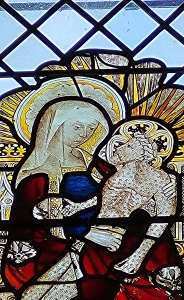
One of the windows is particularly interesting because it shows the Virgin Mary holding the dead body of Christ soon after it had been removed from the Cross. In other words, it is what is known as a Pietà. This subject matter was, and still is, extremely important in Roman Catholic imagery, and had they been able to reach it, those who attacked the church would have certainly wanted to destroy this. A knowledgeable gentleman, who was helping in the church, told us that the pre-Reformation Pietà in the church was an extremely rare survival from the time before Henry decided to break with Rome. What is more is that unlike many images of the Pietà, the dead Christ is shown with his eyes wide open.
The Pietà image in the surviving mediaeval stained-glass is just one of many interesting things that can be seen in the magnificent, large parish church at Long Melford. As the Michelin Guidebooks often say, the place is “worth a detour”.
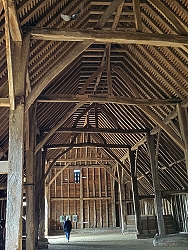
IF WE HAD NOT MISSED a turning at a road junction in Essex, we might never have visited Prior Hall Barn (near Widdington). Maintained by English Heritage, this well-preserved, huge timber-framed, wood-cladded 15th century barn. Constructed entirely of timber – without any metal, it has been estimated that its 900 pieces of timber were derived from 400 trees. Some metal structural elements have been added since the barn’s original construction, which judging by the date of the timbers commenced no later than about 1472. It remained in use as a barn until 1976.
A mediaeval barn such as this one is fascinating enough. However, the land on which it stands has a most interesting history. Just before William the Conqueror set sail for England, he assembled his fleet in the river port of Saint-Valery-sur-Somme. It is believed that he was made welcome in the town’s priory. As a gift of thanksgiving for his successful conquest of England in 1066, he gave the farm on which the barn stands to the priory in St Valery.
In the 14th century, lands owned in England by foreign owners became a drain on the economy, and properties such as the village of Widdington were confiscated by King Edward III. In 1377, the land where the barn and village stand were given to William of Wykeham, the Bishop of Winchester. In 1379, Wykeham founded New College Oxford and endowed it the farm, The college owned the farm from 1379 until 1920, when a local farmer purchased the freehold. It was resold in 1950, and in 1976 its owner, Mr Jeremy Dillon-Robinson placed the barn into the care of the Department of the Environment. Now, it is cared for by English Heritage.
Although I have no idea whether William the Conqueror ever set foot in Widdington, the place’s connection with St-Valery-sur-Somme adds to the excitement of seeing this historic barn. Had we stuck to the ‘beaten track’, we might well never have even heard of the barn, let alone the land’s interesting ownership history.
UNTIL THIS SEPTEMBER (2022), I had only visited Knole House (near Sevenoaks in Kent) once, and that was in about 1972.
I remember three things about that visit. First, it was a grey, drizzly day. Second, in those far-off days, visitors were taken on a guided tour of the house. Third, was the miserable guide. He was an elderly man who did his best to seem unenthusiastic about Knole House. He took us from room to room, stopping at various exhibits, saying things like:
“This is a Jacobean cupboard. Quite interesting if you like that kind of thing”
And:
“Here is a Queen Anne clock. Quite interesting if you like that kind of thing.”
And:
“This is a carved wooden staircase, if you like that kind of thing.”
He made similar comments, always lacking in enthusiasm, each time he pointed out an exhibit or feature. What with the dull weather and the depressing commentary provided by the guide, I believe that subconsciously I avoided revisiting the place.
It was only recently, when we were on our way to visit some friends who live in Kent, that my wife said that she had never visited Knole, and that we should see the place. I agreed, thinking that it would be a good idea to see Knole again: to give it another chance. We went on a sunny afternoon. We walked at our own pace from room to room in the building that was the country home of an archbishop of Canterbury in the 15th century, and later (for over 400 years) the home of the Sackville family, which still resides there. In each room, there were knowledgeable National Trust volunteers who answered our questions and, unlike the guide I met on my first visit, inspired us with enthusiasm for the fascinating place.
Whereas after my first visit to Knole and the poor impression it made on me, I used to be reluctant to recommend people to visit it, but having seen it again, I would put into my top 10 places to visit in Kent.
ONE OF THE JOYS of travelling around in one’s own car is the ability to go almost anywhere one wishes and by any route, direct or indirect. Recently, we were driving along the A1141 between the Suffolk wool towns of Lavenham and Hadleigh when we noticed a small brown and white sign directing tourists to “St James Chapel”. We turned off the main road and drove along a narrow, winding by-road, which threaded its way through cultivated fields and small clumps of trees. We had no idea where the chapel is located and it was almost by chance that we noticed the small building, which is located well away from the lane. The best view of this tiny edifice is through a farmyard next to which it stands, otherwise it is well concealed by tall hedges.
Maintained by English Heritage, the chapel is approached via a narrow L-shaped passage between it and the hedges. A board close by gives the history of the place. The tiny 13th century chapel served the nearby Lindsey Castle, which was abandoned in the 14th century and now exists only as earthworks (www.heritagegateway.org.uk/Gateway/Results_Single.aspx?uid=384905&resourceID=19191). During the 13th century, a lady called Nesta de Cockfield (c1182-c1248; https://our-royal-titled-noble-and-commoner-ancestors.com/p5161.htm#i154959), who was born near Lindsey Castle at Kersey, established a tithe (tax) to maintain the chapel of St James. Along with all other chantries (usually, chapels on private land), St James was closed in 1547 as part of the religious reforms instigated by King Edward VI.
The chapel was used as a barn from 1547 until the early 1930s, when it became designated as a historic monument. The building is built with roughly cut flints held together with mortar or cement. The entrance with its gothic archway and the windows are trimmed with well-cut stone blocks. The interior walls are not plastered and look the same as the exterior. On the south wall there is a niche or ‘piscina’ (used for draining water used in the Mass in pre-Reformation church services), which, like the windows, is topped by a gothic arch. Apart from the piscina, there is nothing else left within the chapel apart from the ghosts of those who prayed there many centuries ago.
The ceiling of St James is formed of the exposed timbers that support the roof, which is attractively thatched, and looks well-maintained. The north wall of the chapel faces the road across the car park of the farm next door to it.
Without a car or bicycle or horse, reaching the tiny chapel of St James would involve a tiring walk. Without a car and plenty of leisure time we would most likely never have visited this delightful remnant of East Anglia’s rich mediaeval heritage.
A SHORT REMNANT OF the old Roman city wall, which used to surround London, runs just south of the church of St Giles Cripplegate, which itself is on the southern edge of the Barbican complex. The garden of Salter’s Hall lies where once a moat ran along the outer side of the wall. And on the other side of the wall, between it and the wide road called London Wall (the A1211), there are the remains of a mediaeval structure, which look as if they might have been the lower part of a gothic tower. These ruins can be examined close-up or a few feet away, seated at a table under the awnings of Barbie Green, an Australian-style, contemporary eatery, which serves good coffee. The restaurant is relatively new, but the ruins have been there far, far longer. Oddly, although we have passed this area often, it was only yesterday, 16th of August 2021, that we first noticed them.
A notice next to the ruins explains that they are all that remains of the tower of St Elsyng Spital, which was also known as ‘The Hospital of St Mary within Cripplegate’ (www.british-history.ac.uk/vch/london/vol1/pp535-537). This hospital was founded in 1330 by the merchant, a mercer, William Elsyng as a college for priests and to provide shelter and other assistance to London’s homeless blind people (https://ethos.bl.uk/OrderDetails.do?uin=uk.bl.ethos.538317). A victim of the Black Death, he died in 1349. Following his instructions, after his death it became an Augustinian priory, which survived until it was dissolved in 1536 during the reign of King Henry VIII. After its dissolution, the parishioners of the nearby St Alphage Church, which had become derelict, purchased the church of Elsyng’s establishment. According to the architectural historian Nikolaus Pevsner, the 14th century tower, whose remains we saw, was incorporated into the structure of St Alphage. St Alphage was demolished at the end of the 16th century and its parishioners used what was left of Elsyng’s priory church, which was eventually replaced by a newly built church on a different site in 1777 (https://en.wikipedia.org/wiki/St_Alphege_London_Wall).
The well-maintained ruins consist of several tall gothic arches connected to each other by walls made of roughly hewn stones and mortar. Most of the arches are arranged around what was once the base of a tower. This mediaeval site is surrounded by modern buildings, lies beneath a sinuous elevated oxidised metal walkway. It is sandwiched between the fragment of London’s Roman Wall and the busy London Wall dual carriageway. Part of the joy of stumbling across this relic of pre-Reformation architecture is that unlike so many others we have seen on our travels, it is in the heart of a modern metropolis rather than a rustic environment.
Small though it is in comparison with its modern surroundings, finding this reminder of London’s distant past, founded long ago by a philanthropic merchant, was a delightful surprise. Even today, so many centuries later, philanthropy thrives in the heart of the old City of London in the form of the descendants of the guilds, of which The Salters, whose hall I mentioned above, is just one example of many.
BROTHER PETER IS one of six retired ex-servicemen who reside at The Lord Leycester Hospital, one of the oldest buildings in the town of Warwick apart from its famous, much-visited castle. He explained to us that the word ‘hospital’ in the name refers not to what we know as a medical establishment but to a place providing hospitality. The men, who reside in the Hospital are known as the ‘Brethren’.
The Hospital is contained in an attractive complex of half-timbered buildings that were erected next to Warwick’s still standing Westgate in the late 14th century. They are almost the only structures to have survived the Great Fire of Warwick that destroyed most of the town in September 1694. The buildings and the adjoining chapel that perches on top of the mediaeval Westgate were initially used by the guilds of Warwick, which played a major role in administering the town and its commercial activity. The ensemble of edifices includes the mediaeval Guildhall in which members of the guilds carried out their business. Between 1548 and 1554, it was used as a grammar school.
In 1571, Queen Elizabeth I’s favourite, Robert Dudley, Earl of Leicester (1532-1588), who lived in nearby Kenilworth Castle, was asked by the queen to clear the streets of Warwick of ailing, infirm, and disabled soldiers, by establishing a refuge (i.e., ‘hospital’) to shelter them. It is said that Dudley persuaded the town’s officials to give him their Guildhall to be used for this purpose. This ended the guilds’ use of the complex of mediaeval buildings, now known as Lord Leycester’s Hospital.
Initially, Dudley’s hospital provided accommodation for The Master, a clergyman, and twelve Brethren, poor and/or wounded soldiers, and their wives. According to the excellent guidebook I bought, the original rules of the hospital include the following:
“That no Brother take any woman to serve or tend upon him in his chamber without special licence of the Master, nor any with licence, under the age of three-score years except she be his wife, mother, or daughter.”
To accommodate them, modifications of the interiors of the buildings had to be made. Brother Peter, with whom we chatted, is one of the current Brethren. He introduced us to another of his fraternity, a young man with a scarred head, who had survived an explosion whilst serving in Afghanistan.
Dudley’s arrangement survived until the early 1960s, when the number of Brethren was reduced to eight. By this time, the Master was no longer recruited from the clergy but from the retired officers of the Armed Forces. What is unchanged since Dudley’s time is his requirement, established in an Act of Parliament (1572), that the Brethren must attend prayers in the chapel every morning. They recite the very same words chosen by Dudley when he established the hospital.
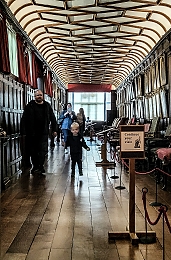
We did not have sufficient time to take a tour of the buildings that comprise the hospital, but we did manage to enter The Great Hall, which now serves as a refreshment area for visitors. This large room has a magnificent 14th century beamed timber ceiling made of Spanish chestnut. It was here that King James I was entertained and dined in 1617, an event lasting three days. We were also able to catch a glimpse of the Mediaeval Courtyard, which is:
The Lord Leycester Hospital is less well-known than the nearby Warwick Castle, which has become something of a costly ‘theme park’. However, the hospital is a far more interesting place to visit, However, you will need to go there before the 23rd of December 2021, when it will be closed for restoration for quite a lengthy period.
OUR DETAILED ROAD atlas – yes, we are still using one of these in preference to ‘GPS’ – marks ‘churches of interest’. One of these is at Little Dunmow in Essex and was labelled ‘priory church’. As we were nearby, we made a small detour to the tiny village of Little Dunmow and found the superb gothic structure standing near some small modern dwellings. As is frequently the case, the church was locked up, but someone suggested that if we asked the lady who lived in one of the nearby houses, she would most likely open it for us. We knocked on her front door and a neighbour looked into her back garden, only to discover that she was not at home. Another of her neighbours suggested that she might be out walking her dog. We saw several ladies out walking with their dogs, and the third one we asked happened to be the one with the key to the church. She opened the church for us, and we had a good look around its interior.
The Flitch Chair at Little Dunmow, Essex
The church of St Mary in Little Dunmow is all that remains of what was once a huge priory church. In fact, it is what was once the Lady Chapel on the south side of the chancel. The rest of the church and the Augustinian Priory, to which it was attached, was demolished in the 16th century following the passing of the Suppression of Religious Houses Act 1535 during the reign of King Henry VIII. Some of the great area that was once occupied by the priory and its large church now contains the village’s extensive cemetery.
The north wall of the existing church was the south arcade of the chancel of the former priory church. The arches through which one could have passed from the Lady Chapel into the now demolished church have been filled in with masonry, but the original supports of the arches remain intact. The south wall of the current parish church has four large gothic windows and on the eastern wall another, which allow a great deal of light to suffuse the church. Probably, these date from 1360 when the chapel was, according the architectural historian Nikolaus Pevsner writing in his Essex volume of “The Buildings of England”, opulently remodelled. The red brick bell tower at the western end of the edifice was added in 1872 and Pevsner describes it as being “… a silly NW turret.”
The church’s well-lit interior has a wonderfully spacious feel beneath its ceiling lined with simple dark timber beams. Apart from enjoying the place in its entirety, several features attracted my interest. Two alabaster effigies, a man and his wife lying down with carved animals at their feet, commemorate Walter Fitzwalter (died 1432) and his wife Elizabeth (née Chideock, died 1464). Walter was the grandson of Robert Fitzwalter (1247-1346), First Baron Fitzwalter. And, more interestingly, Robert’s father, Robert Fitzwalter (died 1235), feudal baron of Little Dunmow, was one of the barons who opposed King John and made sure that he adhered to what was contained in the Magna Carta, which he signed in 1215. A modern plaque on the eastern wall of the church honours his memory.
The pair of effigies are located next to the north wall of the church, west of an alabaster effigy of a now unknown woman, also located next to the wall. Information in the church suggests that she might have been the mother of Walter Fitzwalter, or Matilda, the daughter of Robert, the Third Baron, or even Maid Marion of Robin Hood fame.
Another curious feature within the church is a wooden chair with carvings made in the 15th century, using wood with 13th century carvings. This, the Dunmow Flitch Chair, is a unique piece of furniture. Its seat is wide enough to comfortably seat two adults. It was used during the so-called ‘Flitch Trials”, which still take place in Great Dunmow every four years:
“The ancient Flitch of bacon custom rewarded a couple who had been married in church and remained ‘unregreted’ for a year and a day, with a flitch of bacon. The claimants had to swear an oath kneeling on two sharp pointed stones in the churchyard. They were then carried through the village to be acclaimed.” (www.magnacartabarons.info/index.php/the-towns-and-villages/little-dunmow-essex/)
A flitch of bacon is a side of bacon (half a pig cut lengthwise). The trials were held at the priory church in Little Dunmow until 1750, and were later revived in the 19th century following the publishing in 1854 of “The Flitch of Bacon”, a novel written by William Harrison Ainsworth (1805-1882). In the preface to his story, the author hints at the origin of the tradition:
“”Among the jocular tenures of England, none have been more talked of than the Bacon of Dunmow.” So says Grose, and truly. The Dunmow Flitch has passed into a proverb. It is referred to by Chaucer in a manner which proves that allusion to it was as intelligible in his day as it would be in our own. The origin of the memorable Custom, hitherto enveloped in some obscurity, will have found fully explained in the course of this veracious history. Instituted by a Fitzwalter in the early part of the Thirteenth Century, the Custom continued in force till the middle of the Eighteenth—the date of the following Tale.”
According to the novel, the couple attempting to win the flitch of bacon had to came to the priory church at Little Dunmow, where they were subjected to a trial with witnesses, jury, and judges, to assess whether their marriage had been without blemish for a year and a day. On arrival at the priory church, Ainsworth related, the couple:
“… kneel down on the self-same spot, and on the self-same stones, where, more than four centuries ago, Reginald Fitzwalter and his wife knelt when they craved a blessing from the good prior. Benedicite! fond pair! Ye deserve holy priest’s blessing as well as those who have knelt there before you. Bow down your gentle heads as the reverend man bends over you, and murmurs a prayer for your welfare. All who hear him breathe a heartfelt response. Now ye may look up. He is about to recite the Oath, and ye must pronounce it after him. The Oath is uttered.”
Having been awarded the flitch, we learn that:
“All is not over yet. Ye have to be placed in the antique chair, and, according to usage, borne on men’s shoulders round the boundaries of the old Priory, which in the days of your predecessors stood hereabouts. And see! the chair is brought out for you. It is decked with rich though faded tapestry, woven with armorial bearings, which ye must know well, since they are your own, and with a device, which each of you may apply to the other—Toujours Fidèle.”
Well, our road atlas marked the church at Little Dunmow as being “of interest”, and having visited it, we can assure you that it is of very great interest.
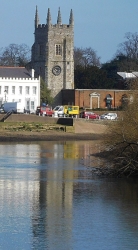
THE TOWER CAN BE seen from far away. From a distance, the visitor to Old Isleworth on the River Thames might be fooled into believing that the 14th century stone square church tower topped with four pinnacles, one at each corner, is attached to an equally venerable church, but this is no longer the case. The mediaeval tower is almost all that remains of the mediaeval church of All Saints in Isleworth. It is attached to a twentieth century structure that now serves as the church. When I saw this, I wondered what disaster had befallen the rest of the original pre-20th century church.
The origin of the name Isleworth is unknown. In the Domesday Book, it is listed as ‘Gistelworde’ and Norden, writing in 1591, named it both ‘Thistleworth’ and ‘Istleworth’. Simon de Montfort (c1205-1265), who expelled the Jews from Leicester in 1231, and his barons are known to have camped in Isleworth Park in 1263. To digress, maybe, in view of his anti-Semitism, the authorities of De Montfort University in Leicester, ought to reconsider its name. Getting back to Isleworth, the Domesday Book records that there was Christian worship in Isleworth (https://allsaints-isleworth.org/about-us/church-history/) and a vicarage is mentioned in records compiled in 1290 (www.british-history.ac.uk/vch/middx/vol3/pp122-129). The church, whose tower is still standing, was dedicated to ‘All saints’ in 1485 and was connected to Syon Abbey, a Bridgettine establishment, founded in 1415 in Isleworth, which was disbanded by Henry VIII. Interestingly, it was in the Abbey’s chapel that the body of Henry VIII lay overnight on its journey from Westminster to St Georges Chapel in Windsor (https://en.wikipedia.org/wiki/Syon_Abbey). The abbey stood where Syon House stands today.
The church is said to have been ‘very ancient’. Its chancel was rebuilt in 1398-99. By 1701, the church was in a poor condition and needed rebuilding. Christopher Wren, architect of London’s St Paul’s Cathedral, was invited to redesign the church. His design was deemed to costly to be carried out and was discarded. Eventually, the churchwardens brought out Wren’s plans and modified them to make the construction of the church more economical. James Thorne, author of “Handbook to the Environs of London” (published 1876), wrote that:
“Apart from its ivy-covered tower, there could not well have been an uglier ch[urch] than that of Isleworth a few years ago…”
However, he added:
“…but it has been transformed, the windows altered, a new roof of higher pitch, and a lofty white-brick Dec. [i.e. gothic revival] chancel added, greatly to the benefit of the general effect.”
He also described many improvements to its interior and noted the existence of a fine organ built by Father Schmidt (Bernard Schmidt: c1630-1708). Alas, none of what Thorne described, apart from the tower, can ever be seen again.
Except for the tower, the church was destroyed by fire in 1943 during WW2. The fire was not the result of military activity but was caused by two young boys. These same two miscreants also set fire to Holy Trinity Church in Hounslow a few days later. This is what happened (https://stmargarets.london/archives/2013/05/fire_starter.html):
“In the early hours of Friday, 28th May 1943, All Saints Church, standing by the Thames in Old Isleworth, was destroyed by fire. The alarm was given at 2.30am by Miss Burrage who lived next door and again by Mr. McDonald, the publican of the “London Apprentice”. Against the darkness of the wartime black-out the glow of the huge fire could be seen for miles.
Three days later, on the afternoon of Tuesday 1st of June 1943, the Parish Church of Hounslow (Holy Trinity) was completely destroyed by fire. Shortly after 5.00pm smoke was reported to be issuing from the church … The police noted that an attempt had been made to open the church safe…”
Two boys, one aged 12 and the other 13, were arrested and tried at Brentford in the old courthouse, which is now home to a restaurant/café called The Verdict. These two youngsters had been in court several times before for crimes of petty theft. In court, they admitted:
“…that they only set fire to the churches out of spite and only if they found no money to steal. They told the chairman Mr. A. J. Chard J.P, how easy it was to break into churches and how easy it was to burn them down. At the Mission Hall they set fire to the curtains. At Broadway Baptist Church they set eight separate fires. At Holy Trinity it was five. The older boy also confessed to burning down a haystack in a coal yard a year earlier.”
The two arsonists were sent to approved schools. The Chairman of the Court recommended:
“…to the Home Office that the two lads should go to separate schools and that the schools should be of the strictest kind; further, that they should be kept there for the full period of three years.”
All Saints Church was rebuilt yet again in 1970 to the designs of architect Michael Blee (1931-1996), who built several churches. From the outside it is quite an attractive structure attached to the mediaeval tower.
While wandering around the church, two things caught my eye. One is a stone placed close to a large yew tree in the churchyard. The stone informs us that the yew tree is growing upon the site where 49 people, who died in the Great Plague of 1665, were buried. The other feature that interested me was a group of stones set in the wall surrounding the churchyard. Each of these records the level to which water reached when the Thames flooded on various years between 1774 and 1965. The building of The Thames Barrier, completed in 1984, brought an end to these flooding events.
All Saints Church stands a few yards away from the riverbank from where there are wonderful views of the Thames and Isleworth Ait and a rich selection of waterfowl swimming in the river. Given how close the old part of Isleworth is to suburban west London, it has a remarkably rustic feeling, and is a peaceful place, providing you ignore the low-flying aircraft that pass above every few minutes.





 yamey
yamey 