A hidden river and supplying water to London

IT IS EASY to miss this small, inscribed stone set low down close to the pavement of Marylebone Lane just south of its intersection with Wigmore Street. The stone is inscribed with the following:

“Conduit belonging to the City of London 1776”

Noticing it for the first time today (14th of November 2024) although I have passed it many times before, I was puzzled by it.
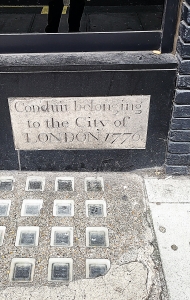
Marylebone Lane runs between Oxford Street and Marylebone High Street. It is far from straight because it follows the course of the now hidden Tyburn River, one of the tributaries of the Thames. Since the middle of the 18th century, this river has run in an underground culvert. Water from this river was once taken from it to supply the City of London with water. As a website (https://coalholesoflondon.wordpress.com/2012/02/21/marylebone-conduit/) informed, the inscribed plaque:

“… reminds us where the water was once piped to the City of London, close by the Lord Mayor’s old Banqueting House, which once stood in fields now occupied by nearby Stratford Place. Alongside this field was a small lane leading to Marylebone – the present day ‘Marylebone Lane’ – where on this corner stood the chief conduit, now marked by this commemorative stone inlaid into the wall and dated 1776 with its City of London claim.”

Had this modest plaque not been placed and preserved, an interesting feature of London’s hydrological history might have been lost for ever. Apart from avoiding pitfalls on London’s not always perfect paving stones, looking where you are walking can often be quite interesting.

The first and only Queen of Haiti

UNTIL FEBRUARY 2022, only very few people with specialised knowledge of history would have been able to point out the house in which Marie-Louise Christophe lived in London between 1821 and 1824. Now, there is a plaque on the house in Marylebone’s Welbeck Street that marks the house in which she resided. And by now, you might well be wondering why anyone might want to know.

Marie-Louise (1778-1851) was born into a free black family, which ran a hotel, in St Dominique (which is now Haiti). In 1793, she married Henri Christophe (1767-1820), who had been one of her father’s slaves before he had earned enough in tips to purchase his freedom. After several years of revolution, in which Henri Christophe was an important freedom fighter, Haiti gained independence from France in 1804. In 1811, Henri was crowned the King of Haiti and the following year, Marie-Louise was given the title of Queen of Haiti. After the death of her husband in 1820 and the assassination of her two sons, she fled from Haiti along with her daughters. Their escape was assisted by the British, and they settled first in Blackheath, where they were hosted by the Anti-Slavery activist (abolitionist) Thomas Clarkson. After several changes of address, the Queen and her daughters settled in number 49 Welbeck Street.

According to the British press of the time, she and her daughters were popular with British people in all the social echelons. In 1824, they left London for Europe. Marie-Louise died in Rome, where she is buried. She never returned to Haiti. It was only in February 2022 that the Nubian Jak Community Trust were able to put up the commemorative plaque which you can see on number 49 Welbeck Street. It correctly describes Marie-Louise as “First and Only Queen of Haiti.”

The Poles in London’s Marylebone

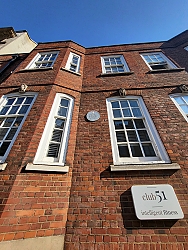
IT ALMOST GOES WITHOUT saying that wherever you are in central London, you are never more than a few footsteps away from a spot that has played a role in significant historical events. Most of these historical spots have been recorded, and therefore are not unknown to at least a few people. However, when walking around London, I often come across a memorial which I had not noticed before despite having passed it several times. Such is the case with number 51 New Cavendish Street – a brick building in Marylebone, which we have walked past several times recently.

Number 51 bears a commemorative plaque which has the following information:

“This building housed the headquarters of the Polish navy during 1939-1945”.

Underneath this, but in much smaller letters, are sixteen Polish names. From an informative website (https://wartimelondon.wordpress.com/2018/12/12/new-cavendish-street-and-the-free-polish-navy/), I learned that these are the names of Polish naval vessels -ships and submarines.

Poland became an independent country at the end of WW1. By 1920, then with only 90 miles of coastline, Poland began to construct a navy. This was based in Gdynia, near to the ‘free port’ of Gdansk (Danzig), which was not under Polish control. In 1939, with little chance of withstanding attack by the Germans, Polish naval vessels began leaving the Baltic, and heading for British waters. In late 1939, Polish Naval Headquarters were established at 51 New Cavendish Street. Although the Poles had administrative control over their vessels, operational control was dictated by British military requirements. Between 1939 and 1945, the number of men working in the exiled Polish Navy increased from 1000 to 4000.

After the end of WW2, in September 1946, the Polish Naval Detachment in the UK was disbanded. One of its warships was handed back to the new Communist government of Poland. Only a few of the naval personnel felt able to return to their native land now that it was under Communist rule.

Well, I knew a little about the exiled Polish Air Force and have visited Audley End House, where Polish Special Operations Executive personnel trained before being dropped behind the lines in German-occupied Poland. I have even eaten dinner at a Polish Airman’s Club in South Kensington, but this place’s restaurant might well have closed since then. However, until my most recent visit to New Cavendish, I did not know anything about Poland’s navy and its role in WW2.

A mansion in Marylebone

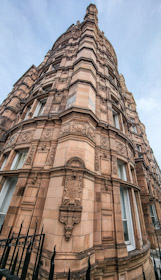
A HIGHLY DECORATIVE BLOCK of flats stands on the southeast corner of the intersection of Wimpole and New Cavendish Streets. Bearing the date 1892, one of its large bricks was laid by Mary Mason Lithgow.

Mary was the mother of the person who commissioned the building, the lawyer and property developer Samuel Lithgow (1860-1937). Samuel was born in Marylebone and after qualifying as a solicitor, he practised at 42 Wimpole Street. Politically inclined, he represented the West St Pancras ward of the London County Council between 1910 and 1913. A philanthropist, he founded the Stanhope Institute for Men in 1891. In addition, he was a governor of the North West London Polytechnic (founded 1896).

Wimpole House was designed by Charles Worley (1853-1906) in the so-called Belgian Renaissance Style. It is a very florid addition to an area filled with buildings displaying a wide variety of decorative flourishes

Remembering an old friend in London’s Marylebone

MY FRIEND MICHAEL Jacobs (1952-2014) studied history of art at A Level (university entrance examinations) and then later at university. Later, he became a prolific author. When we were in our late teens, we used to visit Hampstead’s second-hand bookshops together. A few days ago (early September 2022), I was walking along Marylebone’s New Cavendish Street when I spotted something that reminded me of one of our bookshop visits in the late 1960s.

There is a building on the northeast corner of New Cavendish Street and Wimpole Street, which caught my eye. As I passed it, I spotted a small plaque giving the architect’s details. It reads: “BANISTER FLETCHER & SONS ARCHITECTS AD 1912” Sir Banister Flight Fletcher (1866-1953) trained at London’s Kings College, University College, the Royal College of Art, the Architectural Association, and Paris’s École des Beaux-Arts. In 1889, he became a partner in the architectural firm founded by his father: Banister Fletcher & Sons. In addition to designing buildings, Banister Fletcher (and his father) wrote a book of great importance.

The book, “A History of Architecture on the Comparative Method”, which was first published in 1896, was republished several times during the 20th century. It was the standard reference work in English on the history of architecture.

Seeing the name Banister Fletcher on the building in Marylebone reminded me of an afternoon in Hampstead during the late 1960s. We were rummaging around the somewhat disorderly collection of books in Francis Norman’s bookshop in Perrins Lane when Michael discovered a copy of Banister Fletcher’s history of architecture, a book that was well-suited for the bookshelf of a student of the history of art. Michael bought it at an extremely reasonable price.

Until I spotted the building on New Cavendish, I had always associated the name Banister Fletcher with that afternoon with Michael in Hampstead. The building I saw is the first example of a structure that I have been able to associate with the author of the history purchased by my late friend.

A church near Madame Tussauds

I HAVE PASSED IT OFTEN while travelling along London’s busy Marylebone Road and admired its elegant neoclassical portico supported by six columns with Corinthian capitals, but never entered it until today (the 7th of September 2022). I am referring to the Church of St Marylebone, consecrated in 1817. One of its predecessors, dedicated to the Blessed Virgin Mary was erected nearby in about 1400. It stood near the River Tyburn. The name Marylebone seems to be derived from a conjunction of the words Mary and ‘burn’ (from Tyburn, which began to have a bad reputation because of the much-used gallows close to its banks). This early church was replaced by another, constructed in 1740. It survived until it was demolished in 1949.  Nearby, the present larger church, which we see today, was constructed in 1817 on what was then the New Road, a by-pass on the northern edge London, and is now Marylebone Road. Its grand portico faces north, and the high altar and the colourfully decorated apse are in the south end of the building. The church, a typical example of a Regency interior with first-floor galleries, is tall and spacious.

Charles Dicken’s son was baptised in the church. The poet Robert Browning (1812-1889) married a fellow poet Elizabeth Barrett (1806-1861) in the church in 1846. And the composer John Stainer (1840-1901) composed his oratorio “The Crucifixion” specially for this church in 1887 when he was already a fellow of the Royal Academy of Music, which is across the main road facing the church.

The Methodist Charles Wesley (1707-1788), who lived nearby, asked to be buried in what was the churchyard of the older (1740) church. Where this edifice stood is now a peaceful open space, the Garden of Rest, next to Marylebone Lane (a few feet south of Marylebone Gardens). In this small space, there is a stone obelisk mounted on a pedestal. This commemorates the life of Charles Wesley and several members of his family.

Close to Madame Tussauds and the Royal Academy of Music and neighbouring one of London’s more enjoyable shopping areas – Marylebone High Street, stands the lovely church of St Marylebone, which as I discovered today, merits a visit.

Beyond London’s West End: the story of west London

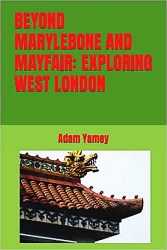
BEFORE THE YEAR 1800, the West End was truly the western end of London. West of Mayfair and Marylebone, there was countryside: woods, fields, private parks, farms, stately homes, villages, and highwaymen. After the beginning of the 19th century, the countryside began to disappear as villages grew and coalesced and the city of London expanded relentlessly westward. What had been rural Middlesex gradually became the west London we know today.  My new book, illustrated with photographs and maps, explores the past, present, and future of many places, which became absorbed into what is now west London: that is London west of Park Lane and the section of Edgware Road south of Kilburn. Some of the places described will be familiar to many people (e.g., Paddington, Kensington, Fulham, and Chelsea). Other locations will be less known by most people (e.g., Acton, Walham Green, Crane Park, Harmondsworth, and Hayes). Many people have seen the places included in my book when they have looked out of the windows of aircraft descending towards the runways at Heathrow, and many of them will have passed some of these places as they travel from Heathrow to their homes or hotels. My book invites people to begin exploring west London – a part of the metropolis less often on tourists’ itineraries than other areas. “Beyond Marylebone and Mayfair: Exploring West London” is aimed at both the keen walker (or cyclist) and the armchair traveller.  

Beyond Marylebone and Mayfair: Exploring West London is available as a paperback from Amazon here:

https://www.amazon.co.uk/BEYOND-MARYLEBONE-MAYFAIR-EXPLORING-LONDON/dp/B0B7CR679W/: