Footpaths in the Painted City: a journey of discovery

HERE IS A BOOK which I have found fascinating. It is “Footpaths in the Painted City” by Sadia Shephard. It was published in 2008. The American born author’s father was an American Protestant, and her mother a Muslim from Pakistan. Her mother’s mother, Nana, converted to Islam when she married in Pakistan. However, early in the book, Sadia reveals how she discovered that Nana was born Jewish in pre-independence India.

What made the book especially interesting is that Nana was born into a Beni Israel family. Nobody is sure of the origins of the Beni Israel Jews, who reside mainly in the western Indian state of Maharashtra. It is commonly said that they are the descendants of Jewish people who left Israel after the destruction of the Second Temple in Jerusalem, and made their way by land and sea to the western coast of the Indian Subcontinent. They have adhered to all the rituals followed by members of other Jewish communities for many centuries. Until some European traveller in India recognised their adherence to Jewish religious ways of life during the nineteenth century, it is said that the Beni Israel community were unaware that they were Jews.

In her book, Sadia tries to discover more about Nana’s life story and the Beni Israel community into which she was born. To do this, the author travelled to both Pakistan and India. Her account of her time in India, investigating what remains of the country’s Beni Israel communities is fascinating and gives the reader a good idea of what a young lady experienced while living on her own for several months in India.

I have greatly enjoyed reading this engaging and moving book, and can recommend it to anyone interested in Judaism in India, the Beni Israel community, family history, travel, and any combination of these.

Kutch from kingdom to district

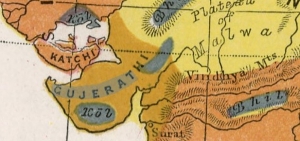
MY WIFE’S COUSIN lives in a part of the Indian state of Gujarat called Kutch (‘Kachchh’). He and his wife have a lovely farmhouse near the port city of Mandvi, where you can watch huge wooden dhows being constructed along the riverbank. Although Kutch is now a part of the state of Gujarat, it has not always been. The people of Kutch (‘Kutchis’) speak a language quite distinct from Gujarati. The Kutchi language has closer similarity to Sindhi than to any other Indian language (Kutch is bordered to its north by Sindhi speaking people*). It is a spoken language, but not written. Even though Kutchi people can speak and write in Gujarati, they will proudly inform you that they are Kutchis and definitely not Gujaratis. During our several visits to Kutch, my wife’s cousin’s driver, who can speak good Gujarati, insists on speaking to my wife in Kutchi, which she cannot speak as well as Gujarati.

Many people with whom I have discussed my travels, look puzzled when I say that we have been to Kutch. Just in case you are wondering, it is the furthest west part of India. Most of the north of the region is bordered by Pakistan, from which it is separated by the arid Rann of Kutch. To the south and separated from it by the Gulf of Kutch (a part of the Arabian Sea) is the peninsula of Saurashtra – now also a part of Gujarat.

Until 1947, Kutch was a kingdom founded by unifying three separate kingdoms, ruled by branches of the Jadeja family, in the 16th century. In 1819, having suffered a military defeat (at The Battle of Bhuj in March 1819), the Kingdom of Kutch accepted the sovereignty of the British East India Company. Under the watchful eyes of the British, members of the Jadeja family continued to rule Kutch – it became one of India’s many ‘Princely States’. On the 16th of August 1947, one day after India became independent, Kutch voluntarily acceded to the new Indian state.

Kutch became a state of India. In November 1956, as a result of the State Reorganisation Act (1956), Kutch ceased to be a state in its own right, but became a part of the then huge Bombay State. The latter was effectively a bilingual region, most people were either speakers of Marathi or of Gujarati. The Marathis and the Gujaratis began to clash. In 1956, the Mahagujarat Movement began campaigning for a state for Gujaratis, which was separated from that for Marathis. The movement was spearheaded by Indulal Yagnik (1892-1972). His nephew, who lives in Bangalore is a family friend, whom we meet whenever we are in the city. As the Gujaratis clamoured for their own state, so did the Marathis, Blood was shed, and much property was damaged. On the 1st of May 1960, the old Bombay state was divided along linguistic grounds. The states of Maharashtra and Gujarat were formed. The latter includes the Gujarati speaking district of Saurashtra as well as the northern part of the former Bombay State, and also Kutch. And that is how it remains today.

Since 2017, we have made several enjoyable visits to Kutch, from which my wife’s maternal ancestors hail, and enjoyed many fascinating experiences there. Some of these can be found in my new book – a collection of true stories about life in India seen through my eyes. The book (also Kindle) is available from Amazon websites including https://www.amazon.co.uk/HITLER-LOCK-OTHER-TALES-INDIA/dp/B0CFM5JNX5/

*When Lord Napier conquered Sindh *which neighbours Kutch) in 1843, he is reputed to have sent a single word message to London in Latin “Peccavi”, which means ‘I have sinned’.

Drowned in India

ON OUR THIRD VISIT to the delightful grounds of Compton Verney House in Warwickshire, we took a close look at the chapel that stands close to the main house. Constructed between 1776 and 1779 in Palladian style, it was designed by someone who was far better known for his skill in landscape planning than for his architectural ability, Lancelot (‘Capability’) Brown (c1715-1783).

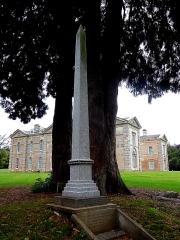
The chapel was constructed to replace another older mediaeval one that Brown demolished in order to improve the view of the garden’s lake from the main house. A slender obelisk stands close to the lake, marking the former position of the older chapel. A carved stone notice below it explains:

“This obelisk is an exact model of the Lateran obelisk at Rome. The marble was given by Joseph Thomas Jeffrey Esq of Place in Cornwall”

A man with the same name ordered the building of the Treffry Viaduct in Cornwall in 1839, using granite from his own quarries (https://explorecornwall.org/a-walk-around-luxulyan-valley/). Maybe this is the same person who supplied the granite on which the Compton Verney obelisk stands. Place in Cornwall is near to Fowey, where Jeffrey was based.

 Close to this monument, there are a couple of gravestones lying in the grass. When the old chapel was demolished in 1772, most of its funerary monuments were saved and then transferred to Brown’s new chapel, where they can be seen today.

A fenced off area near the obelisk contains a brick structure from which spring water issues. This is fed to a rectangular stone bath next to the lakeside. This pool is currently being used to grow watercress.

On entering Capability Brown’s chapel, the visitor cannot help immediately noticing the splendid carved monument in the centre of the eastern half of the nave. Carved in 1631 by Nicholas Stone (c1586-1647), sculptor and architect as well as Master Mason to both James I and Charles I, its top bears the carved almost life-sized effigies of Richard (1563-1630) and Margaret Verney (née Margaret Greville, 6th Baroness Willoughby de Broke; c1561-1631) . Various large gravestones form the floor of the raised step where an altar should normally stand. Some of these have been placed so that the heads of the stone slabs face east rather than the usual west. The oldest memorial that we could find in the chapel is dated 1574. It is the gravestone of George Verney (c1543-1574), son of Sir Richard Verney (c1516-1549) and his wife Frances (née Raleigh; c1521-1544).

While I was looking at the stones set in the floor, our friend, who was accompanying us and knows of my interest in India and its history, pointed to a commemorative plaque on the north wall of the chapel. It informs:

“In memory of Henry Verney 2nd Lieutenant VII Hussars. Born June 19th 1870, drowned at Poonah with two of his brother officers June 25th 1893, and of Katharine Verney born July 3rd 1874, died July 28th 1897.”

Henry’s full name was ‘Henry Peyto Verney’. He was the son of Henry Verney, 18th Baron Willoughby de Broke (1844-1902) and Geraldine (née Smith-Barry). Katharine was Henry’s sister.  ‘Poonah’ is an old name for the city of Pune (modern name) in the current State of Maharashtra in India.

The VII Hussars were originally ‘7th Queen’s Own Light Dragoons’. They took on their new name in 1807. This British army unit, which Henry Verney joined, was in existence from 1805 until 1958. The unit served all over the place: in the Peninsular Wars (1808-1809); in England to help quell the Corn Law Riots (1815); at the Battle of Waterloo (1815); in Canada, quelling riots (1838-1842); in India suppressing the Revolt that began in 1857 (1857-1859); South Africa (1881-1882) during the First Anglo-Boer conflict; the Sudan (1884-1885); and again in India (1886-1895)

Henry Verney joined the VII Hussars and went out to India at the age of twenty. According to a history of the VII Hussars (https://www.britishempire.co.uk/forces/armyunits/britishcavalry/7thhussarsverney.htm) :

“Preparations for embarkation to India began in September 1886 when the 7th left Hounslow to go to Shorncliffe. Horses were handed over to the Mounted Infantry and to the 14th Hussars who were returning from India. Extra men were drafted into the regiment from other hussar units so that the strength was now 21 officers, 587 NCOs and privates. They, with 50 women and 47 children proceeded by rail to Portsmouth where they sailed on the ‘Euphrates’ troopship on 26th Nov 1886. They arrived at Bombay on 23rd Dec, taking less than a month, so must have sailed through the Suez Canal. They were stationed at Secunderabad … In Oct 1891 they moved to Mhow…”

They arrived at Mhow (renamed ‘Dr. Ambedkar Nagar’  in Madhya Pradesh State) in the year following that in which Henry Verney joined them:

“He joined the 7th Hussars on 8th Oct 1890 and served with them in India but he was unfortunately drowned in a boating accident at Poona on 25th June 1893. He and two other young officers, Lt Sutton and Lt Crawley were on leave and hired a sailing boat to go on the river, but they lost control of it in the current and were swept over a waterfall. The three of them were seen clinging to the upturned boat in the swirling waters but they succumbed and went under, one of them was last seen swimming towards a bridge but he never made it. Verney’s body was found on 27th and the other two on the next day. They were buried on 28th June with military honours. A firing party was provided by 2nd Yorks LI and a gun carriage by L Battery RHA. The commanding officer Lt-Col J L Hunt attended with 9 officers and 3 warrant officers.”

This plaque in Capability Brown’s chapel is not the only one recalling the drowning of Henry Verney. Another one can be seen in the church at Lighthorne, a village close to Compton Verney. The trapezoid plaque, which I have yet to see, reads:

“TO THE GLORY OF GOD/ AND IN THE MEMORY OF HENRY PEYTO VERNEY/ LIEUT 7TH HUSSARS DROWNED AT POONAH/ IN INDIA 25 JUNE 1893 AGED 23 YEARS” (www.iwm.org.uk/memorials/item/memorial/83855).

Had Henry not been killed so young, he might have become involved in the Second Anglo-Boer War (1899-1902) or even WW1, by which time he would have been 44 years old. During that war, the VII Hussars lost 224 of their members in Mesopotamia during 1917.  They had been sent to the Middle East from Bangalore (India), where they had been stationed since 1911.

Even if your interest in India is minimal or non-existent, it is well worth making a visit  to Compton Verney to see its art collections, house, chapel, its lake with fine stone bridges, its wonderful trees, and its beautifully landscaped grounds.

NATION OF SHOP KEEPERS

It is popularly believed that Napoleon Bonaparte described the British as a nation of shopkeepers but in reality he might not have said so. More likely, the early economist Adam Smith, author of The Wealth of Nations, might have coined this phrase. He wrote: “… the sole purpose of raising up a people of customers may at first sight appear a project fit only for a nation of shopkeepers…”

Well, Great Britain still contains many shop keepers, but most of them are hopeless. Few shop keepers or their assistants, who are employed to make sales, put much effort into encouraging customers to buy. In general, they are an unhelpful bunch. Often when one asks for something, one is told by a typical British shop keeper: “If we’ve got it, it will be out on the shelves”, and then the customer is left to hunt for it somewhere in the shop.

Occasionally, you can find a helpful salesperson. Once, I was in London’s Oxford Street looking for a winter coat with certain features. I described in detail what I was seeking to a salesman. He replied cheerfully: “I know exactly what you need, Sir. I know just the job. You need a Danimac.” He paused before continuing: ” there’s only one problem: Danimacs are not made anymore.” And, that was it.

Had I been looking for that coat in India, the salesman would not have stopped at that point. Instead, he would have shown me a range of other types of coat in the hope that I might see the benefits of modifying my requirements and buying something else.

Unlike their British counterparts, Indian shop keepers and their sales people take a professional pride in both satisfying the customer and making sales.

Take clothes shopping for example. You enter a shop without much idea which shirt or skirt you want and are bewildered by the variety on display. You will be welcomed by a sales person, who will begin by showing you a garment that may not be to your taste. Then, you will be shown a series of other items. The salesperson will gradually show you merchandise that really appeals to you because he or she has been watching your reactions to what is being shown to you, and from these, your taste in clothes can be accurately ascertained. When you have selected whatever you were looking for as well as much that you never knew you wanted, alterations that might be needed to ensure a good fit will be carried rapidly out at no extra charge.

Some Indian shopkeepers are brilliant salesmen, especially the Kashmiris who run handicraft shops. You might enter one of these shops without any intention of making a purchase, but so expert are the sales people that I doubt that you will leave empty handed!

I could go on and on about the excellence of sales people in India, but I will not. However, before signing off, let me tell you about a simple vegetable seller in Bandra (Maharashtra). Formerly, he used to lay out a cloth blanket by the roadside. At about 1 pm, a truck would stop next to his cloth and various vegetables would be delivered. From day to day, the vendor had no idea which vegetables would arrive, but whatever arrived was, and still is, of a very high quality. His customers, mostly regulars, would turn up and buy what they needed.

After some years, the veg seller acquired a mobile phone. He collected the phone numbers of his customers. Now, every day the veg seller takes pictures of whatever he has received for sale, and then sends the pictures, the prices of his goods, and a description of them, to his customers via WhatsApp. His customers reply with their orders, which they come and collect from him. Thus, from humble beginnings a street vendor has brought his age old business into the 21st century.

Had Napoleon Bonaparte reached India, he would have had good reason to say, as I do, that Indians are truly a nation of first class shopkeepers.