Bouquets of banknotes for brides and grooms in Indore

AT INDIAN WEDDINGS, money is often gifted to the happy couple, usually amounts of rupees ending in 1 (eg 51, 101, 501, 1001, etc). Today (26 December 2025), by chance, we found ourselves in a part of the city of Indore, Sarafa Bazaar, where jewellery and things for use in weddings are sold.


Amongst the numerous shops, we found several that were selling items we had not seen before.  They are decoratively made bouquets of genuine Indian banknotes. These are assembled geometrically around colourful decorative ornaments, and, in some cases, flowers.


When we asked a shopkeeper what purpose these amazing, attractive arrays of banknotes served, he said that they were for what sounded like the ‘dulhan’ (bride in Hindi). The prices of these bouquets is the sum of the banknotes contained within them and the ornamentation, as well as the labour costs.


While writing this short piece, I  found out that these banknotes bouquets or currency garlands can also be presented to bridegrooms.


I do not know how widespread is the practice of presenting banknotes arranged decoratively. So far,  I have only seen it in Indore.

EM Forster and some caves in Mandu (Central India)

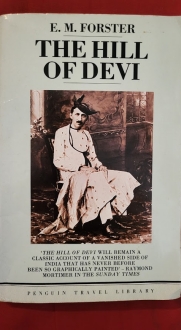
I AM OVER HALFWAY through reading “A Passage to India” by EM Forster (1879-1970). In this exciting novel, which contains the author’s acute observations about the minutiae of India as it was before Independence and to a large degree after,  Dr Aziz, an Indian, ill-advised (in my opinion) accompanies two English ladies to the Marabar Caves (a fictional name). Trouble ensues, and Dr Aziz is arrested.  I will not give away the rest of what I have read so far, but will mention some caves in Mandu (Madhya Pradesh), which we visited on Christmas Day 2025.


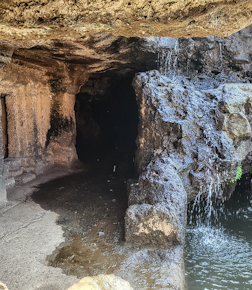
The caves are close to the scant remains of Mandu’s Lohani Gate. Easy to enter, they were excavated and converted into chambers or cells where Hindu priests or yogi might once have resided. Archaeological evidence suggests that the caves were excavated and modified in the eleventh or twelfth century. They predate all of the other archaeological sites in Mandu.


Fortunately,  our visit to these caves was less eventful and sinister as is described in Forster’s excellent story. In fact, the Lohani Caves are delightful, and considering how close they are to Mandu’s most visited places, they are  ignored by most tourists.


Now, I must leave you and get back to my tattered copy of “A Passage to India”.

PS: by “minutiae” I include Forster’s detailed description of the behaviour of Indian squirrels and the Echo Point at Mandu, which we saw recently, as well as the curious echo effects at the Gol Gumbaz in Bijapur, which I have experienced.

A mausoleum admired by the designers of the Taj Mahal

WHEN ARSLAN KHAN was appointed Sultan of the Malwa Sultanate (now part of Madhya Pradesh) in 1406, he became known as Hoshang Shah. He ruled until his death in 1435.


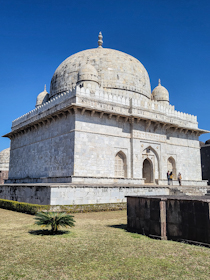
Hoshang’s body lies within a splendid, white marble mausoleum in Mandu. It has one large central dome and 4 smaller domes, one at each corner of the square edifice.  As soon as I saw this marvellous building, I  thought of the Taj Mahal,  which I have seen in many photographs.


Hoshang Shah’s mausoleum was constructed in the fifteenth century, long before the Taj Mahal.  A tablet within Hoshang’s mausoleum has an inscription that records the visit of 4 of Shah Jahan’s architects in 1659. They came to pay homage to the builders of the tomb. One of the four was Ustad Hamid, who was closely involved in the construction of the Taj Mahal in Agra (completed in 1653). This illustrates the high esteem that Hoshang’s mausoleum inspired.

I wonder whether those builders saw Hoshang’s mausoleum before designing the Taj Mahal.

The only road in Indore named after a British man

A ROAD IN INDORE NAMED AFTER A BRITISHER

A STATUE OF of Robert North Collie Hamilton (1802–1887) who was British Resident of Indore during the first war of independence in 1857, stands within the garden of the Lalbagh Palace in Indore.

According to a website about the city’s Lalbagh Palace (www.freepressjournal.in/pbd-indore/hamilton-road-only-road-of-indore-named-after-britisher) :

“In the year 1857, a group of freedom fighters gathered at Hamilton Road to protest against the Britishers. On the same day Hamilton was going on leave and his acting officer Sir Henry Marion Durand had taken charge. Sir Durand, angry at the protestors, ordered British army to attack them. When Hamilton came to know this he cancelled his sanctioned leave and ordered the army to not to attack”

The Hamilton stands close to a statue of Queen Victoria.

Because of Hamilton’s actions, he is remembered in Indore not only by the statue but also the city contains a short road named after him. It is the only road in Indore named after a British person.