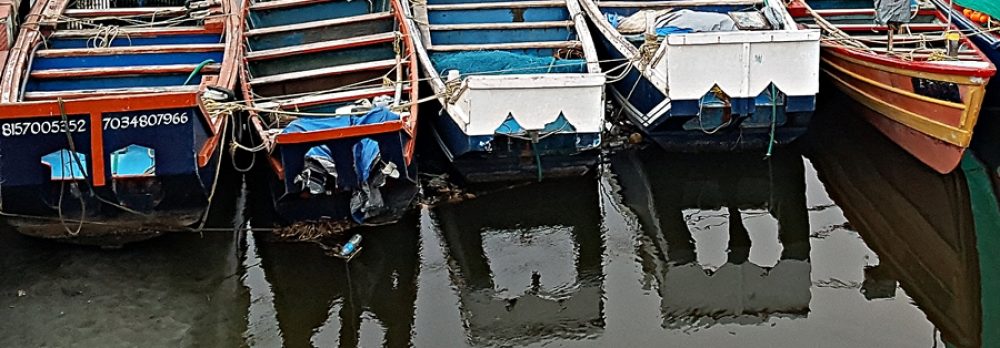
A narrow escape

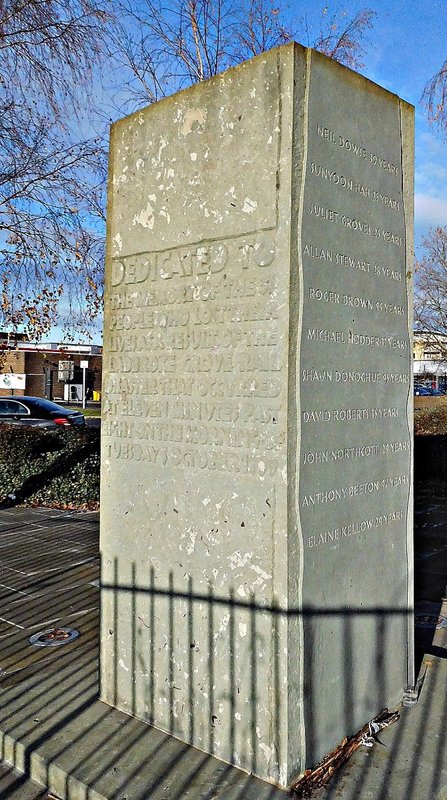
Ladbroke monument


My first job as a dentist was in a lovely practice in the Medway Towns. After having worked there for eleven years, I married and then lived in London. As it became tiring commuting by car between Kensington and north-east Kent, I changed practices. I worked for about nine months in north-west London in a practice where I was not happy. Then, I moved to another practice near Portobello Road. After about four years, the owner of that practice decided to open another branch in Maidenhead, Berkshire. I thought it would be interesting to work in a brand-new practice, and as Maidenhead was served by a good rail connection from Paddington, which is near my home, I decided to move to the new practice, where I treated its very first patient.

Usually, I boarded a local train that left Paddington a few minutes past eight in the morning. Just over half an hour later, I used to disembark at Maidenhead station, which was a couple of minutes’ stroll from the practice. Of the patients whom I treated there, the less said the better. My best memory of the place was that it was near a wonderful sandwich shop. The people who worked there had no idea about portion size control. So when I ordered my favourite sandwich, filled with prawn mayonnaise, it contained so much filling that I could hardly get my mouth around it.

One Monday evening, I returned to Paddington a little earlier than usual. Not being in a great hurry, I bought a ticket for the following Monday’s journey to Maidenhead.

On the following day, Tuesday the 5th of October 1999, I arrived at Paddington early as usual. Having already bought my ticket the evening before, I was able to take the train that left a few minutes earlier than the one I usually boarded. It left just before 8 am. The train I normally travelled on left a few minutes after 8 am.

I arrived at Maidenhead and began working. In those days, I used to have a radio running in my surgery. I heard a news bulletin that mentioned that there had been a terrible rail crash. I thought nothing of it until I returned to Maidenhead station that afternoon. I discovered, to my annoyance, that no trains were running as far as Paddington. They were all terminating west of Paddington at Ealing Broadway, where, fortunately, there is an Underground line which allowed me to continue my homeward bound journey.

It was only when I reached London that I learned more details about the crash. The train that I normally boarded every morning, the one which left a few minutes past 8 am, had collided head-on with a high-speed express train coming in the opposite direction on the same set of rails. Later, it was reported that 31 people had died and over 500 were injured. Most of the victims, killed and injured, were on board the train that I missed taking because I had bought my tickets on the night before.

There is a monument to those who died in the crash. It is near the large Sainsbury supermarket on Ladbroke Grove. Whenever I see this simple stone monument or think about the incident, I shudder. One of the names on that memorial could have easily been mine.

Do they speak Welsh?

MARS

One of the many patients, whom I treated while I was studying dentisty at University College London, was a highly intelligent senior civil servant. There was much work that needed doing in his mouth, so he visited my clinic frequently and we got to know each other reasonably well. At least, that is what I began to think.

 One morning, he arrived for his appointment and sat in my dental chair. After exchanging pleasantries, he said:

“You know those Martians, who have landed in Wales?”

“Mmmm,” I replied.

“Well, I’ve heard that they communicate without exchanging words.”

“Telepathy?” I asked.

“Yes, that’s it”

I turned away from him, ready to wash my hands, when he continued:

“Well, I was wondering whether when they are in Wales they communicate in English or Welsh.”

Feeling a smile coming on, I turned my back to him, and began washing my hands for long enough for my urge to laugh to wear off.

As the saying goes, it takes all sorts…

Magnetic moments

MRI 1

By nature, I am most apprehensive about having to undergo any medical intervention. Even having my hair cut at the barber gets me worried, not because I am concerned about the final hairstyle but because I fret about what might go wrong. Recently, I had to undergo an MRI (Magnetic resonance imaging) scan for reasons that need not concern you, dear reader.

I first heard of magnetic resonance whilst studying biological chemistry as part of my physiology degree course at University College London. Nuclear magnetic resonance spectroscopy is used to investigate the physical and chemical properties of molecules and is of particular usefulness to organic chemists. On the other hand, medical MRI scanning allows a non-invasive investigation of body parts (including soft tissues) without any dangers such as harmful radiation.

Many people who have experienced MRI scanning have told me how fearful an ordeal it is. Their main concern is having to lie still for a long period of time in a noisy, featureless, confined space in a narrow tube barely large enough to hold a body. When I learnt that I was going to have undergo an MRI scan, I was filled with anxiety. For someone like me, who dreads even haircuts and eye-tests, you can imagine that I was not looking forward to having my scan.

I arrived at the scan and felt like the peanut which stood on the railway track, whose heart was all a flutter (when ‘around the track the engine came… toot toot peanut butter’). 

Putting a brave face on it, I entered the scanning room through a reinforced metal door that looked like the entrance to an atomic bunker. I lay on a narrow bed, which turned out to be extremely comfortable. Before being given a set of headphones to protect my ears from the noise that would be produced during the scan, I was asked what music I would like to hear. I asked what was on offer. The choice was between Motown and classical. I opted for the latter.

The bed with me on it slid slowly into the circular tunnel in the centre of the Siemens ‘Magneton’. I continued entering it until only the crown of my head was outside it. When I looked up, all I could see was the grey funnel like rim of the entrance to the machine.

There was a sound like a fog horn, and then the sound of monotonous soporific classical piano music, rather tinny in tone. No decent composer would have had the gall to own up composing this pathetic attempt at ‘classical music’. Nevertheless, it was mildly distracting, and its lack of variety helped me to relax.

Then, the fun began. For reasons that the nurse could not explain the MRI machine produces a series of extraordinary noises, which must have been very loud because I could hear them quite clearly despite wearing the ear-protecting headphones. The first of these noises resembled someone hammering loudly at a building site. This was followed by bursts of sound (each lasting several minutes) that included ‘kerchunk, kerchunk, kerchunk,…’; ‘boop, boop, boop…’; ‘whooo, whooo, whooo,…’, ‘tak,tak, tak…’; and so on. All the time, the monotonous piano music droned on, barely competing with the miscellany of bursts of weird mechanical sounds coming from the magnets in whose womb I was confined. At several stages, the machine seemed to become over excited, not only emitting noises but also causing the bed on which I was lying to vibrate.

Far from hating the whole experience as I was sure that I would, I found it mildly entertaining. The 40 odd minutes of my scan shot by. Let me explain. First, I was extremely comfortable. Having to lie still on a comfortable bed was very restful and relaxing. It was far more comfortable than sitting for 40 minutes in an aeroplane or in some theatres. Secondly, the noises conjured up various images in my mind. During the vibrations described above, I felt as if I was on a reclining chair in Business Class on a long-distance flight. The odd combination of the repetitive classical music accompanied by the series of ever-changing mechanical noises being emitted by the scanner resembled the music of minimalist composers, notably the compositions Steve Reich. At times, I felt as if I was listening to a bad pianist giving a concert in a busy construction site. Many years ago, I attended a concert of Spanish Flamenco dancing. The endless racket produced by the dancers stamping their shoes on a hard floor was far less bearable than what I heard during my MRI.

At the end of the day, I realised that the horror stories that I had heard about MRI scans should possibly be discounted. I have written this to allay the fears of those who might one day need to undergo one of these investigations.

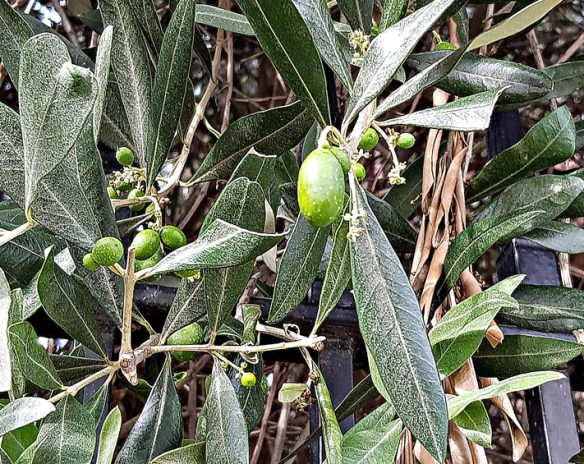
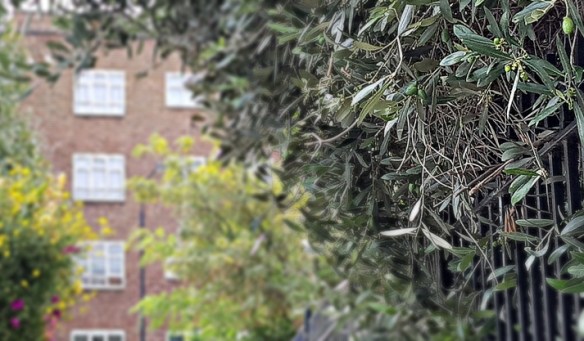
Olives growing near Portobello Road

Florence (Italy) 1960s and London 2018


In the 1960s, my parents, both art-lovers, used to take my sister and me on annual trips to Florence in Italy.

FLORENCE 1

Olives growing near Portobello Rd, Sept 2018

Seeing some olives growing near Portobello Road in London reminded me of these trips. Here is what I wrote in my book, “Charlie Chaplin Waved to Me”, which is about travels I made during my childhood:

“The Oltrarno is the part of Florence on the left bank of the River Arno. It contains major sights such as the Pitti Palace, the Boboli Gardens, the Piazzale Michelangelo, the Belvedere Fortress, and the churches of S Spirito and S Maria degli Carmine. Almost every afternoon included a visit to the Oltrarno. This was made for sartorial rather than cultural reasons. My mother’s dress maker, whose name I can no longer recall, had a small shop near to S Spirito. Maybe, there is a Freudian reason for my amnesia; the visits to his shop filled me with dread. My mother had dresses made in Florence. As I have already hinted, she was a stickler for perfection. The long-suffering dress-maker in the Oltrarno must have valued her custom to have been able to put up with the unending visits we made in order to allow my mother to try the latest version of the garments that he was preparing for her. My father and us two children had to sit in the small narrow shop looking at tatty, well-thumbed magazines full of pictures of dresses whilst my mother and the tailor spent much of the afternoon dealing with the latest stage in the fabrication of her dresses. Our visits to this shop were often prefaced with my mother saying that of course we did need not wait for her there, but we knew better. Our absence would not have been well-regarded.

FLORENCE 60s ARY Sminiato

Adam Yamey at San Miniato, Florence, in the early 1960s

Florence was, and still is, famous for its leather work. My mother was particularly keen on one aspect of this craft: footwear. She liked good shoes, but many of them did not fit her wide feet. So, we tramped around Florence, entering many of its shoe shops and waiting patiently (or impatiently in my case) for her to try on numerous pairs of shoes. Almost all of them were unsuitable for her to wear. One shop whose name still fills me with some dread was that of Salvatore Ferragamo on the Via Tornabuoni. The fact that I remember this high-class shoe store is a testimony to the amount of time that we spent there. As was usual, if any of us showed any signs of impatience, she would tell us that we need not wait for her, but we knew that this was not what she really felt …

FLORENCE 4

San Miniato, Florence. Pic by Adam Yamey in early 1960s

… Florence was not, as you may be beginning to imagine, one long round of paintings, sculptures, shoes, dresses, and brassieres. Many afternoons ended with a trip up to the Piazzale Michelangelo. This panoramic platform or terrace, which is really more of a large open space with one side overlooking the hills sloping down to the River Arno, provides a magnificent view of the city. It is a readymade vantage point for postcard makers and other photographers. A little behind the Piazzale a series of staircases flanked by pine trees leads up to a church with a wonderful black and white marble façade. This is S Miniato al Monte and was our main destination when going up into the hills. This peaceful sanctuary high above the bustling city is undoubtedly a great example of unadulterated 13th century Romanesque architecture.

FLORENCE 3

Cemetery of San Miniato, Florence. Pic by Adam Yamey in early 1960s

After admiring this church, we did not return to the city centre by bus, which is how we arrived. Instead, we walked. We used to descend from the raised terrace in front of S Miniato al Monte and start walking away from the Arno along the level Viale Galileo, which follows a gently sinuous contour along the left side of the river valley. After almost a mile, we would then turn right onto the narrower Via S Leonardo. This road descends gradually, passing the walled gardens of well-separated villas. The branches of olive trees in these gardens overhung the road.

FLORENCE 2

Olives growing near Portobello Rd, Sept 2018

Every year, my mother used to break off a small twig bearing greyish green olive leaves and several, usually unripe, olives. She would take it back to London to remind herself of the great pleasure that she derived from being in Florence.”

I remember finding a sprig of desiccated young olives and dried leaves amongst her possessions long after her early death in 1980.


Adam Yamey’s book “CHARLIE CHAPLIN WAVES TO ME” is a collection of tales of journeys made during the author’s childhood.

In paperback, click: HERE, please

For Kindle version, click: HERE, please