I HAVE NO IDEA how many commercial art galleries there are in Central London. Today (the 14th of May 2024), we visited an art gallery, whose existence was previously unknown to us, and there we saw an exhibition of works by an artist, who was also new to us. The gallery is Carl Kostyal in Savile Row. Its discreet entrance is sandwiched between two fashionable tailors’ stores. Half Hungarian and half Swedish, Carl Kostyál opened his gallery in Savile Row in 2010. Three years later, he opened another gallery in Stockholm.
The artist, whose work is being exhibited, is Leo Park, who was born in Sweden in 1980. His exhibition in Savile Row is called “Beyond Pleasure”. It consists mostly of large paintings, but also a wall covered with a mosaic of small sketches, The beautifully executed artworks are eye-catching, and reminded me a little of the works of some of the pre-WW2 Surrealists. The paintings and sketches are of imagined forms that immediately made me think of human bodies. The images are clearly meant to evoke such thoughts, but looked at objectively, they are all shapes that do not exist in nature. The paintings and drawings are all displayed in the beautifully restored rooms of the 18th century building that houses the gallery.
The show ends on the 2nd of June 2024, and is well worth visiting.
THE ARTIST YINKA SHONIBARE was awarded the prestigious CBE in 2019. In case you do not know what these three letters stand for, it is ‘Commander of the British Empire’ – not that Britain has much of, if any, empire left to boast of. For much of its long existence, places in the British Empire witnessed many injustices and inhumanities. This was especially true before the abolition of the slave trade in the early 19th century. Yinka Shonibare, who was born in London in 1962 and brought up between that city and Lagos in Nigeria, uses his artistic skills to explore Britain’s lengthy history of imperialism imaginatively and creatively. Even without knowing that he does this, his art works are in themselves visually exciting and fascinating to the viewer. The pieces on display until the 1st of September 2024 at the Serpentine South gallery in Kensington Gardens are well worth seeing both for their inherent beauty and for the way that Shonibare expresses his interpretation of Britain’s colonial past and its legacy.
ONE AFTERNOON IN April (2024), out of curiosity we travelled by bus number 46 from Smithfield to Paddington station instead of taking the much faster Underground train route. As we proceeded along the whole route of the number 46 bus, we realised that it links several places of interest to both Londoners and visitors to the city.
The 46 starts within easy walking distance of the BARBICAN CENTRE, SMITHFIELD MARKET, ST BARTHOLOMEW THE GREAT, and THE LONDON MUSEUM. Also, its first stop outside ST BARTHOLOMEWS HOSPITAL is not far from ST PAULS CATHEDRAL.
When the bus gets moving, you will soon pass the ornate Victorian HOLBORN VIADUCT and HATTON GARDEN – famed for its diamond merchants. Next, you will see the Victorian gothic PRUDENTIAL BUILDING and before turning on to Grays Inn Road, you will see a row of half-timbered houses – some of the only PRE-FIRE OF LONDON survivors. Much of the west side of Greys Inn Road is lined with the buildings of GREYS INN – one of London’s four historic Inns of Court.
KINGS CROSS STATION and the magnificent Victorian gothic ST PANCRAS STATION are the next things to look out for. You could leave the bus here to explore the new developments around Kings Cross including COAL DROP YARD and KINGS PLACE hall and events centre. If you remain on the bus, you will head north past the ROYAL VETERINARY COLLEGE to the not over attractive KENTISH TOWN. At CAMDEN ROAD STATION, you will not be far from the REGENTS CANAL and the popular CAMDEN MARKET.
Heading northwards, the 46 reaches Fleet Road in south Hampstead, which is a short walk from the famous Modernist ISOKON BUILDING in Lawn Road. You could disembark at South End Green and visit Mirko to enjoy refreshments in his small MATCHBOX CAFÉ. HAMPSTEAD HEATH is a few minutes’ walk away. If you remain on the bus, you will pass the ROYAL FREE HOSPITAL and next to it, the Victorian gothic ST STEPHENS CHURCH designed by SS Teulon.
The bus then heads up Rosslyn Hill into the heart of historic HAMPSTEAD, where there is plenty for the visitor to explore. Then, the 46 descends the steep Fitzjohns Avenue to Swiss Cottage. Just before it reaches there, look out for the statue of SIGMUND FREUD at the southern end of the Tavistock Institute. The house where Freud lived, now THE FREUD MUSEUM, is close by.
After passing St Johns Wood Station with its several scraggly palm trees, the bus winds its way through streets near Maida Vale until it reaches Warwick Avenue Underground station. Descend here to walk to the REGENTS CANAL near to where it enters the scenic LITTLE VENICE.
Soon, after passing beneath the elevated WESTWAY, the 46 heads for its last stop, which is on a bridge from which you can get a good view of the wonderful glass and ironwork roof of PADDINGTON STATION – a masterpiece of Victorian engineering. From Paddington, there are a few bus routes that will allow you to continue your London sightseeing.
SEVERAL OF THE GALLERIES within London’s Wallace Collection in London’s Manchester Square, have an overwhelming number of paintings crowded together on their walls. One of these galleries contains several paintings by Richard Parkes Bonington (1802-1828), which I doubt I would have focussed on had I not just seen a small temporary exhibition in a room on the ground floor. The exhibition is called “Turner and Bonington: Watercolours from the Wallace Collection”, and is on until the 12th of May 2024. It contains 10 watercolours (of landscapes) held by the Wallace Collection – four by JMW Turner (1775-1851) and the rest by his short-lived contemporary Bonington. Each of the watercolours is delightful and well-executed. Bonington’s watercolours are delicately crafted, but less adventurous than those of Turner. Because they are so sensitive to damage by light, these watercolours are rarely displayed. The last time they were exhibited was 17 years ago.
Watercolour by Bonington
Now, I had heard of Turner and have seen many of his works, but today (the 29th of March 2024) was the first time I became aware of Bonington. He was born near Nottingham and by the age of 11 was exhibiting watercolours at the Liverpool Academy. In 1817, he and his family moved to Calais (France), where his father set up a business. From there they moved to Paris in 1818. During his time in France, Bonington learned painting from French artists and soon became a friend of the French artist Eugene Delacroix. In 1820, he became a student at the École des Beaux-Arts in Paris. Some of his oil paintings were displayed in the Paris Salon of 1822, and elsewhere. By 1825, he had developed a method of mixing gouache with watercolour, which produced an effect close to what could be achieved with oil paints. After making trips to various parts of France, northern Italy, Venice, and London, he developed tuberculosis. He died in London, where his parents had sent him for treatment. In 1861, many years after Bonington died, Delacroix wrote in a letter (quoted in a Wikipedia article):
“To my mind, one can find in other modern artists qualities of strength and of precision in rendering that are superior to those in Bonington’s pictures, but no one in this modern school, and perhaps even before, has possessed that lightness of touch which, especially in watercolours, makes his works a type of diamond which flatters and ravishes the eye, independently of any subject and any imitation.”
I wish I could have thought of those words, which chime with what I thought after seeing Bonington’s watercolours and some of his many oil paintings now hanging in the Wallace Collection – a London address that no art lover should miss visiting.
THE EAST SIDE of London’s Russell Square is lined by large hotels, one of which is the Imperial. On the pavement where Guilford Street enters the eastern side of Russell Square, there is some lettering, which reads:
“Turkish Baths”.
Beneath this is an arrow pointing southwards, and below that, the word:
“Arcade”.
Kimpton Fitzroy Hotel in the background
If you follow the arrow, you will pass the west facing side of the 20th century Imperial Hotel, but you will not neither an arcade nor any Turkish baths. You will pass a vehicle entrance to a courtyard within the hotel. Being puzzled by this old, and it seemed redundant, writing on the pavement, I researched it on the Internet, and soon found out something about it (see for example: https://carolineld.blogspot.com/2012/11/turkish-baths-russell-square.html & www.londonremembers.com/sites/imperial-hotel-statues)
The current Imperial Hotel was built in the late 1960s on the site of an earlier hotel of the same name (built in 1898), which was demolished, rather than restored, in 1966. It was in this first Imperial Hotel that the Imperial Turkish Baths were located. These were demolished along with the hotel that contained them. However, some statues that used to decorate the highly ornate baths were rescued, and now surround the above-mentioned courtyard.
“I have found references to the Librairie Internationale selling copies of Karl Marx publications in the 1920s and in the 1930s as one of the bookshops in London where you could purchase pamphlets such as those produced by the London Freedom Group, whose paper “Freedom – A Journal of Libertarian Thought, Work And Literature” included the address of the Librairie Internationale in Russell Square as one of the London bookshops and newsagents where Freedom could be purchased.”
I had never heard of this bookshop or the Turkish Baths at the Imperial Hotel, and would not have known about either of them had I not noticed the lettering in the pavement. I spotted this after having met a person, whom I had not seen since 1968, when we were both pupils at north London’s Highgate School. We had just met for coffee at a café within the Kimpton Fitzroy Hotel, which was built as The Russell Hotel and opened in 1900. Unlike its neighbour The Imperial, it was not demolished and replaced by something newer. The old Imperial would have been built in the same flamboyant style. Having noticed my interest in signs, my friend from schooldays pointed out another sign on the north side of the Kimpton Fitzroy. It commemorates the fact that a house where the suffragette Emmeline Pankhurst (1858-1928) lived with her daughters (Christabel and Sylvia) between 1888 and 1893. The house was demolished – possibly to make way for the construction of the hotel, which began in 1898.
Everything I have described above lies within a stretch of road less than 200 yards in length. And I have said almost nothing about the historic Russell Hotel that lies along this stretch. This and many other parts of London are so rich in history, which is one of many reasons that I am happy to be a resident of the city.
TWO FADED SIGNS CAUGHT my attention when I was walking along the east side of Southampton Row (just north of Holborn Underground station). The sign is on the southern side of the intersection of Catton Street and Southampton Row. The two faded, painted signs are separated by another which is carved on a stone plaque, and is clear to read. This sign reads:
“This memorial stone was laid by Alexander Maclaren, DD,, Litt D. President of the Baptist Union 1875-6 and 1901-2 on Wednesday 24th of April 1901”
Above this, there is a painted sign that can easily be read:
“To Kingsgate Baptist Church”
Below these two signs, there is another painted sign,a ‘ghost sign’, which has deteriorated considerably, but parts of it can either hardly be read or are illegible. Here is what I made of it:
“The CA[illegible] [2 more illegible words] Kingsgate House Acc[illegible] &(?) Warehouse Church Furniture”
An online article published in July 2020 in Italian (www.thelondonerd.com/tag/statua/) revealed that then, when the sign was more legible, it read:
“The Carey Kingsgate Press Ltd. – Accountancy – Warehouse – Church Furniture”
This web article also includes lovely photographs of the now re-purposed Kingsgate Chapel.
The three notices are on the corner of Kingsgate House, which was built between 1901 and 1903 for the Baptist Church. It was designed by Arthur Keen, architect for the Baptist Union of Great Britain and Ireland. The Baptists used the building up to 1996. Since then, it has been repurposed.
As for the Kingsgate Chapel (the ‘Kingsgate Baptist Church’ on the fading sign), this can now only be accessed by entering Kingsgate House. Constructed in 1856, it is attached to the northeast corner of the building. No longer accessible to the public and hidden away, it is an octagonal building that can be seen on detailed maps of today. When it was in use as a chapel, its entrance would have been just east of Kingsgate House on Catton Street (formerly known as Eagle Street). Close to where its entrance used to be, there is the entrance to the Baptist Bar, which is now housed in the former chapel.
The ghost sign mentions a warehouse and church furniture with an arrow pointing east along Catton Street. This must have been demolished many years ago. I spotted the fading signs whilst returning home late one evening. Now, having found out something about them, I look forward to returning to Kingsgate House and having a drink in the former chapel – if the bar is still open for business.
The remains of former gas storage units (gasometers) have been spruced up and repurposed as blocks of flats (near King’s Cross Station). Where the telescopic, cylindrical gas holders used to be, there are now cylindrical apartment blocks.
A friend pointed out:
” I marvel at the ingenuity and question how you’d furnish such impractical circular geometry that would probably require bespoke furniture. But frankly if you can afford to buy/rent one, you should be able to foot that expense!”
She has made some good points about these buildings.
The photograph above is a simple example. Now a branch of Nando’s, this place in York Way (near Kings Cross station), which bears a ghost sign. It used to house a place where other refreshments were available long before Nando’s company was established.
WHAT IS YOUR EARLIEST memory of a news item? In my case, I remember my parents discussing something about Cuba. This was The Cuban Missile Crisis of October 1962. I had little or no idea about it, but later I learned that US President John F Kennedy was involved in its resolution. A year later, when we were staying in the USA, we were there when he was assassinated. I well recall that and my feelings about it at the time. That remains in the forefront of my memory, but far back in the fleshy recesses of my grey matter, the name Grunwick resides. While visiting an exhibition at the Tate Britain recently, I saw several photographs that brought this vague memory back into my consciousness.
Grunwick Film Processing Laboratories (‘Grunwick’), located at Willesden in northwest London, processed photographic films and produced finished prints from them. Photographers (mostly amateurs) put their undeveloped exposed films into an envelope along with payment, and sent them to Grunwick, who later returned the developed film and the prints made from it. In 1973, some workers at Grunwick joined a trade union and were subsequently laid-off by the company. The company employed many workers of Asian heritage – including a substantial number of ladies. As the then Labour politician Shirley Williams pointed out, the Asian ladies were being paid very much less than the average wage, and conditions were bad – hours were long, overtime was compulsory (and often required without the employer giving prior notice).
On the 20th of August 1976, Grunwick sacked Devshi Bhudia for working too slowly. That day, three other workers walked out in support of Devshi. Just before 7 pm that day, Jayaben Desai (1933-2010) began walking out of the factory. As she was doing so, she was called into the office and dismissed for leaving early. When she was in the office, Jayaben said (see guardian.com, 20th of January 2010):
“What you are running here is not a factory, it is a zoo. In a zoo, there are many types of animals. Some are monkeys who dance on your fingertips, others are lions who can bite your head off. We are those lions, Mr Manager.”
Thus began a two-year long strike, which was supported not only by the company’s workers but also by many politicians and trade unions, including, for a short time, the Union of Post Office Workers, who refused to cross the Grunswick picket lines.
Jayaben was born in Dharmaj, now in the Anand district of the Indian state of Gujarat. Soon after marrying, she and her husband migrated to what is now Tanzania. Just before the Commonwealth Immigrants Act (1968) made it difficult for Commonwealth citizens to settle in the UK, the couple moved to England. There, she was obliged to take up poorly paid work, first as a sewing machinist, and then as a worker at Grunwick.
Not only did Jayaben initiate the strike, but she helped keep it going until the dispute was resolved. In November 1976, when the Post Office workers stopped supporting the strike, she told an assembly of Grunwick’s workers:
“We must not give up. Would Gandhi give up? Never!”
Later, like Gandhi, she employed his tactic – the hunger strike – outside the Trade Union Congress in November 1977. During the court of enquiry led by Lord Justice Scarman, she gave powerful evidence against her erstwhile employer. When the strike was over, she went back to sewing, and then later became a teacher of sewing at Harrow College. After passing her driving test at the age of 60, she encouraged other women to do so to increase their freedom. After her death, some of her ashes were deposited in the Thames, and the rest in the Ganges.
The reason that Grunwick came to mind at Tate Britain was that its current exhibition “Women in Revolt! Art and Activism in the UK 1970-1990” (ends 7th of April 2024) includes several photographs taken at Grunwick during the strike. Three of them include portraits of Jayaben in action.
As I wrote earlier, I had heard of Grunwick, but I could not recall why until I saw the exhibition. As for the remarkable Jayaben Desai, I am happy that I have become aware of her and her amazing achievements.
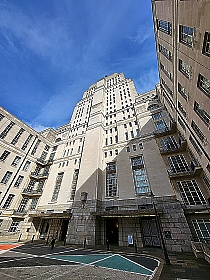
Senate House in London’s Bloomsbury was designed in the Art Deco style by Charles Holden (1875-1960), who also designed many buildings for the London Underground including quite a few stations on the Piccadilly Line. It was once, London’s tallest building.
Senate House was built between 1932 and 1937, and is the administrative centre of the University of London. Currently, there is a small exhibition about the planning of the building on the first floor.



 yamey
yamey 