A house of glass
Home to flourishing tropical plants
At Kew Gardens
SOME SAY SMALL is beautiful. But can colossal also be beautiful? This is something that can be explored at the Thaddeus Ropac Gallery in London’s Dover Street until 2 April 2025, where three much larger than life realistic looking sculptures of dogs are on display. These dogs, each about 10 feet high, have been created by the artist Ron Mueck, who was born in Australia in 1958. He now works in the UK.
As the gallery’s website explained:
“Over a career spanning three decades, Mueck is celebrated for exploring the physiological implications of scale. Whether miniaturised or enlarged, his use of scale heightens our awareness of the relative spaces our own bodies occupy, as he charts the full spectrum of human experience with striking perceptiveness.”
The three dogs on display in the exhibition ought to feel menacing, but I did not experience this sensation. I was more amused than over-awed.
A TRUE STORY
I entered one supermarket and purchased a bottle of gin. I paid for it, and as I left the store, the alarm rang. I ignored it. Nobody stopped me.
I took a bus to another area, where I entered a different supermarket. Once again, as I left the store, nobody, not even the store’s security guard, stopped me.

When I got home, I discovered that the anti-theft device had been left on my bottle. It should have been removed when I paid for the gin.
I tried removing the tag, which was tied to the neck of the bottle with tough metal cable. I realised that without breaking the glass bottle, I would not be able to reach the gin.
In the end, I retraced my steps and returned to the shop, which was a 10 minute bus ride away. I explained what had happened, showed the shop assistant the receipt, and demanded a fresh bottle, but with the security tag removed.
This episode made me wonder why so much effort is put into protecting goods when the security officials at the supermarkets take so little heed of their alarms when they are set off.
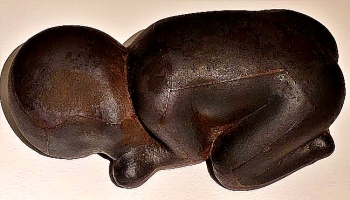
THE FAMOUS SCULPTOR Elisabeth Frink (1930-1993) was a regular visitor to our family home in Hampstead Garden Suburb during the 1960s. During that period, I met her whenever she was invited home for dinner, but then I was too young to realise how famous an artist she had become. She was a good friend of my mother, Helen Yamey (1920-1980), who was also a sculptor. Elisabeth and my mother got to know each other when they were both creating art in the Sculpture Department of the St Martins School of Art, when it was in Charing Cross Road.
Today (15th of November 2024), I was reminded of my mother’s friendship with Frink when we entered Christie’s auction house in Mayfair. We always enter this place when we are passing near it to see some of the works of art that are on display prior to being auctioned. You never know what gems you are likely to see. Today, there was a small collection of British art created during the past 100 years. Amongst the works on display were two by Elisabeth Frink. There were also some pieces by Henry Moore (1898-1986) and by Barbara Hepworth (1903-1975). One of the works by Hepworth was a painting, the other two were sculptures. Each of these artists has become some of the greatest of 20th century British artists.
During the first half of the 1960s, my mother’s sculptures were chosen to be exhibited in prestigious exhibitions, mainly in London. In these various exhibitions, her work was selected to be exhibited alongside the creations of the three artists mentioned above, as well as other artists, who have now achieved fame (e.g., David Hockney, Paula Rego, Michael Ayrton, and Bridget Riley). Despite this, my mother’s artistic work is now largely forgotten. In my recent book about her, “Remembering Helen: My Mother the Artist”, I describe her life, her character, and consider why her art, which was judged worthy of display with the best artists of the time, has faded into obscurity.
[The book is available from Amazon: https://www.amazon.co.uk/REMEMBERING-HELEN-MY-MOTHER-ARTIST/dp/B0DKCZ7J7X/]
ALMOST ALWAYS I ENJOY the annual temporary pavilions erected beside the Serpentine South Gallery in Kensington Gardens. This year’s offering was designed by the South Korean architect Minsuk Cho (born 1966 in Seoul). The Serpentine website (www.serpentinegalleries.org/) explained:
“Tracing the history of past Serpentine Pavilions, Minsuk Cho observed that they often emerge as a singular structure situated at the centre of the Serpentine South lawn. To explore new possibilities and previously untold spatial narratives, Cho approaches the centre as an open space. The 23rd Serpentine Pavilion envisions a unique void surrounded by a constellation of smaller, adaptable structures strategically positioned at the periphery of the lawn.”
The five structures surrounding the void (or open space) in the middle of the pavilion compound vary in shape and purpose. One serves as a library, another as a café serving area with minimum seating, another as a children’s play area, another is a kind of hallway, and the fifth is supposed to represent a tea house.
Apart from two of the small buildings (the play area and the library), I did not find the others visually satisfying. Also, I did not feel that the five structures surrounding the central space were in harmony with each other. All in all, I was unimpressed by this year’s so-called pavilion.
I realise from reading the information on the Serpentine’s website that Minsuk Cho was trying to express a set of concepts by designing the small complex of buildings that together form the pavilion. However, without knowing that, the result looks unsubstantial compared with almost all the pavilions that have preceded it over the years. The architect’s ideas have not translated well into concrete forms. Apart from this, the current pavilion, unlike its predecessors, has few places for people to sit and enjoy the space. In all the pavilions that have been constructed before this year, there has been ample place to sit and rest. And providing such a place within uniquely designed architectural spaces has, until this year, been one of the things that makes the pavilions accessible for people of all ages to enjoy – whether or not they have an interest in the architecture or its designer.
I ARRIVED EARLY for a committee meeting of the Anglo-Albanian Association, which was being held in a house in Walham Grove in London’s Fulham district. It was a warm afternoon, and as I did not want to disturb our host by arriving too early, I sat on a bench in the small yard next to the north side of St Johns Church – a rather unexceptional example of early 19th century church architecture.
Soon, I noticed a tree in the middle of the yard. Its trunk was growing at about 30 degrees to the ground, and was supported by a wooden prop. Branches were growing out of the trunk, more or less vertically. There was a small commemorative notice at the base of the tree – where it had been planted originally. It bore the words:
“This mulberry tree was planted by His Worship the Mayor of Fulham Councillor JF Perotti JP on Victory Day June 8 1946”
On that day, celebrations were held in London to commemorate the Allied victory in WW2, the British Commonwealth, and the Empire. The Mayor, Mr Perotti, was a fitter at London Transport’s Lots Road electricity generating station.
In my mind, mulberry trees conjure up visions of silk growing and exotic landscapes of yesteryear. To be honest, until I saw the notice by the tree in the yard in Fulham, I would not have been able to identify a tree as being a mulberry. I stood up and examined it closely. To my great delight, I saw that the tree has berries. They looked like larger than average raspberries. I have read that when they ripen, they become darker in colour and resemble elongated blackberries.
I was curiously excited to find a mulberry tree with its fruit. I had not expected to find one in a busy part of Fulham. Mulberry trees have been grown in Britain since Roman times. One of the oldest surviving examples is in the garden of Canonbury Tower in Islington. It might have survived since the 16th century. There are several other slightly younger mulberry trees in London. So, the leaning example I saw in Fulham is a youngster on the scene.
IT IS OFTEN a pleasure to see an exhibition of works by an artist, whose existence was hitherto unknown to me. In this case, the artist is the Japanese born Minoru Nomata, who was born in 1955 and lives as well as works in Japan. The exhibition of his works, currently at White Cube in Masons Yard (near Piccadilly) until the 24th of August 2024, consists mainly of paintings (acrylic on canvas).
At first sight, his paintings look almost like photographs. However, after a few moments’ contemplation, they can be seen to depict subjects – often structures and aspects of nature – that are at the same time unreal and almost but not quite real. His subject matter is not quite surreal, but is an unusually dreamy interpretation of the real world. None of the paintings on display contained any signs of human presence. The gallery’s website (www.whitecube.com/gallery-exhibitions/minoru-nomata-masons-yard-2024) includes the following:
“According to the artist, ‘construction, repair and demolition’ occur simultaneously in his paintings; they confer, too, upon the simultaneity of past, present and future distinct to Nomata’s work. As he states, he sets out to create worlds that ‘are not “somewhere”, but “nowhere”, in a position that helps [him] find a place to head for’. Devoid of identifiable temporal or geographical markers as they may be, Nomata’s ambivalent landscapes speak directly to humankind’s long-standing existential concerns about what place, if any, it has in the world.”
As I viewed the pictures, which I found aesthetically pleasing, I felt they had the ‘realness’ of images that appear in dreams, yet at the same time they seemed as if they could almost be depictions of reality. In brief, I found them both attractive and intriguing, and can recommend this show to everyone.