Artists and secret agents

A REMARKABLE ENGINEER and furniture entrepreneur Jack Pritchard (1899-1992) and his family lived at 37 Belsize Park Gardens, in London’s Hampstead district. before WW2. Pritchard, who studied engineering and economics at the University of Cambridge, joined Venesta, a company that specialised in plywood goods. It was after this that he began to promote Modernist design. In 1929, he and the Canadian architect Wells Coates (1895-1958) formed the company, Isokon, whose aim was to build Modernist style residential accommodation.

Pritchard and his wife, a psychiatrist, Molly (1900-1985), commissioned Coates to build a block of flats in Lawn Road on a site that they owned. Its design was to be based on the then new ideas for communal housing that had been realised in Germany including the influential Bauhaus in Dessau. The flats are close to Fleet Road and the Mall Studios in Parkhill Road. Completed in 1934, they were, noted the architectural historian Nikolaus Pevsner, “… a milestone in the introduction of the modern idiom to London.” He continued, writing in 1952, clearly critical of the edifice, which:

“…put on a forbidding face towards the street, with large unmitigated concrete surfaces … It is all in the spirit of revolution, unaccommodating and direct to the verge of brutality.”

Well, I quite like the building’s elegant simplicity. In the basement space of the block, there was a refreshment area known as the Isobar. This and its furniture were designed by Marcel Breuer (1902-1981). Regularly, exhibitions were held in the Isobar and, according to an on-line article in The Modern House Journal these were attended by artists including Adrian Stokes, Henry Moore, Barbara Hepworth, Ben Nicholson and Naum Gabo. The article also noted that this refreshment area was frequented by modernist architects such as Erich Mendelsohn, Serge Chermayeff and, Wells Coates, as well as by left-wing politicians. Pritchard occupied the penthouse flat. In 1969, he sold the block, and now it contains accommodation for 25 keyworkers on a shared ownership basis and 11 flats are in private ownership. The block, first known as the Lawn Road Flats, is now called ‘Isokon. Lawn Road Flats’.

T F T Baker, Diane K Bolton and Patricia E C Croot, writing in A History of the County of Middlesex: Volume 9, Hampstead, Paddington, noted that the Lawn Road Flats were built partly to house artistic refugees, who had fled from parts of Europe then oppressed by dictators, notably by Adolf Hitler. Some of them had been associated with the Bauhaus. These included the architect and furniture designer Marcel Breuer, the architect Walter Gropius (1883-1969), and the artist and photographer Laszlo Moholy-Nagy (1895-1946). All three of them are regarded as being masters of 20th century visual arts.

Despite both having come from bourgeois backgrounds, the Pritchards aimed to free themselves from middle-class conventions. The concept and realisation of the Lawn Road Flats, were important landmarks in their quest to achieve a new, alternative way of living. It is accurate to say that the atmosphere that prevailed in the community that either lived in, or frequented, the Lawn Road Flats was predominantly left-wing and extremely welcoming to cultural refugees from Nazi Germany. Probably, it had not been anticipated that the place should become a convenient place for Stalin’s Soviet spies to use as a base. According to a small booklet about the flats Isokon The Story of a New Vision of Urban Living, published in 2016, the flats were home to the following espionage agents, who had been recruited by the NKVD in Central Europe: Arnold Deutsch, Simon Kremer, Jürgen Kuczinski, and Brigitte Kucynski Lewis. Jill Pearlman, one of the book’s several authors, noted that they found the Lawn Road Flats convenient for several reasons:

“Above all, they blended inconspicuously into the sociable community of tenants there. Many tenants too were refugees from Central Europe … Even the Lawn Road Flats building worked well for the spies. One could enter and exit any unit without being seen … no one could see in. At the same time, the cantilevered decks on each floor provided the tenants a perfect vantage point from which to survey the street below.”

Today, there is a small exhibition area in the garage of the flats. This is open on some weekends, but I have yet to visit it.

Seeing double at the pub

I DO NOT KNOW why there is a huge Albanian flag hanging outside The Cow pub in Notting Hill’s Westbourne Park Road. The large red flag decorated with a double-headed eagle has been fluttering outside the pub for several weeks, if not longer.

I walked into the colourfully decorated pub, for many years a local favourite both for drinkers and diners, and asked two members of staff if they knew anything about the flag. They did not have any real idea, but suggested that it might be because at least one long-serving member of the pub’s current staff is Albanian. A quick search of the internet revealed nothing.

The flag was put up long before the 28th of November, Albania’s Flag Day commemorating the founding of independent Albania in 1912, and is still flying. Maybe, one of you out there can tell me more about the reason that The Cow has an Albanian flag.

The first of its kind in England

THE ARCHITECT JOHN Soane (1753-1837) was skilled in designing buildings with features to permit natural light to reach parts of them that were far away from their exteriors. Good examples of this were the two homes he designed for himself, one in Lincolns Inn Fields, now the Soane Museum, and the other in Ealing, the recently restored Pitzhanger Manor. Another superb example, which we visited recently (December 2021) is the Dulwich Picture Gallery in south London. Completed and opened in 1817, it became the first picture gallery in England that was open to the public.

Light enters Soane’s galleries at Dulwich from above via overhead sky lights. These were placed in such a way that they illuminate the hanging spaces without allowing direct sunlight to hit the paintings on the walls. This system has since been adopted in many other art galleries. Newer rooms, lit entirely by artificial lighting, are used for temporary exhibitions including that of the woodcuts of the American artist Helen Frankenthaler (1928-2011), which we saw on our latest visit. Compared with Soane’s galleries, these newer ones are far less impressive, and despite the modern lighting they feel claustrophobic and rather gloomy.

The permanent collection of old masters, which is hung in Soane’s original galleries, is fabulous. Some of the paintings were parts of collections made before the 19th century. Others were supplied by the artist Sir Francis Bourgeois (1753–1811) and his business partner, the art dealer and collector, Noël Desenfans (1744–1807). Together they ran an art dealership in London and were commissioned in 1790 to purchase a collection of paintings for the then King of the Commonwealth of Poland and Lithuania, Stanisław August Poniatowski (1732-1798). It took them five years to do this but by 1795, the Commonwealth had been dissolved. The collection remained in England. After Desenfans died, Bourgeois inherited the collection and then commissioned Soane to design a gallery to house it. The superb gallery at Dulwich came into existence. Soane included within it a small circular mausoleum in which the remains of both Desenfans and Bourgeois have been placed. Rather irreverently, I felt, it was being used to screen a video about the artist Helen Frankenthaler.

In 1944, during WW2, the western façade of Soane’s gallery was badly damaged by bombing (a German V1 flying bomb) but it has been well-restored. Later, in 1999, a new café and other facilities in a modern style were built to the designs of the architect Rick Mather (1937-2013).

As for the exhibition of works by Frankenthaler, this was a delightful surprise. It is a collection of colourful abstract woodcuts that are the result of years of the artist’s complex and imaginative experimentation. Many of the works reminded me of, but were not identical to, the subtleties of Japanese ceramic glazes. Despite being displayed in galleries far less satisfactory than those designed by Soane, this as an art show well worth visiting before it ends on the 18th of April 2022.

A pottery and a prison

HAMPSTEAD IN NORTH London is full of interesting nooks and crannies.

At the west end of Well Walk in Hampstead, near the lower end of Flask Walk, there is a corner building with a Georgian shop front. It is now a small theatre but was once the Well Walk Pottery, which occupied this place for many years. The pottery was started by the potter Christopher Magarshack in 1959. According to Bohm and Norrie, writing in their “Hampstead: London Hill Town”, published in 1980, Elsie, the widow of the Russian Jewish translator and writer David Magarshack (1899-1977), lived there. She bought this corner building, which had formerly been Sidney Spall’s grocery shop in 1957, for Christopher to use as his pottery. His father, David, left his birthplace Riga, then in Russia in 1918 and later lived above the shop. Elsie died in 1999, aged 100. In addition to selling pottery there, the pottery also held classes for ceramicists, some of whom now have good reputations. David’s daughter Stella, a fine artist, was the Head Art Teacher at King Alfred’s, a ‘progressive’ school situated between Hampstead and Golders Green. In 2016, aged 87, she was brutally attacked in the street close to her home. Now, the premises is to be home to a theatrical enterprise, The Wells Theatre. Its present owners have decorated one of its windows has been  decorated with a pictorial history of the premises.

Before returning uphill along Flask Walk towards the pub, you will pass a pair of doors covered in metal studs arranged neatly in geometric patterns. According to an article in the January 2018 issue of “Heath and Hampstead Society Newsletter”, this pair of studded doors:

“…is supposed to have come from Newgate Prison,”

The prison closed in 1902.

Costly coffee, Handel, and Hendrix in London’s Mayfair

THERE ARE TWO entrances to Lancashire Court from Mayfair’s Brook Street. One of them, the closest to New Bond Street, is a cobbled lane leading down to a courtyard occupied by the back entrance of the Victoria’s Secret store and the outdoor tables of a restaurant called Hush Mayfair. The tables under delightfully decorated canopies looked enticing, and as we felt the need for some coffee, we sat down to enjoy small macchiatos (maybe more correctly, ‘macchiati’). The coffees were enjoyable but not exceptional. However, the bill that arrived after we had drunk our tiny coffees was far from unexceptional. We were charged just under £13 (US $17.46, INR 1300, or EUROS 15.25) for our two hot drinks. Just in case you are not familiar with the London café scene, today, November 2021, two macchiatos usually cost between £4 and £6.

Lancashire Court is a network of lanes and courtyards located behind the buildings on the southwest corner of the intersection of New Bond Street and Brook Street. It was once a part of London, the Conduit Mead Estate (www.ianvisits.co.uk/blog/2021/07/05/londons-alleys-lancashire-court-w1/, an informative web page), that followed the course of an old water conduit that ran through the area in a north/south direction (for a map of the district, see: www.bl.uk/onlinegallery/onlineex/crace/t/largeimage88092.html). From the 1730s until the 1970s, the buildings in Lancashire Court included many workshops, warehouses, and builder’s yards. In 1987, there was a plan to demolish the network of alleys and replace it with a new shopping complex, but this never materialised. Now, the old businesses have been replaced by ‘chic’ establishments including the place where we enjoyed our exorbitantly priced coffees.

Returning to Brook Street, the short section lying between the two entrances to Lancashire Court has two neighbouring houses, numbers 23 and 25, which have importance in the history of music in London. The composer of well-known works such as “The Messiah” and “The Water Music”, George Frideric Handel (1685-1759), moved into what is now number 23 in the summer of 1723, and lived there until his death (https://handelhendrix.org/plan-your-visit/whats-here/handel-house/). In Handel’s time, Brook Street was known as ‘Lower Brook Street’. Handel’s home included a Music Room in which as many as 40 people would be accommodated to perform and listen to Handel’s latest creations.

In 1968, 209 years after Handel died, another musician moved into number 25, the house next door to number 23 Brook Street. Like Handel, the occupant of number 25 was a musical innovator. His name was Jimi Hendrix (1942-1970). According to a useful website (https://handelhendrix.org/plan-your-visit/whats-here/hendrix-flat/):

“The flat on the upper floors of 23 Brook Street was found by Jimi’s girlfriend Kathy Etchingham from an advert in one of the London evening newspapers in June 1968 while he was in New York. He moved in briefly in July before returning to the United States for an extensive tour. He spent some time decorating the flat to his own taste, including purchasing curtains and cushions from the nearby John Lewis department store, as well as ornaments and knickknacks from Portobello Road market and elsewhere. He told Kathy that this was ‘my first real home of my own’.

He returned to Brook Street in January 1969 and almost immediately launched into an exhaustive series of press and media interviews and photo shoots in the flat. On 4 January he made his infamous appearance on the BBC Happening for Lulu TV show, and gave his two Royal Albert Hall concerts in February. In March he was back in New York again and although Kathy remained at Brook Street for a while longer Jimi did not live there again.”

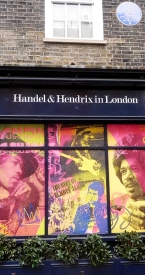
After Hendrix’s girlfriend left the flat, it was used as office space. In 2000, it was taken over by the Handel House Trust. By 2016, both Handel’s House and Hendrix’s flat became open to the public as a museum, which I have yet to visit. Sadly, since the onset of the covid19, the museum, now known as ‘Handel and Hendrix in London’ is only open occasionally and will open fully in March 2023.

The westernmost of the two Brook Street entrances to Lancashire Court is lined with an attractive mural made from ceramic tiles. Created in 2001 by Michael Czerwiǹski (with Ray Howell), it celebrates Handel’s residence in Brook Street. Amongst the many works he composed whilst living there, here is a very small selection of them: the opera “Rodelinda”; “The Messiah” and “Semele”; and “Music for the Royal Fireworks”.

Each of the two musicians of Brook Street did much to change the course of musical history. I wonder what each would have thought of the other, and which of them has the most listeners today. Whatever the answers, their names will live on in people’s minds far longer than that of both the place where we had costly coffee and the currently trendy Victoria Secret high-end but low-cut lingerie store.

They had no choice

ARMISTICE DAY IS celebrated annually on the 11th of November, the day that fighting came to an end in WW1. The day is to celebrate and:

“…remember all those who gave their lives in service to their country since 1914.” (https://www.britishlegion.org.uk/get-involved/remembrance/about-remembrance/armistice-day). It was not only humans who sacrificed their lives, either willingly or less willingly, but also animals, who had been employed in warfare. A monument on a wide traffic island in London’s Park Lane was constructed to remember these four-legged creatures who lost their lives prematurely during battles from which they were unlikely to gain any benefit.

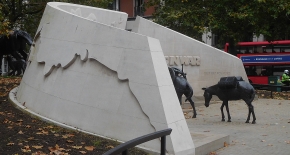
Erected by The Animals in War Memorial Fund (www.animalsinwar.org.uk/) and unveiled in 2004, this dramatic monument consists of a semi-circular Portland stone wall with a gap near its centre. Two bronze horses laden with military equipment are depicted walking towards the gap. and beyond the gap, a bronze sculpture of a running dog can be seen. The western part of the concave side of the wall has bas-reliefs depicting, horses, elephants, and camels. The eastern side of the concavity bears several inscriptions including one with the words “They had no choice”. The convex surface of the wall bears stylised silhouettes of horses. The monument was designed by David Backhouse and was inspired by the book “Animals in War” by Jilly Cooper.

“They had no choice” is a poignantly appropriate sentence on a memorial to creatures who were taken into fields of battle innocent of their likely fate. Seeing this moving monument made me think that these same four words could easily be applied to the numerous Indian participants in WW1 and WW2 who were sent to Europe as ‘volunteers’ innocent of their horrendous destination by their rulers in the Princely States of India, who wished to please the British, whom they served. Had these unfortunate servicemen known what they were about to face, some of them might have objected. That option was not one that would ever been open to the slaughtered animals commemorated on Park Lane.

Oscar Wilde, a bishop, and an art dealer

DOVER STREET RUNS north from Piccadilly, not far from The Royal Academy. It is a thoroughfare we often visit because it contains several commercial art galleries that frequently put on interesting exhibitions. One of these is the London gallery of Thaddeus Ropac. Not only does this international art dealer have good exhibitions, but the house in which the works of art are displayed, 37 Dover Street, is an artwork itsef, an architectural treasure.

The architectural historian, Nikolaus Pevsner (1908-1983), whose writing I enjoy greatly, is a little dismissive of the buildings in Dover Street with one exception. In his “London Volume 1”, which was co-authored by Bridget Cherry, he wrote of this street:

“The only house which needs special attention is Ely House (No. 37)”

This is the building that is now home to Thaddeus Ropac. Ely House was built in the 1770s by the then Bishop of Ely, Edmund Keene (1714-1781), who was appointed to that post in January 1771. According to The Dictionary of National Biography (1885-1900 edition), Keene:

“… obtained in 1772 an act of parliament for alienating from the see, in consideration of the payment of 6,500l. [i.e., £6,500] and an annuity of 200l., the ancient palace in Holborn, and for purchasing, at a cost of 5,800l., the freehold of a house in Dover Street, Piccadilly, London. The present house on that site was built by him about 1776.”

Clearly, the bishop was not short of cash; he was married to Mary (née Andrews), daughter and sole heiress of Andrews of Edmonton, once a successful linen draper in Cheapside.

The architect of Ely House was Sir Robert Taylor (1714-1788). The building remained the London residence of the Bishops of Ely until the beginning of the 20th century. In 1909, the interior of Ely House was greatly modified by the Arts & Crafts architectural firm Smith and Brewer (https://ropac.net/news/245-galerie-thaddaeus-ropac-ely-house-london/), and it became the home of The Albermarle Club. This private members’ club, founded in 1874, was open to both men and women, and was first housed at 13 Albermarle Street. Known for its liberal views on women’s rights, it was in 1895 the site of an incident that led to the first trial of one of its members, the writer Oscar Wilde (www.back2stonewall.com/2021/02/gay-lgbt-history-feb-18-oscar-wilde-accused-sodomite.html). Because of the club’s connection with proceedings that led to Wilde’s downfall, it moved to 37 Dover Street to distance itself from Albermarle Street where these unfortunate events had occurred.

During WW2, Ely House became used by The American Red Cross Interstate Club. Later, it housed a private bank. When Pevsner and Cherry published their book in 1973, the house was being used by Oxford University Press. In Spring 2017, Thaddeus Ropac announced that they would open their London gallery in Ely House.

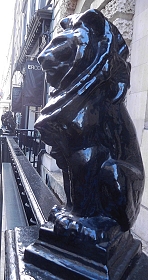
The exterior of Ely House might not have changed much since it was constructed. A medallion on the façade depicts a bishop’s mitre. The magnificent wrought iron railings topped with several models of lions was a 19th century addition based on the lions designed for The British Museum by the sculptor Alfred Stevens (1817-1875). The interior of Ely House would now be unrecognisable to Bishop Edmund Keene apart from a few decorative features that have been preserved. Furthermore, the artworks that are so beautifully displayed in the lovely, whitewashed rooms of the former Ely House would have seemed totally alien to the long-since departed bishop. Rarely, if ever, do the artworks displayed superbly in the gallery lack in visual interest and originality. What drew us to the gallery on the 9th of November 2021 was a small, intriguing collection of creations by Marcel Duchamp (1887-1968) in one room, and several rooms containing disturbingly lifelike, but not always life-sized, sculptures by Ron Mueck, an artist born in Australia in 1958, son of German-born toymakers.

Dover Street is part of a network of Mayfair thoroughfares containing commercial art galleries. Amongst them Thaddeus Ropac has the most beautiful premises and is worth seeing not only for its artworks but also as a fine example of London’s architectural heritage.

Gin and tonic by the pulpit

NAPOLEON BONAPARTE DIED in captivity on the tiny island of St Helena in the south Atlantic. While he was imprisoned on the island, Lieutenant General Sir Hudson Lowe (1769-1844) was the Governor of St Helena. He was buried at St Mark’s Church in North Audley Street in London’s Mayfair, where a commemorative plaque can be found by the main entrance. St Mark’s was built in the Greek Revival Style in 1825-28, designed by John Peter Gandy (1787-1850). In 1878, the church architect Arthur Blomfield (1829-1899) made considerable alterations to its interior including adding a timber vaulted ceiling over the nave.

During the 1950s and 1960s, the size of St Mark’s congregation diminished significantly. In 1974, the church was made redundant, and this is how it remained until 1994, when the church was used by The Commonwealth Christian Fellowship. It continued to serve this group until 2008. After that, it was used as a venue for occasional events. In about 2019 after a 5 million Pound restoration programme, the church underwent a surprising reincarnation.

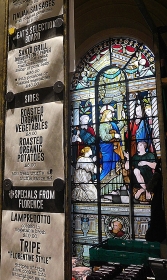
After passing beneath the grand portico supported by two columns topped with ionic capitals, one enters the church’s large vestibule. Since 2019, this has become a marketplace selling upmarket Italian delicatessen goods. Entering the body of the church is rather like taking part in a Fellini film. The floor of the nave is filled with tables and chairs and people drinking and dining. The side aisles, north and south, contain several kitchens, preparing and serving a wide variety of foods, from Turkish to Thai. On the north side of the chancel, just behind the neo-gothic stone pulpit, there is a gin bar, and facing it on the south side of the chancel, there is another bar providing alcoholic refreshments. Look upwards and you can admire the splendid timber roof supports. The wide gallery surrounding the nave at the first-floor level is home to more food stalls, each offering tempting looking fare at not unreasonable prices, especially by local Mayfair standards.

In 2019, the church became home to a branch of Mercato Metropolitano, whose first venture was converting a 150,000 square foot disused railway station in Milan during the 2015 World Expo in that Italian city. The idea of the company was:

“The development of the first Mercato Metropolitano was carefully planned to retain the site’s original appearance, which nurtured the local community’s affection for a special part of their urban history.”

 (https://www.mercatometropolitano.com/mmarketplace/#the-mercato-story).

And this is what has been done at the former St Mark’s in Mayfair. Many of the church’s fittings (for example, the tiled floors, the stained glass, the monuments, the pulpit, and the sacred paintings at the east end of the chancel) have been preserved. Entering the church is like entering the scene of a lively gargantuan feast. Seeing the large number of customers on a weekday lunchtime demonstrates that Mercato Metropolitano have successfully created a great place to meet, eat, and drink. It is highly original and exciting, both visually and gastronomically.

In Chapter 21 (verses 12-13) of the Gospel according to Matthew, we learn that:

“…Jesus went into the temple of God, and cast out all them that sold and bought in the temple, and overthrew the tables of the money changers, and the seats of them that sold doves, And said unto them, It is written, My house shall be called the house of prayer; but ye have made it a den of thieves.”

I just cannot help wondering, as many of you might also be doing, what The Good Lord would have made of what can now be seen inside the Church of St Mark’s in Mayfair.

A flourishing pub in Hampstead

ONCE LONDON’S HAMPSTEAD had two pubs or taverns named ‘The Flask’. This should not come as a great surprise as Flask used to be a common name given to pubs. One of them, The Upper Flask, used to be located at the top (northern) end of East Heath Road and the other, The Lower Flask’ was (and still is) on Flask Walk, a street leading off Hampstead High Street.

The Upper Flask used to be a remarkable establishment. Once called ‘The Upper Bowling Green House’ because of its good bowling green, it was a meeting place favoured by fashionable and ‘cultured’ men (mainly) and women during the 18th century. It was a summer meeting place for The Kit Kat Club, which thrived in the early 18th century and whose members included literary figures and political personalities, who supported the Whig Party. The Upper Flask figures several times in “Clarissa”, a lengthy novel by Samuel Richardson (1689-1761), first published in 1747. The place ceased operating as a hospitality business in the 1750s, when it became a private residence (www.british-history.ac.uk/vch/middx/vol9/pp81-91). In 1921, it was demolished to clear the site for building the Queen Mary Maternity Hospital (https://ezitis.myzen.co.uk/queenmaryhampstead.html), which has since become the site of a luxury housing complex.

The Lower Flask (in Flask Walk) is also mentioned in “Clarissa”, but unflatteringly as:

“… a place where second-rate persons are to be found often in a swinish condition,” (quoted from “Old and New London”, by Edward Walford, about 1880).

Unlike the lost Upper Flask, the formerly named Lower Flask is still in business, but much has changed since Richardson published his novel.

Located at the eastern end of the pedestrianised stretch of Flask Walk, the former Lower Flask, renamed The Flask, was rebuilt in 1874 (and extended in 1990; https://historicengland.org.uk/listing/the-list/list-entry/1322190). Formerly, it had been a thatched building and was a place where mineral water from Hampstead’s chalybeate springs was sold. It and Keith Fawkes’ second-hand bookshop are the only things in Flask Walk, which were in existence when I used to visit Hampstead regularly in the 1960s and 1970s. In those, now far-off, days, I remember that there used to be another second-hand bookshop and a butcher, both on the south side of the passageway. Before the 20th century, there used to be a fair held for a few days in August on the triangular open space a few yards downhill from The Flask pub. Close to The Flask, also on Flask Walk, miscreants could be found languishing in the parish stocks. Both the stocks and the fair are now but long distant memories recorded only in books published many decades ago.

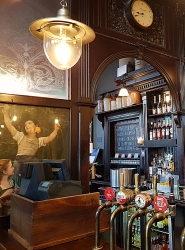
Oddly, despite visiting Hampstead literally thousands of times during the last more than 65 years, it was only on Halloween 2021 that I first set foot in the Flask pub, and I am pleased that I did. The front rooms of the pub retain much of their Victorian charm and the rear rooms are spacious. Although we only stopped for a drink, I could see that the Sunday lunches being served to customers around us looked delicious. We hope to return there soon.