By car from Kuwait to London

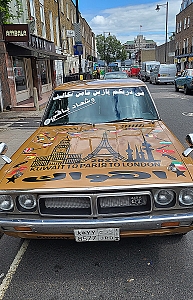
ON THE FIRST OF August (2023), we went to one of our favourite kebab shops – Raavi in London’s short Drummond Street (near Euston station). There was a large Datsun saloon car parked outside Raavi, and another across the road. Neither of them was in pristine condition.  Both were covered with stickers, and each had Kuwaiti registration plates. On the front bonnet of each of them were the words:

“Kuwait to Paris to London 2023”

Beneath these were words in Arabic. Above the word ‘Kuwait’, there was an image of London’s Big Ben. Above ‘Paris’, there was an image of the Eiffel Tower, and above ‘London’, there was a picture depicting some Kuwaiti landmarks. In Arabic, one reads from right to left. Therefore, reading the Arabic way, the images depict: Kuwait to Paris to London’.

On each of the car’s bonnets, there were flags of different countries and either a boat or an arrow between neighbouring flags. Reading the bonnets from right to left, the route taken by the intrepid drivers of these cars was as follows:

By sea from Kuwait to Turkey; by road from Turkey to Bulgaria to Romania to Hungary to Slovakia to Poland to Holland to Czech Republic to Austria to Belgium to Germany to Italy to France to England to Spain. Then, by ship to Morocco.

The order of the countries seems a little odd. Maybe, a few have been omitted. Because there is an arrow rather than a ship between France and England, and between England and Spain, I guess that the cars travelled through the Channel Tunnel.

I do not know why these cars were parked in Drummond Street, but whoever drove them had made a journey that I am sure I would have enjoyed.

Is nothing sacred?

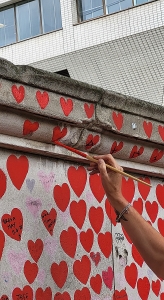
A LONG WALL on the south bank of the River Thames faces the Houses of Parliament. It is literally covered with hearts painted in red. Each heart is supposed to commemorate one of the more than 220,000 people who died of covid19 in Britain. Families and friends of the victims can write the names of their lost ones on the hearts on this wall – the National Covid Memorial Wall. For those who work in the Houses of Parliament and those who walk past it, this heart covered wall is a chilling and moving reminder of a terrible period during the recent history of Britain as well as the rest of the world.

A group of volunteers:

“… repaint faded hearts, re-write dedications that are being absorbed into the Wall, remove graffiti, and look after the Wall to ensure that those lost to Covid19 in the UK are remembered as people, not as a statistics.” (www.nationalcovidmemorialwall.org/)

Recently, we watched some of these generous people, some of them mounted on ladders, working with their paint brushes. As we walked alongside the wall, reading some of the names of people who were killed by the covid virus, we noted that not all of the inscriptions were dedicated to remembering the dead. Some of them, it is sad to relate, were tasteless graffiti and statements such as “X loves Y”. It is these thoughtless additions to a wall of sorrow that the dedicated volunteers work to eradicate. Seeing these irreverent and irrelevant ‘blots’ on the wall made me think “is nothing sacred?”

White and nutritious – milk and racism

UNTIL I WAS ABOUT 18, I drank a pint of chilled milk in the morning and another when I came home from school. I did not drink all the varieties of milk that were supplied by the milkmen who worked for the Express Dairy Company, but chose the ‘homogenised’ variety, which did not have cream at the top of the bottle. Never once whilst drinking this refreshing slightly watery liquid did I ever imagine that I would one day visit an exhibition about milk. Today, the 29th of July 2023, I viewed an exhibition called “Milk”, which is being shown at the Wellcome Collection in London’s Euston Road until the 10th of September 2023. Amongst the numerous exhibits displayed in this beautifully curated show, the following particularly interest me.

  1. There was a collection of decorated porcelain cream jugs.  Each one was shaped like a cow. Cream used to be poured into the hollow cow via a hole in its back. Then, a lid was placed to cover that orifice. To use the cream jugs, the cows were tilted so that the cream could flow out of another hole through creatures’ mouths.
  2. There was a terracotta model of a mule carrying two trays laden with cheeses. This Ancient Roman artefact dating back to the 3rd or 2nd century BC was found by archaeologists in Southern Italy. In times long before refrigeration, making cheese was one way of preserving milk for future use.
  3. I saw a metal lactometer, which was used to determine the amount of water in milk. My wife said that when she was a child in India, milk used to be delivered to the door. To check whether the milkman had watered it down, her mother used a lactometer just like the one on display at the exhibition.
  4. Our daughter spotted an 18th century etching depicting St Bernard of Clairvaux kneeling before the Virgin holding the Christ Child. As the saint knelt before the Virgin, he received a squirt of her milk from her breast. This was supposed to grant him wisdom and eloquence. When she was studying History of Art, our daughter wrote a thesis about this curious episode – The Lactation of St Bernard’.
  5. A rather uninteresting looking exhibit proved to be most fascinating. It consisted of two milk testing forms, which had to be completed after a farmer’s batch of milk had been tested for diseases, bacteria, fat content, and protein content. The forms on display related to milk produced by cattle on the Dartington Hall Estate in Devon. The Estate was founded to research the merits of various scientific farming methods. One of the founders of the Estate was the agronomist Leonard Elmhirst (1893-1974). What made him special in my mind was that after meeting the great Rabindrath Tagore (1861-1941) in the USA in 1913, he later (in 1922) set up for Tagore an Institute of Rural Reconstruction near Tagore’s university at Shantiniketan (now in West Bengal). After marrying Dorothy Straight, Elmhirst and his wife established the Estate at Dartington in 1925. It was modelled on what he had founded near Shantiniketan.

There were plenty of other exhibits that were both visually interesting and thought provoking. A theme that I felt pervaded the exhibition is related to the colour of milk – white. Because milk is often perceived as being healthy, pure, and virtuous, it may also nourish the malevolent ideas of white racists. One of the exhibits showed a video of Trump supporters cavorting around, each one of them waving large bottles of white milk whilst shouting racist and anti-Semitic slogans. Yet, the ancestors of racists like these were perfectly happy to snatch the newborn babies of black slaves away from their mothers, so that these unfortunate women could be forced to breast-feed the babies of the white women of the families who owned them. Their milk was white, but not their skin colour. To compensate for these and other harsh reminders that all is still not well in the racial tolerance scene, the exhibition includes a satirical film from You Tube ( https://youtu.be/cevXg_SlT-Q ), which makes fun of people with racist tendencies.  

Well, it never occurred to me that milk and racism might be considered in the same brackets until I visited the splendid show at the Wellcome Collection. It is well worth seeing not only because of its historical and scientific aspects, but also for its artistic and sociological content.

Getting around the planning regulations in London and Oxo cubes

DESPITE THE PRESENCE of many distinctive buildings constructed on the south bank of the River Thames since the end of WW2, the OXO tower built in about 1929 is still a noteworthy and unusual landmark. OXO, just in case you do not already know, is a company that is most famous for its meat extract cubes, which can be dissolved to make soups, nutritious teas, and gravies. The company uses a process for making meat extract (in liquid form) that was invented in 1840 by the German scientist Baron Justus von Liebig (1803-1873). In 1866, Liebig’s Extract of Meat Company (‘LEMCO’) was founded in Britain. At first it produced the liquid form of the meat extract, which was quite costly. So, they developed a cheaper solid form, which was sold as OXO cubes, and they are still available today.

In the 1920s, LEMCO acquired the riverside building (opposite St Paul’s Cathedral), which had been first used as a power station for the Post Office. The company modified it considerably to produce an edifice with Art Deco features. This was designed by the company’s architect Albert Moore between 1928 and 1929. LEMCO wanted their effectively new building to include a tower with illuminated advertising signs. However, at that time, planning permission for skyline advertising near the riverfront was refused.  The architect came up with a brilliant solution to get around the planning regulations.

The square tower was designed with three windows on each of its four external walls. Each set of windows were shaped as a pair of circles separated by a cross shaped like an ‘X’. Thus, each of the four sets of windows spelled the name ‘OXO’. Even during daytime, when there are no lights switched on behind the windows’ glass panes, the name OXO can be seen from quite a distance. Because they were designed as windows, the planning authorities were in a weak position to object, and LEMCO got away with their attempt to use the tower to advertise.

By the 1970s, the OXO building had fallen into disuse. In the 1990s, the building along with its distinctive tower began to be redeveloped for use as housing, retail, and recreational purposes (including a now famous restaurant). At night the windows on the tower now are surrounded by neon lighting and the windows spelling out ‘OXO; can be seen from afar. OXO still exists, but it is now owned in the UK by Premier Foods.

When religious art was frowned upon

WE OFTEN VISIT the Tate Britain art gallery on London’s Millbank, usually to see special temporary exhibitions. Rarely, if ever, do we spend time looking at the Tate’s permanent collection. However, today, the 6th of July 2023, we met some friends who wanted to see the recently re-hung paintings in the permanent collection. The paintings are arranged in rooms in chronological order. Each artwork has an interestingly informative label, which describes the social conditions of the era in which it was created and other points about it.

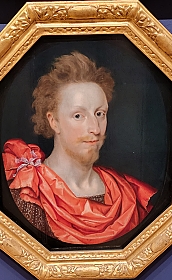
The first room of the series of galleries is dedicated to works created just before, during, and after the (Protestant) Reformation in 16th century England. I found it to be most interesting.  The radical rejection of Roman Catholic religious practices involved, amongst many other things, a profound disapproval of the artistic portrayal of religious subjects. A consequence of this was that artists switched from painting religious scenes to portraiture. Just as people love being portrayed in photographs today, those who could afford it in the 16th century were pleased to have themselves immortalised in well-executed paintings. What I had never realised before was that the Reformation unwittingly gave birth to the long tradition of British portrait painting. Maybe, most people know this already, but it was news to me.

The gallery dedicated to the Reformation era has many fine portraits, by artists both known and unknown. However, one of the paintings hanging amongst the portraits is a religious scene, “An Allegory of Man”, by an unknown artist. Painted in about 1596, it would have been a highly controversial subject given the Protestant aesthetics prevailing at that time.

Although the temporary exhibitions at the Tate Britain are usually well worth viewing, the permanent collection deserves many a visit, as we discovered today.

The first and only Queen of Haiti

UNTIL FEBRUARY 2022, only very few people with specialised knowledge of history would have been able to point out the house in which Marie-Louise Christophe lived in London between 1821 and 1824. Now, there is a plaque on the house in Marylebone’s Welbeck Street that marks the house in which she resided. And by now, you might well be wondering why anyone might want to know.

Marie-Louise (1778-1851) was born into a free black family, which ran a hotel, in St Dominique (which is now Haiti). In 1793, she married Henri Christophe (1767-1820), who had been one of her father’s slaves before he had earned enough in tips to purchase his freedom. After several years of revolution, in which Henri Christophe was an important freedom fighter, Haiti gained independence from France in 1804. In 1811, Henri was crowned the King of Haiti and the following year, Marie-Louise was given the title of Queen of Haiti. After the death of her husband in 1820 and the assassination of her two sons, she fled from Haiti along with her daughters. Their escape was assisted by the British, and they settled first in Blackheath, where they were hosted by the Anti-Slavery activist (abolitionist) Thomas Clarkson. After several changes of address, the Queen and her daughters settled in number 49 Welbeck Street.

According to the British press of the time, she and her daughters were popular with British people in all the social echelons. In 1824, they left London for Europe. Marie-Louise died in Rome, where she is buried. She never returned to Haiti. It was only in February 2022 that the Nubian Jak Community Trust were able to put up the commemorative plaque which you can see on number 49 Welbeck Street. It correctly describes Marie-Louise as “First and Only Queen of Haiti.”

Once it was a hospital, now it is a bar

I STUDIED AT University College London (‘UCL’) between 1970 and 1982. I was not there for so long because I kept failing examinations. Instead, I was a student there while I completed three different degree courses. Today (and during the years I attended UCL), the Students Union building is still located in a not particularly attractive building on the southwest corner of Gower Place and Gordon Street. Whereas it was a popular haunt of many of my fellow students, I hardly ever entered it except for a very brief period in the mid-1970s, when I was a PhD student in the Physiology Department.

During that short period, an Italian man opened a small restaurant on one of the floors of the Union building. His menu was limited to beautifully prepared beefsteaks that were accompanied by salad. This wonderful steak was priced no more than the often mediocre (or sometimes even poor) food that was available in the various subsidised student canteens in UCL. The reason for the Italian’s low priced, superb fare became obvious when after a few weeks, his eatery closed – or was closed. It turned out  (so I was led to believe) that he was using the Union’s premises, but not paying the rent that he owed.

Winding the clock forward to the 26th of June 2023, we walked past the Union building, and I noticed something that I had never seen before. The building has a commemorative plaque that reads:

“This building housed the London School of Tropical Medicine and the Hospital for Tropical Diseases. 1920-1939.”

The plaque was placed by the Seamen’s Hospital Society, based in Greenwich. I do not know when the memorial was affixed to the Union, but I feel sure that it was not there when I was a student. It is interesting that what was once a hospital has become a centre for hospitality.

A home and museum near Holborn

THE ARCHITECT SIR John Soane (1753-1837) created what is my favourite museum in London – Sir John Soane’s Museum. Son of a builder, Soane became a successful architect in the reigns of Kings George III and George IV. In 1806, he was elected Professor of Architecture at the Royal Academy. Although he was able to undertake the Grand Tour in Italy and Malta during the period 1778 to 1779, many of his students were unable to do so because of the Napoleonic Wars raging in Europe between 1803 and 1815.  This meant that they were deprived of the opportunity of viewing the great works of art and architecture, which was considered an important part of an architect’s training during the Regency Period. However, Soane got around this problem as I will explain.

Between 1792 and about 1812, Soane purchased and then demolished three neighbouring houses on the north side of Lincoln’s Inn Fields. He rebuilt them to his own designs. He continued remodelling their interiors to test out the efficacy of his novel architectural designs. One feature that stands out are his clever ways of getting natural light to reach parts of the buildings that were far from natural light sources. Often skylights are located above tall internal lightwells, which allows light to reach, for example the basement rooms. In addition, carefully placed mirrors assist the distribution of natural light. These clever methods of illumination were important innovations in the era before electricity or gas-lighting.

Soane lived in his houses, had his architectural workshops there, kept a picture gallery, and created a museum. The picture gallery is ingenious. A small square room, lit from above, has some of the pictures arranged in two layers, one covering the other. The wall carrying the outer layers of pictures is in fact a huge, hinged door, which can be opened to reveal the pictures on the layer it covers (see the photo above). By this method, Soane created much more hanging area within the room. The pictures and drawings include many by Hogarth and Piranesi, and at least one by Canaletto. There is also a pair depicting Soane and his wife. Other pictures depict buildings designed by Soane as well as projects that he planned but were never fulfilled. To squeeze so many large artworks into such a small room, where they can be viewed comfortably, is a work of genius.

Soane, who was a successful architect and married the daughter of a wealthy builder, was not short of cash. He spent some of it on purchasing a huge variety and a great number of antiques including the Sarcophagus of Seti (Egypt, c 900BC). The sarcophagus had lain in front of the British Museum for two years before he was able to purchase it from the man who owned it. It had been offered to the British Museum, which declined to purchase it for £2000. So, Soane bought it, and it is the most important exhibit in his museum. The other antiques include Ancient Greek and Roman as well as mediaeval and renaissance artefacts. Soane put much effort into arranging his collection and established it as a museum. In 1833, he managed to get a Private Act of Parliament passed. This enshrined in law that after his death, number 13 Lincoln’s Inn Fields (the museum) should be preserved in perpetuity in the state he left it. And this has been done faithfully, but with careful restoration when necessary.

One of the purposes of Soane’s Museum was to allow his architectural students to view and study the sort of things that would have been able to see had the Napoleonic Wars not prevented them from undertaking their own Grand Tour. A visit to the curiously cluttered museum is fascinating and wondrous. The staff and volunteers that keep an eye on the various rooms and chambers in the museum are well-informed and provide interesting information.

Keeping watch in the Kyoto Garden

LONDON’S HOLLAND PARK contains a lovely area – the Kyoto Garden. It is a well-maintained Japanese-style garden. I visit it frequently. Each time, I see something different there.

The garden is planted around a small pond in which there are several rocks, which look like miniature islands. Today, I saw a heron perched on the summit of one of these rocks. It stood still, moving its head slowly every now and then. It showed little interest in the many fish that swim in the pond. My wife noticed that there was a nest containing eggs just below the bird’s feet. The creature stood like a sentinel, guarding its future offspring.

I could see four eggs in the nest – there might have been more. In general, so I learned from Wikipedia, the various species of heron are monogamous and lay between three and five eggs. I have no idea what species I saw in the Kyoto Garden, but it is the first time I have seen a heron’s nest with eggs anywhere in Holland Park.