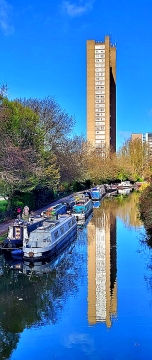
Trellick tower
Its architect Erno Goldfinger
Stands tall and proud

Trellick tower
Its architect Erno Goldfinger
Stands tall and proud
THE NEWPORT STREET Gallery near Lambeth Bridge on the south side of the River Thames was founded by the artist Damien Hirst as a place to show items from his extensive collection of contemporary artworks and sometimes his own work to members of the public. Every few months, a different selection of the works in his collection are tastefully exhibited in the gallery. The gallery is housed in converted industrial buildings, described in Newport Street’s website as follows:
“The construction of Newport Street Gallery involved the conversion of three listed buildings, which were purpose-built in 1913 to serve as scenery painting studios for the booming Victorian theatre industry in London’s West End. With the addition of two new buildings, the gallery now spans half the length of the street.”
We visit it regularly, and usually enjoy what is being shown and the way it is displayed.
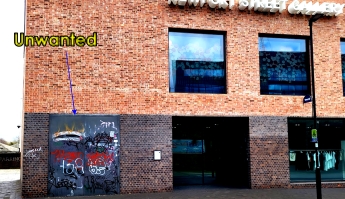
Today (25 March 2026), we visited the gallery again. Before we entered, we noticed two outer doors covered with spray-painted graffiti, and part of the entrance disfigured in the same way. We asked a woman at the reception desk if the graffiti was an artwork sanctioned by the gallery, and were told that it was not. I said that although unwanted, the graffiti was in the spirit of many things that are often exhibited within the gallery. She laughed, clearly understanding what I was getting at.
I AM ATTRACTED to the Art Deco style of architecture that had its heyday during the period between WW1 and WW2. Although there is no concentration of buildings made in this style in London, such as can be found in Bombay, there are plenty of examples scattered around the city. One of these is on Wilton Street, facing one side of Victoria railway station.
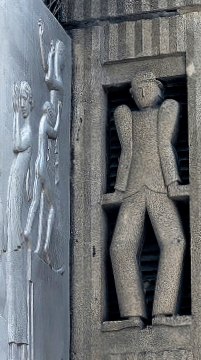
Originally built to be a cinema, it was completed in 1930. Its architects were William Edward Trent (1874 – 1948) and E Walmsley Lewis (1898–1977). Plans were made to demolish the Apollo in the 1950s, but, fortunately, they were never realised. In the 1970s, it hosted several musical events including rock concerts. In 1981, the Apollo re-opened as a theatre. Since then, it has hosted musical theatre (‘musicals’) including “Fiddler on the Roof”, “The Sound of Music”, and “Camelot”. Since September 2006, it has been showing the musical “Wicked”.
Surrounded by twenty-first century and nineteenth century buildings, this Art Deco theatre makes for a pleasing element in the architectural ensemble around the railway station.
RECENTLY I WENT to a hospital, St Bartholomew’s (‘Barts’), which is near to London’s Smithfield meat market and the Barbican. I went there not because I was ill, but to view a magnificent artwork. It is in the hospital’s North Wing.
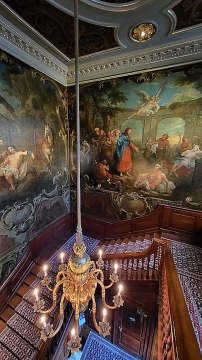
The walls of the main staircase in the North Wing are covered with huge paintings depicting scenes from stories in the Holy Bible. What makes them both attractive and interesting is that they were painted by the English artist William Hogarth (1697-1764). According to a website relating to this artwork (https://bartsnorthwing.org.uk/):
“Hogarth decorated the stair free of charge, allowing him to indulge his ambition, and giving the hospital a grand entrance to the Great Hall at no cost.”
Hogarth was a Governor of the hospital. The paintings that illustrate ‘The Pool of Bethesda’ and ‘The Good Samaritan’, were created in 1736–1737.
In 2025, the restoration of the paintings was completed, and the staircase was opened for public viewing at last – they had been hidden from public view for about 300 years. The stairs lead up to the spectacular, vast Great Hall (designed in 1732 by architect James Gibbs), which can also be visited.
And when you have admired the artwork and the Great Hall, head around the corner into Long Lane, and enjoy refreshments at Details, a charming café (near Barbican station) with interesting interior design.
FACING SMITHFIELD MEAT market, there are three wall plaques commemorating four men who were martyred at Smithfield, which several centuries ago was an important site for executions. The four men, whose memorials I saw today (17 March 2026), were: Wat Tyler (c1320-1381), John Ball (c1338-1381) who was executed in St Albans, William Wallace (c1280-1305), and John Bradford (1510-1555).
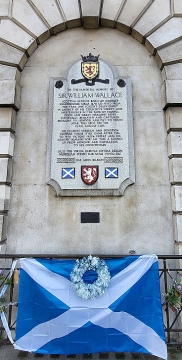
Tyler and Ball were significantly involved in the Peasants Revolt. William Wallace, a Scot, was one of the main military leaders in the First Scottish War of Independence (1296-1328), and was captured by the English, taken to London for trial, and executed at Smithfield. And Bradford, a Protestant, was executed for alleged crimes against the Catholic Queen Mary I.
I saw memorials to these men, but have read that they were by no means the only people martyred at Smithfield (see https://en.wikipedia.org/wiki/List_of_people_executed_in_Smithfield for more names).
Today, Smithfield is becoming a trendy area with plenty of bars, pubs, and restaurants. It is difficult to imagine that it was once a place where these dreadful executions were carried out.
EVERY NOW AND then, when touring around England, we have spotted village lock-ups. These were small places with barred doors where prisoners could be held briefly in a cell until more suitable accommodation could be found for them. These miniature jails were:
“… used in the eighteenth and nineteenth centuries to house criminals who were apprehended on suspicion of committing petty crime … Lock-ups were only temporary forms of imprisonment, usually for one or two people, before the local authorities of the day decided how to deal with the offender. Criminals could be released or sent to the closest large town for trial.” (www.essexlive.news/news/essex-news/historic-jails-essex-you-can-3227277).
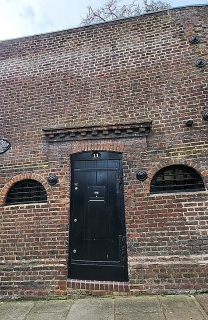
There were probably quite a few parish lock-ups in London, but now most of them have disappeared. However, if you walk along Cannon Lane in Hampstead, you will find one that has been preserved to some extent. It is within the garden wall of the grounds of Cannon Hall, which is where local magistrates held court, A plaque next to its entrance informs that the lock-up was established about 1730. Soon after the creation of the police force in 1829, the lock-house became disused, and prisoners were locked up in the Watch House that stands in Hampstead’s Holly Walk. Today, it seems as if the entrance to the former lock-house, flanked by two barred windows, is now the front door of some kind of residential accommodation.
For more information about Hampstead past and present, why not read my book:https://www.amazon.co.uk/dp/B09R2WRK92
THE AUCTION HOUSE Christies was founded in London in 1766 by James Christie (1730-1803). Their main premises are on King Street, near St James Palace in the City of Westminster. Usually, the auction house is open to the public, who may enter and view the items waiting to be auctioned, and to watch or participate in an auction. Until 12 March 2026, works from the collection of the Belgian couple Roger and Josette Vanthournout, both now deceased, are up for sale. The sale is being held as a series of auctions over a period that extended from 25 February 2026 until 12 March 2026.
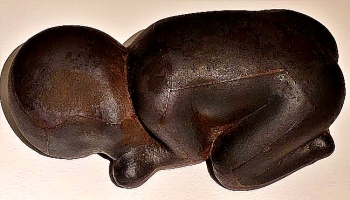
The Vanthournout couple have been collecting art for over 60 years. At first, they collected Chinese vases, but soon after that, they began buying modern and contemporary art. Roger trained as an interior designer and ran a furniture store in Izegem, Aurora, which had been founded by his father in 1921. Josette (née T’Kint) was an artist and an art lover. From the 1950s onwards, the couple travelled a great deal, visiting art fairs where they engaged directly with artists, dealers and galleries. They tended to buy much of their art from artists, who had not yet achieved great fame, and by doing so acquired artworks at reasonable prices. And viewing the pieces on display at Christies today (5 March 2026), one can easily see that Roger and Josette both had a ‘good eye’, and bought wisely. After the widowed Josette died in 2025 aged 95, the family decided to sell the collection.
And what a collection it must have been, judging by what we saw on display at Christies. There were fine examples of artworks by, to name BUT A FEW: Josef Albers, Pablo Picasso, Man Ray, Rene Magritte, Henry Moore, Yayoi Kusama, Jean Arp, Lucio Fontana, Jean Dubuffet, Lynn Chadwick, Paul Delvaux, Jacques Lipchitz, Tracey Emin, and James Ensor. I was interested to see a couple of works by Victor Vasarely (1906-1997) because when I lived at home, we had one of his abstract prints hanging on the wall of our living room (I have not seen the print since 1991). There were several sculptures by Antony Gormley. These are quite unlike any of the many works I have seen by this artist. Josette and Roger were lucky to have these examples of his work.
The collection we saw at Christies was well-displayed and filled with an amazing array of art created in the twentieth and twenty-first centuries. Once they have been auctioned, many of the bought by private collectors and galleries far away from London, it will be a very long time, if ever, before they can be seen again by the London public.
Because it is possible to see works of art that are not usually on public display, visiting Christies (and other auction houses) allows ‘the man (or woman) in the street’ to catch a glimpse of artists’ creations that are frequently not usually accessible except by their owners. And even if you have no intention of making a bid, the staff at Christies are most welcoming and willing to answer any questions you might have regarding the items awaiting auction.
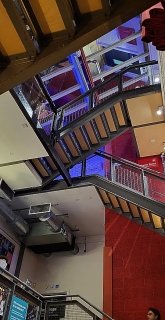
Go up or down
The staircase is waiting for you dear
The choice is yours
WHILE WALKING ALONG a path in Holland Park, I passed a pile of sawn, short logs. The timber was not arranged tidily. It was piled up haphazardly. At first, I thought that the park workers had created this collection of wood prior to it being removed elsewhere, but then I noticed that one piece of wood had a label attached to it, which read:

“This loggery is a habitat for invertebrates such as Britain’s largest Coleopteran, the stag beetle. The larvae live in rotting wood for up to seven years …”
So, what I thought was a temporary storage place for the sawn timber is intended to be more of a permanent feature. At other parks, I have seen collections of dead tree stumps, which are called stumperies, but this was the first time I have come across a loggery. Out of curiosity I looked up the word ‘loggery’ on the Internet, and discovered that websites concerned with wildlife conservation use the word as the notice in Holland Park states.
However, loggery has another, older meaning. It is an adjective meaning ‘rank growth’, rank meaning ‘strong’ or ‘vigorous’. The Oxford English Dictionary quotes this example of its usage in “The farming and memorandum books of Henry Best of Elmswell” by Henry Best (c1592-1645):
“When barley is loggery and full of greenes.”
Well, let us hope that the loggery in the park will allow the stag beetle larvae to achieve rank growth.
WHEN WALKING ALONG the north side of London’s Euston Road between Albany Street and Hampstead Road, I passed a metal sculpture of a man, life-size, looking into the ground floor plate glass window of a newish building, part of the Regents Place development.
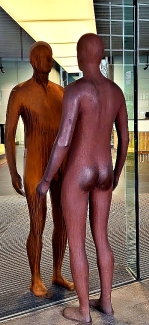
At first sight, it looked as if the sculpture was being reflected by the glass. As I thought that the sculpture looked like the kind of thing created by the British sculptor Antony Gormley, I took a closer look, and saw a plate embedded on the floor next to the artwork. It read:
“Antony Gormley Reflection 2001 cast iron”.
Then, looking carefully, I realised that what I thought was a reflection was in fact a replica of the sculpture outside on the other side of the window, in the building. And as I looked at this interesting idea, I noticed that the two sculptures differed in colour, otherwise they were mirror images of each other. Simple though the sculptures are, the idea that a reflection need not be a reflection struck me as intriguing.
 yamey
yamey 