
A village of tents in the heart of London

EUSTON ROAD IS a busy dual carriageway. Where it runs near Warren Street Underground station, there is a central divider, a few feet wide.
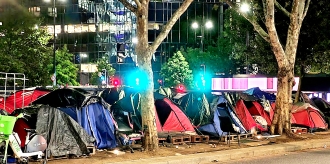
There are twenty to forty small tents pitched on the narrow divider strip. They have been there for several years, maybe since 2020. These tents house homeless people. They are these peoples’ homes. Some of the tents contain no more than simple bedding – mattresses and blankets. Others are more elaborately furnished with domestic equipment in addition to bedding. None of the tents could be described as desirable residences. Yet they are home to people hailing from a variety of places including Ukraine, Bulgaria, Romania, elsewhere in Europe, and Britain.

The tents can be seen clearly from the west bound bus stop near Warren Street station. Behind these barely adequate dwellings are recently constructed high-rise office blocks as well as luxury apartment blocks.

Seeing these inelegant tents and their inhabitants, whose impoverished circumstances can easily be imagined, reminded me of street dwellers I have seen on the pavements in prosperous districts of large cities in India.

What is to be done about these tents and their inhabitants? I have no idea and it seems that our politicians are also without ideas about them.
It looked like a reflection but that was an illusion

WHEN WALKING ALONG the north side of London’s Euston Road between Albany Street and Hampstead Road, I passed a metal sculpture of a man, life-size, looking into the ground floor plate glass window of a newish building, part of the Regents Place development.

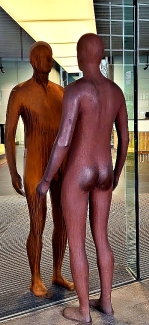
At first sight, it looked as if the sculpture was being reflected by the glass. As I thought that the sculpture looked like the kind of thing created by the British sculptor Antony Gormley, I took a closer look, and saw a plate embedded on the floor next to the artwork. It read:

Antony Gormley Reflection 2001 cast iron”.

Then, looking carefully, I realised that what I thought was a reflection was in fact a replica of the sculpture outside on the other side of the window, in the building. And as I looked at this interesting idea, I noticed that the two sculptures differed in colour, otherwise they were mirror images of each other. Simple though the sculptures are, the idea that a reflection need not be a reflection struck me as intriguing.

An attempt to avoid confusion on the Underground in London

THERE ARE THREE Underground stations close to each other and very close to London’s Euston Road. Warren Street station is 285 yards west of Euston Square station, which is about 376 yards southwest of Euston Underground station.

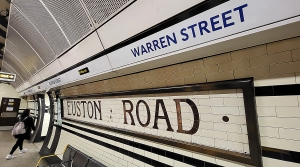
When Warren Street station (on the Northern Line) was first opened in 1907, it was named ‘Euston Road’. An old station name sign on the platform has been retained as a souvenir (see photograph above), and it reads “.Euston Road”. Had this name remained unchanged, there would have been three stations with ‘Euston’ in their names. So, in 1908, no doubt to reduce the possibility of confusion, the present Warren Street station lost its original name and was given its current name.