
There is more to Wigan than Orwell’s famous Wigan Pier

WHEN WE VISITED Wigan in Lancashire in 2022, we saw hoardings that advertised the forthcoming opening of an “artisan deli”, and wondered what George Orwell would have made of it.

We returned to Wigan Pier in September 2025, and headed for the site of the proposed artisan deli. However, it has not been built and the signs advertising the plans to build it are no longer to be seen. The area around the Pier looks similar to what it did in 2022. The warehouses that were to have been redeveloped stand empty. Peering through their windows all that could be seen were huge, dusty empty spaces.

During our second visit to Wigan, we took a stroll in the town’s Mesnes Park. This beautifully maintained park was laid out in 1878 on glebe land (terrain set aside to provide income and support for a parish priest). Apart from a lovely pond, lawns, and carefully tended flower beds, the park contains several interesting features. One of these is the octagonal pavilion built in 1880. Now containing a café, it stants on a raised mound, and can be approached by elegant stone staircases. In fron of its main entrance, there is a statue of a soldier, which is part of a memorial to those men of Wigan who fought in the 2nd Anglo-Boer war (1899-1902). And a few steps down from this, there is the elegant cast-iron Coalbrookdale Fountain. This is a replica of one which stood in the park until 1921. Near the pavilion, there is a 10-sided Victorian bandstand.

Between the Pavilion and the main entrance to the park, there is a statue of a seated man. It depicts the Conservative politician Sir Francis Sharp Powell (1827-1911). He held a seat in the House of Commons from 1863 until 1910.   He was born in Wigan, but represented several different constituencies during his long parliamentary career. The bronze statue in the park was created by Ernest George Gillick (1874-1951), and erected in Wigan in 1910.

Just over two miles northeast of central Wigan, lies Haigh Hall (built between 1827 and 1840), which was undergoing restoration in 2025. It is surrounded by Haigh Woodland Park, which is a vast parkland area containing a variety of leisure facilities including eateries, adventure playgrounds, a golf course, a mini-golf course, and a fine walled garden. It is hoped that when the restoration of the Hall is completed in 2028, it will provide opportunities for a whole range of activities for visitors.

Our second visit to Wigan has shown us that there is much more to the place than Orwell’s famous Wigan Pier.
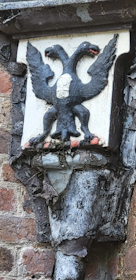
Birds with two heads in Lancashire

I HAVE LONG been fascinated by the double-headed eagle (‘DHE’). The earliest evidence of its use as a symbol is on Mesopotamian seal rings made as long ago as c3000 BC. Since then, it has been used by the Seljuk Turks, the Byzantine Empire, the kingdom of Mysore, Russia, Austro-Hungary, Serbia, Montenegro, Albania, and many other peoples.

In England, aristocratic families such as the Killigrews and the Godolphins in Cornwall have incorporated it in their coats-of-arms. Today, we visited Rufford Old Hall in Lancashire. It was once the seat of the Hesketh family. And their original coat-of-arms included the DHE. This two headed bird can be seen in many places on the building.

For those less interested in the DHE than me, the main attraction of the place is the 16th century Hall with its hammer beam ceiling and its amazing timber screen.

When we decided to visit Rufford Old Hall today, I had no idea that I would be seeing yet another British family’s use of the DHE. I have no idea what if anything caused these families to incorporate this creature in their crests. It is far less used in Englush heraldry than other creatures such as, for example, the lion, the eagle, the unicorn, and the griffin.

A mill and a bottle in a village in Lancashire

PARBOLD IS A village about 16 miles northeast of the centre of Liverpool. In 1742, the Douglas Navigation, a canal that links Wigan and Liverpool, became operational. It carried stone, coal, and other goods to Liverpool from where they could be shipped to Dublin. The canal passes through the centre of Parbold, and led to the mining of coal in the area. In turn, this led to an increase in the village’s population. With the arrival of the railway in 1855, Parbold became more easily accessible to Manchester and Wigan. This resulted in wealthy inhabitants of these towns coming to live in Parbold. And in the 1960s and 1970s, new housing estates were built in the area. Despite this, Parbold remains a charming place to visit.

Parbold mill

Parbold Hall, which was built in the 1750s, housed a Benedictine School. This institution was the forerunner of  the leading Roman Catholic Ampleforth School, which opened in North Yorkshire in 1802. Soon after that, the boys studying at Parbold Hall were moved to Ampleforth, and the Parbold school was closed. Currently, the hall is privately owned, and let out for weddings and holiday accommodation.

One of Parbold’s main attractions is the tall, conical tower that was once a windmill. It stands next to the canal, and replaced a water mill that no longer exists. A website published by West Lancashire Borough Council related that the tall mill:

“… replaced the water cornmill which once stood near the Douglas bridge in Alder Lane. The windmill in its turn was superseded in the middle on the 18th century by the present mill which was originally worked by a steam engine and produced compound cattle foods until its closure in 1985.”

Part of the former mill is now an art gallery. Next to it, there is a pub appropriately named The Windmill. It opened in 1794 to serve both the growing traffic along the newly opened sections of the Leeds to Liverpool Canal and the farmers delivering grain to the neighbouring windmill. It soon became a meeting place for locals. Today, it incorporates a restaurant in addition to the usual bars.

The most interesting sight in Parbold is on a hill overlooking the village and the fields around it. Looking like the top third of a wine bottle, it is a stone monument known as both the Reform Pillar and the Parbold Bottle. It was erected by local worthies to replace another structure, which commemorated the passing of The Reform Act in 1832. The Act made great changes in the electoral system by changing constituency boundaries; creating new constituencies in areas that had been hitherto unrepresented in Parliament; and extending the franchise, giving the vote to all men owning houses over £10 in rateable value. It was the beginning of the path that led eventually to universal suffrage in Great Britain. As a result of the Act, Lancashire gained 11 new Members of Parliament. The bottle-shaped monument was badly damaged by a gale in 1942, but was restored in 1958. A short path leads from a busy main road to the Bottle from which lovely views can be obtained. The monument itself, although interesting, is not a thing of beauty.

Today, Parbold is mainly residential and a popular place for those wishing to walk along the canal or to go fishing. And apart from The Windmill pub, there are several other places where refreshment can be obtained.

Discovering the versatility and creativity of an artist born in Lancashire

UNTIL AUGUST 2024 when I visited Salford, I believed that there was little that excited me about the work of the artist Laurence Stephen Lowry (1887-1976). My first impression of this artist was back in the 1970s and ‘80s, when reproductions (posters) of his paintings of industrial landscapes crowded with stick-like depictions of people were popular items in print shops of the Athena chain. I liked the pictures, but there seemed to be little variety amongst the paintings that were reproduced for sale.

My appreciation of Lowry’s art was not improved after seeing a special exhibition of his paintings held at Tate Britain in 2013. The paintings were badly displayed. There were too many of them crowded on to the walls of the galleries. They were so densely packed into the gallery that they were difficult to examine carefully. As far as I can remember, there was little difference between the subject matter depicted in the paintings. Most of them were of the kind that I had seen reproduced in the Athena shops. I came away from the exhibition neither being impressed by it nor having gained more admiration for Lowry.

So, in August 2024 when we headed for The Lowry, a modernistic cultural centre at Salford Quays in Greater Manchester, which contains a collection of artworks by Lowry, my enthusiasm was somewhat dampened. The Lowry itself is a successfully adventurous example of modern architecture, which is well worth seeing. It contains a gallery devoted to the works of LS Lowry. Our visit to this gallery, which contains about 400 of his artworks, was, as the saying goes, ‘mind-blowing’. First of all, in comparison with the 2013 exhibition at the Tate, the works of art are extremely well displayed. Secondly, and more importantly, what we saw completely changed my mind about Lowry’s works.

Although there were several of Lowry’s works in the style favoured by customers of Athena’s outlets, these wonderful pictures were outnumbered by other images which demonstrate Lowry’s versatility as an artist. Lowry painted many faces and portraits, all of which convey the personalities of the people portrayed and the artist’s sometimes quirky or humorous perceptions. There are numerous images – both sketches and paintings – of ships. There are evocative landscapes devoid of people. Most surprising to me, are his paintings of seascapes, which are so brilliant that they put Lowry alongside Turner in his ability to capture the sea on canvas. Apart from paintings, there are numerous sketches and ‘doodles’ on display, each one of which demonstrates Lowry’s skill as a draughtsman.

The immense variety of what is on display in the gallery in The Lowry demonstrates the amazing diversity of LS Lowry’s depictions of life in Lancashire and elsewhere. The exhibition at Salford Quays opened my eyes to his brilliance, and now I realise how wrong I was when I came to a judgement of his talents before having discovered how wide a range of art he created so skilfully.

Cotton and Abraham Lincoln and Mahatma Gandhi and Lancashire

LANCASHIRE USED TO be the centre of the cotton processing industry in the UK. Cotton grown in the southern USA and in India’s Gujarat was shipped to Lancashire, where the cotton mills used it to manufacture textiles.

In the heart of the city of Manchester, we were surprised to find a huge bronze statue of the former President of the USA, Abraham Lincoln (in office from 1861 to 1865). Lincoln played a significant role in the abolition of slavery in his country. Many of the slaves worked to grow and harvest cotton, much of which was sent to Lancashire. The processing of the cotton grown by the slaves provided employment for the workers of Lancashire. The statue was created by the American artist George Grey Barnard (1863-1938) in 1919, and is one of three castings – the others being in Louisville, Kentucky and in Cincinnati, Ohio.

Beneath the statue in Manchester and carved in the plinth, there is the wording of a letter sent by Lincoln to the working people of Manchester. Written on the 19th of January 1863, Lincoln thanked the workers of Manchester, who were supporting the abolition of slavery and at the same time suffering because of the blockade that prevented cotton reaching Lancashire from the southern states of the USA. According to one website (https://manchesterhistory.net/manchester/statues/lincoln.html), Lincoln’s blockade of the cotton exporting ports was not universally welcomed:

“To what degree the people of Lancashire gave this support willingly is questionable. Lincoln’s Union Army blockaded the southern ports preventing the Confederate supporters from trading their cotton and causing what was known as the Cotton Famine in the UK. By November 1862, three fifths of the labour force, 331,000 men and women, were idle. The British Government was encouraged to take action to overturn the blockade and riots broke out because of the hardship suffered by the workers. The Confederate Flag flew on some Lancashire mills.”

The American Civil War was not the only time that the Lancashire cotton workers had to suffer because of a freedom struggle taking place many thousands of miles away. In addition to the USA, British India was a supplier of cotton to the mills of Lancashire. Indian cotton was sent to Lancashire, and processed to make textiles that were then sold in India. Because of this, a vast number of weavers in India, who could have made the textiles, were made unemployed and impoverished.

As part of Mahatma Gandhi’s attempt to free India from British rule, he initiated a boycott of cloth and clothing made with textiles manufactured in England. This was sufficiently successful to render a great number of Lancashire textile workers unemployed – at a time when the Great Depression was hitting the country. On the 25th of September 1931, Gandhi travelled from London to Darwen, a small town (with textile factories) north of Manchester. He spent the following days speaking to people of all walks of life, explaining the purpose of his Khadi movement – the boycotting of imported textiles and the encouraging of homespun Indian textile production. Both of my wife’s grandmothers chose to wear only khadi cloth because they supportrd the freedom struggle. James Hunt described Gandhi’s visit to Lancashire in his book “Gandhi in London”, and noted that:

“Everywhere Gandhi explained that whatever the effect of his khaddar movement and boycott might have on Lancashire’s unemployment was a result of his prior concern with the greater sufferings in India. While Britain had 3,000,000 unemployed. India had 300,000.000 villagers idle every year. The average Indian income was a tenth of what the British unemployed worker received from the dole …”

Overall, despite the effects that his boycott was having, the workers of Lancashire welcomed him warmly and supported his cause.

Until we visited the Manchester Museum, which is about 1.3 miles south of Lincoln’s statue, I was unaware of Gandhi’s visit to Lancashire. The museum has a gallery dedicated to the South Asian diaspora, despite being called “the South Asia Gallery”. One of its showcases concentrates on the Mahatma’s brief visit to Darwen.

We visited Manchester in May 2024 to see an art installation curated by our daughter. We also wandered around the city, sightseeing. Little did we expect to discover connections between this vibrant city and both Abraham Lincoln and Mahatma Gandhi.

The road to Wigan Pier and …

WIGAN PIER WAS made famous by the author George Orwell, who published his “The Road to Wigan Pier” in 1936. Recently, we were staying in Widnes (Cheshire), which is not far from Wigan, a town that was in Lancashire when Orwell wrote his book. So, we decided to see Wigan Pier for ourselves.

A quick glance at a map reveals that Wigan is not on the sea, which is where most piers are to be found. The town is inland, and the so-called Wigan Pier is neither a pier nor on the seaside. It is on a part of the Leeds and Liverpool Canal in central Wigan. It was originally a landing stage where locally mined coal was loaded onto barges.

The name ‘Wigan Pier’ might have originated when a train carrying excursioners to the seaside was delayed at Wigan and they saw a structure that looked like a pier, as the following (from http://www.wiganarchsoc.co.uk/content/Projects/WiganPier.htm#Folklore )  described:

“…not long after leaving Wallgate Station, an excursion train from Wigan to Southport, was delayed on the outskirts of Wigan and passengers saw a long wooden structure that reminded them of Southport Pier. This structure would have been the 1,050 yard long wooden gantry … It was built in the late 1880s and carried a double line of rails from Lamb and Moore’s Newtown Colliery high across the River Douglas, the canal and the Wigan to Southport Railway line, to Meadows Colliery by Frog Lane … It certainly would have been easy to see this wooden gantry from a train heading towards Southport.”

I cannot say whether or not this is the true origin of the name, but it is a good story.

We took a road to Wigan Pier and after going around the town’s one-way system and several roundabouts, passing a huge Asda store a couple of times, we arrived at a series of old warehouses labelled Wigan Pier, and parked next to the canal. The Orwell visitor centre, which we were led to believe existed, is no more. A passer-by, with whom we chatted, told us that any memorials to Orwell and his book had disappeared a few years ago. Likewise, the collieries: these have been closed down long ago. Where they were there are housing estates, factories, and shops.

The warehouses close to where the coal used to be loaded many years ago, were inaccessible. They are being redeveloped to create a leisure ‘hub’. This will include (according to hoardings surrounding the old buildings): a beer tap house; conferences; live music; canal tours; festivals; a food hall; and an ‘artisan deli’. I am not sure what is meant by an artisan deli, but whatever it is, I am sure that should George Orwell ever make his way back along the road to Wigan Pier, he would be truly astonished by it.