Washing the dishes as a kind of therapy

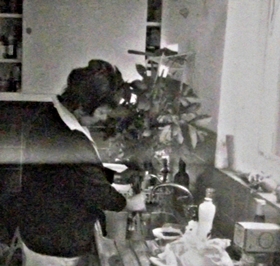
SEEING A PILE of unwashed pots and other cooking utensils reminded me of my father, who died aged 101 in 2020. A couple of years ago, I began writing my memories of him as a father, but have never completed the work. However, here is an excerpt that relates to my father and the kitchen sink:

Many people who knew my father would not have associated him with household chores. And that would be largely correct. My mother was more involved than Dad with the practical running of the household. However, there were a few things that he did on a regular basis. One of these was washing the dishes after a meal.

Dad had a rather puritanical attitude to work. Often, I felt that he considered it to be unworthy to stop working to relax, yet he did, but sometimes in an unusual way. He liked standing at the kitchen sink doing the washing of dishes, cutlery, and cooking utensils. By doing this, he was relaxing by being away from his desk, but he was not wasting time by doing nothing. He felt that he was achieving something useful whilst at the same time he was relaxing or just thinking about his academic work. When we bought our first dishwashing machine in the 1960s, I felt that Dad regretted it, because this machine had reduced the amount of time he could pass standing at the kitchen sink. Because my mother refused to put pots and pans and cooking knives in our machine, he was not entirely deprived of his time at the sink.

Having shared this with you, I will now head for our kitchen sink, and tackle the task that confronts me.

Blades and flames and other hazards in the kitchen

WHILE PREPARING A SAUCE for pasta today, my mind shot back to my mother in the kitchen during my childhood. Many people regarded her as being a competent cook. She was an enthusiastic follower of the recipes in cookbooks by Elizabeth David.  She bought only the best cooking utensils, and sourced many ingredients in the Mediterranean food stores that used to exist in Soho – a few remain, but many have gone. As a child, I was allowed in the kitchen to watch when my mother was cooking. The more I saw, the greater my desire to try to cook. However, this wish was not to be fulfilled while my mother was alive.

My birth and the first few months of my life were difficult as far as health was concerned. Consequently, my mother was highly protective of me, and then later also of my sibling. My mother saw danger everywhere, and not least in the kitchen. There were sharp knives, razor like tin can lids, and the risk of getting burnt either by the oven or the hot things prepared on it. We had electric hob rings because my mother was anxious about gas explosions and open flames. I was allowed to watch her cooking, but not to touch anything she was using. Curiously, even though knives were involved, I was often asked to wash the dishes, cutlery, and cooking utensils.

Sadly, my mother died at a young age. I was 28 when she went, and still residing in the family home along with my father, who had no interest in cooking. He enjoyed good food, but would have no part in preparing it. With my mother no longer around and a well-equipped kitchen, I began to experiment with cooking, and enjoyed the activity.

Over the years, I have done much cooking, and still enjoy doing it. I am not sure what made me think of my mother today as I prepared the pasta sauce, but it might have been the pan in which I was making it. For, that pan was one that my mother used often. She must have bought it back in the 1960s, and because she purchased only the best, it is still perfectly usable much more than 50 years later.

My wife is a good cook, but I do most of the day-to-day cooking. When she told a friend of ours that I do most of the cooking, the friend asked my wife:

“Don’t you feel diminished as a woman if Adam does most of the cooking?”

My wife, who is quite happy with the arrangement, replied with another question:

“Do I look like an idiot?”

Sometime later when our daughter was a toddler, she and my wife visited some friends. After a few minutes, our little one, used to seeing me cooking, came running out of the kitchen with wide open eyes, and said to my wife:

“Do you know, Mama, but the Mummy is doing the cooking in this house.”

My wife answered:

“Well, I never…”

Feeding the faithful at a Hindu temple in Kutch (Gujarat)

THE DHRABUDI TRMPLE complex is near the sea about 5 miles east of the town of Mandvi (Kutch, Gujarat). It is located ated next a small Freshwater lake, where pilgrims can bathe. Our driver told us that baby boys are brought to be blessed at the temple when they reach their first birth anniversary. When we visited, we saw a group of people doing a puja in the open air. They were respecting the first death anniversary of one of their relatives.

While wandering around the temple compound, we saw a group of Rabari women seated in the shade, under a large banyan tree. The Rabari are nomadic cattle and camel herders, as well as shepherds. In India, they aremost frequently found in Gujarat, Punjab, and Rajasthan.

Worshippers come from far and wide to do pujas at the mandir. The temple offers free meals to pilgrims. These are served in a large dining hall. One wall of this is lined with numerous portraits of people who have died. We were told that diners pick up a thali and other eating utensils before lining up to be served food.

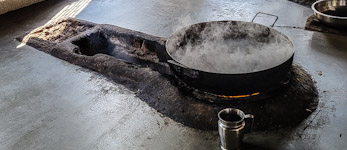
Pit containing glowing charcoal for cooking

The kitchen, which is next door to the dining hall is vast. It was spotlessly clean. I saw a few gas rings, but what really fascinated me was the other method by which food is heated up. I saw three or four pits sunk into the floor. Each one is shaped like a large spoon. Glowing charcoal is heaped in the bowl of the ‘spoon’, and can ve spread along the stem. Pots are placed above the charcoal. The arrangement reminded me of the Turkish ocakbaşı. I imagine that the cooking speed can be adjusted by varying the amounts of glowing charcoal beneath each of the enormous cooking pots.

We did not stay to join the pilgrims having lunch. Although the temple cooks kindly invited us, we had lunch awaiting us at my wife’s cousin’s home.

I always enjoy visiting place of worship. What made Dhrabudi special for me was being shown its wonderful kitchen.

Weightless

HBY Kitchen 1960s

My late mother (see picture above, taken in the 1960s) was averse to weighing machines.

When she visited the doctor and had to be weighed, she did not want to be told or in any other way infrormed of her weight.

Her dislike of weighing machines extended into the kitchen. There were no kitchen scales in our home. A good cook, she managed without them. However, she did use a conical measuring device made by the Tala company. This contains printed markings that allow the user to dispence known amounts of powdered ingredients such as, for example, flour, rice, and sugar.

Years after my mother died, I married a lady from India. She told me that in the olden days, professional cooks of Indian origin often measured out cooking ingredients by feel rather than using a weighing device. For example if a cake required an equal weight of egg and flour, the cook would hold the egg in one hand and estimate its weight by feel and then measure the required amount of flour, also assessing its weight be feel alone. I do not know whether my mother possessed this skill, but regardless of that she was widely recognised to have been a competent cook.

Getting to grips in the kitchen


Just in case you have not got one in your kitchen, here is an implement that is extensively used in Indian kitchens and tea stalls.

The sandasi (pronounced roughly like ‘sun-er-see’ said fast), which is is also known as a pakad (from the verb ‘to hold’ in Hindustani) or a chimta (from the verb ‘to pinch’ in Hindustani), is essentially a pair of sturdy hinged metal (stainless steel) tongs. The handles of the implement are several times as long as the gripping elements. This means that quite heavy things may be lifted with the beaks of the tongs without any risk of them slipping out of their grip.

The sandasi’s long handles also mean that the user’s hands can be kept at a safe distance from the hot cooking vessels that are lifted with this pair of tongs. For example, the tea maker can lift and manipulate with ease the huge pots containing several litres of a bubbling, boiling mixture of milk, tea, and spices. 

I find the sandasi very useful for gripping the edges of large casseroles when I am stirring hot food like stews or curries.

Cooking tongs are, of course, available in countries other than India, but the sturdy construction and long handles of the sandasis have much to reccommend them.

What? No kitchen…

During my early years in dental practice, I came across two instances of people living in houses without  kitchens.


antique burn burning close up


The first instance concerned one of my fellow dentists. He bought a house from a lady, who only used a microwave oven. Her home had no kitchen. My colleague had to convert one of the rooms in his new home into a kitchen. 

The second example was also connected with dental practice. It was the home of one of my dental nurses, whom we shall call ‘S’. She was a delightful young lady, who worshipped the late Marilyn Monroe. Sadly, her eyesight was not quite adequate enough for working in a dental surgery. She and the senior dental surgeon in the practice decided that she should seek another type of employment, which she did.  On her last day of working with me in my surgery, I gave S a small bottle of Chanel No 5 perfume as a ‘thank you present’. S was thrilled. I could not have chosen a better present. S told me that Chanel No 5 was all that her heoine Marilyn Monroe wore in bed. Well, I had no idea about the filmstar’s habits, but I was pleased that inadvertantly I had chosen the right gift for my visually-challenged dental assistant.

If you are now thinking that I have strayed from my subject, you are wrong. While S was working in our practice, she revealed that her mother hated cooking, so much so that there was neither kitchen nor dining room in the house where S lived with her family. S told me that the family ate every meal, including breakfast, at restaurants and cafés near their home.

Maybe I am too conventional, but I was surprised to learn that people who are able to afford accomodation with a kichen or kitchenette choose not to have one. In complete contrast, my wife told me that some of her ancestors lived in homes (in India) with two widely separated kitchens: one for meat and one for vegetarian food.


Photo by Fancycrave.com on Pexels.com

Cheese is nice


Once, we spent a weekend with a German friend living in Germany. She was a great cook and spent much time preparing delicious meals for us in her kitchen. 

I was sitting in the living room, which was next to the kitchen when I heard our hostess angrily shouting what sounded to me like “cheese is nice”. Now, I would be the first to agree with that sentence. However, she kept repeating it angrily whilst crashing about in the kitchen. I could not see why anyone except possibly a vegan could possibly use that sentence so angrily.

After a while, it dawned on me that our friend was not talking to herself about cheese, but about Jesus, whose name she pronounced as ‘Cheesus’. What she was really saying angrily in her strong German accent in English was ‘Jesus Christ’.

Let loose in the kitchen

There is no love sincerer than than the love of food

George Bernard Shaw

Most people think highly of their mother’s cooking. Many people thought highly of my mother’s cooking. She was an early disciple of Elizabeth David, the cookery book writer who introduced Mediterranean cuisine to British kitchens.

My mother regarded our kitchen as her territory. Being highly protective of my sister and me, she would not let us near the cooker nor sharp knives. However, she was quite happy to have us accompany her in the kitchen for two main reasons. One was to give her company while she cooked. Another was to do the washing up of crockery and cutlery. I did not much mind keeping her company, but washing up was not much fun.

Eventually, in the 1960s we acquired a dishwashing machine. This did not prove to be much of a labour saving device because my mother insisted on us, often me, washing every item before putting them in the machine. And, unloading the dishwasher and stacking everything away was as time consuming as washing up manually.

Sadly, my mother died young in 1980. By then, my sister had left home. As my father had no interest in cooking, the kitchen became my own territory. At last, I could begin to use the cooker and all of the kitchen utensils that my poor mother had guarded so jealously. This did not compensate for losing a beloved parent, but it did open a new door in my life experience: the art of food preparation.

My love of cooking commenced. At first, I followed recipes from an excellent series of cookbooks published by the Sainsbury’s supermarket company. Then, I experimented with Indian food guided by a cookbook written by Madhur Jeffrey. Later, I made use of a very practical Chinese recipe book written by Ken Hom and published by the BBC. For middle eastern dishes, I was guided by the well-known Claudia Rosen, who has also written a very good book of Italian recipes, and a superb one by the lesser known Arto Haroutian. For Hungarian food, the book by George Lang is hard to beat. Since marriage, I have been guided in the art of cooking by my wife, who is a superb cook.

I suppose that over the years I have become a ‘foodie’. ‘Foodie-ism’ seems to run in my family. My sister, a very competent cook, ran a restaurant in Italy for about 15 years; she was the chef. My mother’s sister was an excellent chef and her two children, my cousins, have inherited her culinary skills. Our daughter has also inherited the foodie gene, both from me and my wife, both of whose parents had discerning palates.

There are those who consider food simply as fuel. They are missing out on one of the pleasures in life, which I value greatly: the preparation and enjoyment of cooking and eating.

Let me end by wishing you all A DELICIOUSLY HAPPY NEW YEAR!

Claim your steak

STEAK

When I was much younger, my parents often took my sister and me to eat dinner in restaurants.

Before we looked at the menu, my late mother used to examine the plates and cutlery on our table. If there was a blemish on the cutlery or a crack or chip in the porcelain, the waiter would be summoned to replace the defective item(s). Often this delayed the arrival of any food. If we looked reproachfully at my mother, she would say:

“You can eat off cracked plates if you like, but I am not paying good money to eat off bad plates.”

She said this in such a way that meant that really there was no way that any of us could eat off damaged crockery, even if we wanted to.

As the years went by, I used to look at my plate and cutlery carefully as soon as we sat down. If I spotted a defect, I used to casually lay my hand on it so that my mother would not see it. I was always hungry before a meal and wanted to get on with it rather than having to wait for perfect eating utensils to be fetched. Once any defective cutlery/crockery was replaced, the meal could be ordered.

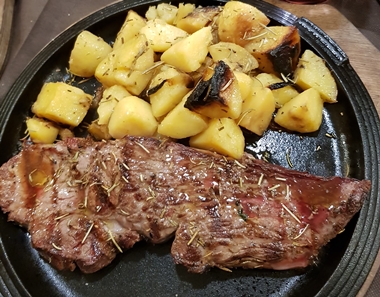
My mother was fond of beef steak. Rather unfashionably for London in the 1960s, she preferred her steak rare, almost what the French call ‘bleu’. This simple request was the real test for a restaurant. Frequently, the rare steak would arrive cold. My mother would then summon the waiter or maitre d’hote.

“My steak is cold.”

“Madame, I will ask the kitchen to heat it for you.”

The steak would then be returned, and my mother would begin cutting it. Soon the waiter would be called again.

“My steak is no longer rare; it is overcooked. Take it away and bring me another one cooked rare and warm.”

Any restaurant that could get this right without fuss, won my mother’s custom. She would then return there frequently.

Today, rare steak is the ‘in thing’. Most good chefs and discerning diners prefer the insides of steaks to be red, if not bloody.

Writing of steaks reminded me of Monty Modlyn (1921-94), a radio presenter and journalist. Occasionally he would speak on the early morning Today programme on the BBC Home Service (now ‘Radio 4’). He would report on steaks and other meat he had eaten. He had a metal ball that he would drop onto pieces of meat. The depth of the indentation made by the ball’s impact was his measure of the meat’s quality. It all sounded a bit mad to me when I listened to him when I was a young boy. Apparently, what he was doing was quite sound. The quality of raw meat can be judged by indenting it with a finger tip and then watching how quickly the indentation disappears. If the meat recovers quickly, then the quality is likely to be lower than if it recovers slowly.