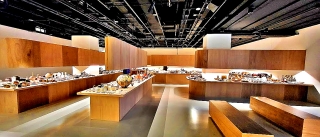
THIS IS AN exhibition you should not miss if you are in London anytime before 10 May 2026. It is being held at Japan House London in High Street Kensington, and is called “Hyakkō”. This Japanese word means ‘one hundred makers’. The exhibition is a display of 2000 handmade works made by 123 craftsmen and craftswomen in Japan. The exhibits are all exquisitely made. They are made using one or more of the following materials: ceramics, wood, metals, leather, and glass,
The works are attractively displayed, labelled, and well-lit. Accompanying the exhibits, there is a series of beautifully filmed videos. Each of these shows the makers at work in their studios and workshops in Japan. The videos show how natural materials are gathered, processed, and then transformed into fine examples of applied art. Many of the items seen being made in the films can be found in the exhibition. Watching the videos is an important part of enjoying the exhibition because you begin to appreciate the skill and artistry employed to create what you can see close-up in the show. I would advise you to watch the screenings first, and then to view the products of the skilful creators who appear in the films.
Not only are the creations wonderful in themselves, but the way that they have been exhibited is a work of art. Whoever designed the exhibition seems to share the superb aesthetic sensibilities of those who created the exhibits. It is worth visiting Kensington to enjoy this visual treat from Japan.
DURING THE EASTER weekend, we visited two exhibitions. Unlike many exhibitions I have written about lately, neither of them finish soon. Both shows relate to wood and trees. One is being held at the Serpentine South Gallery in Kensington Gardens and it ends on 7 September 2025, and the other is at Japan House in High Street Kensington and continues until 6 July 2025. So, there is plenty of time to see both exhibitions.
By Giuseppe Penone
The show at the Serpentine is of artworks by the Italian artist Giuseppe Penone. I have already written a bit about him (https://adam-yamey-writes.com/2025/04/15/boulders-lodged-in-trees-at-a-park-in-london/). I did this after seeing those of his works that are on display near the outside of the Serpentine Gallery. I have now seen what is on display within the gallery, and was pleasantly surprised. Penone is fascinated by the intricate relationships between humans and nature, and this is what inspires his artworks. Many of the artefacts (paintings, installations, and sculptures) on display relate to trees and their leaves. The walls of the central hall of the Serpentine Gallery are lined with containers that hold thousands of dead laurel leaves. Another exhibit consists of semi-abstract sculptures that resemble human forms, and these are entwined with living plants growing out of large flower pots. Other works are formed from pieces of wood and twigs. One particularly effective work consisted of living branches with leaves and twigs. One of the twigs has been forced through a hole cut in a photograph of a man’s face in such a way that the twig seems to have grown from within the centre of the eye. I like this piece because it encapsulates what Penone does: he sees nature through his eyes and is inspired by what he sees.
In contrast to Penone’s work at the Serpentine, which is art for art’s sake, the exhibition at Japan House is designed to illustrate how man can create artistic yet functional artefacts from wood. Called “The Craft of Carpentry: Drawing Life from Japan’s Forests”, the show sets out (successfully) to illustrate the amazing skills of traditional Japanese carpentry. This informatively labelled exhibition has exhibits showing the variety of tools used, the types of wood employed, the range of joinery methods, templates for cutting shapes, and some of the final products including a life-size replica of the Se-an teahouse in a temple in Kyoto. Although everything on display is related to creating functional products, each exhibit is so beautiful that it could be considered a work of art in its own right. As with every exhibition I have seen at Japan House, the exhibits are displayed imaginatively and beautifully. The exhibitions themselves are works of art.
I recommend visiting both exhibitions not only because they are fascinating but also because they illustrate two completely different approaches to dealing with trees and their wood.
IT IS OFTEN a pleasure to see an exhibition of works by an artist, whose existence was hitherto unknown to me. In this case, the artist is the Japanese born Minoru Nomata, who was born in 1955 and lives as well as works in Japan. The exhibition of his works, currently at White Cube in Masons Yard (near Piccadilly) until the 24th of August 2024, consists mainly of paintings (acrylic on canvas).
At first sight, his paintings look almost like photographs. However, after a few moments’ contemplation, they can be seen to depict subjects – often structures and aspects of nature – that are at the same time unreal and almost but not quite real. His subject matter is not quite surreal, but is an unusually dreamy interpretation of the real world. None of the paintings on display contained any signs of human presence. The gallery’s website (www.whitecube.com/gallery-exhibitions/minoru-nomata-masons-yard-2024) includes the following:
“According to the artist, ‘construction, repair and demolition’ occur simultaneously in his paintings; they confer, too, upon the simultaneity of past, present and future distinct to Nomata’s work. As he states, he sets out to create worlds that ‘are not “somewhere”, but “nowhere”, in a position that helps [him] find a place to head for’. Devoid of identifiable temporal or geographical markers as they may be, Nomata’s ambivalent landscapes speak directly to humankind’s long-standing existential concerns about what place, if any, it has in the world.”
As I viewed the pictures, which I found aesthetically pleasing, I felt they had the ‘realness’ of images that appear in dreams, yet at the same time they seemed as if they could almost be depictions of reality. In brief, I found them both attractive and intriguing, and can recommend this show to everyone.
SEVERAL MONTHS AGO, I watched a wonderful film set in Japan and directed by Wim Wenders: “Perfect Days”. Set in Tokyo, the main character is a man who cleans the city’s public toilets. Each of the public conveniences he cleans is of a different design. And each of them, like so many things designed in Japan, is a beautiful work of art. Making things and places look special and visually pleasing seems to be an important feature of the Japanese philosophy of life, and has been since time immemorial. Yet, unlike many other countries, Japan has not yet established a dedicated national design museum.
Until the 8th of September 2024, the Japan House in High Street Kensington is hosting an exhibition called “Design Discoveries”. The website of the Japan House (www.japanhouselondon.uk/whats-on/design-discoveries-towards-a-design-museum-japan/) explained:
“This exhibition brings together seven major designers, from filmmakers to architects, to consider what they would put into a permanent collection of design treasures. Their personal responses capture Japan’s regional diversity and 10,000 years of history.”
The beautifully laid out exhibition is not merely educational but also a feast for the eyes. Examples of Japanese design (and technology) dating from about 4500 years ago to the present century are beautifully displayed and intelligently explained.
Should the Japanese eventually get around to creating a museum of design, I am certain that visiting it would be a very exciting experience. Meanwhile, if you can get to Japan House – a beautifully designed place – you should not miss visiting the exhibition in its basement.
DURING OUR TRIP to India in late 2023 and early 2024, we saw works of art that have been created using ceramics. The creators of these ceramic artworks shape clay into a form that they have in mind, glaze it, and fire the object in a kiln. The artists hope that what emerges from the kiln after firing and cooling will resemble what they had in mind. The resulting sculptures and other artworks bear the conceptual imprints of the artists’ visions – usually with considerable accuracy.
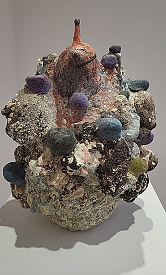
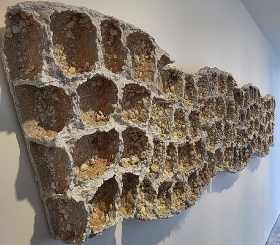
Today, the 7th of February 2024, we visited an exhibition in London’s Lisson Gallery in Paddington. On until the 10th of February 2024, it is a display of the creations of the Japanese sculptor Masaomi Yasunaga (born 1982), who works in Japan. All the exhibits are bizarre but beautiful – quite unlike anything I have ever seen.
Yasunaga is part of an avant-garde group of Japanese artists, Sodeisha, which was formed after WW2. The movement rejected and challenged previous Japanese artistic traditions. It also introduced non-functional ceramic objects as an artform. The objects on display at the Lisson Gallery were created as follows. Yasunaga used glaze rather than clay as his starting material. Combining it with raw materials such as feldspar, whole rocks, metal and glass powders, he created artistic forms. Then, he buried the creations in layers of sand and kaolin, before subjecting the whole lot to heat in a high temperature kiln. After the firing and cooling, the sculptures were carefully excavated from the beds (of kaolin and sand) in which they were fired.
Apart from fusing the various elements of each artwork, the heat of the furnace also produces unexpected transformations (both chemical and morphological) of the work so that although it bears some resemblance to what existed before firing, it has acquired characteristics that the artist would not have been able to foretell. The action of the fire in destroying the artist’s original conception is described by Yasunaga as follows:
“…melting the material and letting gravity take hold of its shape once again, eradicating the ego along the way …”
Further, he explained:
“… the ultimate goal of my art is not self-expression but what’s left of self, after being filtered through fire.”
The effects of the heat are uncontrollable, but as the website of the Lisson Gallery explained:
“… Yasunaga describes how beauty can be discovered in the most uncontrollable situations, referring to the process of his sculptures transitioning in the fire, evolving from something artificial to natural, and yielding a beauty that is perfectly pure.”
Regardless of how and why these sculptures have been created, they are a joy to behold. One of the many roles of an artist is to show us the world in a new light and to open our minds to new ideas. Yasunaga has achieved both aims in a wonderful way.
A FEW WEEKS AGO, we viewed a wonderful exhibition of contemporary quilt making at Swiss Cottage Library (see: https://adam-yamey-writes.com/2023/07/15/quilts-in-a-wonderfully-designed-library/ ). These quilts were made with both recycled bits of material and/or textiles specially bought for use in their manufacture. Although some of the works on display could be used as rugs or coverings, many of them were designed as non-functional artworks for display. Today (1st of August 2023), we visited the Brunei Gallery in London’s Bloomsbury. Our intention was to see an exhibition of paintings and drawings from the south of India. However, when we entered the place, we discovered that in addition to what we had come to see, there was another exhibition, which we did not know about. This is the rather intriguingly named “Japanese Aesthetics of Recycling”, which is on until the 23rd of September 2023. With a name like that, we could not resist taking a look at what was on show.
The exhibition has a fine collection of exhibits demonstrating the Japanese tradition of recycling old materials to create new objects. In a country where raw materials were highly valued, it made a lot of sense not to waste them, but to re-use them. We saw many examples of ‘Boro’ textiles. These are items made by fashioning worn clothing and waste fabrics to create another usable textile. Often, a large piece of used material with damage (e.g., holes) was made usable by patching it with scraps of waste material. Both quilting and Boro involve sewing pieces of material together. Unlike quilting, which uses scraps of material to create a brand-new entity, Boro uses scraps to restore worn textiles to make them usable again. There were also examples of ‘Washi’ on display. This is handmade paper concocted from already used sheets of paper (for example from discarded account books). The Washi was made waterproof by painting it with persimmon paste. Washi paper was used for many purposes including wrapping valuable clothing, floor coverings, room dividers, making bags, and more. For example, there was a conical hat made in leather and lined with waxed recycled Washi paper. In addition to these recycling techniques, there were several others. One which caught my attention was ‘Sakiori’, which in many ways resembles the North American and European rag weaving technique.
The exhibition was not only fascinating because of the range of recycling techniques exemplified, but also because many of the items made from the recycled materials were aesthetically pleasing. The exhibits are beautifully displayed, and the accompanying labels are interesting and informative. Whether you are interested in Japan or recycling or both, it is well worth visiting the Brunei Gallery to see this show.
THE JAPAN HOUSE in London’s High Street Kensington first opened in 2018, and its aim is to increase people’s awareness and knowledge of Japan, the Japanese, and their culture. Until the 11th of June 2023, the Japan House is host to a superbly laid-out exhibition of Kumihimo – Japanese silk braiding. The braiding is a complex form of plaiting, using dyed silk threads. When, for example, hair is plaited or braided, three or more strands of hair are intertwined to form a plait. Practitioners of Kumihimo plait great numbers of often different coloured threads to create braids with beautiful repeating patterns. The most expert craftsmen and craftswomen can braid patterns using up to 140 different threads.
The exhibition shows how the threads are dyed, then spun into bobbins before finally being woven into braids. The braider uses a stand that holds the reels of thread. The threads are then plaited over each other in a repeating sequence to produce a patterned braid. Great concentration is required to maintain the sequence without making errors. A weight is hung onto the braid to hold it straight and taut whilst it is being created. In addition to examples of the various types of braiding stands, there are well-made videos illustrating braiders at work. There are many examples of finished products, including belts, fashion items, armour plating, and modern artworks. All of them are intricately patterned and incredibly beautiful.
The exhibition was set up by a Tokyo-based company, Domyo, which has been producing braided silk cords since 1652 AD. Kumihimo was a technique imported into Japan between 538 and 794 AD from the Asian mainland, and then refined and developed in Japan
When I learned that I was to visit an exhibition of braiding, I was not filled with enthusiasm. However, as soon as I entered the basement exhibition area, I realised that I was about to see a fine and most interesting display. Not only is there great beauty in the exquisitely detailed braiding, but this was also the case for the way the exhibits have been arranged. To summarise, see this exhibition if you can!
AT FIRST GLANCE, the lower floor exhibition space at the Barbican art gallery in London resembles the lighting department of a furniture store such as Habitat. It is full of lighting units with Japanese-style paper and bamboo shades. After a moment, you will notice that these lighting units are not run-of-the-mill illuminations; they are interestingly shaped works of art lit up from within. These lamps are part of an exhibition of the artistic creations of Isamu Noguchi (1904-1988). Born in Los Angeles, he was the son of a Japanese father and an Irish American mother. The first 13 years of his life were spent in Japan, where he began learning carpentry whilst helping his mother building their family house. From these early skills, it was not long before he embarked on what was to become a highly productive creative career, making works from a wide variety of materials from wood and stone to metals and plastics and … you name it.
Noguchi studied sculpture at the Leonardo da Vinci Art School in New York City. In 1927, he was given a grant to travel to Paris. It was there that he was apprenticed to the Romanian-born sculptor Constantin Brâncuși (1856-1957), who introduced him to abstraction. After learning much from the great sculptor in Paris, Noguchi abandoned pure abstraction and moved towards depicting the living world. However, his experiences working with Brâncuși influenced his artistic output for the rest of his life. After Paris, Noguchi travelled extensively, learning about techniques and philosophies, especially Chinese and Japanese. In 1929, he first met the architect and inventor Richard Buckminster Fuller (1895-1983), whose ideas about science and technology chimed with his. In the exhibition, there is a shiny chrome-plated bronze bust he made of Buckminster Fuller in 1929. There are also a couple of models he created in collaboration with Buckminster Fuller. Noguchi’s interest in science was not only expressed in sculptures but also in stage settings for ballet performances choreographed by Ruth Page and for performances by Martha Graham.
During WW2, although it was not required for him to enter one of the camps where the Americans ‘cooped up’ potential Japanese enemy aliens – Japanese who lived in the USA – Noguchi volunteered to be confined in a camp in Arizona. By doing so, his aim was to create an arts programme that would ease the lives of those confined in the camp. The barren landscape surrounding his camp proved to be yet another influence on his creative output.
Amongst the many exhibits in the Barbican’s show, there are, in addition to the lighting units, several pieces of furniture designed by Noguchi. One of these is a triangular plate glass tabletop supported by two interlocking timber supports. I have seen this elegant item for sale in upmarket furniture shops, but until I saw the exhibition, I had no idea it had been designed by Noguchi as long ago as 1944. It is still being made today. The wonderful variety of lighting sculptures, which at first reminded me of lampshades that were trendy in students’ rooms in the 1970s, are examples of ‘Akari’. Noguchi began creating them in the early 1950s, and despite their fragile nature, they are still in good condition now. One of the gallery invigilators told us that the translucent paper used to construct these lamps is made from mulberry tree bark. Known as ‘Washi’, this handmade paper can also be made from the bark of some other tree species.
As with other exhibitions at the Barbican gallery, the artworks are well-displayed and beautifully lit. If you go to this exhibition, you should not miss the video film in which Noguchi talks about his life and art very eloquently. And while you are watching it, you can sit on stools and a bench Noguchi designed. Prior to visiting this show, I had heard of Noguchi and seen a few of his works. The exhibition, which continues to the 23rd of January 2022, has truly opened my eyes to what a magnificent artist he was.
PARTICLES OF SNOW, whisked by the breeze, were whizzing about in the air in random directions and eventually reaching the ground this early February afternoon in London. I had just finished my midday meal with some nutritious fermented cabbage and was wondering what to write. Maybe, it was the kimchi that helped me remember an old friend who spent some of his working life in Manchuria, which is close to Korea, the home of this weirdly delicious fermented food substance, or was it something else that has brought him to mind?
Sir Norman had already retired from Britain’s diplomatic service when I first met him in the mid-1970s. An accomplished musician, a string player, he used to perform in concerts given by a fine amateur orchestra based west of London, whose treasurer was both a player in it and a friend of mine. Usually, after concerts, my friend and her husband hosted a coffee party at their home for the conductor and selected patrons of the orchestra. Sir Norman was a patron, and it was at these parties that I first got to know him. The few tales that he related about his years as a diplomat fascinated me.
On graduating from university, Sir Norman had a good command of several modern European languages as well as Latin and Greek. He told me that it was typical of the diplomatic service that they decided that his first posting was to Japan, where he was to have a role in the interpreting of a language he did not know: Japanese. Being a good linguist, he was able to learn it.
During the late 1930s, he was sent to Shanghai in China for a year (1937-38). When he arrived, a war between China and Japan was in progress. He told me that every afternoon, he would sit taking tea on the roof of a building in the European cantonment of the Chinese city. As he sat there, he could see shells shooting overhead. They were being fired at the Chinese on one side of the Yangtse River by the Japanese artillery on the other side. This went on day after day for several months. Then one day, the shelling stopped suddenly and for good. Sir Norman wondered why.
Soon after the shelling ceased, he met some senior officers of the victorious Japanese forces. He asked them why the fighting that had been dragging on for so long had ended so abruptly. The officers explained that the Chinese soldiers were mostly mercenaries. Once the Japanese had ascertained how much to pay them to stop fighting, they stopped.
Later, Sir Norman was transferred to Manchuria, where he was the Acting Consul General in Dairen (now ‘Dalian’). He was serving there when the Japanese attacked Pearl Harbour. After that incident, the Japanese authorities in the city of Dairen ordered him not to leave the consulate building, in which he lived. They cut off his telephone and forbade him to use his wireless to listen to radio broadcasts. Frequently, Japanese officers used to visit his premises to check that the radio was inactivated. Sir Norman, who told me that he had never been much of a technological wizard, told me more about the radio. He said that he had unscrewed a wire in the radio, which rendered it inoperable, and left it disconnected whenever he did not want to use the apparatus. With a smile on his kindly face, he explained to me that whenever he wanted to listen to a news broadcast, it was a simple matter to reattach the wire. During the time that he was being held under house-arrest, none of the Japanese officials who had visited to check on him had ever bothered to examine the radio properly.
In about 1942, the Japanese transported Sir Norman to Tokyo and eventually he was transferred into Allied hands. He said that at no time was he treated badly by the Japanese. In fact, he was looked after by them very well.
The last time I saw Sir Norman was not long before he died. We went to visit him at his home, whose lovely garden ran down to the bank of the River Thames. He was in good spirits, recovering from a hip replacement. He told my wife and me that both of his hips had prosthetic joints and that every few years they required replacing.
“It’s like changing a car’s tyres, you know,” he explained cheerfully, “except that it lays you up for a few weeks each time.”
Although I did not meet Sir Norman as nearly as often as I would have liked, I feel privileged to have been able to hear about historical events from someone who experienced them first-hand.
Sir Norman died in 2002. Sitting at home today in early February 2021, watching whisps of snow swirling in the air, whipped up by a strong cold wind, had brought him to mind. I am not sure that it was because of the kimchi I had just eaten that made me think of him. I wondered if I had recalled him because just as he was confined in Manchuria, we are also being confined, or at least being restricted in our freedom to move around. Unlike him, we have plenty of access to communications from the outside world, much of which arrives in ways that Sir Norman did not live long enough to experience. However, like him, we are currently limited in our movements. We can leave home, which Sir Norman could not, but we cannot travel as far from it as we had become accustomed to doing before the onset of the covid19 pandemic. Sir Norman used to sit out the several weeks of recovery from his hip surgeries patiently. I suppose that we must also wait patiently, but for far, far longer.





 yamey
yamey 