
An artist from Bengal and the freedom struggle of Mahatma Gandhi

BENGALI ARTIST NANDALAL Bose (1882-1966) was chosen as the artist to provide illustrations for the ceremonial manuscript of the Constitution of India. A few copies of these images are currently (January 2024) on display at Bangalore’s National Gallery of Modern Art (‘NGMA’).

Bose was part of an international group of artists who were endeavouring to revive classical Indian culture and art. Because of this, he came into contact with Japanese artists. Their painting techniques influenced the way Nandalal painted. This can be seen in many of his works on display at the NGMA in a temporary exhibition of a selection of his Haripura Panels, which is on until April 2024.

The ear cleaner at work

In 1938, the 51st session of the Indian National Congress was held in Haripura (now in Gujarat). Mahatma Gandhi asked Nandalal Bose to paint a series of panels depicting Indian village life in such a way that the images would be easily accessible to the common people (villagers etc.). Bose obliged, creating about 400 colourful paintings on handmade paper, using organic (rather than industrial) coloured paints. 77 of these are in the exhibition at Bangalore’s NGMA.

Each of the 77 panels is a delight to behold. They look as if they have been done quickly and highly competently by an artist with a decisive mind. On many if them, the influence of Japanese painting can be discerned. However, on every panel the subject matter is unmistakably Indian. Some of the panels depict scenes from village life (fir example, a potter at work, a tailor, wrestlers, making butter, etc) and others show animals and mythological scenes. One panel depicts an ear cleaner – a man is shown cleaning a lady’s ear with a long thin instrument. Villagers visiting the pandal (temporary shelter), which was decorated with these panels, would have had no trouble recognising Bose’s scenes of daily rural life. And political delegates would have been reminded of Gandhi’s professed allegiance to the ‘common’ people of India. Seeing these wonderful panels made me think of Socialist Realism images, but Bose’s paintings have a human touch that is lacking in politically inspired art such as Socialist Realism.

The exhibition at the NGMA is well hung and nicely lit. The panels hang in the galleries which were once rooms in the elegant Manikvelu Mansion. Several informative panels provide interesting information about Bose, his art and his association with Gandhi and his attempt to rid India of British domination.
Hertford and the East India Company

HAILEYBURY SCHOOL WAS founded by the East India Company (‘EIC’) in Hertfordshire in 1806. It was an institution where young British men heading out to India to become British colonial administrators were given training. It was not the first of such establishments. In 1800, Fort William College (in Fort William, Kolkata) was founded by the Governor General Richard Colley Wellesley (1760-1842) to teach Indian languages, laws, and so on, to young recruits to the EIC. This school continued until it was closed in the 1830s. For various reasons, the EIC decided to open a training school in England – The East India College.

The East India College was first housed in Hertford Castle, where it remained whilst bigger premises, designed by the architect of University College London, William Wilkins (1778-1839), were being built nearby in Haileybury. When it was completed, the college moved from the castle to the new building, where a school has been located ever since then. Teachers at the East India College included well-known people such as Thomas Malthus and the Sanskrit scholar Monier Monier Williams.

It is ironic that one of the former students of the EIC college at Haileybury was Allan Octavian Hume (1829-1912). After studying at London’s University College Hospital, he was nominated to the Indian Civil Service. He went out to India in 1849 having passed through the course at the EIC college at Haileybury. After returning to England in 1894, having worked in the Indian Civil Service, he recognised that there was a sense of hopelessness and unrest amongst the Indian population and that the people were held in contempt by their British rulers. To try to remedy the plight of the Indians and to provide a ’safety valve’ for relieving unrest that he perceived in Inda, he founded what soon became the Indian National Congress. Little was he to know that eventually this organisation would play an important role in getting Britain to leave India.

Taking a rather circuitous route from Cambridge to London, we stopped for lunch in Hertford. I wanted to see the castle because I had just read about it and its brief connection with the EIC in an interesting book, “The Colonial Subjugation of India”, by Amar Farooqi. After enjoying a portion of splendid fish and chips, we entered the small park in which the castle is located.

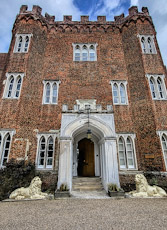
What can be seen today is a well preserved brick building with crenellations and windows in gothic style frames. When viewed face on, the edifice can be seen to consist of a tall central portion flanked by two lower wings. The tall central part, which was constructed in the 15th century was the gatehouse to the castle, which was fell into disuse and was demolished long ago (in the 17th century). The two wings were added during the reign of George III. Today, the so-called castle, erstwhile gatehouse, houses Hertfordshire council offices. We entered the lobby and noticed the gothic revival interior décor within the castle. We will revisit the castle on one of its open days and see some more of the building.

Hertford Castle played a short role in the history of British India and the EIC. The school at Haileybury continued its imperialistic function until 1857/8, when the EIC was wound up after the Indian Mutiny (First Indian War of Independence) of 1857-58. The present school, Haileybury College, a private school with boarding facilities, opened its doors to pupils in 1862 and occupies the old college’s premises.