
Flickering light
In a tiny hand craft-ed lamp
Hindu flame of faith

Flickering light
In a tiny hand craft-ed lamp
Hindu flame of faith
I HAVE VISITED BANGALORE regularly over the past 31 years. Each time, I have been impressed by the city’s numerous well-stocked bookshops. Many of them are now located along the short Church Street, which runs parallel to a stretch of the much longer MG Road. At the last count, I found 9 bookshops along Church Street, which is less than half a mile in length.

One of these shops that impresses me most is called Bookworm. Its location has changed several times since I first found it in 1994. Now, it is housed in a former mansion set back from Church Street and reached by a tree shaded pathway. It contains many rooms, each of which has walls lined with bookshelves filled with books from floor to ceiling. Much of the floorspace in these rooms is covered by piles of books. The books range from the latest releases to out of print and secondhand volumes. Recently, a small room has been added to display rare antiquarian editions. Despite this, there are many old and interesting books within the other rooms.
Bookworm is an ideal place for browsing if you have plenty of time on your hands. If you are pressed for time or know what you are looking for, the helpful staff will either know where to find what you are seeking, or will search for you.
When you have selected what you wish to purchase, some of the newer titles are subject to a discount at the cash desk. The older books and secondhand editions are priced very reasonably.
Although there are other superbly stocked bookstores in Church Street, notably Blossom Book House, Bookworm is my favourite. It is truly a magnet for bookworms.
AN ICON IS a person or symbol worthy of veneration. These days ‘iconic’ has come to mean “widely known and acknowledged especially for distinctive excellence”. Thus, for example, the Taj Mahal and the Gateway of India are now described as being iconic.
Today, we visited a pavement shoe-repairer (‘cobbler’ or ‘mochi’) in Bangalore. All over India, one can find these useful street side artisans. Often, they work from small open fronted huts, which contain their tools and materials as well as footwear that is either waiting to be repaired or already fixed. One could say that the mochis are iconic features of the streets of India.
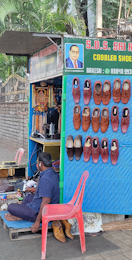
Apart from being iconic, many mochis adorn their huts with icons. These icons always include at least one picture of BR Ambedkar (1891-1956). He not only drafted the Constitution of India but also fought for the political rights and social freedom of the Dalits (once known as the ‘untouchables’).
Traditionally and still today, mochis are almost always from Dalit communities. This is why mochis have images (icons) of Ambedkar on their huts. The mochi we visited today on St Marks Road had not only some images of Ambedkar but also one of a Mr Haris, the local member of the Karnataka legislative assembly. And this is not all. Within his hut, the mochi had an image of Shrinatji, who is the God Krishna represented as a young child. This was garlanded with flowers as was one of the pictures of Ambedkar hanging beside it.
The iconic mochi polished my well-worn leather sandals while I sat beside his hut covered in icons
IN AUGUST 1947, India and Pakistan became independent sovereign nations. Following this, vast numbers of Sikhs and Hindus fled from Pakistan to India, and many Muslims fled in the opposite direction. This mass migration of people was accompanied by unbelievably horrific incidents of violence; many lost their lives on both sides of the frontier. Meanwhile, in much of India, daily life for many went on without incident. A yearly publication was published in Bombay from 1919 until 1979. It was called “Times of India Annual”, but between 1942 and 1948, it was called “Indian Annual”. The 1948 issue of “Indian Annual” was published by the Times of India soon after Independence was achieved in 1947. I have a copy of this beautifully illustrated issue. In common with many magazines, it is amply supplied with advertisements. Studying these was interesting because although some of them seem to have recognised that India was independent of both the British Empire and separate from Pakistan, others have not taken this into account.
I imagine that many of the readers of the 1948 Indian Annual were Indians. The magazine includes advertisements for many products used by Indians. Many of these commercials depict faces or people. Some of them show people with faces that look Indian. These include the adverts for Firestone tyres, the India Tea Marketing Expansion Board, Cyclax (beauty products), Tata Steel, Saba Radio Company, and Himanlal Manchand (jewellers). Others feature people with faces that are unmistakably (white) European, for example: Ovaltine, Terra Trading Corporation (modern Czechoslovak glassware), Argoflex (cameras), Rogers (soft drinks), Yardley (beauty products), Rendells products (feminine hygiene), and Virol (a health product). Either these companies that used European faces were recycling pre-existing company advertising material or not sensitive to the fact that India was then independent, or both. Another possibility is that these companies were appealing to the spending abilities of the many European people who were to continue living in India until well into the 1970s. For even after Independence, there were institutions (e.g., some clubs and schools) in India that for many years were only for Europeans, but excluded Indians.

Several of the advertisements in the 1948 publication listed the cities where they had branches. Some of these listings ignored the fact that India and Pakistan were no longer parts of one country. Ovaltine was distributed by a company that had branches in Bombay, Calcutta, Karachi (Pakistan), and Madras. The mechanical and construction engineers Garlic &Co had branches in Indian cities and also in Lahore. And Modern Trading Company listed offices in Bombay, New Delhi, Karachi (Pakistan), Calcutta, and Lahore (Pakistan). Another advertisement, that for the Chicago Telephone & Radio Co. Ltd, includes listings of offices both in India and Pakistan. The Rootes Group, which manufactured cars like the Humber, the Hillman, and the Sunbeam Talbot, list their (I quote) “Distributors in India” as being in towns such as Karachi, Lahore, Peshawar, and Rawalpindi. Had the advertiser not realised that these towns were now no longer in India, but in Pakistan? In all the cases I have mentioned in this paragraph, the advertising agencies seemed to have ignored the fact that what had once been (greater) India was now India and Pakistan. Given what was happening in the way of the misery caused by the partition of India at the time the Annual was published, it seems odd or even insensitive that the advertisements display no sign that the Subcontinent had been divided.
After Independence, Jawaharlal Nehru wanted to move India into what he perceived as the ‘modern era’. Some of the advertisements reflect this both in their design and the products they were promoting. The advert for Godrej shows some tubular household furniture of a design that many would have considered avant-garde in 1948. An advertisement for Indian-made Panama cigarettes is reminiscent of the Italian Futurist style. Likewise, for the Tata steel advertisement. This has futurist features but also veers towards the Soviet Socialist Realism style.
Finally, we come to a very interesting advert, that for the Bombay based Himanlal Manchand jewellers. It depicts Indian warriors on horses and is covered with crests of various rulers of Princely States and that of the Governor of Bombay, which is accompanied by the words:
“By appointment to H.E. Rt. Hon’ble Sir John Colville, Governor of Bombay”
Sir John Colville (1894-1954) was appointed Governor of Bombay in March 1943. He held this post even after India became independent, and was replaced by Raja Maharaj Singh in early January 1948. The jewellers were also by appointment to the princely rulers of Baroda, Jodhpur, Cooch-Behar, Jubbal, Jaipur, Indore, Palanpur, and Dewas. These maharajahs had been the rulers of ‘semi-autonomous’ (vassal) states within the British Empire. All of those listed became incorporated into the India which came into existence in August 1947. Their rulers were recognised officially by the Indian government until 1971. Between 1947 and 1971, these and other rulers of princely states received a privy purse from the Indian government. In 1971, Prime Minister Indira Gandhi put an end to the majority of these payments and de-recognised their titles and put an end to all of their royal privileges. So, in 1948 when Himanlal Manchand placed their full page coloured advertisement in 1948, they were entitled to show off their appointments to Indian royalty. The advertisements alone make the 1948 Indian Annual an interesting curiosity. The articles in the magazine along with many of its fine illustrations make it into a real treasure of great historical interest. While writing this piece, I discovered that the 1949 issue can be read online (https://archive.org/details/dli.venugopal.824/page/n91/mode/2up) . Skimming through this, I noticed that some companies still depicted European faces in their adverts and others included cities in Pakistan in the lists of their branches. This was despite the fact that since October 1947 Pakistan had been fighting a war over Kashmir. This only ended on the 1st of January 1949.
DURING MY TEENAGE years, I had the idea that later I might train to become an architect. I enjoyed drawing, and read books about twentieth century architects such as Frank Lloyd Wright, Mies van der Rohe, Walter Gropius, and Le Corbusier. When the Bauhaus exhibition was held at the Royal Academy in London (September to October 1968), I visited it three times. My enthusiasm for becoming an architect ended after lunch one day when walking from the Highgate School dining hall back to the classrooms. Suddenly, I thought that instead of designing great buildings such as those created by the architects, whom I had read about, I might end up designing extensions and garages for people’s houses. This fleeting thought made me give up the idea of becoming an architect. However, since then, I have continued to enjoy looking at, and reading about, architecture.

One of the 20th century architects who intrigues me much is Le Corbusier. I have seen many of his creations in France and a few in the Indian city of Ahmedabad. But I have never been to Chandigarh in the Punjab. It was to be the new capital of the Indian Punjab. The old capital, Lahore, found itself in Pakistan after 1947. This was a new city that Le Corbusier helped to design in the 1950s – both the layout and many of its buildings. Last year, I acquired a copy of a magazine called “Times of India Annual”. I have the 1955 edition. Although much of Chandigarh was already built by 1955, it was far from completed. The magazine contains an illustrated article by the British Modernist architect Edwin Maxwell Fry (1899-1987).
The article is illustrated with photographs that show both the novel designs employed for residences as well as some of the larger buildings including the Punjab Engineering College, the High Court, and a school. Several of Le Corbusier’s major projects such as the Palace of Assembly and his Open Hand Monument are not illustrated because they had not been completed by 1955. The Secretariat Building designed by Le Corbusier was complete when the article was published, but has not been included amongst its illustrations. The pictures tend to concentrate on the designs for dwellings that were economical without seeming mechanical or inhuman.
Having a great interest in Le Corbusier and Chandigarh, I was excited to find an article written by Fry, one of the city’s planners, at a time when the place was still in its infancy. For three years, he and his wife Jane Drew (1911-1996) worked with Le Corbusier on the planning of Chandigarh. Knowing that, I thought it would be interesting to see what Fry wrote in the magazine. Sadly, Fry’s article’s content is rather anodyne and self-congratulatory. Nevertheless, I am pleased that I have the magazine because apart from Fry’s article, it contains a wealth of other material – both written and illustrative.
KENWOOD IN NORTH London (next to Hampstead Heath) is a delightful place to visit at all times of the year. Amongst its attractions are a collection of fine paintings within Kenwood House; architectural features designed by Robert Adam; beautiful grounds with a lake; some modern sculptures; and a refreshment complex housed in the former servants’ quarters and stables. Close to the cafeteria, there are some toilets for use by visitors.
After visiting the ‘gents’ toilet, I looked down at the floor of the passageway leading to it, and saw a square, metal manhole cover. It had some lettering on it. Amongst the lettering, I noticed the following “KIC-INDIA”. Seeing this made me wonder if this manhole cover in north London had been made in India.

When I returned home, I looked at the Internet to see whether I could find out anything about the connection of this manhole cover with India. KIC-INDIA refers to an ironworks in India called KIC Metaliks Ltd (www.kicmetaliks.com), whose office is in Calcutta (Kolkata) in West Bengal. The company website revealed:
“K I C Metaliks Limited, founded in 1986 and headed by entrepreneur Radhey Shyam Jalan, is a leading pig iron manufacturer in West Bengal headquartered in Kolkata. Publicly listed on the BSE, the company has over 35 years of experience catering to hundreds of satisfied customers using cutting-edge technology. Its factory in Durgapur produces pig iron with a current capacity of 2,35,000 MTPA. The company takes a prudent yet ambitious approach to capacity expansion to become a dependable pig iron supplier.”
The company was formerly known as ‘Kajaria Iron Casting Limited’, and its plant is at Durgapur, 100 miles northwest of Calcutta. While searching the Internet, I came across other examples of KIC manhole covers in the British Isles, including at Bangor (County Down), South Shields (Tyne and Wear), and Plymouth (Devon).
Often when I am out walking, I look down at manhole covers. Sometimes they have interesting designs on them. When I spotted the KIC manhole cover at Kenwood today (6th of November 2024), it was the first time I had seen one made in India set into a floor in England.
I HAVE BEEN to Calcutta (Kolkata) several times, and each visit I am impressed by the Howrah Bridge. It is a suspension type balanced cantilever bridge that carries pedestrians and road traffic across the Hooghly River, which is part of the mighty Ganges. This massive bridge contains 26,500 tons of steel riveted together – it contains no nuts and bolts. When it was opened for use in 1943, it was the world’s third largest cantilever bridge.
Before the present bridge was constructed, there was another bridge that crossed the Hooghly. Unlike the existing bridge, its roadway was close to the water. It was a pontoon bridge. Its roadway rested on floating pontoons. It had a section that could be opened to allow the passage of large vessels travelling along the Hooghly. The pontoon bridge was completed and ready for use in 1874. It served its purpose until the current bridge was opened in 1943.

The pontoon bridge
Recently, I obtained a book called “Wonderful India”. Inside its front cover, a former owner of the book had handwritten “LW Morris, Royal Air Force, Calcutta-July 1943”. The current bridge was opened in February 1943. The book does not contain a picture of that bridge, Instead, it contains a photograph of its predecessor, the pontoon bridge, with the caption:
“The famous pontoon bridge to Howrah, with the railway terminus in the background.”
I am guessing that had the new bridge been near completion when this book was compiled, it would have included this wonder of bridge engineering. As the book has no date of publication, the inclusion of the pontoon bridge rather than the suspension type cantilevered bridge, I feel that the book must have been compiled long before the new bridge was near completion, That the book includes a photograph of another bridge across the Hooghly: The Willingdon Bridge (also known as ‘Vivekananda Setu’). As this bridge (upstream from the Howrah Bridge) was completed in 1931, it would seem that “Wonderful India” was published sometime between 1931 and early 1943.
Crossing the Howrah Bridge as a pedestrian is a thrilling experience. One shares the footway with many other people. A large proportion of them are carrying loads on their heads, The water is far below one side of the footway, and the wide roadway is on the other. From the footway, one can see a huge flower market and several bathing ghats lining the riverbank. A steady stream of traffic flows across the bridge, including buses painted in many colours; ancient, yellow-painted Ambassador taxi cabs; hand-hauled carts; trucks; and other motor vehicles. And all of this crosses a stretch of the holy Ganges River. Although traversing the present Howrah Bridge is a memorably enjoyable event, which I am happy to repeat whenever I visit the city, crossing the former pontoon bridge must have been at least as exciting.
WHEN THE PUNJAB WAS divided (by the British) between Pakistan and India in 1947, its former capital, Lahore, became a Pakistani city and the Indian part of the region was left without a capital. Jawaharlal Nehru, the first Prime Minister of India, decided that instead of assigning an existing city to become the capital of India’s Punjab a new city should be created. It was to symbolise the birth of modern India. A team of architects led by the Swiss born Le Corbusier began designing the new city, Chandigarh, in the early 1950s. In late 1953, it became the capital of India’s Punjab, which was later further divided into Punjab and Haryana states.
Amongst those who were on the team designing Chandigarh was Le Corbusier’s cousin, the architect Pierre Jeanneret (1896-1967). He designed much of the furniture installed in the buildings created in Chandigarh. According to one source (www.worldofinteriors.com/story/pierre-jeanneret-and-le-corbusier-chandigarh-furniture):

“Pierre Jeanneret, was strongly influenced by local materials and craftsmanship, with a Modernist twist. Due to the vast scale of what needed to be created for an uninhabited city – from Palace of Assembly chairs to university cafeteria tables and and linen baskets – Jeanneret experimented with what was on hand. Iron Sikh Sarbloh bowls became lampshades; mango tree trunks became tables. Readily available materials such as bamboo, teak, rope and wicker were woven into the designs.”
Recently, I saw a couple of examples of this furniture on display at a special exhibition at the Victoria and Albert Museum. Today, the 29th of October 2024, we visited an exhibition, “Syncretic Voices:Art & Design in the South Asian Diaspora”, in a private house near London’s Primrose Hill. What made it special for me is that there were many examples of Jeanneret’s Chandigarh furniture on display. The exhibition ends on the 1st of November 2024.
The house near Primrose Hill is owned by Rajan Bijlani, whose parents came from India to the UK in 1975. Rajan has been collecting Jeanneret’s Indian furniture for some time, and he showed it to us. Of particular interest was a table with a zinc table-top, which was once used in the Punjab University cafeteria in Chandigarh. Many of the other pieces on display were chairs and stools. There was also a shelving unit designed to hold files. Most of the furniture came from various government buildings in Chandigarh. Some of the pieces still have their original inventory numbers painted on them.
The furniture is in several rooms of the house. The walls of these rooms are decorated with attractive modern artworks by several artists of Indian origin including Vipeksha Gupta, Rana Begum, Soumya Netrabile, Tanya Ling, Harminder Judge, and Lubna Chowdhary. Rajan told us that they were all for sale and he was holding them as consignments from various galleries. He is also selling some of his Jeanneret furniture. Rajan showed us around and was a perfect guide. It was a great pleasure and privilege to have been able to see his beautifully designed home and the fascinating furniture and other artworks displayed within it. If you wish to see this exhibition before it closes, visit: https://www.rajanbijlani.com/about
IN A SECONDHAND BOOKSHOP in Thame (Oxfordshire) I purchased a book called “Wonderful India”. It must have been published by 1943 because inside its front cover there is the name of its first owner, LW Morris, and next to that he added “Royal Air Force, Calcutta, July 1943”. The book is trilingual. Its text is written in Bengali (Bangla), English, and Urdu. It was published by The Statesman and Times of India Book Department. The Statesman is a newspaper that was founded in 1818, and published simultaneously in Calcutta, New Delhi, Siliguri and Bhubaneswar. The Times of India was founded 20 years later. The gloriously illustrated book, which covers pre-Partition India, as well as Sri Lanka, Burma, and Nepal, contains no text in Hindi. In British India, the official languages were English and Standard Urdu, and later Standard Hindi (https://en.wikipedia.org/wiki/Languages_with_legal_status_in_India#History). Oddly, for many years Bengalis were opposed to using their language as an officially recognised one, for a long time preferring to use Persian for formal (especially commercial) use (https://thespace.ink/bengali-and-persian-in-british-raj/). Yet despite this, the book I found favours Bengali and omits Hindi. I suspect that because the book might well have been published in Bengal, the Bengali script has been included. Hindi written in the Devanagari script only became the official language of India in September 1949, several years after “Wonderful India” was published.

Dhaka (now in Bangladesh)
The book covers all the regions of pre-Independence India as well as some of its neighbours. It is rich in black and white photographs, many of which are superb examples of photographic technique. Each picture is captioned in Bengali, English, and Urdu. The only pieces of prose are the general introduction (which includes a photograph of Mahatma Gandhi) and introductory paragraphs at the beginning of each section. The Urdu introduction is at the rear of the book, and is next to a picture of Jawaharlal Nehru. There is no picture of any member of the British Indian hierarchy.
Bangalore, a place which I have visited often, is given only one sentence at the beginning of the section on Mysore and Coorg:
“The British retain some territory at Bangalore, which is the administrative headquarters of the state, while Mysore is the capital.”
There are three photographs of the city, Sadly, not the most interesting in the book. To compensate for this, the book is filled with pictures of touristic sights and daily life of India as it was before WW2 had ended. The book provides a fascinating window on a part of the world that has in many aspects changed beyond recognition.
THE OBJECTS IN an exhibition are usually chosen to fit in with a particular theme. An exhibition might be based on the work of an individual artist or a group of artists; on a style of art (e.g., Impressionism or Expressionism or portraiture); on a specific genre (e.g., etchings or sculpture or paintings or photographs); a period of history. It is the latter theme – a period of history – which has been adopted to create a superb exhibition, “The Imaginary Institution of India” at London’s Barbican gallery. This show is on until the 5th of January 2025.

The theme connecting the artworks on display at this exhibition is India during the period from 1975 to 1998. You might well wonder why these years have been singled out. Some landmarks during these years include Prime Minister Indira Gandhi’s proclamation of a state of emergency in 1975; problems in West Bengal (in 1979); the founding of the BJP party; inter-communal problems; the attack on the Golden Temple in Amritsar (1984); the toxic leakage at the Union Carbide plant in Bhopal; Hindu-Muslim tensions in Ayodhya; the destruction of the Babri Masjid (in Ayodhya); terrorist attacks in Bombay; and India’s successful underground nuclear tests. These events and many others occurred during the period covered by the exhibition.
The works on display at the exhibition are, according to the Barbican’s useful handout (a booklet), expressions of the various artists’ reaction to the events and social upheavals occurring in India during the years 1975 to 1998. The booklet describes what the exhibition’s organisers believe were the artists’ (political) messages being expressed in their creations. Interesting as these observations are, the works on display can be enjoyed without having any knowledge of what might have or might not have been going through the artists’ minds while they were producing their artworks. The exhibition provides a wonderful display of the excellence of Indian art produced during the period covered by the show.
I had not heard of most of the artists apart from MF Hussain, Bhupen Khakar, Sudhir Patwardhan, and Arpita Singh. The works that I liked most are by Patwardhan, Singh, Gieve Patel, and some lovely bronzes by Meera Mukherjee. I was also impressed by a set of collages by CK Rajan. That said, almost every work on display is worth seeing. The only disappointment for me was a video-based installation by Nalini Malani.
The Barbican has displayed these works in this exhibition both brilliantly and dramatically. I hope that the seemingly specialised nature of the theme of the exhibition (and its rather odd name) will not deter people from experiencing this superb collection of artworks.
 yamey
yamey 