Inspired by Claude Lorraine and Nicolas Poussin in Wiltshire and Somerset

WHEN I WAS a teenager, I made excursions – day trips – to places outside London with a small group of friends. Being too young to have driving licences, we had to rely on public transport. One place that we always wanted to get to is on the border between Somerset and Wiltshire: the gardens at Stourhead. Sadly, despite much research we could never find a way to reach it by public transport. It was only many years later (in the second half of the 1990s) that using a car, my wife and I were able to visit this place that my friends and I yearned to reach in the 1960s. We have visited Stourhead several times, both before and after the covid19 pandemic. Our latest trip there was on the 8th of July 2024. Despite it having rained extraordinarily heavily the previous day, the paths in the garden were not waterlogged.

The gardens were laid out between 1741 and 1780. They were designed to resemble the arcadian scenes as portrayed in paintings by Claude Lorraine, Nicolas Poussin, and Gaspar Dughet. The designer and source of inspiration for the gardens was the banker Henry Hoare II (1705–1785), also known as ‘Henry the Magnificent’. The resulting horticultural creation is a remarkably successful realisation of what had inspired him. A central water feature – a lake – is fed by streams and rivulets. Around the lake, are a series of picturesquely positioned neo-classical pavilions, a bridge, a Tudor cottage (which existed before the garden was created), and a man-made grotto.

One of the neo-classical structures, The Pantheon (designed by Henry Flitcroft; 1697-1769 – he died in London’s Hampstead), contains a set of 18th century sculptures of Ancient Greek gods and heroes. It also contains a well-preserved Ancient Roman statue, which one of the Hoares bought while travelling in Rome. It was interesting to enter this building because on all our previous visits, it had been locked closed. Another pavilion, smaller than The Pantheon, contains a huge white vase made from Coade Stone (made from clay, quartz, and flint), which was regarded as a ‘wonder’ material by architects and designers in the 18th century. In those days, it was cheaper than most stones and timber. It is named after the businesswoman Eleanor Coade (1733-1821), who was very successful at marketing this material invented by Daniel Pincot. The reason I write about this is that currently there is a small exhibition about Eleanor Coade in the small neo-Classical pavilion that faces The Pantheon across the lake.

Even if you are unable to enter any of the pavilions surrounding the lake, a visit to Stourhead Gardens is a magical experience. Here, nature has been guided into creating the 18th century ideal of a classical landscape. It brings to life the Latin expression ‘Et in Arcadia Ego’, which means something like ‘even in Arcadia, there am I’.
Loads of lavender in rural Kent

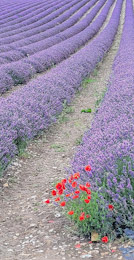
ON OUR WAY to visiting new friends in Kent, at their recommendation, we stopped en-routr at Castle Farm near Shoreham. We were delighted to discover that this agricultural enterprise specialises in cattle and growing lavender. It is the largest lavender farm in the UK.

I had no idea until we visited the farm that lavender was grown on such a large scale in England. I have visited lavender farms in Provence and seen many glorious photographs of lavender fields in that and other regions of France. However, it came as a complete surprise to discover similar fields in South East England. I am grateful to Asha and Matthew for introducing us to this place.

From paper come plants

A TALL MINARET OVERLOOKS Ebrahim Saheb Street in Bangalore’s busy Commercial Street bazaar district. Not far from the lofty structure stands the premises of a printing firm called Sundaram. It is here at this efficient enterprise that I have often had visiting (business) cards printed.

Recently, I went to Sundaram’s to collect my latest batch of cards. While I was waiting to have them packed, I noticed a man in the shop, folding what looked like A3 sized sheets of plain white paper. He folded them in half lengthwise. I asked him what he was doing, and he replied:
“Seed papers”
I must have looked puzzled because the owner of the business added:
“You put them in the ground and plants will come. You leave them in the ground after plants have come. The papers have seeds in them.”
He told me that these seed papers were made in Coimbatore, a town south of Bangalore. Then, he went to the rear of his shop and brought me a few offcuts of the seed paper.

The paper is quite thick and rather stiff. It has a slightly rough surface. When you examine it you can see well spaced, small darkish thickenings. These spots are the seeds, which have been incorporated into the biodegradable paper.

Not being a gardener, I had not come across seed paper before. It has been around for many centuries. Until 1941, it used to be handmade in small batches, but after that year it began to be made on an industrial scale.

The paper can incorporate a variety of seeds from flowers to edible plants. I suppose that the advantages of seed papers include appropriate spacing of seeds and protection from consumption by birds etc.

When I entered Sundaram’s to pick up my cards, little did I expect to learn about seed paper, or to discover horticultural material being processed in a printing shop. It is surprises such as these that make visiting India so much fun.

Amongst the agapanthus

We visited Funchal in Madeira in early June 2022. Although we were recommended to visit some of the numerous botanical gardens in and around the city, it was hardly necessary. I do not think that I have ever visited a place filled with such a profusion of flowers as is the case for Funchal. The whole city seems to be one great garden.

During our visit, we were in time to see a vast number of blue flowered agapanthus plants. Although they are commonly known as ‘lily of the Nile’ or ‘African lily, they are not of the lily family. They are members of the Asparagales order of plants, a part of the Asparagus genus. Had I not seen so many of these flowers in Funchal, I might never have bothered to find out anything about them. As the saying goes, travel broadens the mind.

Going green in an urban jungle

REMNANTS OF LONDON’S ROMAN wall can be seen from various points in the Barbican Estate, whose construction began in 1965. The not entirely unattractive residential brutalist concrete jungle, known as The Barbican is sited next to the northern edge of what was formerly Roman Londinium. According to a history of the area (www.cityoflondon.gov.uk/services/barbican-estate/barbican-estate-history):

“The name of the Barbican comes from the Low Latin word ‘Barbecana’ which referred to a fortified outpost or gateway: an outer defence of a city or castle or any tower situated over a gate or bridge which was used for defence purposes. The “Barbecana” was probably situated somewhere between the northern side of the Church of St. Giles Cripplegate and the YMCA hostel on Fann Street.”

By the 1850s, the district of Cripplegate, where the Barbican is located, was very crowded with dwellings and business premises. Much of the area now occupied by the Barbican had been destroyed by bombing during WW2. The Estate was built to replace what the Luftwaffe had destroyed.

Apart from several water features, there is one oasis of greenery on the otherwise extremely urban site. This is the Barbican Conservatory. Opened in 1982, it is located above the Barbican’s main theatre and can be entered through an entrance close to that of the Barbican’s Art Gallery. Despite it having been in existence for so many years and having known about it for several decades, it was only yesterday (6th of April 2022) that I first ventured inside it. We had just viewed the current exhibition in the Gallery, “Postwar Modern: New Art in Britain 1945-1965”, an impressive display of rather unexciting artworks. Entering the Conservatory was literally “a breath of fresh air” after viewing the exhibits that had been arranged to illustrate the depressing emotional aftermath of WW2 as depicted by artists in Britain.

I was surprised to learn that the Barbican Conservatory is:

“… the second largest in London (after Kew Gardens) and home to over 1,500 species of plants, but is one of the city’s lesser-known green spaces.” (www.atlasobscura.com)

Apart from the plants, many of them exotic, which are arranged on various levels and can be viewed from both a lower floor and an elevated walkway, there are three ponds. One contains koi carp and the other, raised above ground level, is home to two terrapins, which were found in ponds on Hampstead Heath. The Conservatory is divided into two main sections. The larger is the tropical section, where visitors are permitted to wander about. The other, which was locked up yesterday, is the arid section, containing cacti and succulents.

Despite being in the midst of a manmade, visually intriguing, but harsh urban environment, the Conservatory with its tall trees, bushes, flowers, and other vegetation, feels like another world – a primaeval paradise from which the modern world can be glimpsed in the background.  

A guilty secret

I was lucky enough to be invited by a friend to the annual Chelsea Flower Show. It would not be exaggerating to say that the displays of plants are all quite wonderful.

Among the show gardens, I spotted some fine examples of peonies, some in bud and others flowering. Seeing these brought back memories of my childhood when we lived in a house with a fine garden in north-west London. At one end of the garden, there were several peony bushes. At the appropriate time of the year, these plants produced almost spherical buds.

My sister and I were attracted to these buds and used to pull them off before they could flower. My late mother used to get very upset by our horticultural vandalism, and told us off so severely that I still recall our midemeanours on the rare occasions that I think of peonies, which is not all that often.

You will be pleased to read that I resisted the temptation to pluck any of the peony buds I saw at the Chelsea Flower Show!

And, here is an interesting fact: Peony is the name of a novel by Pearl S Buck. The story is set in China and features a Chinese Jewish family.

Green crime

plant


I am no gardener, but I enjoy garden, plants, and flowers. When I lived in Kent, I had an enormous garden, which I filled with shrubs because someone advised me that they needed little care and attention. This was good advice.

There was a strip of earth next to where I parked my car at night. I filled this with various shrubs that needed almost no care. One of these plants was a very slow growing conifer, which looked like a miniature Christmas tree. It grew close to where I entered the driver’s door of my car.

One day, I noticed that this tiny tree was no longer in its place. It had disappeared. I thought that maybe it had died and rotted away. After that, I thought little if anything about the missing plant. Where it grew was soon covered with foliage from the neighbouring fast-growing shrubs.

Many weeks later, a uniformed policeman visited my house and asked me if anything, such as garden tools or plants, had gone missing from my land. At first, I thought that this was an odd request. Then, I remembered the mysterious vanishing of my small conifer. I told the policeman about this. Then, he told me that there had been a garden thief operating in the area and the police were collecting evidence.

I told the policeman that I could not believe that my tiny plant could have been of any value for a thief. He explained to me that plants are valuable, and that the maturer they were, the greater their value. I was amazed that there was such a species of criminal as a plant thief.  But, since then, I have heard it is quite common, especially amongst respectable looking visitors to horticultural gardens such as Kew Gardens.

Well, as the saying goes: ‘you learn something new everyday’