A horse trader from Persia and his life in Bangalore

MR HUSSAIN WAS a charming old gentleman full of ‘joie de vivre’, even when infirmity confined him to his bed. A retired businessman, we knew him as ‘Mahomet Uncle’. He was a Kutchi Memon (a Muslim whose ancestors had migrated from Kutch – now a part of Gujarat – to Karnataka). He was immensely popular. His many friends and relatives used to visit him to enjoy his company and to share their news. Once, near the end of his life, we went to his house to wish him ‘Eid Mubarak’ at the end of Ramazan. While we were in his bedroom, where he used to ‘hold court’, a seemingly endless stream of people passed through his front door to celebrate the occasion with him. His death was a great loss not only to his family but also to a vast number of people in Bangalore, who knew and loved him.

We were introduced to Mahomet Uncle by one of his sons who was studying in London at the same time as my then future wife, Lopa, and I were undertaking post-graduate courses. Mahomet Uncle lived in a house on Aly Asker Road Cross, a quiet lane close to the busy Cunningham Road. The Cross road is an offshoot of the larger Aly Asker Road. We have often travelled along this thoroughfare, not only to visit Mahomet Uncle but also other friends who live close by. In addition, when returning from the excellent Shezan Restaurant (on Cunningham Road) to the Bangalore Club, where we often stay, the best route is along Aly Asker Road.

For many years, I have wondered about Aly Asker and why a road should have been given his name. The answer was provided only recently, at the end of January 2024 just before we flew from Bangalore back to London. My friend Subhash Agarwal, with whom I often enjoy an afternoon cup of tea on the lawn in front of the main building of the Bangalore Club, knowing of my interest in the history of Bangalore, kindly presented me with a book, which has the title “Agha Aly Asker”.  Published in 2019, it was written by Syeda Mirza, the wife of Aly Asker’s great grandson. The book is well-researched and a pleasant, compelling read. Apart from detailing his life, the author gives many insights into the traditional Persian ways of life.

Aly Asker, a Persian, was born in Shiraz (Persia) in 1808. In 1824, along with his two brothers, he set off for India to sell horses to the British military. They travelled with 200 horses by sea to Mangalore, and then travelled overland to Bangalore. The brothers left him and the horses in Bangalore, where he began selling them to the army of the East India Company. The business was successful, and he imported more batches of horses to sell. Ali Asker became a successful businessman and was befriended by Sir Mark Cubbon (1775-1861), who was the Chief Commissioner of Mysore between 1834 and 1861. Amongst Cubbon’s many achievements were the introduction of Kannada and Marathi as the official state languages, instead of the formerly used Urdu, Hindi, and Persian.

Cubbon was very fond of horses, and is said to have had up to 60 in his stables. His equestrian interests helped develop his friendship with Aly Asker. As a result, Cubbon asked Aly Asker, who had already built himself a fine bungalow, to build 100 bungalows to accommodate the growing military establishment that was developing in Bangalore. Cubbon offered the land free of charge, but Aly Asker told him that he was happy to pay for it, which he did. The residences were constructed on land near today’s Palace Road, Sankey Road, Cunningham Road, and Richmond Road. Many of these houses no longer exist – Bangalorean property developers seem to value heritage far less than profit. One notable example that still stands is the Balabrooie State Guest House. Aly Asker also owned the land on which the luxurious Windsor Manor Hotel now stands.

Aly Asker’s interest in horses extended beyond trading, He was keen on horse-racing, and is said to have been important in putting Bangalore on the horse-racing map of India. His biographer, Syeda Mirza, includes an appendix in which the many victories of Aly Asker’s horses are listed. He was a frequent visitor to the racetrack in Bombay, and then later in Bangalore.

It was their interest in horses that drew together Aly Asker and another noteworthy person in Mysore State – Mummadi Krishnaraja Wodeyar III (1794-1868), the 22nd Maharajah of Mysore. It was through Aly Asker’s help that the British were encouraged to allow the Maharajah’s adopted son Chamarajendra Wadiyar X (1863 – 1894) to become his successor on the throne. Initially, the British, who effectively ruled the state, were reluctant to recognise him as the successor, and it was partly due to the gifts that Aly Asker chose for Queen Victoria that changed their mind in his favour.

Aly Asker died in Bangalore in 1891. He is buried in a cemetery near to the city’s Hosur Road. This is a Persian Cemetery that stands on land granted to Aly Asker and his heirs in 1865. His simple grave is beside that of his wife, and is shown in in a photograph in Mrs Mirza’s book. She noted that he established Bangalore’s first Shia Muslim community. It was when he married Sheher Bano that the first Muharram rituals were first observed in the city. In his will, Aly Asker left money to build the Masjid-e-Askari. It was built in 1909, and still remains as the city’s oldest Shia mosque.

So, having read Syeda Mirza’s book, I now know why there are roads in Bangalore named after Aly Asker. In addition to detailing his life in, and contributions to, the development of Bangalore, Mrs Mirza also described the exciting journey that Aly Asker made between his native land and India. Oddly, Aly Asker does not appear in the index of the authoritative history of Bangalore. “Bangalore Through The Centuries” by M Fazlul Hasan (publ. 1970). In a later (2014) comprehensive history of the city, Maya Jayapal makes one mention of Aly Asker Road, but gives no description of Aly Asker’s contribution to the story of Bangalore. It is therefore valuable that Syeda Mirza took the trouble to write about Aly Askar. As her book bears no ISBN number, and I could not find it either on Amazon or the much wider ranging bookfinder.com, it might well have been privately published, and is now probably quite a rare volume. I am very grateful to Subhash Agarwal for gifting me this informative book – a window on a hitherto poorly described aspect of Bangalore’s history.
Horses and a golf course in Calcutta

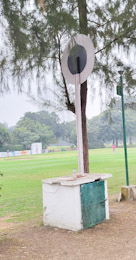
HAVE STAYED AT the Tollygunge Club several times, but it was not until yesterday (18th of January 2024) that my friend Prihvi Chaudhury made me aware of an interesting historical object. Near the club’s Shamiana refreshment area and partly hidden by the foliage of a tree, it is a circular metal plate mounted on a tall metal pole. Prithvi told me that it is all that remains of the former Tollygunge Club horse racing track. It was the finishing post.

The Tollygunge Club was founded by a Calcutta banker, Sir William Cruikshank. He established the club on land bought from the descendants of Tipu Sultan. The Club was originally founded for British colonialists to enjoy equestrian activities within easy reach of the city. The racecourse was laid out in connection with this.

In addition to the racetrack, much of the extensive grounds of the Club were develope into an 18 hole golf course. This is beautifully landscaped and provides many challenges to the golfers who play there.

The race course was ‘dismantled’ many years ago. However, the Club’s association with horses continues today. On the Club grounds there is an airy, well-maintained stable block, which is currently home to at least 36 horses. We visited the stables today and fed some of the animals with carrots provided by members of the friendly stable staff.

The horses are exercised twice a day either in a special paddock or on some of the footpaths that thread their way through the club’s grounds. Club members can join horse-riding lessons and can hire steeds for taking rides (not gallops) around the Club’s terrain. When taking a ride, the horse and rider are accompanied by a stable hand.

Had Prithvi not pointed out the historic finishing post, I doubt that we would have become aware of the stables for a long time, if at all.

The Sport of Kings and a bar in Bangalore

I MUST ADMIT that I have never been much of a sportsma, and I know hardly anything about the game of polo, apart from the fact that it involves both horses and humans. Yesterday evening, as I enjoyed a postprandial brandy in the recently renamed ‘Polo Bar’ (formerly, ‘The Mixed Bar’) at the Bangalore Club, I spotted a large ‘coffee table’ book by Jaisal Singh about Polo and India.

What surprised me is the great age of the game of Polo. It seems to have been existence in some recognisable form as long ago as the 6th century BC. Then, it was played by some nomadic peoples in Central Asia. The book in the Polo Bar has a photograph of a terracotta model of a Chinese woman playing polo. This model was made between the 7th and 11th century AD. Another photograph shows the earliest known picture of a Polo player. This depicts a man on a horse, and was created in the same era as the model.

Much of the rest of the book is about polo in India. It charts the rise in popularity of the game amongst the wealthy rulers of the Princely States and the upper echelons of the British administrators and military in India.

The Polo Bar, which until recently was known by another name, has been decorated with polo memorabilia (e.g., photographs, trophies, and horseshoes). The handle on the door leading into the bar is horse-shaped. However, for me, the most interesting polo related item is in the Club’s Gardens. It is an inscribed stone block, which was the foundation stone of the Domlur Polo Pavilion laid in January 1914 by Lady Daly, wife of the British Resident.

The stone includes the information that one Major C Rankin was “Hon-Secy” and R Evans Esq was the architect. Both were military personnel, members of the “7th (Q.O.) Hussars”. The pavilion’s building contractor was BV Venkataswami Naidu.

In “Bangalore, the Story of a City”, by M Jayapal, the author wrote that initially the race course was out at Domlur. [Hence, the existence of Old Race Course Road]. In the late 19th century it moved to near Lalbagh, and then to its present position near to High Grounds. Presumably, because there had been equine facilities at Domlur, this would have been a suitable place for the Bangalore Club to locate its polo club there. I am not sure whether anything remains of the polo club pavilion whose foundation stone stands in the Bangalore Club gardens.

According to a blog article (https://wp.me/p1YuI1-1xA) about the pavilion, this is of interest:
“Information, thanks to the Bygone Bangalore group on Facebook: The Polo Club was located on Cambridge Road, in the area that is now Cambridge Layout. Opposite the Sai Baba Temple, there exists a portion of an old building which is said to be a part of the Polo Club.”
Incidentally, the centre of Cambridge Layout is less than a mile from the heart of Domlur.

As for the Bangalore Club’s association with polo, the following words quoted from the Club’s website (www.bangaloreclub.com) are of interest:
“Bangalore Club was established in 1868 as the Bangalore United Services Club for the officers of the British Empire. Originally the buildings were occupied by the Polo Club which moved out in the beginning of the 1860’s.”

I do not know how many current members of the Club play Polo these days. Even if it is not many, the Club’s former associations with the military ( the Club was formerly a club for military officers) and the land upon which it stands justify the naming of one of its bars to commemorate what was once known as “The Sport of Kings”.

They had no choice

ARMISTICE DAY IS celebrated annually on the 11th of November, the day that fighting came to an end in WW1. The day is to celebrate and:

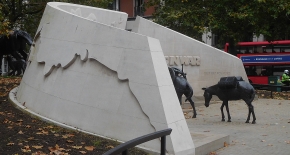
“…remember all those who gave their lives in service to their country since 1914.” (https://www.britishlegion.org.uk/get-involved/remembrance/about-remembrance/armistice-day). It was not only humans who sacrificed their lives, either willingly or less willingly, but also animals, who had been employed in warfare. A monument on a wide traffic island in London’s Park Lane was constructed to remember these four-legged creatures who lost their lives prematurely during battles from which they were unlikely to gain any benefit.

Erected by The Animals in War Memorial Fund (www.animalsinwar.org.uk/) and unveiled in 2004, this dramatic monument consists of a semi-circular Portland stone wall with a gap near its centre. Two bronze horses laden with military equipment are depicted walking towards the gap. and beyond the gap, a bronze sculpture of a running dog can be seen. The western part of the concave side of the wall has bas-reliefs depicting, horses, elephants, and camels. The eastern side of the concavity bears several inscriptions including one with the words “They had no choice”. The convex surface of the wall bears stylised silhouettes of horses. The monument was designed by David Backhouse and was inspired by the book “Animals in War” by Jilly Cooper.

“They had no choice” is a poignantly appropriate sentence on a memorial to creatures who were taken into fields of battle innocent of their likely fate. Seeing this moving monument made me think that these same four words could easily be applied to the numerous Indian participants in WW1 and WW2 who were sent to Europe as ‘volunteers’ innocent of their horrendous destination by their rulers in the Princely States of India, who wished to please the British, whom they served. Had these unfortunate servicemen known what they were about to face, some of them might have objected. That option was not one that would ever been open to the slaughtered animals commemorated on Park Lane.

Watching stars where horses drink

FOUR MILES FROM ST GILES Pound and four and a half miles from ‘Holborn Bars’, there stands a white stone milepost close to a pond at one of the highest places in north London. This pond in Hampstead got its name Whitestone because of its proximity to this white milepost.  Originally known as ‘Horse Pond’, it was a place where horses could drink and wash their hooves. The pond was supplied with ramps to allow easier access for the horses. These were preserved when the pond’s surrounding banks were extensively renovated in 2010.

The pond used to be supplied by dew and rainfall but was later kept filled by water from the mains water supply, which is fortunate given how little rain falls during some periods of the year. Being a shallow pool in an exposed location so high above sea level (443 feet), it is often covered with ice in cold weather.

A tall flagstaff stands a few feet west of the pond. This marks the spot where there was once a beacon that formed part of a network of beacons that could be lit to communicate with each other during the 16th century when the threat of invasion by the Spanish armed fleet was feared. The beacon by the Pond was the most northerly of a series of beacons which originated on the cliffs at St Margarets near Dover. This network can be seen on old maps such as that drawn by William Lambarde (1536-1601) in 1570, several years before the arrival of the famous Spanish Armada. Currently, the only purpose of the tall white pole is to fly the red and white flag of the City of London high above the pond.

High as the pond is, it is not the highest point in Hampstead. That honour goes to the small observatory on the top of the reservoir just south of the pond. This point is 449 feet above sea level. The reservoir is a:

“… wonderful example of mid Victorian architecture … The reservoir and railings were constructed in 1856 for the New River Company to serve Hampstead with the water being delivered by pipes from Highgate. The company was absorbed into the Metropolitan Water Board in 1902.” (http://www.ianclarkrestoration.com/122/Hampstead_Reservoir,_London_-_Thames_Water/).

This structure is inaccessible to the public, but the observatory perched on top of it is, in normal times, opened to the public occasionally.

The small observatory topped with a dome was established in 1910 by the Hampstead Scientific Society (www.hampsteadscience.ac.uk/astro/history.html). It can be seen best from Lower Terrace. The first secretaries of the Society were two keen astronomers, Patrick Hepburn and PE Vizard. The first telescope, a ten-and-a-half-inch reflecting telescope, was donated by Colonel Henry Heberden on condition that it be used by members of the public. In normal times, the observatory is still open to the public on clear nights. At the beginning of the 20th century, nights were much clearer than they became later and valuable observations could be made. As time passed, both dust and light pollution have rendered it far more difficult to make any observations at all. In addition to astronomical uses, the observatory is home to a collection of devices used in meteorology. The weather station at the observatory has the longest continuous record of climate measurements for any still extant meteorological site in Greater London, having begun in 1909 (www.weather-uk.com/page2.html).

Returning to the Pond, I remember that during my childhood, the traffic around it was terrible, especially during rush-hours. It became even worse when police officers arrived to try to control it. While I was studying at Highgate School, there was an extremely bright boy in my year group, ‘B-W’ was his surname. During physics classes, he appeared not to pay attention to the teacher because he was too busy designing complicated electronic circuits. When we took our physics mock-O’Level examination, he was the only person in the class to pass it, exceeding the pass mark by a large margin. My result in this test was a miserable 15%, which was five times higher than the boy with the lowest mark. In case you are wondering, I did well during the actual examination a few months later.

One morning, B-W arrived at school and showed us a complicated diagram. It was his proposal for a scheme that should allow traffic to flow smoothly around Whitestone Pond (where five major roads meet). It is a long time since I saw the scheme that he designed, but I would not be surprised if it is much the same as the much-improved traffic flow system that exists today and was only instituted a few years ago.

The Pond has been part of my life intermittently since my earliest days. In the late 1950s, and early 1960s, my parents and I used to walk past it every Saturday morning on our way to the shops in the centre of Hampstead. During the ‘80s, and ‘90s, I used to drive past it on my way to see my father and other members of my family, who lived in the Hampstead Garden Suburb, which is north of the Pond. More recently, my wife and I have been finding that visiting Hampstead, which has a rich history and many attractive old buildings, is a lovely way to pass time and enjoy fresh air. Whitestone Pond and the carpark nearby make for a good starting point for a stroll through a part of London that has to a large extent resisted the ravages of time and so-called ‘progress’.