Down in Hampshire at The Vyne with the Sandys and the Chutes

THREE MILES NORTH of Basingstoke, there is a magnificent stately home, The Vyne, which is now owned by the National Trust. Set in fine grounds alongside a long, thin lake, this edifice is a wonderful mixture of architectural styles and features.

The present house began its life as a Tudor mansion built between 1500 and 1510 for William Sandys, 1st Baron Sandys, Lord Chamberlain to King Henry VIII. It remained a possession of the Sandys family for most of the time from when it was constructed until 1653, when it was sold to Chaloner Chute (died 1659), who was a lawyer and the Speaker of the House of Commons during the Commonwealth. Because he felt that the Vyne was too big for his requirements, he had much, but not all, of the Tudor mansion demolished. Fortunately, several of the beautiful rooms with elaborate wood panelling were saved, along with the Tudor chapel.

The rest of what remained of the original building was converted to a version of the Palladian Style. This included adding a neo-classical portico to the north side of the hose, facing the lake. In the eighteenth century, one of Chaloner’s descendants, John Chute, influenced by his friend Horace Walpole, redesigned the interior of the chapel, adding trompe l’oeil features and also installed a very spectacular staircase in the house. The staircase is in the neo-classical style. It must have impressed those who visited the Chutes, and it still dazzles the visitor today. Although there are many fine artefacts to be seen in the house, this staircase was, for me, the ‘star of the show’.

When John Chute died childless, The Vyne was inherited by his cousin Thomas Lobb, who then changed his surname to Chute. After that, few changes were made to the house. The house remained in the Chute family until 1958 when Charles Chute bequeathed the estate to the National Trust.  

In the pie, or the core of the matter

RECENTLY WHEN WALKING in an an orchard in Hampshire, we found that the trees were literally groaning beneath the weight of apples growing upon them. Seeing all of these ripe fruits brought back memories of visiting family friends, who lived in Kent, during my early childhood.

Whenever we went to their home, we were given a lavish lunch. The dessert was always apple pie. The apples were covered with a topping of pastry. What fascinated me was that the centre of this topping was always raised above the rest of it. Beneath this centrally located curved mound, – and this is what used to fascinate me – there would be a ceramic cup buried amongst the cooked apples. Discovering a cup buried in an apple pie tickled my imagination, and always puzzled me. I believe that it is normal practice to insert something to support the pastry topping, but when I was less than 10 years old, I did not know this. Our friend who used to cook this apple pie for us is, sadly, no more,

Incidentally, in recent years, some of the best apple pie I have tasted is that served at The Only Place in Museum Road, Bangalore (south India). Its recipe was introduced to the restaurant by the American wife of Haroon, who founded the restaurant many years ago.

A village in Hampshire that lives up to its name

THERE IS NOT much to see at Little London, a village in Hampshire, located between Basingstoke and Reading. It is a part of the civil parish of nearby Pamber. The place is spread out along its single main road. There are several attractive houses, and new ones are being constructed in the neighbourhood. This upsets the long-established locals who point out that apart from a single pub, there are no other amenities, not even a village shop.  The one pub, The Plough Inn, an old-fashioned looking building, was closed when we passed, but it is highly recommended judging by the reviews it receives.

Although Little London has an appropriately small village hall, I could not find any church in the place. On an old map surveyed in 1894, there is a Methodist chapel shown in the village. Today, the building, constructed in 1867, has been repurposed, and now provides bed and breakfast accommodation. 

If you are a church enthusiast, it is worth driving 1.8 miles northwest of Little London to the much larger village of Tadley. Using your navigating equipment, find Malthouse Lane, and drive carefully along this narrow road. Soon you will arrive at a building that could easily be mistaken for country cottage except that it is set amid a small cemetery. It is Tadley United Reform Church (‘URC’). A notice board near its entrance reads: “‘Old Meeting’ United Reform Church (1662)”. According to the establishment’s website, the reason that this church was designed to look like a house from the outside was it was built during the period when non-conformist worship was a punishable offence. It was best to disguise the purpose of the building. The website related:

“The original worship area consisted of an open space with a gallery on three sides which was accessed by an external staircase. It is recorded as being able to seat 450 people, although this must have been very cosy! It is understood that during the times of persecution there was a hidden door below the pulpit to allow the presiding minister to escape if there was a raid. The worship area was extended in … 1828 to accommodate an additional 100 worshipers and the ‘School Room’ added to the side maybe around 1848.”

It appears that although it is not a ‘mainstream’ church, it is one of the closest to Little London.  

By now, you might be wondering about Little London’s name. Apart from the village described above, there are 17 more Little Londons in England and Wales. Several of these, including that near Tadley, are within about 50 miles of London. One explanation of the name is that it was a place to which Londoners came when fleeing the Great Plague of 1665. Another possibility is that it was a place where people from London came to assist with the harvest. Another suggestion is that Little London is a corruption of Little Loddon, the Loddon being a stream that runs close to the village.

Hampshire’s own Little London is near to the site of the Roman town of Calleva Atrebatum, which is close to the town of Silchester. Until the mid-nineteenth century, Little London was a centre for brickmaking, and it was from places such as this that the Romans built their nearby town. The brickfields at Little London were close to The Plough Inn.

Pleasant as it is, Little London lives up to the first part of its name. It is truly little.

Imitating the great: gothic in Winchester

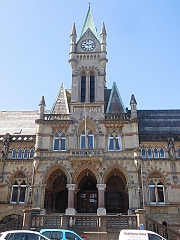
THE CITY OF WINCHESTER has one of the longest gothic cathedrals in the continent of Europe. Built from 1091 onwards under the auspices of Bishop Walkelin, a relative of William the Conqueror, the bulk of the gothic part of the edifice was erected in the 14th century in the Perpendicular style of gothic. What was created, is exceedingly beautiful and gives a great sense of space. It is a masterpiece of gothic stone masonry. The cathedral stands not far from another large building, also built in a style of gothic inspired by what was achieved during mediaeval times.

This near neighbour is far younger than the cathedral. It is the 19th century Winchester Guildhall, which was constructed between 1871 and 1873. It stands on the site of St Marys Abbey, which was taken over by Henry VIII in the late 1530s during the Dissolution of the Monasteries. The remains of the abbey, which was known as ‘Nunnaminster’, persisted until the 17th century, after which they were removed. Today, some excavated remnants can be seen behind the Guildhall.

Guildhall, Winchester

The Guildhall was built in the gothic revival style to the designs of the architects Albert William Jeffery (1840-1915) and William Skiller (1838-1901), who also submitted a design for a town hall for Hastings in Sussex. Tragically, Skiller committed suicide in 1901 (http://hastingschronicle.net/archives/architect-hangs-himself/). The Guildhall was later extended by J. B. Colson (1820-1895), who was the surveyor of Winchester Cathedral.  The original building is rich is features borrowed from mediaeval gothic, but it is topped by roofing styles that remind the viewer of French ‘chateaux’. One source summarises the Guildhall’s appearance as:

“ Gothic, symmetrical, with a middle tower and this as well as the angle pavilions provided with French pavilion roofs”; and as having a “deeply vaulted porch” at the entrance — for all this part “[t]he style is Second Pointed,” while Colson’s long extension is “much plainer”” (https://victorianweb.org/art/architecture/winchester/1.html).

Without doubt, the cathedral is a far finer building than the Guildhall, but both are impressive in their own ways. The cathedral’s integrity depends on its gothic features that have both structural and aesthetic functions, whereas in the case of the Guildhall these features have a greater decorative than structural purposes.

The Guildhall is an example of so-called ‘gothic revival, which lovers of London’s St Pancras Station and Bombay’s Victoria Terminus (Chhatrapati Shivaji Maharaj Terminus) will appreciate’. Years ago, I read “The Gothic Revival: An Essay in the History of Taste”, written by the art historian Kenneth Clark (1903-1983) in 1928. One thing that impressed me was, if I recall correctly, that the author queried whether the gothic style of architecture ever really died out in England, as it did elsewhere in Europe. Clark suggested that the gothic style continued to be used. In other words, what is described as ‘gothic revival’ is simply a continuation of the early use of this style. It is my impression that by the 19th century, when, for example, the Winchester Guildhall was built, architects were often simply borrowing features of earlier gothic buildings, as, for example Winchester Cathedral, and applying them often more mechanically than artistically. Often when the gothic style was being used structurally, as is the case in many churches built during the Victorian era, it tends to be imitative rather than creative, as is the case in the great mediaeval cathedrals and other churches. There are a few exceptions, where the 19th century architect manages to use the gothic style both structurally and artistically, as for example in the Church of St Augustine in London’s Kilburn.   Be that as it might be, The Guildhall does not lack in good aesthetic features and adds positively to the rich tapestry of the architectural scene in the historic centre of the city. I recommend visitors to Winchester not to concentrate all their time at the Cathedral but to spare some to view the Guildhall before seeing the other sights of the city.

Lady with the lamp

ROMSEY IN HAMPSHIRE is a delightful small town with a spectacular parish church, Romsey Abbey, with many Norman and gothic architectural features. The edifice that stands today was originally part of a Benedictine nunnery and dates to the 10th century, but much of its structure is a bit younger. It rivals some of the best churches of this era that we have seen during travels in France. That it still stands today, is a testament to the good sense of former citizens of the town.

During Henry VIII’s Dissolution of The Monasteries in the 16th century, much of the nunnery was demolished. However, the establishment’s church was not solely for the use of the monastic order but also served as a parish church for the townsfolk. As Henry VIII was not against religion per se, and the need for a parish church was recognised, the townsfolk were offered the church for sale. In 1544, the town managed to collect the £100 needed to purchase the church and what remained of the abbey from The Crown. Thus, this precious example of church architecture was saved from the miserable fate that befell many other abbey churches all over England. However, what you see today was heavily restored in the 19th century, but this does not detract from its original glory.

The town of Romsey is 3.4 miles northeast of East Wellow, the burial place of Florence Nightingale (1820-1910), the social reformer and statistician as well as a founder of modern nursing. I had no idea that Florence was famous in the field of statistics. Her biographer Cecil Woodham Smith wrote:

“In 1859 each hospital followed its own method of naming and classifying diseases. Miss Nightingale embarked on a campaign for uniform hospital statistics … which would ‘enable us to ascertain the relevant mortality of different hospitals, as well as different diseases and injuries at the same and at different ages, the relative frequency of different diseases and injuries among the classes which enter hospitals in different countries, and in different districts of the same countries.’”

In 1858, she was elected a member of the recently formed Statistical Society. So, there was much more to Florence than the commonly held image of ‘the lady with the lamp’ during the Crimean War.

Florence was christened with the name of the Italian city, where she was born. Part of her childhood was spent at the family home of Embley Park, which is 1.8 miles west of Romsey Abbey church and close to East Wellow. Now a school, it remained her home from 1825 until her death.

Broadlands, which was built on lands once owned by the nuns of Romsey Abbey, is a Georgian house on the southern edge of Romsey. It was home to Lord Palmerston (1784-1865), who was Prime Minister in 1856 when the Crimean War came to an end. Broadlands was Palmerston’s country estate. It is maybe coincidental that both Palmerston and Nightingale were associated with both Romsey and the Crimean War.

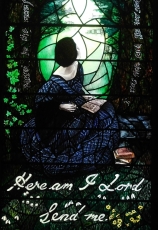
Palmerston is celebrated in Romsey by a statue standing in front of the former Corn Exchange. Florence has a more discreet memorial in the town. It is a stained-glass window within the Abbey church. Placed in the church in 2020, it was formally dedicated in May 2020. It depicts a young lady seated by a tree, her face turned away from the onlooker. Created by Sophie Hacker, the image depicts Florence seated on bench beside a tree in Embley Park. The tree in the window, a cedar, still stands in Embley Park’s grounds. The image is supposed to recall the moment when, as a young girl, she received her calling. Woodham Smith wrote:

“Her experience was similar to that which came to Joan of Arc. In a private note she wrote: ‘On February 7th, 1837, God spoke to me and called me to His service’”.

The window includes the following words above her head:

“Lo, it is I.”

And beneath her:

“Here am I Lord. Send me.”

There are a few other words on the window, some in English and others in Italian.

A visit to Romsey Abbey church is highly recommendable. We thought that we had visited it many years before 2021 and arrived expecting to see an abbey in ruins. We were delightfully surprised to realise that we had mistaken Romsey with some other place, whose name we have forgotten, and instead we had discovered a church that was new to us and unexpectedly wonderful both architecturally and otherwise. Anyone visiting nearby Winchester with its fine cathedral should save some time to come to see the magnificent ecclesiastical edifice in Romsey.