The world’s smallest visitor centre and a fatal field

THE SCOTTISH FOUGHT the English at the Battle of Flodden Field on 9 September 1513. If you want to know all about it, see: https://en.wikipedia.org/wiki/Battle_of_Flodden . In brief, the Scots were defeated. At least 10000 Scottish men and about 1600 English were killed.

The battle was fought close to the village of Branxton in Northumberland.   A stone cross on the top of a grassy hill commemorates “The Brave of Both Nations”. This monument was erected in 1910. Visitors to the battlefield can follow marked trails to explore the area in which the battle was fought. Every now and then, there are informative noticeboards that help visitors to understand the course and locations of the fighting.

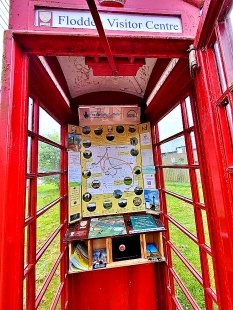
Within the village of Branxton, there is a telephone box/kiosk. It is the standard design that has existed for many decades, but it no longer contains a telephone. This small edifice has been repurposed to become a Visitor Centre. It contains an information panel and a few leaflets. It claims to be “The World’s smallest Visitor Centre”. I would not be surprised if that were the case.

Although visiting the battlefield was surprisingly moving, seeing the minute visitor centre was quite intriguing.

The town clerk who helped to save a wall built by the Romans

HADRIANS WALL WAS commenced in 122 AD to fulfil the order of Emperor Hadrian, who wanted to separate Roman Britain from the so-called barbarians who lived in what is now Scotland and parts of Northumberland. The wall stretched 73 miles west from Bowness-on-Solway to Wallsend (next to Newcastle) on the River Tyne. Soon after it was built, it began to decline, and over the years, people used some of its stones to construct their own buildings.

Had it not been for the efforts of people like John Clayton (1792-1890), much of what we can see of Hadrian’s Wall today might have been lost forever. After having had a classical education, Clayton was a Town Clerk of Newcastle-on-Tyne and an antiquarian.

In 1796, John’s father, Nathaniel, bought the Chesters Eastate, through which part of Hadrian’s Wall runs. In its grounds, there stands a mansion, which was built in about 1771. After his father’s death in 1822, John inherited Chesters. John, who was keen on antiquities, excavated the Roman ruins on his land. These included what was left of a Roman fort known as ‘Cilurnum’. He also discovered the remains of a Roman Bridge that traversed to Tyne from the fort. After 1832, Clayton purchased other pieces of land on which there were remains of the Wall and its associated forts.

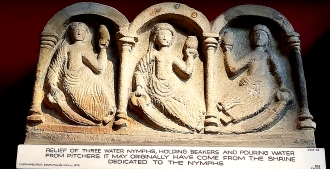
We visited Chesters, which is maintained by English Heritage. In addition to its well conserved remaims of the various parts of the Roman fort, there is a wonderful museum that contains many roman sculptures and inscribed stone discovered by Clayton. The museum, which is filled with many fine carvings, is delightfully old-fashioned. The museum was built after John Clayton’s death, but I am sure that he would have approved of the way his finds have been displayed.

A railway station without trains on which you can travel

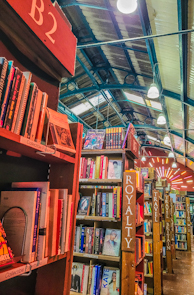
I LOVE SECONDHAND bookshops, and Alnwick in Northumberland has a remarkable example. Called Barter Books, this treasure house of used books is housed in a former railway station, the Terminus of the Alnwick branch line.


The station opened in 1887, and was closed in 1968. Stuart and Mary Manley established Barter Books within the old station in 1991. Its stock of books is amazingly large. The friendly people who work in the store are both knowledgeable and helpful. They assist customers looking for particular books. There is also a computerised catalogue that customers can use.


At first sight, the shop seems overwhelming. However, unlike many other secondhand bookshops, the Books at Barter are beautifully shelved in a well organised way.


Apart from the books, the former station has a superb refreshment area – the former station buffet, where everything from beverages to full meals are available.


Although trains neither arrive nor leave the former station, there are trains within it. These are model trains that run along tracks attached to the tops of some of the bookcases.


Finally, the name ‘Barter’. The store is happy to receive books brought in by customers. After assessing them – a process that takes about 10 minutes – the store offers a price for those volumes it is keen to buy. This payment is in the firm of a credit note, which can be used to pay for books sold at Barter.


Luckily, for an avid book buyer like me, Barter is not too close to home: it is 310 miles away from our dwelling.

A castle, a chapel, and cider in Northumberland

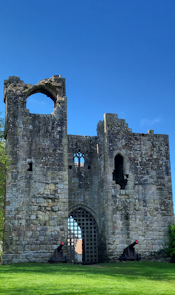
ETAL CASTLE OR what is left of it can be found southwest of Berwick on Tweed,  a few miles of the A1 trunk road. Constructed in about 1341, by 1603, it  had fallen into disrepair and was abandoned.  Now the remains of this fortification are maintained by English Heritage.


Etal Castle

Next to the ruins, stands the former Presbyterian chapel. Once a place where people concentrated on the Holy Spirit, it now deals with a different kind of spirit. Currently,  the chapel contains a ‘cidery’, a place where alcoholic ciders are manufactured  using apples grown in Northumberland. Visitors are encouraged to sample some of the  ciders produced in the repurposed chapel, and bottles are available to purchase.


The old castle is picturesque, as is the small village that includes a row of whitewashed houses. In the village, there is a pub and a very pleasant tea room that also serves as the village shop and post office.

Recycling old herring fishing boats on an island off Northumberland

HOLY ISLAND IN the North Sea is reached by travelling along a causeway that links it to the coast of Northumberland. The causeway disappears under water for several hours during high tide, which occurs twice a day.

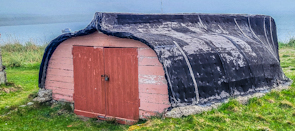
Near the island’s harbour, there are upturned herring boat hulls. Some of them have been covered with a layer of tar. At the rear of each of these hulls, there are doors fitted. For today, these upturned, retired fishing boat hulls now serve as storage sheds.

Apparently, the fishermen of Holy Island consider it sinful to send these boats to breaker’s yards or to otherwise dispose of them. So, they recycle these herring boats (cobles) as sheds.