A tree and two shrines

WHILE TRAVELLING AROUND India, I have seen many trees that serve some kind of Hindu religious purpose. Often they are peepul trees, whose leaves are heart-shaped. Frequently, there is some kind of shrine next to the trunk, and often there are fine threads wrapped around the circumference of the trunk.

Near the middle of the market place in 8the Goan town of Mapusa, there is an old tree next to which there are two shrines. The tree’s leaves did not look like those of a peepul tree. What interested me was that at first sight both of the shrines, which resemble small huts, looked similar.

On closer examination, it could be seen that one of the shrines was, as I expected, Hindu, and the other was, to my surprise, Christian.

Whether this close proximity of the two shrines was pure coincidence or related to the fact that the tree provides good shade, I cannot say. Another possible explanation of the closeness might possibly be a symptom of inter-religious tolerance in this small Goan town. Who can say? Whatever the explanation for the closeness of the two shrines, it was heartening to see.

Baby Jesus with bangles

DURING SEVERAL TRIPS within the ex-Portuguese colony of Goa on the west coast of India, we have visited churches and other Christian religious establishments built under Portuguese rule. The Portuguese arrived in India several centuries ago, and finally left their colonies in 1961 when they became incorporated (or annexed) into India. One of the aims of the Portuguese was conversion of their Indian subjects to Christianity. Many of the conquered people became Christian, and many churches and seminaries sprung up in the occupied territories. We have visited quite a few of these.

In most of the churches we have seen in Goa as well as in the recently opened Museum of Christian Art in Old Goa, we have noticed that depictions of angels saints, and Christ himself have facial (and other) features that are typical of Indian physiognomy. This is not too surprising as many artefacts in the churches of Goa were created by Indian artists.

When we visited the Museum of Christian Art in Old Goa, we saw two depictions of Baby Jesus lying on what looked just like typical Indian ‘charpoys’ (traditional Indian beds). The Holy Child in each case is a tiny doll. What fascinated me is that the dolls were wearing the sort of tiny bangles that are often worn by small Indian babies. One of the tiny models of Jesus was also wearing earrings.

Moving away from Christian sculptures and paintings, which have incorporated Indian characteristics, day to day Christian worship in India often incorporates features with origins in Hindu ritual practice. One example is the use of flower garlands (‘malas’), which is just as common in Christian settings as it is in Hindu settings.

Christianity was introduced to India not only by the Portuguese, but by others including St Thomas (apocryphally), and various European invaders. However, despite its foreign origins, India was not only affected by the Christian religion but has also made its mark on it.

A grand hotel in Goa

OUR FIRST VISIT to Goa was in about 2007. We stayed at a state run hotel in Colva, a seaside place in South Goa. It was August and the middle of the monsoon season. Much of the time, there was rain and frequently the beach was inaccessible because if the furious waves and wind dashing against it.

One day, we were driven to Panjim North of Colva, and stopped for lunch in the city’s tall Mandovi Hotel. The food served in its grandiose dining room was good. However, what impressed me most was that the hotel, which was built as a luxury establishment when the Portuguese ruled Goa, was a perfectly preserved and well maintained example of an old-fashioned inter-war European grand hotel.

Because the hotel at Colva was, to put it mildly, very badly managed, we left it sooner than we had planned and spent a few days in the Mandovi. As far as I can recall, the hotel was both comfortable and well managed.

In 2018, we paid another visit to Panjim, and had a meal in its restaurant, which looked the same as it did in 2007. Sadly, the quality of the cooking and service had deteriorated.

The Mandovi Hotel was constructed on a plot that had belonged to a Noronha family. The seven storied building was ready to receive its first guests in December 1952, on the day that the Cardinal of Lisbon arrived in Goa. The hotel was where important Portuguese persons stayed. It was the best hotel in all of the territories ruled by Portugal. Stepping inside it was like taking a time trip back to the 1950s, if not before.

Behind the hotel, away from the riverfront, there is a domed Chapel attached to the hotel. This was built by the Noronhas family in 1827, and has been used ever since.

December 2022 found us back in Panjim. We walked over to the Mandovi Hotel and were horrified to find that its main entrance was padlocked closed and the place looked lifeless. A bystander told us that the hotel closed about 4 years ago because the two families who own it are fighting over it in a court of law.

I hope that the Mandovi Hotel will reopen and that it’s remarkable late Art Deco and Indo-Portuguese decorative features will be preserved. Even if it’s interior is modernised, which would be a pity, I hope that the terracotta coloured bas-reliefs on the hotel’s external wall will be saved.

A padlock with an unfortunate name

ABOUT 26 YEARS AGO, we had lunch in a state run hotel near the archaeological site at Hampi in Karnataka. On the way to a toilet, I had to pass some of the hotel’s bedrooms. Each was closed with a padlock. I do not know why I bothered to look at a lock carefully, but I am glad that I did. The lock was manufactured by the Hitler lock company. I could not believe my eyes, and I took a closeup photograph of it.

Since seeing that lock, I have visited India about 50 Times. On every visit, I have spent some time wandering around markets and bazaars in many Indian towns and cities. At every market I have kept an eye open for Hitler locks, but never found even one of them. When I have asked lock sellers if they stock them, the majority of them look blankly at me.

Today, the 9th of December 2023, we enjoyed a journey on a crowded local bus in Goa. We travelled from Panjim to the town of Mapusa to experience its large market. After wandering around for a few minutes, I noticed a small stall selling locks.

As I have always done at other markets I stopped to examine what locks were on sale. To my great surprise, the vendor had some Hitler padlocks. They were available in three sizes. I bought the middle sized version.

The locks are manufactured by Hitler Lock Enterprises,which is located in Aligarh in Uttar Pradesh State. I can only guess that the name Hitler was chosen because someone must have regarded him as being at least as strong as the locks they produce. Why they chose Hitler, rather than strong personalities such as Hanuman or Hercules, puzzles me.

After making my purchase and some others (mainly clothes), we ate superb seafood in the St Francis Xavier restaurant in the centre of the market. On our way back to the bus station (bus stand), we passed another lock seller. I noticed that he also had Hitler locks for sale.

Hitler is a brand name that would not sell well in most parts of the Western World. Judging by the fact that so far I have only found these locks in Mapusa, maybe it is not a trade name that goes down particularly well in India. However, Adolf’s book “Mein Kampf” is available in most Indian bookshops. Although its author was fixated on Aryans, he did not have a soft spot for Indians, as you will discover in the book “Hitler and India”, recently written by Vaibhav Purandare.

Some eagles in Old Goa

THE MUSEUM OF Christian Art has been recently been upgraded and is now a truly excellent display of Christian religious artefacts. It is housed in part of the convent of Santa Monica on Holy Hill in Old Goa. The convent Church was built in the early 17th century.

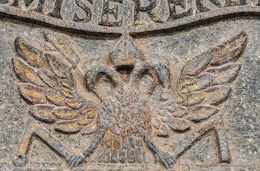
On arrival at the outside (south side) of the church, I spotted a bas-relief carved in stone above the main entrance to the church. It depicts an example of a heraldic creature that has long fascinated me: a double-headed eagle.

Inside the church, we met Natasha, who is the curator of the museum. I asked her if she knew about the reason for the double-headed eagle on the church. She informed us that the convent had been an Augustinian establishment, and that the double-headed eagle is a symbol used by that Order. That was news to me. She also directed me to another depiction of this creature on a carved tablet set into the church’s north wall.

When I returned to our lodging in Panjim, I consulted the internet, and learned about the connection between the Augustinian Order and the bird with two heads. It appears that although the main emblem of the Augustinians was a heart pierced with two arrow, the Hapsburgs allowed this Order to use their emblem, the double-headed eagle.

It will be recalled that there was a significant linkage of the Habsburgs and Spain. And Spain ruled Portugal between about 1580 and 1640. The Convent of Santa Monica was constructed between 1606 and 1627, and that was during the time that Portugal, which colonised Goa, was united with Spain. During that period, the united countries were ruled by Habsburg kings.

Although the museum, which I will describe later, was well worth the visit, discovering yet another example of the use of the double-headed eagle was a great thrill for me.

A refreshing breeze in Goa

I SHOULD NOT BE TELLING you about a wonderful place in the heart of Panjim in Goa, but I will.

The Clube Vasco da Gama is situated on the first floor of a building beside Panjim’s lovely Municipal Garden. Founded in 1909, it occupied other buildings before it moved to its present site. With a pleasant decor, which evokes times long past, the Clube serves a wide range of drinks and superbly prepared Goan food. Today, we enjoyed baby squids stuffed with minced vegetable and chopped up squid, served in a tasty sauce. We also ate croquettes filled with a mildly spiced prawn purée. In addition, we consumed fried fish served in a very spicy sauce. Everything tasted wonderful, and as we will be in Panjim for several days, we will work our way through the menu.

We first came across the Clube in April 2018, when the weather was almost unbearable: extremely hot and humid. Quite by chance we came across the Clube and decided to enter it. We discovered that it has two small balconies, each overlooking the Gardens. Each of them has a small table with three chairs. All day long, there is a lovely, cooling breeze blowing across these two tables, making them the coolest places to sit in central Panjim (without resorting to finding places with air-conditioning).

It is because there are only two of these wonderfully positioned tables, it is with some trepidation that I am telling you about them. I do not want to turn up at the Clube to find them occupied by those who have just read this!

Hotel Oslo

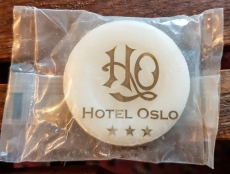
A BAR OF SOAP reminded me of our first visit to Portugal. I am looking at a small, round piece of soap sealed in a transparent package labelled “Hotel Oslo”, which we would never have acquired had I not been a victim of pick pocketers on a tram in Lisbon. We had only been in Portugal for about four hours when we took a ride on a picturesque old-fashioned tram (route 28) in the Portuguese capital. I was on the point of taking a picture of a sign that told passengers to beware of pick pocket thieves when I became one of their victims. Amongst the valuables that were stolen from me was my driving licence.

Losing the licence was a disaster as we were planning to hire a car to visit several country places in Portugal. Without the licence, the car hire company was unwilling and unable to lend me a vehicle, but it was good about refunding the money we had paid. We decided that we would attempt to carry out our plans using public transport.   

The first place on our itinerary was to have been a farmhouse in small rural place, whose name I do not remember, east of Coimbra. We travelled by train from Lisbon to Coimbra, which has two railway stations in the centre of the city. We discovered that there was a railway line from Coimbra to a spot near our planned destination. When I say “near”, it was really about half an hour’s taxi drive from where we were to stay. After lugging our baggage through the rain about 1000 yards from the station, where the Lisbon train arrived, to the other station from which we were about to depart, we ‘phoned the accommodation to which we were heading. They told us that they did not provide food, not even breakfast, and that the nearest restaurant was about half an hour’s drive from them. As we had no car and were planning to spend three days there, we began to worry how we would survive so far away from any supply of food.

Our next train was not due to depart for another two hours. I decided to walk back to the centre of Coimbra to see whether there was a hotel where we could stay instead of heading out into the ‘wild’. I rushed through the rain and found the Hotel Oslo, which had space for us and did not seem unreasonably priced. After reserving a room, I dashed back through the rain to the rest of the family, who were waiting on the platform. These were the days before we had more than one mobile ‘phone in the family, so I had to reach them to tell them about the Oslo instead of phoning them. Using our one ‘phone, we rang the rural accommodation and explained our plight. They were helpful in that they cancelled our booking gracefully and without cost.

Although not a de-luxe hotel, the Hotel Oslo was solidly built and extremely comfortable. It was located close to most of the sights in Coimbra, a place that had not been on our original itinerary. We spent four pleasant days in this delightful university city, and we were fortunate that, by chance, we were in the city at the time when the university students were starting a new academic year. By day and by night, we encountered groups of boisterous, happy students wandering about the city dressed in traditional  capes.

Had my driving licence not been stolen, I know that we would never have stayed in Coimbra and that we would have missed seeing one of the loveliest places that we have so far visited in Portugal.  As people say, every cloud has a silver lining. Although I was deprived of a lot of cash, I gained the pleasure of spending time in a wonderful place and witnessing some age-old traditions that added to our fondness of a country that we have grown to love.

The Hotel Oslo was, when we visited it, an old-fashioned style of hotel even though the 20th century building that housed it did not look archaic. Some years after staying there, we spent a couple of nights in the Hotel Mandovi in Panjim, Goa (India). This hotel had been built in 1952 by the Portuguese while they ruled Goa as a colony. It was built to coincide with the Pope’s visit to the Tenth Exposition of the relics of St Francis Xavier, which are kept in Goa. They are ceremoniously displayed once every ten years, subject to the discretion of the authorities who keep them in the Basilica of Bom Jesus in Old Goa. Although the Mandovi looks much older than the Oslo, they both have high standards of service and comfort that are old-fashioned in the best sense of the term. I am not sure whether we have kept any soap from the Mandovi as a souvenir, but you never know, one day we might find we have one lurking about somewhere in our home.