
There is a set of doors in the gallery of Bangalore’s Chitrakala Parishath art college. They consist of glass spheres set in a metal matrix. Here is a picture of the distorted images that can be seen through the spheres.

There is a set of doors in the gallery of Bangalore’s Chitrakala Parishath art college. They consist of glass spheres set in a metal matrix. Here is a picture of the distorted images that can be seen through the spheres.

A glass of cider
Chilling by the lazy river
It’s summer time
TWO TEMPLE PLACE was built for the American businessman William Waldorf Astor (1848-1919) in 1895. Located close to Temple Underground Station and Middle Temple, this distinctive edifice is said to be designed in the ‘neo-Gothic’ style, although I would prefer to describe it, and especially its interior, as ‘Tudor Revival’. Every year, between late January and late April, the building, which is now owned and maintained by the Bulldog Trust charity, houses an exhibition, which is always worth viewing. This year’s exhibition, which continues until the 21st of April 2024, is called “The Glass Heart”.
The exhibition is described on the Two Temple Place website (https://twotempleplace.org/) as follows:
“It will explore the narratives central to glass art and manufacturing, and celebrate the timeless skills, artistry and innovation required to work with this challenging material.”
And it does that very successfully by exhibiting a superb collection of glass creations ranging from industrial products, such as Pyrex, through stained glass, to intriguing artistic creations that defy the imagination. I will not attempt to describe all of these exhibits – each one of them both fascinating and beautiful – but I will concentrate on one small collection of items relating to the Red Lion – a pub in West Bromwich (West Midlands).
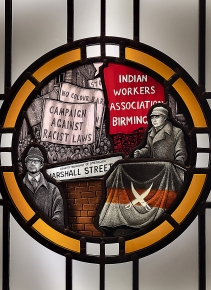
The Red Lion is a ‘desi’ pub owned by Indians, whose families originated in the Punjab, and came to work in the factories of Britain’s Black Country. Although all are welcome, the pub is mainly a socialising place for local people whose families came from the Subcontinent. It is one of several desi pubs in the former industrial heartland. In 2016, Steven Cartwright, who runs a studio that produces creative and decorative glassworks, was commissioned to create some stained-glass windows to decorate the Red Bull. His mission was to create traditional pub style stained-glass, but with an interesting slant – it was to celebrate the rich culture of the desi pub in the West Midlands. To do this, as Steven explained on his website (www.cartwrightglassdesigns.co.uk/projects/red-lion):
“I designed the window to give the appearance of a traditional pub but with a twist. The window utilises some of the colours and elements of the sub continent and tells the story of the punjabi community who migrated to the area in the 50’s. It also celebrates the establishment of the Indian workers association by Avtar Singh Jouhl and the visit of Malcolm X at their invitation.”
At the exhibition in Two Temple Place, there is a small piece of this pub’s stained-glass and some photographs of the rest of it.
What particularly intrigued me was the mention of The Indian Workers Association (‘IWA’) of Birmingham. The IWA was founded in the 1930s by Indian workers from Coventry to combat racist objections to them both by the British trade unions and the British people in general. The quote mentioned Avtar Singh Jouhl. He was born in the Punjab (British India) in 1937, and after the 1947 Partition, he came to London to study at the London School of Economics, arriving in 1958. Three years later, he moved to Smethwick in the Midlands, where he became an industrial worker. There, he saw and experienced racist anti-Indian conditions that prevailed at the time, He joined the IWA, and soon, along with others, he founded its Birmingham branch.
In February 1965, Jouhi invited the civil rights campaigner Malcolm X to visit Smethwick. A few days before his assassination, Malcolm X said of Smethwick:
“This is worse than America. This is worse than Harlem.”
In Jouhi’s obituary (The Guardian, 4th of November 2022), the following was written:
“The anti-racism campaign that attracted Malcolm X to Smethwick was spearheaded by Avtar Singh Jouhl, who has died aged 84 … Jouhl, as general secretary (1961-64; 1979-2015) and national organiser (1964-79) of the Indian Workers’ Association (IWA), challenged trade union members, factory owners and publicans to end this racism … When it came to breaking the colour bar in the town’s pubs, the IWA’s tactics were similar to those used by the Freedom Riders in the US in the previous decade. White university students were enlisted to order drinks, then hand them to British Indians, such as Jouhl. The landlord would invariably eject them, while the students challenged the eviction. The IWA then used evidence of these actions to successfully oppose the publican’s licence when it came up for renewal … This targeted campaign led to discrimination in pubs being outlawed in the Race Relations Act (1965) and paved the way for Britons of Indian heritage to become publicans themselves and set up what are commonly now known as “desi pubs”.
It was his actions described above and many others that helped to suppress racism in the Midlands and elsewhere in Britain. And it is very pleasing to see that what he achieved is being celebrated in glass in a pub owned and frequented by the people whom he helped. I visited the exhibition at Two Temple Place because I enjoy viewing glass artefacts. Little did I know that I would leave the exhibition having been introduced to an important political movement, about which I had known nothing.
BERMONDSEY STREET IS only about 500 yards in length, and about 200 yards of it runs under the railway tracks and has no shops, eateries, or any other outlet open to the public. The remaining 300 yards of this thoroughfare is a delight to visit. It is lined with numerous cafés, restaurants, and a couple of pubs. In addition, there is a good picture framer, several art galleries, some fashionable shops, a church, and a museum of fashion and textiles. There are also a couple of open spaces – small parks. Apart from the magnificent Caphe House – a superb Vietnamese restaurant, one of my favourite places on this street is London Glassblowing (see: https://londonglassblowing.co.uk/).

London Glassblowing is a gallery dedicated to the display and sales of artistic glasswork creations. It was founded by Peter Layton, who was born in 1937 in Prague (then in Czechoslovakia). Fleeing the Nazis, his family moved to Britain in 1939. They settled in Bradford near his grandfather, a pathologist who was a colleague of Sigmund Freud. Initially specialising in ceramics, Peter went to teach at the University of Iowa in the USA. While he was there, Peter soon became fascinated with glass and studied in the institution’s glass blowing programme. After his return to the UK, where artistic glass blowing was not yet highly developed or even highly regarded, he opened the London Glassblowing Workshop in Rotherhithe in 1976. After moving to several different locations, it arrived at its present home on Bermondsey Street.
In addition to displaying fine works of art made with glass, visitors to the gallery can watch the glass blowers at work. This is fascinating to see. When we visited yesterday, the 16th of February 2024, there was a group of young children watching the glass blowers at work. A gentleman was patiently explaining what the glass blowers were doing and how they were achieving the exquisite multicoloured vase they were making. It was only when I got home that I realised that the person explaining was none other than Peter Layton.
IT IS UNNECESSARY to travel from London to Venice to see masterpieces of glass bowing. You need only make your way to Bermondsey Street in south London where you will find London Glassblowing. It is both a gallery and workshop set up by Peter Layton, who is now over 80 years old and still creating beautiful artefacts. Layton was born in Prague and grew up in England. After studying ceramics at London’s Central School of Art and Design, he taught ceramics at the University of Iowa in the USA. It was there that he discovered glass blowing and took to it. When he returned to England in 1976, he established his London Glassblowing in London. It has been located at its present address for about 15 years. Before that, he was in Leather Yard. Apart from creating works of art in glass, he also teaches and mentors other glass blowers.

Whenever we visit Bermondsey Street, we make a point of visiting Layton’s establishment. Always the works on display are both beautiful and highly inventive. Occasionally, if we reach the place at the right time, we can watch glass blowers at work in the invariably hot workshop behind the gallery. Unlike the workshops we have visited on the island of Murano (near Venice), the works produced in Bermondsey Street – both sculptural and functional – are tastefully contemporary and often avant-garde.
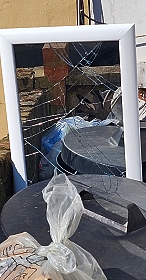
The glass is broken
The mirror image is distort’d
But life goes on
LONG BEFORE IT became the Apple Store on Regent Street in central London, I used to look at the colourful mosaics on its building’s façade. Running in a line along the top of the mosaics, which are above the four arches of the shopfront, are the names of several cities including St Petersburg. This used to intrigue me a lot in the years before Communist rule ended in Russia and the city was then called Leningrad.
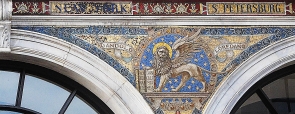
The mosaics contain depictions of several coats-of-arms including and two lions, each resting a paw on an object. One of the lions has wings and rests its paw on an open book on whose pages are the words: “PAX TIBI MARCE ENVANGELISTA MEUS”. For, this creature is the lion of St Mark, symbol of Venice and its former empire. On both sides of the lion, there are depictions of streamers. One reads “DANDOLO” and the other “LOREDANO”. Both are the names of important patrician families in Venice. Two other crests also appear, one on each side of the winged lion and the two names. One is for the island of Murano and the other for the island of Burano. These two islands in the Lagoon of Venice, especially Murano, are known for their glassmaking activity.
The mosaics were originally installed when the Venetian glass-making company Salviati opened its store in this building, designed by GD Martin, on Regents Street in 1898. The business made both fine glassware and mosaics. Soon after the firm was founded in 1859, it began to be established in England. According to a company history (www.salviati.com/en/our-story/):
“It was also in London, on 21st December 1866, that the “Società Anonima per Azioni Salviati & C.” was established with the support of diplomat Sir Austen Henry Layard and historian William Drake.”
Fortunately, the lovely mosaic has survived and has been kept in good condition. I have always marvelled at it when wandering along Regent Street, but I wonder how many people rushing into Apple’s attractive looking shop notice it.
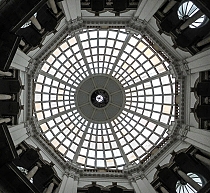
Light shining downward
Bright and high above my head
A glazed dome indeed
KEW GARDENS CONTAINS several magnificent Victorian plant houses made mainly of glass and iron. These include: The Palm House built 1844-1848; The Waterlily House built 1852; and The Temperate House built in about 1859. Although they are early examples of massive glass and iron structures for the cultivation of plants, they are not the earliest. The conservatory in the gardens of nearby Syon House predates them, having been built in 1827, ten years before Queen Victoria came to the throne. As a work of architecture, it rivals the best of those Victorian ‘glasshouses’ that can be seen at Kew.

We had parked in the grounds of Syon House several times before we visited its gardens in April 2021 and each time, I noticed the large glass and iron dome towering over the high garden walls. Until we entered the gardens, I had not realised that this splendid dome is attached to one of the most attractive plant conservatories that I have ever seen.
The extensive gardens of Syon House were landscaped by Lancelot ‘Capability’ Brown (1716-1783) in 1760 but were replanned in the 19th century. The architect Charles Fowler (1792-1862), who designed the market buildings in London’s Covent Garden, designed The Great Conservatory at Syon Park. It was built for Hugh Percy the Third Duke of Northumberland (1785-1847), who served as Lord Lieutenant of Ireland under the Duke of Wellington from 1829 to 1830 (https://en.wikipedia.org/wiki/Hugh_Percy,_3rd_Duke_of_Northumberland).
Writing in 1876, James Thorne, author of “Handbook to The Environs of London”, noted:
“The Great Conservatory designed by Fowler is in the form of a wide crescent, with pavilions at the extremities, and a lofty central dome. The centre, 100 feet long, is a tropical house, and is said to contain the finest collection of tropical plants in any private establishment in England. It is noteworthy that here only in this country has the cocoanut palm fully ripened …”
Thorne also noted that the vases on pedestals on the terrace in front of the conservatory were carved by Grinling Gibbons (1648-1721). The circular pool in front of the conservatory has a statue of Hermes (Mercury), which is a copy of one by the Italian sculptor Giambologna (1529-1608).
Although we were unable to enter The Great Conservatory, we could see most of it through its clean windows. The central dome is supported by a ring of perforated semi-circular arches held aloft by slender iron pillars. Even without entering it, the central area of the building can be seen to be a beautifully designed, airy space. Though not as crowded with plants as the conservatories at Kew Gardens, the one at Syon contains a collection of palms, cactuses, and other warm weather plants, mostly large and well-established. Unlike the glasshouses at Kew, much of the rear wall of The Great Conservatory is constructed with brickwork instead of glass and iron.
Much time can be spent enjoyably exploring the lovely gardens at Syon House, but despite their beauty, the pièce-de-rèsistance is without doubt The Great Conservatory, an impressive and beautiful example of construction in glass and iron. It is well worth purchasing an admission ticket even if only to see and admire this great work of Regency architecture.
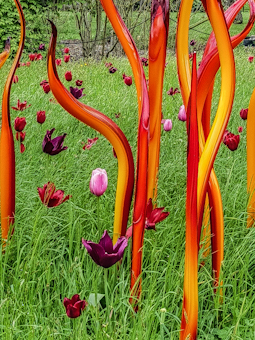
Once again, London’s Kew Gardens is hosting an exhibition of glass sculptures by Dale Chihuly (born 1941). The amazingly crafted glass artworks of often quite complex design have been placed both in the open-air and inside some of Kew’s lovely old glass-houses.
The curvy tubes with pointed ends shown in my photograph have been tastefully planted in a grassy field dotted with tulips. In the Temperate House, a large glass mobile has been suspended from the ceiling and smaller objects mingle with the plants. Wherever you look, you will find glass artefacts in intimate contact with the plants growing around them. In the Water-Lily House, large glass sulptures evoking the flowers of water-lillies mingle with the real plants whose fronds float on the water.
As time passes and the plants grow more, some of Chihuly’s colourful glass objects will become harder to find. The plant-like forms of many of the artworks mix with the plants to provide in some cases a stark contrast or in others they almost blend with the plants around them.
It is well worth visiting Kew whilst these sculptures are on display. However much I like the glass artworks, the stars of the show are for me the plants themselves (rather than the sculptures). This highlights how difficult it is for man to compete with nature on the aesthetic playing field.
The Chihuly works are on display at Kew Gardens until the 27th October 2019
 yamey
yamey 