An abbey no more: slavery and sightseeing

ENTIRELY JUSTIFIABLE FURORE over recent unlawful police killings of Afro-American citizens in the USA has heightened awareness of the history of unjust treatment of ‘people of colour’ under colonialism and slavery during years long passed. It was only after enjoying an afternoon in the lovely gardens of Anglesey Abbey near the city of Cambridge that I learned that this delightful place was once owned by someone whose fortune was at least partially derived from  exploitation of India and elsewhere by the East India Company. But first some history of the house, whose gardens we enjoyed despite the rain and gloomy grey late October skies.

Between 1536 and 1541, King Henry VIII disbanded the monasteries, abbeys, and other religious institutions in England. One of these was an Augustinian priory established near Cambridge by Richard de Clare in 1212. This was originally founded as the Hospital of St Mary during the reign of Henry I (that is between 1100 and 1135). The site of this religious establishment became the property of John Hynde, an important judge, who died in 1550. The religious buildings having been largely demolished, the next owner of the place, the Fowkes family who acquired it in 1595, built a Jacobean style house where the priory used to stand. The house incorporated some of the remains of the disbanded priory and abbey.

Later, the house became the property of Thomas Hobson (1544-1631), a Cambridge carrier from whose name the expression ‘Hobson’s choice’ is derived. Hobson maintained a profitable livery stable in Cambridge as well as arranging the carriage of mail between London and Cambridge. ‘Hobson’s choice’, a name derived after Hobson’s death is essentially the choice between ‘take it (i.e. the one thing on offer) or leave it’. Hobson’s son-in-law Thomas Parker and some of his descendants owned Anglesey Abbey (as the property became known). Later, the Member of Parliament for Malmesbury and then Cambridge, Samuel Shepheard (1677-1748), became owner from 1739. We will return to him later.

In 1848, the Reverend John Hailstone (1759-1847), an important geologist, a member of the Linnean Society as well as the Royal Society, bought Anglesey Abbey. He carried out many restorations and planted many trees in the Abbey’s extensive gardens, which we can enjoy today. Jumping ahead, in 1926, two brothers, Urban Huttleston Broughton (later ‘1st Baron Fairhaven’) and Henry Rogers Broughton, bought the property. They made improvements to the house, enhanced their collections of artworks, and developed the gardens. Henry moved out in 1932, leaving Anglesey Abbey to his older brother Urban, then Lord Fairhaven. Urban built a library to store his ever-growing collections of art works and books and restored the working Lode Mill on his property. When Lord Fairhaven died in 1966, the property was bequeathed to the National Trust. Sadly, because of the current covid19 crisis, we were not allowed to enter the lovely house to view his collection.

Between 1717 and 1720, Samuel Shepheard, an early owner of Anglesey Abbey, was involved with the East India Company (founded 1600 during the reign of Queen Elizabeth I). He was elected a director in 1718. His father, Samuel Shepheard (c1648-1719), was one of the so-called ‘interlopers’ who used political connections set up The New East India Company in 1691. So, not much has changed in connection with the overlap of political influence and commercial interests since then! The ‘New’ company thrived alongside the older one for a few years before the two companies merged (https://www.nber.org/system/files/working_papers/w21536/w21536.pdf). Samuel’s father tried to involve his son in the promotion of the New East India Company and is alleged to have been involved in irregularities connected with his son’s political advancement (www.historyofparliamentonline.org/volume/1690-1715/member/shepheard-samuel-ii-1677-1748). The on-line History of Parliament website includes the following about Samuel (junior):

“Concern for trade, and in particular his father’s commercial interests, suggest that he, rather than James Sheppard, twice acted as teller in that session: in favour of engrossing a bill to open up commerce with Africa; and in support of the second reading of a clause for a bill to encourage the tobacco trade.”

As for the former owner of Anglesey Abbey’s connection with India:

“Although serving as a director of the East India Company under George I, he did not seek advancement in the City, preferring the lifestyle of the country gentleman. The establishment of a residence at Exning probably reflected his association with the Cotton family, who were lords of the manor there.”

He became extremely wealthy:

“Dying ‘vastly rich’, he left the bulk of his estate to his natural daughter, who was celebrated as ‘the greatest fortune in England’, and subsequently married Charles Ingram, the future 9th Viscount Irvine.”

Exning is about six and a half miles north-east of Anglesey Abbey. Although Shepheard owned the Abbey, it is unlikely that he resided there as much as in Exning.

Samuel Shepheard was, as already mentioned, a director of the East India Company between 1718 (possibly 1717) and 1720. During that time, the company appears to have been, if not actually involved in, certainly interested in transporting slaves from Madagascar to North America in 1720 (“The William and Mary Quarterly”, Vol. 26, No. 4, pp. 548-577). To what extent Samuel Shepheard and his father were involved in the slave trade remains unclear. The National Trust are also somewhat opaque on this subject as their report (https://nt.global.ssl.fastly.net/documents/colionialism-and-historic-slavery-report.pdf) reveals:

“Shepheard was a wealthy merchant and Cambridgeshire Member of Parliament (MP) who served as director of the new East India Company and headed the South Sea Company. His father, Samuel Shepheard senior (c.1648–1719), was also an MP and merchant, building the family fortune on overseas trade. He was a founder member of the new East India Company and the South Sea Company, where he held the office of deputy-governor from 1713.”

Does the term ‘overseas trade’ include slavery? While we can not be certain whether or not either Samuel Junior or his father were involved in the slave trade, there is little doubt that the East India Company was not averse to it and might well have profited from it (see, for example: www.journals.uchicago.edu/doi/abs/10.2307/2715359?journalCode=jnh and https://aquila.usm.edu/cgi/viewcontent.cgi?article=1153&context=slisconnecting ), certainly in Africa and maybe also in the Indian subcontinent.

Should we let our enjoyment of Anglesey Abbey be disturbed by the knowledge that for a brief period of its existence it was owned by someone, who was involved in a company that ‘plundered’ India and was involved in the slave trade? By stating that Shepheard “… built the family fortune on overseas trade” to quote the National Trust in its report, which was triggered by the recent formation of the ‘Black Lives Matter’ movement, we can get no closer to ascertaining whether we should have a bad conscience about visiting the lovely gardens of Anglesey Abbey or should simply enjoy the experience without being concerned with an ill-defined unsavoury part of its history. After all, as far as we know, neither of the Shepheards, father and son, can yet be tarred with the same brush as, for example, the disgraced Bristol slave-trader Edward Colston (1636-1721), whose lifespan overlapped those of the two Samuel Shepheards. And, furthermore, unlike some other stately homes whose fame is largely due to fortunes made by persons involved in slavery, Anglesey Abbey is not one of them. If anything, the glory and splendour of this house and gardens in Cambridgeshire is due mainly to the efforts of men who owned it many, many years after Samuel Shepheard Junior died.

Two gardens: one old and one new

DURING OUR TEENAGE YEARS, my friends. Francis, Hugh, and Michael, and I used to take short trips to places of interest outside London. Amongst the many places we visited were Oxford, Cambridge, Salisbury, and Winchester, to name but a few. In those days, the mid to late 1960s, none of us could drive. So, we had to rely on getting to places by public transport. On one occasion, we arrived in Cirencester, hoping to find some way of getting to the remains of the Roman villa at Chedworth, which is about ten miles distant from it. The situation looked desperate. We were worrying that we would have to walk when I spotted an old-fashioned looking bus arrive. The driver told us that he operated a once a week service that passed Chedworth. We boarded and reached our goal.

Pavilion by Smiljan Radic in the Oudolf Field garden

One place that we always wanted to visit was the garden at Stourhead in Wiltshire. Famed for its spectacular landscaping including many architectural ‘follies’, this place was, despite our extensive research, impossible to reach using public transport. It remained one of our greatest wishes to see Stourhead, as great as the Jewish people’s desire to see the so-called Holy Land. Stourhead was almost our ‘Goldene Medina’. We never managed to  reach it together.

Many years later, in the 1990s, my wife and I made our first visit to Stourhead, travelling by car. We saw the place at its best on a bright sunny afternoon. In late September 2020, we returned to Stourhead on a grey, rainy afternoon during the covid19 pandemic. Despite the inclement weather and the restrictions as to where we could walk, we had a wonderful time. Every footstep we took led to one after another exciting view of the landscaped parkland. Wherever we looked, we saw fine trees and a wide variety of shrubs and other plants. Much of the walk is around an irregularly shaped man-made lake, the shores of which are dotted with architectural ‘follies’, constructed to enhance the romantic landscape. Many of these are built to resemble Greek or Roman classical temples. There is also a cottage built in Gothic Revival style and a wonderful and rather weird artificial grotto containing statues and fountains. Words cannot begin to do justice to the beauty of the gardens at Stourhead. The place has to be seen to be believed, and the weather, both good or bad, simply enhances the delightful experience that has been produced by nature skilfully assisted by mankind.

The gardens in the 2650-acre estate of Stourhead were designed by Henry Hoare II (1705-1785), a banker and garden designer. They were laid out between 1741 and 1780 in a classical 18th century design, based on the landscape paintings by artists such as Claude Lorraine and Poussin. The Hoare family owned paintings by some of these great masters. Many of the monuments or follies that adorn the garden were designed by the architect Henry Flitcroft (1697-1769), who died in Hampstead, the area in which I grew up. The slightly over one-mile long walk around the lake was designed to try to evoke a journey similar to that of Aeneas’s descent into the underworld. The design of this path was conceived to produce alterations in the mood of the visitor as he or she walks along it, moods reflecting those of Aeneas on his journey. If that was the intention, Aeneas must have had a wonderful trip.

In brief, the grounds at Stourhead should not be missed by anyone with even the very slightest interest in gardens. In the words of the Dutchman Baron Van Spaen van Biljoen (1746-1827), who visited the garden in the late 18th century:

“Nothing in England could compare with Stourhead … we were in such ecstasy we had the utmost difficulty in tearing ourselves away from this charming spot…”

This noble Dutchman visited many gardens in England with his stepfather-in-law, Baron W. C. H. van Lynden van Blitterswijk (1736–1816) during the summer of 1791. His opinion is still valid today. The Dutch visitors would have seen Stourhead when the oldest part of the garden would have been only fifty years old. The plants would have been far less developed than they are today. As my wife said wisely, Hoare and his family were not only creating the garden for themselves but for the many generations that would surely follow in their footsteps.

On the day we visited Stourhead, we visited another garden not far away, near the charming town of Bruton in Somerset. Like Stourhead, created in the 18th century to depict nature naturally but under the guiding hand of man, the Piet Oudolf Field next to the Somerset branch of the Hauser & Wirth art gallery is a carefully curated ‘wilderness’, an attractive sea of wild flowers and shrubs. Piet Oudolf (born 1944), a Dutch garden designer, began creating the one-and-a-half-acre garden next to the gallery less than ten years ago.

The garden grows on a plot that slopes gently down to the buildings housing the gallery. At the highest point in the garden, there is what looks like an oversized donut or, perhaps, a huge whiteish mushroom (when viewed from outside it). It is in fact a structure that was the temporary summer pavilion at London’s Serpentine Gallery in 2014.   It rests on giant rocks and was designed by Smiljan Radic, a Chilean architect born in 1965. Made of a semi-transparent fibre-reinforced plastic shell, it is hollow and allows the visitor to walk around in what looks like part of a large snail shell. Although it looks quite different from the plants growing around it, its fungal resemblance makes it blend with them in a remarkably pleasing way.

Incidentally, the Oudolf Field is worth visiting in combination with the spacious art gallery and its associated restaurant that provides exceptionally good food. I recommend their Sunday roasts!

Both Stourhead and the nearby but much younger Oudolf Field, are fine and beautiful examples of man’s interaction with nature. Visiting these gardens lifted our spirits despite the rain that fell almost incessantly.  I had to wait for over thirty years before my wish to visit Stourhead was fulfilled, but it was well worth waiting for.

Gardening and me

I LOVE GARDENS BUT I am not, and never have been, a great gardener. As a child, I used to mow the lawn and cut parts of the privet hedge surrounding our garden in Hampstead Garden Suburb. Neither of these activities endeared me to gardening. In 1983, I became a homeowner in Gillingham, Kent. My house had a 180-foot-long garden which was about 30 feet wide. About 120 feet of it was lawn bordered by narrow beds and the rest of it was, I imagine, once dedicated to growing fruit and vegetables. On taking possession of my new home, I was determined to make a success of the garden.

For a few weeks, I dug up weeds, hoping to clear a space to plant potatoes and onions. Day after day, I would return home from a session of pulling out teeth and other dental activities and then get down to pulling up weeds. It was disheartening to discover that a patch, which I had cleared a day earlier, was already becoming refilled with weeds. What I did not know at the time was that my garden was infested with a weed that was extremely difficult to eradicate manually or even with chemicals. The smallest fragment of this horrendous plant was enough to ensure its rapid and thorough propagation.

After a while, I abandoned my grand ground clearance plans and lowered my ambitions. I decided to clear a small patch to grow some parsley, a herb that was only available in local shops at Christmas time. I planted the seeds as instructed on the packet, watered them as required, and inspected the parsley patch every day.  Soon, tiny green shoots began appearing. I was horrified. I thought that once again the weeds were beginning to defeat me. So, I plucked them out to clear the ground for my parsley to have the best chance of its survival. It was only later that I realised that what I had regarded as weeds was in fact the parsley I was hoping to grow.

My solution to managing my garden was simple and effective. I began visiting garden centres to buy fast-growing shrubs. I had decided to let them compete with the weeds instead of me. This plan was successful. Soon, I had plenty of attractive plants that were growing larger in height and volume at high speed.

The long lawn proved problematic after a while. I bought an electric mowing machine that trimmed the grass nicely. However, it was not long before I began sneezing violently whilst mowing the lawn or even driving past a lawn that was being mowed. I tried mowing while wearing a paper face mask such as is commonly seen today during the covid19 pandemic. The mask proved to be useless even though it covered nose and mouth. My solution was to abandon mowing and just to let the grass do ‘its own thing’.

My neighbours were not happy about my wild looking garden, which, incidentally, became a haven for butterflies. They complained to me. My solution was to mow a winding path, the width of the mowing machine, through the savannah that was developing on my lawn. I explained to my neighbours that this was a carefully conceived plan to create a wildlife garden. I am not sure that this convinced them, but the level of complaining diminished. My neighbours were not so keen on wildlife as the following will demonstrate. One evening, someone living in my neighbourhood rang my doorbell. He asked me whether I wanted to contribute some money to help pay for the hire of a professional gun man to shoot the local foxes. I sent him away empty handed.

One evening, I returned from dinner with friends and as it was a pleasant night, I stepped out into my garden. I was surprised to smell burning but could see no fire. On the next morning, I met one of my neighbours and mentioned the burning to him. He told me that he had extinguished the fire before it reached my house. He said that the elderly lady who lived on the other side of my house had become fed up with the state of my garden and had set fire to it hoping that might prevent the spread of weeds from my garden to hers.

What is interesting is that when I came to sell my house back in 1995, at a time when the property market in the area was sluggish, it was the garden that appealed to the buyers. Apart from the fact that the house was the kind that they were seeking, it was the prospect of taming the garden, which the estate agent had described as being “in its natural state”, that appealed to the buyers. Sometime after the purchase was over, we dropped in to say hello to the new buyers. They showed us the garden. It looked as if it had been sprayed with a strong herbicide. The grass had gone, so had the atmosphere of wildness; the garden seemed sterile. However, I noted that all my shrubs had been preserved.

Now, I do not want you to get the impression that I have something against gardening. I do not like doing it, but I admire those who do it. Gardening is a complex art form in which human beings have to harmonise with nature to produce aesthetically pleasing results. Not only does the geometry of the laying out of plants have to look good, but garden planning must take into consideration the passage of time, the seasons, meteorology, the behaviour of pests and weeds, and ecology. In addition, there is also the distribution of form, colour, and odour that must be planned. And above all, the maintenance of healthy growth adds to the complexity of gardening successfully. A successful garden is multi-dimensional artform involving all the six senses as well as the relentless passage of time and the endless changes in the weather.

Rather like music, which I enjoy listening but cannot perform, I gain great pleasure from gardens, but prefer others to create and maintain them.

Pleasure Gardens then and now

BATTERSEA PARK IS but a very few miles (only three!) from where we live in London, yet it is a place that until now we have hardly ever visited. Maybe, this is because it is across the River Thames on its south bank. To those who live on the north side of the Thames, anything across the Thames seems extremely far away and almost in another country. That sounds ridiculous, but it is the case. The river is like a psychological barrier to us ‘northerners’, but it is well worth crossing it. We parked our car in Chelsea close to the Albert Bridge, an elegant structure built in the early 1870s. A short stroll across the bridge brings you to Battersea Park, which stretches along the south bank of the Thames to Chelsea Bridge, which is downstream from the Albert Bridge.

Before 1858, when the park was opened, the land on which it now stands was marshland reclaimed from the Thames and used by market gardeners. Prior to the opening of the park, the area was a popular location for duels. The Duke of Wellington challenged the Duke of Winchilsea in this area in 1829.

The name Battersea is derived from the Anglo-Saxon name ‘Badrices īeg’, meaning ‘Badric’s Island’. In the Domesday Book, it was called ‘Patricesy’. Gradually, the name evolved into its present form. The park was laid out between 1846 and 1854 by the architect Sir James Pennethorne (1801-1871), but when it opened in 1858, the year that Chelsea Bridge was completed, it differed somewhat from his original plans. In 1889, the year when the Eiffel Tower opened in Paris, the park came under the control of London County Council (‘LCC’). Moving forwards to 1951, the year of the Festival of Britain, much of which took place near Waterloo Station on what is now called the South Bank, Battersea park was used to stage a part of the festival known as the ‘Pleasure Gardens’.

You can read much about the Pleasure Gardens on an interesting and informative illustrated website at https://alondoninheritance.com/eventsandceremonies/the-festival-of-britain-pleasure-gardens-battersea-park/ . In contrast to the rest of the Festival, the aim of the Pleasure Gardens:

“… was to balance the other events and add an element of fun to an otherwise mainly serious festival.”

Unlike other parts of the great event, the Pleasure gardens allowed commercial sponsorship. This was because the cost of these gardens was greatly in excess of what the government could afford. The Pleasure Gardens’ attractions included: a shopping area, ‘The Parade’; the Grand Vista with its fountains, arcades, towers, eating areas, and firework displays; a miniature passenger-carrying railway with two stations (Oyster Creek and Far Tottering); a fun fair; lawns and flower gardens; a dance pavilion; specially designated areas for children’s performances such as ‘Punch and Judy’; and a zoo. It must have been quite a wondrous place and a great relief for many people who had suffered hardships during WW2 and just after it. Many of the structures in the Pleasure Gardens were designed by well-known artists of the time including, to mention a few, John Piper, Osbert Lancaster, and Hugh Casson.

The former Pleasure Gardens were on the north side of Battersea Park close to the river. Little remains of what must have been a wonderful sight. The Children’s Zoo flourishes. It is the descendant of the zoo created in 1951. It nearly closed in 2003, but was rescued by Carol and Roger Heap, a couple intensely interested in wildlife education and conservation. Their son Ed is involved with the zoo’s management and his wife Claire is the zoo’s resident vet. I have yet to see the zoo, which we did not visit recently on account of the rain.

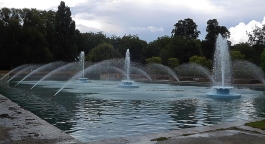
Hardly anything remains of the other parts of the Pleasure Gardens. The funfair that was opened in 1951 continued to operate until the early 1970s when an accident involving the Big Dipper occurred on the 30th of May 1972 hastened the fairground’s demise. What little remains of the Pleasure Gardens today has been conserved well by Wandsworth Council. This includes, The Parade (a tree-lined avenue running inside the park parallel to the riverbank), the Fountain Lake, and a few remnants of the Grand Vista. The prominent Peace Pagoda (erected 1985) with its gold coloured Buddha stands where once the Mermaid Fountain (sponsored by Lockheed Hydraulic Brakes) stood.

We visited Battersea Park on a grey weekday when few other people were in the park. The remnants of the Pleasure Gardens, where many people once congregated to have fun, was eerily empty, almost surrealist in appearance. Next year, it will be 70 years since the Festival of Britain. Being optimistic, it would be nice to imagine that maybe the pandemic will have subsided significantly, and we might be able to celebrate again, possibly with an element of ‘socialdistancing’ as one of the ‘attractions’.

Ten places to breathe and relax

Heron_500


Another list for you, now that the weather is improving.

Here are ten open public spaces in London north of the River Thames. These are places, which I particularly enjoy. They are listed in no particular order:

1 Golders Hill Park

2 Kenwood

3 Kensington Gardens

4 Regents Park

5 St James Park

6 Holland Park

7 Hampstead Heath

8 Thames Barrier Park

9 Postmans Park

10 Soho Square


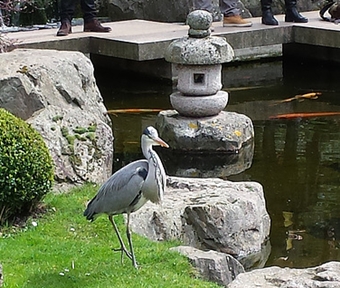
Picture taken in the Kyoto Garden at Holland Park