THE PARISH CHURCH at Luxulyan in Cornwall, which is dedicated to St Ciricius and St Julitta, is very attractive. Although it was built in the 15th century, it contains a stone baptismal font that was created long before the church was constructed. It is a Norman stone font designed like that in St Petroc’s Church in Bodmin (Cornwall). It consists of a circular bowl with carved outer sides on a central shaft, with 4 outer shafts each surmounted by a carved head. It stands on a granite plinth.
The font in Luxulyan is in a good state of preservation. The carved faces on it have a simplicity of design that made me think of early Greek Cycladic sculpture as well as mid-20th century ‘modern art’. Sculpted before the era of gothic art, these faces are curiously alluring. It is amazing to think that this beautiful item has been in use for about 1000 years.
THE PARISH CHURCH OF St John stands at the western end of Hampstead’s elegant Church Row. We have visited it often, and each time we notice things we had not observed on previous visits. During our most recent one (in May 2025), we spotted two things that we had not been aware of previously. One is a small detail, and the other is glaringly obvious now that we have thought about it.
The small detail relates to the font that stands close to the main entrance to the church. It incorporates the bowl of the font that was originally constructed in 1745. The stem that supported it is elsewhere in the church. The font is covered by a wooden lid inlaid with religious images. On top of this cover there is a statue of st John the Baptist standing within a cast-iron frame. What we had not noticed before is that there is a lifting mechanism for raising the lid. This consists of a chain, which is attached to the top of the frame, and then runs over some pulleys, At the other end of the chain there is a heavy looking weight, presumably added to make it easier to raise the heavy cover.
The glaringly obvious thing about this church, which it has taken us years to notice, is that the chancel (containing the high altar) is at the west end of the church. This is unusual because in most churches, the chancel is at the east end. When we were in Pondicherry (in Southern India) in January 2025, we visited two of its churches. Both of them have, as does St John, their chancels at their west ends.
I was brought up near Hampstead, and from my childhood onwards, I have visited this charming hilltop place innumerable times, each time discovering something I had not noticed before. In January 2022, I published a book about Hampstead (which is available from Amazon sites such as https://www.amazon.co.uk/BENEATH-WIDE-SKY-HAMPSTEAD-ENVIRONS/dp/B09R2WRK92).
WARE IS AN ATTRACTIVE small town on the River Lea in Hertfordshire. Coaches travelling between London and Kings Lynn passed through Ware because it was on the route of the Old North Road (now followed approximately by the modern A10). The parish church of Ware, St Mary the Virgin, is large and spacious as befits the size of the town. Much of what we can see today was built over several centuries, from the 12th to the 15th. It was the church’s stone font that attracted my attention.
The octagonal font is believed to have been donated to the church in 1408 by the then Lord of the Manor, Thomas Montagu (1388-1428), Earl of Salisbury. Each of its eight sides contains fine bas-relief carvings. Many of them depict saints connected with birth, baptism, and childhood. For example, ther is a carving of St Christopher carrying the young Jesus across a river. Most of the faces on the carvings are in remarkably good condition considering their age and that they were in place long before the iconoclastic activities of Protestants took place. The church’s guidebook mentioned that in the 1540s, the faces of the statues were attacked, but fortunately the workmen, who might well have been men of Ware, responsible for defacing did a “token job”, only defacing the faces of the Virgin and St Margaret because they could be seen by people entering the church. Luckily for us living in the 21st century, these workmen managed to protect what is an attractive piece of church art.
ST BARTHOLOMEW THE GREAT church in the City of London was founded in 1123 by Rahere, a courtier of King Henry the 1st, who reigned from 1100 to 1135. It was originally built as the church for an Augustinian priory, which was abolished and partly destroyed during the reign of King Henry VIII. When this happened (in 1539), the priory church’s nave was demolished, leaving only the apse and beyond it, the Lady Chapel. The choir, which used to be at the west end of the apse and at the eastern end of the demolished nave, now stands at the east end of what is now the nave, but was formerly the apse. The current nave (formerly the apse of the original church) is a magnificent example of Norman architecture. I could go on describing this magnificent church in great detail, but I will not because plenty of people have done it before me (e.g., https://en.wikipedia.org/wiki/St_Bartholomew-the-Great and https://medievallondon.ace.fordham.edu/exhibits/show/medieval-london-sites/stbartsgreatchurch). Instead, I will mention a couple of the many interesting items in the church that caught my interest during a visit today (the 2nd of April 2024).
Both the objects of interest stand in the southwest corner of the church, close to the entrance that leads to the path that runs along the location of the long-since demolished apse of the priory church. The two things stand a few feet from each other. One of them is a carved stone font, said to be one of the two oldest fonts in London – the other being in the parish church of St Dunstan & All Saints in Stepney. What interested me about St Bartholomew’s font, which is still in use, is that it was here that the painter William Hogarth (1697-1764) was baptised. He had been born in a house in Bartholomew Close near the church in the Smithfield district of London.
Hogarth was a successful artist in his time, and has become recognised as one of the famous British artists of the 18th century. Not far from the font, there is a dramatic gold coloured sculpture by one of the most famous British artists of our times – Damien Hirst (born 1965). The sculpture, which is on loan from the artist, is called “Exquisite Pain.” It is Hirst’s depiction of St Bartholomew holding his skin, having been flayed. The church’s website (www.greatstbarts.com/visiting-us/artworks/damien-hirst-exquisite-pain/) revealed:
“St Bartholomew, one of the original twelve disciples, was sent as an Apostle to Armenia, where he was killed by being skinned alive. The classic iconography of the saint sees him naked, his muscles exposed, his skin hanging over his arm – and in his hands, the instruments of his torture. This statue sees Damien Hirst conform to this imagery, but give it a unique twist: the instrument in his hand is not a standard knife, but a scalpel, used in the hospital across the road which also bears the saint’s name.”
I think it is a wonderful sculpture. However, like most works of art, it might not suit everyone’s taste, but there is no doubting that its dramatic impact and skilful execution are remarkable.
While Hirst’s fame is great today, and his works command high prices, I wonder whether his reputation as a notable British artist will survive as long as Hogarth’s.
HITCHIN IS A SMALL, attractive town in Hertfordshire. When we first visited it in 2020, despite an easing of the covid19 lockdown rules, we were unable to enter the town’s 14th to 15th century church of St Mary’s. On the 26th of August 2023, we spent a couple of hours in Hitchin and were able to enter the church. It contains many items of interest including a large painting created in the studio of Ruben’s.
It was the 15th century carved stone font that particularly interested me. The column supporting the bowl, which contains water with which children are baptised, has twelve carved figures. These depict the 12 apostles. Looking at these closely, you will see that they are all mutilated. Their faces have been chipped away, leaving the figures faceless.
The very helpful and informative gentleman who was looking after the church was not sure whether the faces were obliterated by Thomas Cromwell during the Reformation of Henry VIII or during the time of that other iconoclast Oliver Cromwell.
Luckily the carved angels that adorn the ceiling of the Chapel of St Andrew and a finely carved 15th century wooden screen escaped the attention of the iconoclasts. In one or two Suffolk churches we have visited, angels such as these were destroyed as part of the attempts to ‘purify’ the English Church.
Apart from what I have described, there are plenty of other things that make a visit to Hitchin’s church worthwhile. And if you enjoy ‘Olde Worlde’ British buildings, the town centre is rich in them.
THE CHURCH OF ST MARY in Fort St George in Chennai (Madras) was constructed by 1680, when it was consecrated. It is the oldest Anglican church east of Suez.
The church contains a memorial to the founder of the famous American Yale College – Eliahu Yale. He had been Governor of Chennai’s Fort St George, where the church is located, between 1687 and 1692. He had also been the vestryman and treasurer of St Mary’s church.
The font within the church is made of a form of black granite known as Charnockite. This stone is named after Job Charnock (c 1630-1693). A member of the British East India Company, he is credited with founding a British settlement at a pre-existing village on the bank of the Hooghly River. Although the place had already been settled long before his arrival, Charnock’s establishment grew into what is now Kolkata (Calcutta).
In about 1678, Job entered a romantic relationship with a Hindu woman, whom he called Maria. They produced a son and three daughters. The daughters were baptised in the font in St Mary’s in Chennai in August 1689. A few years later, Job died. His funerary monument is in Kolkata, where he passed away. Like the font in Chennai, Job’s tomb, which is housed in a mausoleum in Kolkata, is made of Charnockite. This form of granite can be found in the south of India. It was local to Chennai but far from Kolkata. This type of rock was first described in Tamil Nadu and was named in honour of Job Charnock.
Apart from the font and the memorial to Yale, the church of St Mary’s has many fascinating sculpted monuments to Britishers who died in India or on their way to or from it.
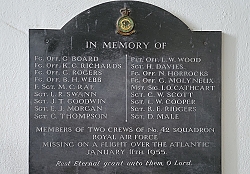
ST COULOMB MAJOR is a small town in north central Cornwall. It has a beautiful gothic parish church, St Columba, which dates to the 13th to 15th centuries. Inside, on the north wall of the church, there is a memorial plaque that caught my eye and roused my curiosity. It lists 18 people, members of the Royal Air Force (‘RAF’) along with their ranks. The plaque was place in memory of:
“Members of two crews of No. 42 Squadron Royal Air Force missing on a flight over the Atlantic. January 11th 1955.”
I was both horrified and intrigued by this.
Both ‘planes that were lost were Shackletons. At 10.14 am, Shackleton WG531 took off from RAF St Eval to commence a routine 15-hour patrol over a part of the Atlantic. At 10.20, Shackleton WL743 took off from the same airfield to join WG 531 on patrol in the same area. At 20.00, the two planes were 85 miles apart. At 20.58, a ground-based radio operator tried to make contact with WL 743, but was unable to do so. This was not cause for alarm because contact was often difficult when planes were at normal operating altitude.
After both aircraft failed to return at the expected time, a search and rescue operation was launched. An extensive search failed to discover either of the aircraft or any bodies of the crew members. In July 1966, one of the engines of WL 743 was caught up in a trawler’s net. Despite a thorough board of inquiry, no plausible explanation of the planes’ disappearances was provided.
St Coulomb Major is 4 miles southeast of RAF St Eval (as the crow flies). There is a church, St Mawgan, between these two places, but that in St Columb Major is larger. Maybe, that is why the memorial to the airmen is where it is. Apart from the RAF plaque, the church contains many other items of interest including its font (c. 1300), which has several faces carved on it.
RAINHAM IN THE London Borough of Havering, but formerly in Essex, has an attractive and venerable parish church: St Helen & St Giles. Helen (c247-c330) is mistakenly believed to have been British. Probably born in Asia Minor, she was mother of Constantine the Great. Giles was a 7th century saint of Greek origin. Much of the body of this building was constructed in the 11th century. A small doorway on the south side, which has a fine carved stone Norman arch, was added in the 12th century, and is known as the Priest’s Entrance. The main entrance is via the South Porch, which was restored or recreated in 1897. As with so many old parish churches, Rainham’s is filled with interesting features, some of which I will describe.
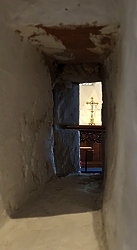
View through the squint (hagioscope) in Rainham parish church
The simple stone font bowl is from the 12th century. Almost as old as the church, it stands on a carved stone pedestal, created in the 15th century. The nave is flanked by sturdy square columns that support semi-circular arches typical of the pre-gothic era. The arch above the chancel has geometric carvings (chevrons), a fine example of Norman architecture. At the southeast corner of the nave, there is an old wooden door, covering the entrance to a spiral staircase that used to lead up to a no longer existing gallery. The door was originally located in the above-mentioned Priest’s Entrance, and was constructed in the 13th century. On the floor near this old door, there lies the black gravestone of John Harle, who built nearby Rainham Hall in the 1720s. His wife and son are also buried beneath it. Near to the grave, there are a couple of memorial brasses set in the floor.
Close to Harle’s gravestone on the wall of the south aisle, there is a niche in the wall and below this, part of a late 12th or early 13th century piscina. This small basin was used by the clergy for washing sacred vessels used during a service. The nave receives natural light through several clerestory windows. In Rainham’s church, these are shaped like human eyes. Probably installed in the 13th century, their shape is extremely unusual in English churches.
The lady, who was kindly showing us around the church, pointed out a slit in the north side of the western end of the chancel. The slit, which passes through the thick wall, is not perpendicular to the wall. It runs from the northwest to the northeast. It is what is known as a ‘squint’ or a ‘hagioscope’. These were incorporated into churches to allow worshippers a view of the high altar when their view was obstructed by the walls of the side aisles in churches where the width of the chancel was considerably less than that of the combined aisles and nave.
Our guide suggested that the squint in Rainham’s church might have been used by diseased worshippers such as those suffering with leprosy. She believed that these unfortunates would have been admitted to the church by the small north door and confined to the northern aisle. By peering through the squit, they could glimpse the crucifix on the high altar in the chancel. Where or not this was really what happened, I cannot say, but I like the story.
We were extremely lucky to have been able to enter the church because, as we learned later, it is often closed. We happened to arrive when our self-appointed guide and her colleauges, all volunteers, were decorating the building with flowers.
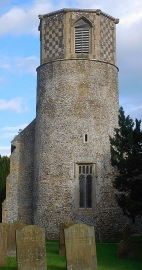
THE HELPFUL FEMALE voice with a North American accent emitting from our mobile ‘phone was quite persistent in trying to direct us onto the A47 road, the most direct route from Swaffham to Norwich, but we chose to ignore the advice we were being given. Instead, we forced ‘her’ to change her instructions so that we could follow a far longer but more pleasant route via Watton and Old Buckenham. As we wound our way between the two last mentioned places, we spotted a church with a round tower, made with flint and mortar, topped with a newer octagonal structure. This was in a Norfolk village that rhymes with freckles: Breckles. The church is St Margarets in the parish of Stow Bedon.
Churches with round towers are a rare breed in England compared with those with square towers. There are only 186 of the rounded versions (www.roundtowers.org.uk/) and some of them are in ruins. Of all the examples of this kind of church, the greatest number can be found in East Anglia, 131 of them in Norfolk. Church towers were built to house bells and sometimes the items used in services (e.g., church vessels). It is unlikely that they were built as part of the country’s defence against invaders because many of them were built after the last invasion of England (www.roundtowers.org.uk/about-round-tower-churches/).
“It has been suggested that the main reason was the lack of suitable local building material. Square towers require strong stone cut and dressed into blocks at each of the corners. But there is no suitable stone to be found in East Anglia and to transport stone from another county was very expensive for a small parish.
The only locally available stone was flint. Flint is a small, knobbly stone which, although creates strong walls when set in mortar, is not suitable for tower corners.”
The round tower of St Margarets was built in the 11th century (https://historicengland.org.uk/listing/the-list/list-entry/1248441), so could have been constructed either before or after 1066, when the Normans invaded. The octagonal structure on the top of the tower, the belfry, is late 15th century (www.norfolkchurches.co.uk/breckles/breckles.htm). Restored in 1856, the nave and chancel were constructed in the 15th and 14th centuries, respectively.
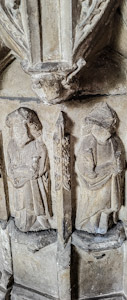
The interior of St Margaret’s is attractively simple. The carved, probably highly restored, wooden rood screen, separating the nave from the chancel, is one of the few decorative features in this small church. However, for me, the greatest attraction is the carved stone font, which is decorated with patterns and four carved figures standing in archways. The latter are carved in a simple, almost naïve or unsophisticated style, which made me wonder whether they date to pre-Norman times. Various sources describe it as being Norman. Whatever it is, it is a lovely piece of carving. When we saw it, it was decorated with flowers and foliage as part of the church’s preparations for celebrating the harvest season.
Having seen this charming church, we were pleased that we did not obey the voice on our GPS app, but instead took a route that our electronic navigator was initially so dead against. The more round about route allowed us to find a lovely church with a round tower.




 yamey
yamey 