ONE OF MY TWELVE FIRST cousins, having just read my recent piece about Finchley Road in north London, reminded me about a hospital close to that road, where she and her parents had received medical care. This reminded me that I had also been treated at that hospital many years ago. So, here is what you have all been waiting for: undergoing surgery in St Johns Wood.
One night early in 1962, I decided to see what it would be like sleeping on the floor with only the carpet between me and the floorboards in my bedroom. I have no idea what made me want to try that. I woke up the next morning, feeling a mildly uncomfortable sensation in my abdomen. It was not a feeling that I had ever experienced before. At first, I imagined that it had something to do with spending a night on the floor, but something made me decide to tell my mother about it. She was concerned about it and made an appointment to see our GP, Dr Clough, who had his consulting room in the ground floor of his home on Finchley Road, close to Golders Green Underground Station.
Dr Clough was a kindly man, a family friend. His waiting room had a large fish tank as well as the usual collection of well-thumbed magazines. His home was directly beneath an outdoor section of the Northern Line. Trains rumbled overhead every few minutes.
The doctor examined me and rapidly concluded that I had a ‘grumbling’ appendix. He told us that it should be removed, but there was no hurry to have the surgery carried out. He recommended a surgeon, who operated at the private St John and Elizabeth Hospital (a Roman Catholic institution) in St Johns Wood, not far from its Underground Station.
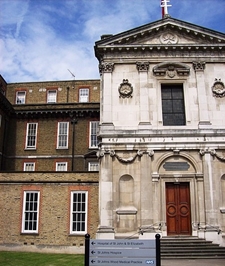
This station, which had, and still has, scraggy palm trees growing near its entrance, was close to the ground floor surgery of our ageing Jewish dentist, Dr Samuels, who was a refugee from Nazi Germany. His waiting room did not have a fish tank, but its floor was covered with luxurious oriental carpets, and the magazines in it were issues of the glossy paged Country Life. Dr Samuels’ surgery was in a block of flats, Wellington Court on the corner of Wellington Road (part of Finchley Road) and Grove End Road, on which the St John and Elizabeth Hospital is located.
I was installed in a private room with, to my great delight, a television for my exclusive use. My delight stemmed from the fact that we did not have a television at home. There were also chairs for visitors. The seat of one of these, which was nicely upholstered, could be removed to reveal a commode.
On the day before my operation, I was taken to a bathroom and told that after I had bathed, I was to call for a nurse by tugging on a cord attached to a bell-pull. There were several cords dangling near the bath. I pulled one at random. Then, I peered out of the slightly open bathroom door and saw a frenzied scene. Nurses were running hither and thither, some of them carrying oxygen cylinders. My nurse returned to the bathroom and told me that by mistake I must have pulled a cord attached to the fire alarm.
The operation went without hitch. I do not recall feeling much pain after it. I was kept in my private room for almost a week. Everyday, I watched as much television as I could. As I had been instructed not to get out of bed unless nature called and the television was far too old to be equipped with a remote control, I had to ring for a nurse each time I wanted to watch a different TV channel. When I pressed the bell button, a nun with a white apron (many of the nurses were nuns) would arrive and switched the channel. (The first time I ever saw a television with a remote control was in December 1963 in a hotel in Baltimore (USA). The controller was attached to the television by a long cable).
Many people including my parents and close family, visited me in hospital. Although this was very kind of them, I always hoped they would not stay long because while they were in my room I had to have the television – the best thing about being in hospital – switched off. It always amused me when a visitor sat on the seat that concealed my commode. I wondered what he or she would think or do had they known what was beneath them.
During the Easter holiday, which occurred a few weeks after I had left the hospital and gone back to school, we set out on a driving holiday to Denmark. We drove to Harwich, where I watched our car being loaded into the hold of the ferry in a rope basket lifted by a crane on the quayside. We drove through Germany, a country in which my parents preferred not to linger longer than needed. We spent one night in a German hotel. It was there that we experienced sleeping under quilts (duvets) for the first time in our lives. We all thought they were a marvellous alternative to sheets and blankets.
In Denmark, we spent several days on a farm near Toftlund, which is about 23 miles north of (formerly ‘West’) Germany. The farm was owned by one of our former au-pair girls and her husband. My sister and I spent several glorious days mingling with the animals on the farm, mostly cows and pigs. This experience made this holiday one that I remember with great fondness. My mother, who saw danger everywhere, was most concerned that I should not be injured by any of the cows’ horns. She was worried that should a horn impact me, it might cause my recently healed surgical scar to split open. She had no need to be anxious. The weather was so cold that we were wrapped in several layers of clothing including thick duffel coats held closed with wooden toggles.
Our hostess’s father was an interesting fellow. He showed me houses in Toftlund that bore two kinds of house numbers, one blue with white figures, and the other red with white numerals. Between 1864 and 1920, Toftlund had been in what was then German ruled territory. One kind of house number had been affixed by the German authorities, the other by the Danish. This made a great impression on my young mind. Since then, I have always looked out for small details, souvenirs of historic eras, like these.
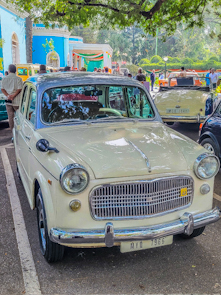
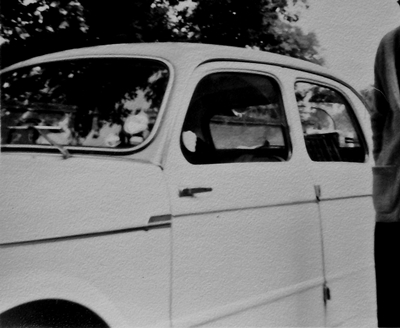
My mother was so impressed by the duvets (‘dune’ in Danish) under which we had slept both in Germany and Denmark that she bought four down filled duvets in Denmark along with covers for them. These were transported on the back seat of our Fiat 1100. My sister and I sat on them for the rest of our holiday, which took us to Odense and Copenhagen before we returned to London.
We spent the Easter weekend in Copenhagen. Almost everything was closed and the temperature outside was very low. We wandered around trying to keep warm. The only warm place that was open were the tropical houses in a botanical garden.
Our return trip was not without incident. We broke down in the German border town of Flensburg just after leaving Denmark. Some electrical component needed replacing. We had to wait about four hours for a replacement part from a company I had never heard of before: Bosch. Well, I was about to become ten years old. So, perhaps it was not surprising that I was unfamiliar with the names of German companies. Whenever I hear the name Bosch or the French word for the German invaders during WW2, Boches, I always remember our four hour wait, parked next to an inlet of the sea in an industrial landscape.
We returned to London. My scar had not burst open. Our four blue cloth covered duvets filled with duck down were intact. After our return to London, we never again used blankets and the hitherto tiresome job of laying beds was replaced by the relatively simple task of spreading the duvets over the beds. I believe that we were amongst the first households in the UK to use duvets.
Of the four duvets we brought to London from Denmark, I kept and used one of them for about 48 years. Reluctantly, we disposed of it because over the years it had lost most of its feathers. I have got so used to sleeping under duvets that when I stay somewhere which had tightly tucked sheets and blankets, I have to untuck them fully.
Since my youthful experiment of sleeping on the floor, I have only repeated it when camping. And, when in a tent, I like to separate myself from the ground with a fully inflated air mattress. On the one occasion when I had no air mattress, I barely slept and barely escaped contracting pneumonia, but that is another story.
An appendix usually follows a story or text but in this case, it is at the start of my story. I have lost a short and, apparently, useless evolutionary intestinal vestige, my appendix. Thinking about its loss and the good time I had at the St John and Elizabeth Hospital, has triggered a chain of memories of an era long past. I hope that I will not be deprived of any more parts of my anatomy, especially whatever keeps alive my recollections of the past, many of which I enjoy sharing with anyone who is interested.
Picture of Hospital of St John and Elizabeth (from Wikipedia)


 yamey
yamey 