A SHORT CARRIAGEWAY leads from Piccadilly into the courtyard of London’s Royal Academy of Art. It passes beneath a magnificent tall archway with a curved ceiling. Within the arch there are two doorways leading from the carriageway. The one to the west is the entrance to the headquarters of the Linnaean Society. This organisation was founded in 1788 by Sir James Edward Smith (1759–1828). It is named after the pioneer of modern taxonomy, Carl Linnaeus (1707-1778). It was he who ‘invented’ the modern method of classifying and naming animal and plant species. For example, human beings form the species Homo sapiens. After Linnaeus died, Sir James Smith purchased some of his collections of specimens, books, and other items. These are now preserved by the Society (see www.linnean.org/), which is the world’s oldest surviving organisation dedicated to the study of natural history. Its mission is to understand, disseminate information about, and protect, the natural world.
Alfred Wallace in the Linnean Society library
On the first of July 1858, a paper was read to the members of the Linnaean Society. Its title was “On the Tendency of Species to form Varieties; and on the Perpetuation of Varieties and Species by Natural Means of Selection”. Its authors were Charles Darwin (1809-1892) and Alfred Russel Wallace (1823–1913). Both men had come up with the same idea independently – namely, that evolution was based on what is now known as ‘natural selection’. With his publication of “On the origin of species by means of natural selection” in 1859, Charles Darwin eclipsed Wallace as far as being recognised as the ‘father of modern evolutionary theory’. However, the two men continued to be good friends until the end of Darwin’s life. They are both amply celebrated for their achievements by the Linnaean Society.
Apart from making adventurous trips to study species and their variations in the Malay Archipelago – studies that led him to develop his ideas about evolution – Wallace became famous for his other endeavours. His work made him the founder of a discipline known as biogeography – the geographical distribution of species. He was also one of the first people to discuss the deleterious impact of man on the environment. His “Tropical Nature and Other Essays”, published in 1878 warned about the dangers posed by man’s activities (e.g., deforestation). In 1904, he published a work in which he made a serious scientific study of the possibility that there was life on Mars. Wallace’s deep interest in spiritualism, mesmerism, and his views on vaccination (he was against vaccination), led to the downfall of his reputation amongst his contemporaries in the scientific establishment. Sadly, after his death, his name was barely remembered until more recently when several biographies were published. These rehabilitate his reputation as a scientist of great importance.
During our recent visit to the Linnean Society, we viewed a small but fascinating exhibition about Wallace. It is being held in the Society’s magnificent library until the 20th of December 2023. The exhibits include Wallace’s personal library and other exhibits relating to his life and work. Everything is beautifully explained by good labelling, and the library staff were very friendly and informative.
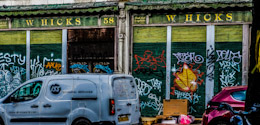
I PRACTISED DENTISTRY in North Kensington’s Golborne Road between late 1994 and about 2000. When I first began working there and for a year or so afterwards, the practice faced a double-fronted, old-fashioned fruit and vegetable shop. It was run by the friendly Hicks family.
Later, Hicks closed. Their premises were acquired by their neighbour the Portuguese Lisboa Delicatessen, which continues to flourish today. Lisbon use the former Hicks shop as a warehouse. Whenever I have been able to peer inside the former fruit and veg shop, I have noticed that it’s current users have displayed e little if anything to change its interior appearance.
Hicks is just one of several shops on Golborne Road that have retained aspects of their original facades despite changes of ownership and usage.
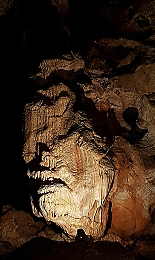
LONG, LONG AGO, the land where Torquay now stands was below the Equator in the southern hemisphere. Shifting of tectonic plates over the millennia has moved it to where it is now. Along with this migration, a series of caves has also reached this location but far beneath the town, about 1 mile northeast of the Torquay Harbour seafront. The cave network known collectively as Kents Cavern has been open to the public since 1952. What makes it fascinating is that archaeologists have found, amongst other things, the earliest known human remains in Britain. Three types of hominid have made, use of these caves: Homo heidelbergensis (thrived roughly 750,000 to 200,000 years ago), Homo neanderthalensis (thrived from 400.000 to 40,000 years ago), and Homo sapiens (that is us today: we have been around since about 300,000 years ago). The two earlier forms of hominid lived or sheltered in the caves. Now, we, the current edition of this type of primate, merely explore the caves as archaeologists, and visit them as tourists.
The earliest evidence of recent exploration of the caves is some inscriptions found within them. William Pete scratched his name on a stalagmite in 1571 and Robert Hedges did the same in 1688. Scientific exploration of the caves began in the early 19th century. In 1824, the geologist Thomas Northmore (1766-1851) made the first recorded excavation in 1824. Since then, others have made systematic archaeological excavations and discovered the remains of our early ancestors, their tools, and the remains of animals that sheltered in the caves. Two notable explorers of these underground passages and caverns are The Reverend John MacEnery (1796-1841) and William Pengelly (1812-1893). The latter established his reputation as an archaeologist by his discovery of the hominid remains in Kents Cavern. In addition, his discoveries helped in to prove that the biblical chronology of the earth was incorrect.
In 1903, the caves were acquired by a carpenter, Francis Powe, who used them as a workshop for constructing beach huts for the seafront in Torquay. His son, Leslie, converted them into a tourist attraction by installing electric lighting and laying down concrete paths. The caves are now run by a member of the family, Nick Powe.
At first sight, the visitor complex with its shop and café seems unexceptional and rather too ‘touristy’ for my liking. Visitors are escorted within the caves in groups led by a guide. The tourist facilities give little or no clue as to the wonders that await visitors after they step into the parts of the cave system that are on display. We were guided by a knowledgeable man, who was able to make geology and archaeology both palatable and extremely comprehensible to us. Even if you had had no interest in these subjects prior to going on the tour, he was able to sow seeds of interest in these subjects during the tour. Not only did he relate the facts clearly, but he was able to recreate in our minds the nature of life in the caves as it was when our ancestors illuminated them with lamps consisting of fat impregnated moss or other vegetable matter in scallop shells, and when enormous wild bears and other creatures hibernated or roamed about in these dark spaces. In addition, he pointed out interesting features of the geology of the caves including, stalagmites and stalactites in various stages of their continuing formation. Throughout the tour, our guide explained the difficulties that early explorers of the cave encountered.
To conclude, a visit to Kents Cavern is both visually spectacular and of great interest. Having seen the place, I would say that a visit to Devon must include a wander through these caves.
IT AMAZES ME that one can walk along the same route many times and miss features that turn out to be fascinating. I do not know how many times we have walked past Leinster Square near Bayswater and missed seeing a small information plaque attached to the cast-iron railings that keep the public out of the lovely private Leinster Square Gardens. Today, the 1st of April 2021, we saw it for the first time. Apart from providing a short history of this London square, it also mentions a person, about whom I have been curious for a while, since seeing a memorial to him near Portobello Road during our first covid19 ‘lockdown’.
Leinster Square was laid out by a property developer, George Wyatt, between 1856 and 1864 on land that was once used for market gardening and plant nurseries (http://www.lsga.org.uk/LSGA_Histories.html#:~:text=Building%20began%20in%201856%20and,character%20soon%20grew%20rather%20mixed.) The first inhabitants of the square were wealthy but soon the square became surrounded by hotels, flats, and lodging houses. Since then, this has remained the case. The buildings surround a beautifully maintained private garden, accessible mainly to people living around the square.
An article in Wikipedia (https://en.wikipedia.org/wiki/Leinster_Square) lists the following ‘notable residents’ of the square: the suffragette Georgina Fanny Cheffins (1863-1932); the musician Sting; and the architect Sir Charles Locke Eastlake (1836-1906). The article does not mention the naturalist William Henry Hudson (1841-1922), who lived at both numbers 11 and 16 Leinster Square.
William Henry Hudson
Hudson was born in Quilmes, Argentina, son of parents of English and Irish origin, settlers from the USA. His father Daniel was son of a Devon man and an Irish mother. William’s mother was born in Maine (USA), a descendant of one of the Pilgrim Fathers. During his youth in Argentina, William made many observations about the local flora and fauna as well as human activity. Some of his findings, mainly ornithological, were published in the prestigious “Proceedings of the Royal Zoological Society” and were communicated to the Smithsonian Institute in the USA. His life, his works, his travels, and his extensive writings, have been described in detail in “WH Hudson. A Biography” by Ruth Tomalin.
On the 1st of April 1874, William departed from Argentina on board the “Ebro”, bound for Southampton in England, a journey that lasted 33 days. One of the first places Hudson visited was Clyst Hydon in Devon, where his father had lived. By the 22nd of December 1875, he had received his ticket for the reading room at the British Museum. It gave his address as 40 St Lukes Road, Bayswater. Known as the Tower House, this was a boarding house run by Miss Wingrave. The house, which still stands is at the corner of St Luke’s Road and Tavistock Road, close to Portobello Road. It bears two plaques commemorating the life of Hudson. It was in this house that he died. However, in between first arriving at this address and his final days, he lived in Leinster Square for a while.
Hudson’s hopes of gaining recognition in the scientific circles in London were disappointed. His romantic and artistic approach to natural history did not chime well with the London’s scientific elite with its more purely objective approach and its disdain for amateurs, however diligent they might be. And also, as Tomalin explained, Hudson did not:
“…belong to the right public school and university background.”
Unable and unwilling to join London’s somewhat dry academic community, Hudson, often short of money, wrote and published a great deal: fiction, non-fiction, natural history, travel, and poetry. On the 18th of May 1876, he married his landlady Emily Wingrave, once a professional singer (a soprano). His wife gave ‘no profession’ on the wedding certificate. She and William moved into number 16 Leinster Square, where she let out some of its rooms to paying guests. Although she claimed to be two years older than her husband, it was not for many years that he learned that she was 11 years older than him.
By 1878, the couple had moved into number 16 Leinster Square. Tomalin wrote of Emily:
“She gave him [i.e. Hudson] a home, companionship…, and a chance to devote himself to the slow unfolding of his gifts; something of the security of the mother and child relationship which, as his writings show, was often in his thoughts.”
After the Tower House came into the possession of Emily when her sister died, the Hudsons moved back there from Leinster Square, where the letting business had failed. Hudson was a keen opponent of cruelty to animal life and killing birds for collections. He was in touch with some women in Manchester, who founded the Royal Society for the Prevention of Cruelty to Birds (‘RSPB’) in 1889. From the start he was a keen supporter of the RSPB and became the Chairman of its Committee in 1894.
In the summer of 1911, Emily became seriously ill and increasingly dependent of William’s assistance. After this, she suffered more bouts of illness. She died in March 1921. After her death, William rewrote his will, leaving much to the RSPB. Hudson died a year later in bed at Tower House, having just put the finishing touches on his last book, “A Hind in Richmond Park”.
This brief essay hardly does justice to the life of a remarkable naturalist, who criticised Charles Darwin in 1870, claiming, in connection with the great man’s fleeting observations a particular type of bird:
“… so great a deviation from the truth in this instance might give opponents of his book a reason for considering other statements in it erroneous or exaggerated…
…The perusal of the passage I have quoted from, to one acquainted with the bird referred to, and its habitat, might induce him to believe that the author purposely wrested the truths of Nature to prove his theory…”
The book referred to was Darwin’s “Origin of Species”. Hudson’s letter evoked a long and detailed response from Darwin, which was published in the “Proceedings of the Zoological Society”, which had also published Hudson’s criticisms. Although Hudson exonerated Darwin of having “wrested the truths of Nature … etc”, Darwin wrote in response:
“… I should be loath to think that there are many naturalists who, without any evidence, would accuse a fellow worker of telling a deliberate falsehood to prove his theory.”
Tomalin points out that Hudson’s criticism of Darwin was not surprising because he was not a believer in evolution as formulated by Darwin. Hudson believed in the theories of Jean-Baptiste Lamarck (1744-1829). Putting it extremely simply, Lamarck believed that, for example, giraffes developed long necks so that they could reach the highest of leaves, whereas as Darwin believed that variants of giraffes that grew long necks had a better chance of survival and propagation than variants which did not and were therefore less able to survive and multiply.
Hudson would have appreciated Leinster Square and its lovely garden, a haven for birds and plants, had he been able to see it today. He would have easily recognised Tower House in St Luke’s Road, which has apparently changed little since he lived there. Once again, keeping one’s eyes open even when walking somewhere familiar can often lead to exciting discoveries. It would take more than a lifetime of visiting the same place repeatedly to become familiar with each and every one of its varied aspects.
In 1973, the economist EF Schumacher coined the phrase ‘small is beautiful‘. But, is small always beautiful?
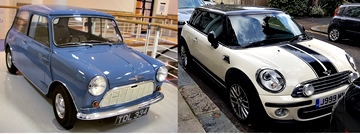
The Mini, made by the British Motor Corporation, was first available for drivers to purchase in 1959. This compact, low-priced car, designed by Alec Issigonis, remained popular until 1986 when production ceased. I was not upset by this as the original Mini was extremely uncomfortable to sit in. Small the car was, but beautiful it was not.
In 1994, the German car manufacturer, BMW, bought the right to make cars bearing the trade name ‘Mini’. Models made from the year 2000 onwards faintly resemble the old-style Mini models, but contain many more up-to-date features. However, the BMW models look like bloated versions of the original versions. The new models look like Minis on steroids. They are not so small, and definitely not so beautiful.
The picture of the blue, old style Mini, was sourced from Flickr via Wikipedia



 yamey
yamey 